
The AI “Bubble” Just Refused to Burst: 5 Counter-Intuitive Truths Behind the 30% Semiconductor Rally.y
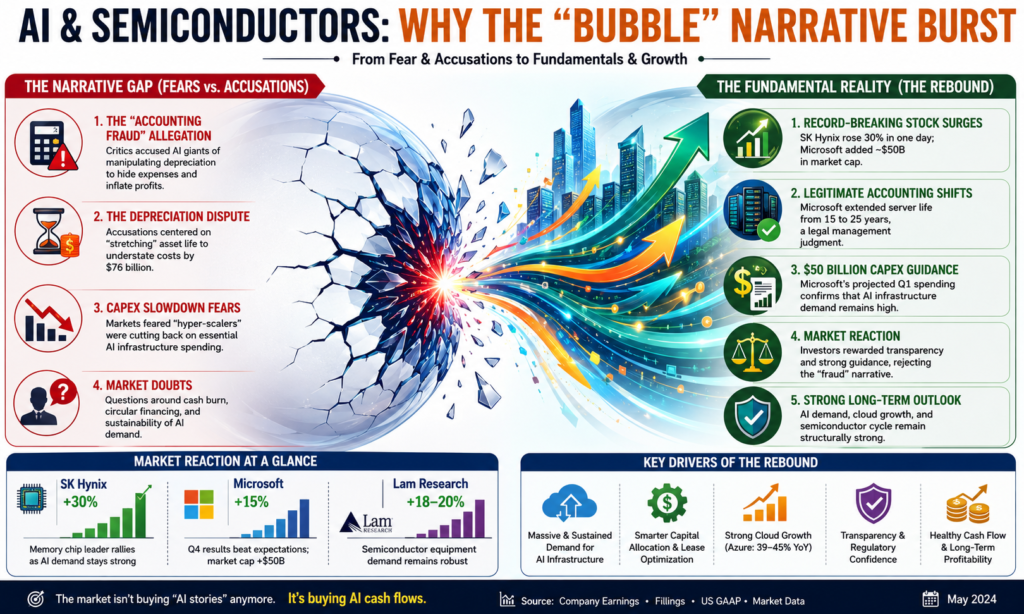
For months, Wall Street was preparing for the collapse of the artificial intelligence boom. Analysts warned that AI infrastructure spending had become unsustainable, semiconductor valuations were excessive, and hyperscalers were relying on accounting tricks to maintain profitability.
Then Microsoft released its earnings.
Instead of triggering a sell-off, the results sparked one of the strongest semiconductor rallies of the year. Microsoft added tens of billions of dollars in market value, while AI chip leaders including SK Hynix, Micron, Lam Research, Nvidia suppliers, and memory manufacturers surged sharply.
The biggest surprise wasn’t the rally itself—it was why investors suddenly became optimistic.
Here are the five overlooked reasons that completely changed the market narrative.
1. Microsoft’s Depreciation Change Was Financial Logic, Not Accounting Magic
One of the most misunderstood announcements was Microsoft’s decision to extend the useful life of certain infrastructure assets from 15 years to 25 years, beginning in fiscal 2027.
Critics immediately claimed the company was artificially boosting earnings.
In reality, depreciation is a management estimate under US GAAP. If an asset is expected to remain productive for a longer period, accounting standards allow companies to adjust its useful life accordingly.
For data center buildings, a 25-year depreciation period is not aggressive.
Many countries—including India—commonly depreciate commercial buildings over 30 to 60 years.
Microsoft is primarily extending the life of physical infrastructure rather than rapidly evolving AI chips.
This lowers annual depreciation expense without changing actual cash flow.
The market interpreted this as better reflecting economic reality rather than manipulating profits.
2. Microsoft’s Transparency Defused the AI Fraud Narrative
Earlier this year, several critics—including renowned investor Michael Burry—argued that hyperscalers were masking profitability by stretching depreciation schedules.
The accusation suggested that billions of dollars of expenses were effectively being hidden.
Instead of avoiding the discussion, Microsoft openly explained:
- Why infrastructure lasts longer
- How depreciation assumptions were changing
- When those changes would become effective
- What impact investors should expect
Markets reward transparency.
Rather than creating uncertainty, Microsoft’s disclosure increased confidence in management.
Investors concluded that if these accounting practices violated regulations, they would have attracted much greater regulatory scrutiny long before earnings season.
Instead of validating the bearish thesis, Microsoft’s communication weakened it.
3. The CAPEX Paradox: Lower Guidance Doesn’t Mean Lower AI Spending
Many investors initially focused on Microsoft’s quarterly capital expenditure guidance and believed AI investment was slowing.
That interpretation ignored a much larger trend.
Actual AI infrastructure investment continues accelerating rapidly.
The key difference lies in how companies finance that infrastructure.
Finance Lease
Companies own the assets.
Advantages:
- Greater control
- Long-term ownership
Disadvantages:
- Larger balance sheet
- Lower Return on Assets (ROA)
- Higher depreciation
Operating Lease
Companies rent capacity from infrastructure providers.
Advantages:
- Lower upfront capital
- Better ROA
- Greater flexibility
- Faster expansion
Rather than reducing AI investment, Microsoft appears to be optimizing the mix between owned infrastructure and leased capacity.
This allows cloud expansion while protecting profitability metrics.
The AI spending cycle remains intact.
The accounting presentation has simply evolved.
4. Free Cash Flow Has Become the Market’s Favorite Metric
During the first phase of the AI boom, investors mainly cared about:
- Revenue growth
- AI announcements
- GPU purchases
- Model launches
That has changed.
Today’s market increasingly rewards companies capable of generating substantial Free Cash Flow (FCF) while continuing aggressive AI investment.
This explains why reactions across Big Tech have started to diverge.
Microsoft
- Strong Azure growth
- Healthy cash generation
- Balanced investment strategy
Amazon
- Improving cloud profitability
- Better operating leverage
Meta
Heavy AI investment has significantly reduced free cash flow compared with previous years.
Alphabet
Facing similar investor questions regarding capital intensity.
Investors now want proof that AI spending eventually creates cash—not merely revenue growth.
Liquidity has become the new competitive advantage.
5. Semiconductor Valuations Finally Returned to Reasonable Levels
Many semiconductor stocks experienced extraordinary gains during the first AI wave.
Several companies appreciated between 500% and 700% over a relatively short period.
Corrections of 30% to 40% are normal after such explosive rallies.
Rather than signaling the end of the AI cycle, recent weakness allowed valuations to return closer to fair value.
Microsoft’s earnings became the catalyst investors needed to re-enter high-quality AI companies.
Instead of chasing momentum, institutional investors began focusing on:
- Cash flow
- Valuation
- Earnings quality
- Sustainable AI demand
That shift is considerably healthier than pure speculation.
What the Semiconductor Rally Really Means
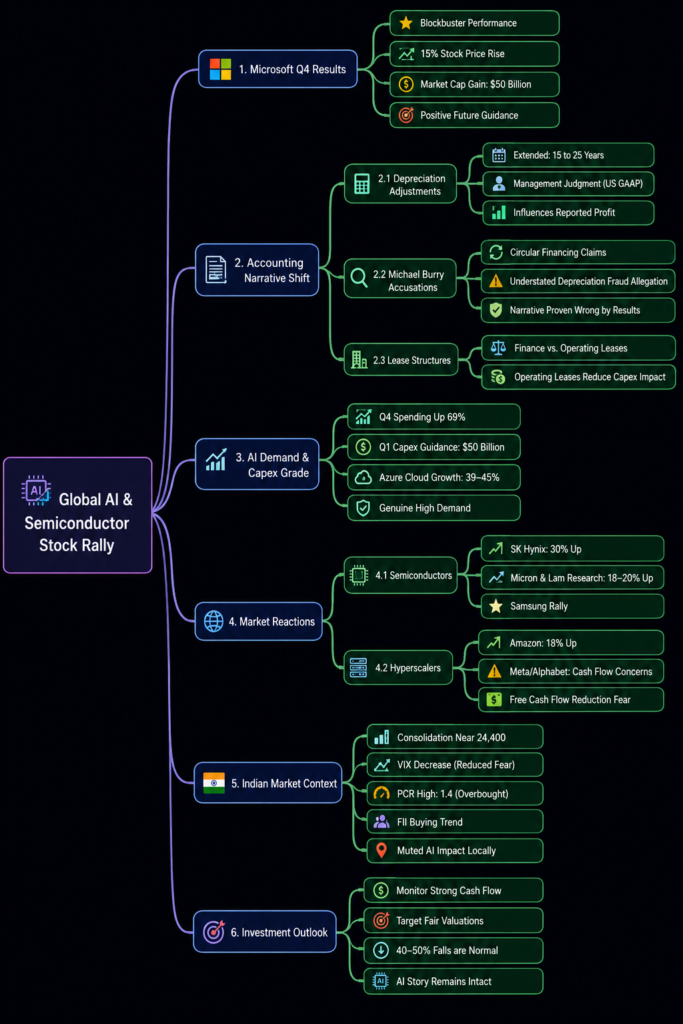
The latest rally demonstrates that the AI investment cycle remains extremely strong.
However, investors have become far more selective.
The winners of the next phase are unlikely to be companies making the loudest AI announcements.
Instead, markets will increasingly reward businesses that combine:
- Strong free cash flow
- Sustainable capital expenditure
- Efficient infrastructure spending
- Transparent accounting
- Long-term cloud demand
The AI story has evolved from excitement to execution.
Final Thoughts
Predictions of an immediate AI bubble collapse appear increasingly premature.
Microsoft’s earnings showed that accounting changes alone cannot explain the strength of AI businesses.
What truly impressed investors was the combination of:
- Durable cloud demand
- Disciplined capital allocation
- Better infrastructure economics
- Healthy cash generation
- Improved valuation opportunities
The next stage of the AI revolution won’t be decided by who buys the most GPUs.
It will be decided by which companies can transform AI investment into consistent, long-term cash flow.
For investors, the lesson is clear: follow the cash, not the headlines.
Frequently Asked Questions (FAQ)
Is the AI bubble over?
No. The market has shifted from valuing AI hype to valuing AI companies with strong cash flow, sustainable spending, and profitable growth.
Why did semiconductor stocks rally after Microsoft’s earnings?
Investors gained confidence from Microsoft’s transparent accounting changes, strong cloud demand, improving AI infrastructure efficiency, and continued capital investment.
Why is free cash flow important for AI companies?
Free cash flow shows whether a company can continue investing in AI without weakening its financial position. Markets increasingly favor AI leaders with strong liquidity.
Is Microsoft’s depreciation change accounting manipulation?
Not necessarily. Under US GAAP, companies may revise an asset’s useful life if supported by management’s reasonable judgment and underlying economic reality.
What should investors watch next?
Key indicators include AI infrastructure spending, free cash flow trends, cloud revenue growth, semiconductor demand, and capital allocation efficiency.
SEO-friendly title options:
- AI Bubble Refused to Burst: 5 Reasons Behind the 30% Semiconductor Rally
- Why AI Stocks Surged: 5 Hidden Reasons Behind the Semiconductor Rally
- Microsoft Just Changed the AI Story: 5 Truths Behind the Chip Stock Rally
- AI Bubble or AI Boom? 5 Reasons Semiconductor Stocks Are Rising Again
- The AI Bubble Didn’t Burst—Here’s Why Semiconductor Stocks Jumped 30%
- Microsoft’s AI Strategy Ignites 30% Chip Rally: What Investors Missed
- AI Semiconductor Rally Explained: 5 Counter-Intuitive Truths Every Investor Should Know
- Why the AI Bubble Is Still Alive: Microsoft’s Move Changed Everything
- 30% Semiconductor Rally Explained: The Real Reason AI Stocks Are Climbing
- AI Stocks Are Rallying Again: 5 Hidden Signals Smart Investors Can’t Ignore