
SEBI Closing Auction Session (CAS) explained: 3% price band, 20-minute auction window, Nifty volatility, F&O impact, Jane Street controversy and what retail traders need to know
India’s stock market has entered a new phase.
From 3 August 2026, the closing-price mechanism for eligible F&O stocks changed with the introduction of the Closing Auction Session (CAS). Instead of relying on the traditional last-30-minute VWAP mechanism, eligible stocks now go through an auction-based price-discovery process.
The stated objective is straightforward: improve closing-price discovery, reduce distortions around index rebalancing and derivative expiry, and help passive funds and ETFs track their benchmarks more efficiently.
But the first few trading sessions produced exactly the kind of reaction regulators would have wanted to avoid.
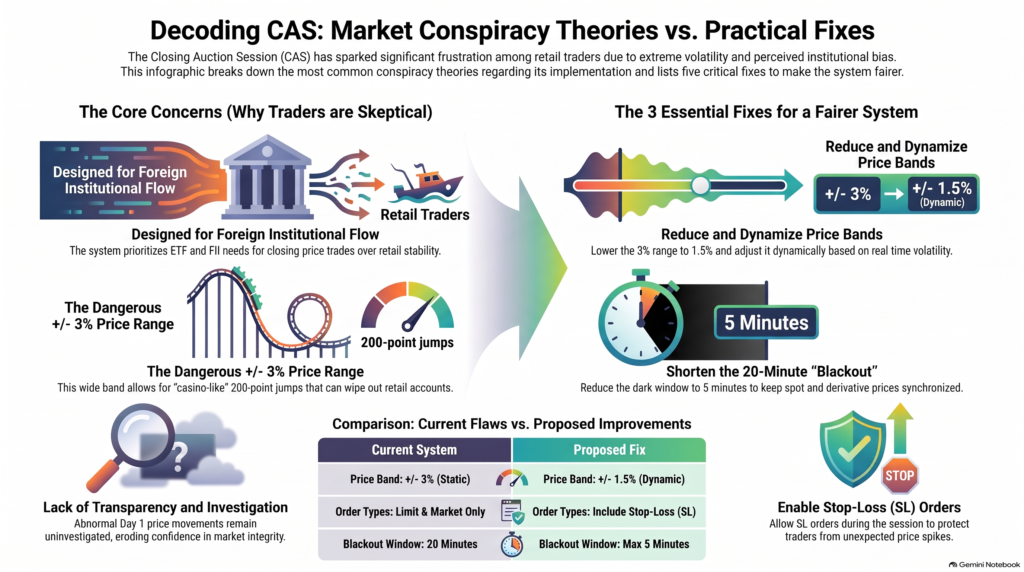
On the first day of CAS, the Nifty reportedly experienced a sharp late-session move of roughly 200 points, while the following session saw another late rebound of around 150 points. The moves triggered questions among retail traders about liquidity, derivatives pricing and whether the new mechanism could unintentionally increase short-term volatility.
So the real question is:
Is CAS a necessary market-structure upgrade—or does its current design create a new risk window for retail traders?
What Is SEBI’s New Closing Auction Session?
The Closing Auction Session (CAS) is a new mechanism designed to determine the official closing price of eligible stocks through an auction rather than simply using the previous closing-price methodology.
SEBI first published its consultation paper on introducing CAS in the equity cash segment on 5 December 2024. The regulator argued that India’s existing closing-price mechanism could create tracking differences for passive funds, particularly during index-rebalancing and derivative-expiry events.
SEBI’s analysis found that volatility in the last 30 minutes can become significantly higher during major index events.
For example, in the regulator’s study, volatility for Nifty 50 stocks during the final half-hour was approximately 1.8 times the 9:15 AM–2:30 PM period during one MSCI rebalancing event and 1.5 times during another FTSE event.
For stocks affected by international index changes, the difference was even larger: some MSCI Standard Index stocks recorded final-half-hour volatility of around 3.3 times the earlier trading period.
That is the problem CAS was designed to address.
How the New 20-Minute CAS Window Works
For CAS-eligible stocks, normal continuous cash-market trading ends earlier, followed by the auction process.
The broad structure is:
3:00 PM–3:15 PM
The reference price is generally calculated using the VWAP of trades during this period.
3:15 PM–3:20 PM
Transition into the auction mechanism.
3:20 PM–3:25 PM
Market and limit orders can be entered.
3:25 PM–3:30 PM
Only limit orders are accepted; market orders already entered become locked.
Around 3:28 PM–3:30 PM
The order-entry phase closes randomly.
3:30 PM–3:35 PM
Orders are matched, and the equilibrium price is determined.
The final equilibrium price becomes the official closing price where an equilibrium can be established. If it cannot be determined, the prescribed reference-price fallback mechanism applies.
This means that 20 minutes can influence the official closing price, even though the normal continuous cash market has already stopped.
And that is where the retail-trader debate begins.
The 3% Price Band: Protection or Too Much Room?
One of the most controversial features of CAS is the ±3% price band around the reference price.
Suppose a stock’s CAS reference price is:
₹1,000
The auction price can operate within approximately:
₹970–₹1,030
The same framework affects stock futures during the CAS-linked period, while options continue under their existing framework.
For a highly liquid stock, this may not necessarily create a problem.
But the concern is what happens when:
- liquidity becomes thin,
- large orders arrive,
- derivatives positioning is heavy,
- expiry is approaching,
- and traders cannot use normal stop-loss orders inside CAS.
NSE’s operational guidelines state that stop-loss orders are not permitted during CAS. Only permitted market and limit orders can participate, subject to the auction rules.
That creates a genuine risk-management issue for traders carrying positions into the closing process.
The First-Day Shock: Why Did Nifty Move Nearly 200 Points?
The first day of CAS on 3 August 2026 immediately put the new system under the spotlight.
The Nifty experienced a sharp late-session jump of approximately 200 points, creating confusion among traders who were watching the index near the market close. Reuters reported that the new mechanism contributed to significant volatility and a divergence between Nifty and Sensex during the initial adjustment period.
The following day, the Nifty again experienced a sharp late-session rebound of nearly 150 points, even though the index ultimately closed lower for the day.
This does not automatically prove market manipulation.
That distinction is extremely important.
An auction can produce a sudden change in the displayed closing value because the official close is being determined through a different price-discovery process.
NSE subsequently clarified that the Nifty did not simply “jump” because someone suddenly bought the index at the last second; the closing value was being calculated under the new structured process.
So the correct question is not:
“Was the 200-point move automatically manipulation?”
The better question is:
“Does the new mechanism create an environment where price discovery becomes vulnerable to concentration, thin liquidity or aggressive positioning?”
That is a question that deserves serious surveillance and data.
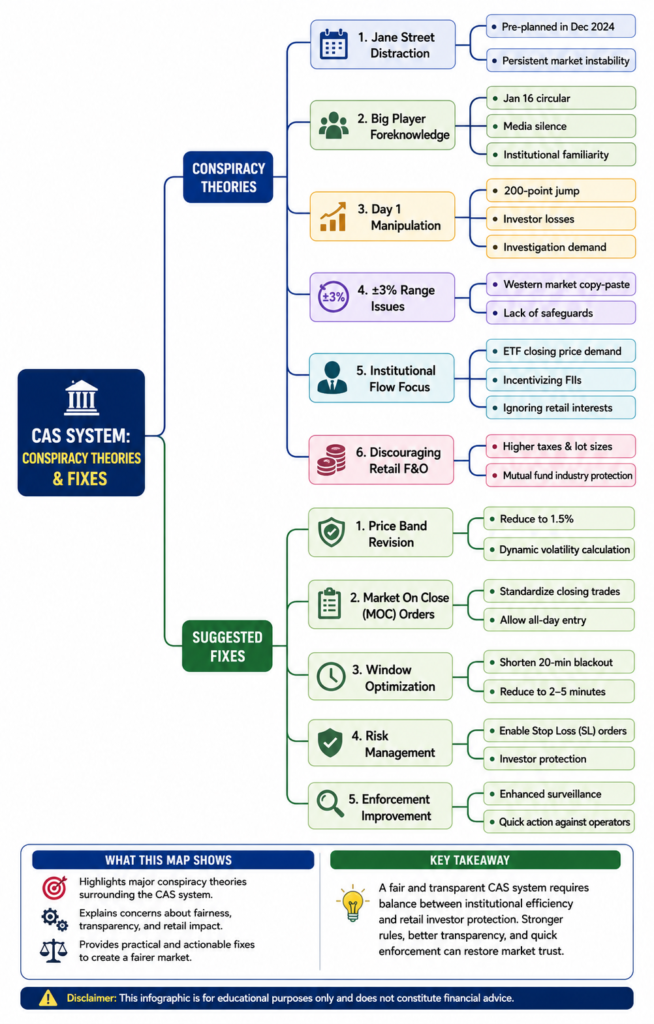
The Jane Street Connection: Was CAS Created Because of the Scandal?
This is where the timeline matters.
The original SEBI consultation paper for CAS was published on:
5 December 2024
The SEBI interim order involving Jane Street Group was issued on:
3 July 2025.
Therefore, it would be inaccurate to claim that the Jane Street case directly caused the CAS proposal.
The proposal already existed before the July 2025 action.
However, the Jane Street episode significantly increased public attention on index derivatives, institutional trading behaviour and the relationship between cash-market prices and derivatives.
SEBI’s interim order said that concerns about Jane Street’s trading patterns had arisen in early 2025, and that NSE had cautioned the group in February 2025 regarding large risks and trading patterns in index options that raised concerns about potentially manipulative behaviour.
Therefore, the strongest conclusion is:
CAS was not originally created as a direct response to Jane Street, but the Jane Street episode changed the context in which the mechanism was being viewed.
That is a much more defensible argument than saying CAS itself was a Jane Street-related measure.
Why Does SEBI Want CAS?
The regulator’s argument is not primarily about retail F&O traders.
It is about price discovery and passive investing.
SEBI’s original consultation paper highlighted the growth of passive investing and the difficulty of executing exactly at a closing price under the existing Indian framework.
That matters because index funds and ETFs need to track their benchmarks as closely as possible.
On major:
- index rebalancing days,
- derivative expiry days,
- MSCI changes,
- FTSE changes,
large institutional flows can arrive near the close.
SEBI found that these events could increase volatility and tracking differences.
Therefore, there is a legitimate market-structure argument for CAS.
But Does CAS Favour Institutions?
This is where the debate becomes complicated.
It would be too simplistic to say:
“CAS was designed for FIIs and against retail traders.”
There is no evidence establishing that intent.
But it is equally reasonable to ask whether the design disproportionately benefits participants with:
- faster technology,
- better execution systems,
- deeper liquidity,
- sophisticated arbitrage models,
- institutional order-flow information,
- quantitative pricing systems.
That is a legitimate market-structure concern.
The irony is that the mechanism was designed partly to improve the execution quality of passive funds and reduce tracking differences.
In other words:
The system has a clear institutional use case.
That does not automatically make it anti-retail.
But it does mean retail traders need to understand the new rules before carrying leveraged positions into the closing process.
The Bigger Problem: Retail F&O Was Already Under Pressure
CAS should not be viewed in isolation.
Indian regulators have already introduced several measures aimed at improving investor protection and reducing excessive retail participation in equity derivatives.
The scale of the problem is enormous.
SEBI’s September 2024 study found that 93% of individual traders in equity F&O incurred losses during FY22–FY24.
The aggregate losses of individual traders exceeded ₹1.8 lakh crore over the three years.
That number explains why SEBI has been tightening the derivatives framework.
In October 2024, SEBI announced measures aimed at strengthening the equity-index derivatives framework for investor protection and market stability.
The regulator has also introduced measures around risk monitoring and safer participation in algorithmic trading.
So the broader trend is clear:
SEBI is trying to make the derivatives market safer—but that process can also make trading more difficult for small leveraged traders.
The 20-Minute “Blackout”: Why Retail Traders Are Nervous
The most important issue for an option trader is not simply the existence of an auction.
It is the interaction between:
Spot → Futures → Options → Settlement Price
The cash market and derivatives market are deeply interconnected.
Under the new structure, eligible cash stocks enter CAS while derivatives continue operating under their own schedule.
This creates a period in which the cash-market price discovery process is fundamentally different from normal continuous trading.
For traders who are short options or holding leveraged futures positions, that difference matters.
A trader may have:
- an option position,
- a predetermined stop-loss,
- a hedge,
- a technical setup,
but the CAS mechanism does not guarantee that the trader can execute a conventional stop-loss order during the auction.
The exchange framework specifically excludes stop-loss orders from CAS.
That is why the final 20 minutes deserve special attention from retail F&O participants.
Is CAS Really a “Casino Window”?
Calling CAS a casino would be an exaggeration.
Closing auctions are not inherently dangerous. They are widely used internationally and are designed to improve price discovery.
The real issue is market design.
A closing auction can work efficiently when:
- liquidity is deep,
- participation is broad,
- price information is transparent,
- order flow is sufficiently balanced,
- surveillance is strong,
- and participants understand the rules.
The danger emerges when a large derivatives market depends heavily on a relatively concentrated closing-price discovery process.
Therefore, the correct concern is not:
“Auction = manipulation.”
It is:
“Can the Indian market provide sufficient liquidity and surveillance to make the auction robust under extreme derivatives positioning?”
That is the question worth testing.
Five Changes That Could Make CAS Safer for Retail Traders
1. Consider a Dynamic Price Band
A fixed ±3% band may not be appropriate for every stock and every volatility regime.
A volatility-linked band could potentially provide more flexibility during calm markets and tighter protection during abnormal conditions.
For example:
Normal volatility → tighter band
High volatility → appropriately calibrated wider band
The objective should be to prevent disorderly price discovery without unnecessarily restricting genuine demand and supply.
2. Improve Market-on-Close Functionality
A robust Market-on-Close framework could allow investors to communicate closing-price demand earlier instead of concentrating activity into a narrow window.
This could improve liquidity and reduce last-minute order imbalances.
3. Reconsider the Risk Window
Twenty minutes is a meaningful period in a highly leveraged derivatives market.
The regulator and exchanges should continuously evaluate:
- order-book depth,
- price impact,
- execution rates,
- imbalance,
- volatility,
- F&O basis,
- options IV,
- and settlement-price divergence.
If the data shows persistent distortions, the auction structure should be adjusted.
4. Better Risk Controls for Retail Traders
The biggest weakness for a leveraged trader is the inability to use normal stop-loss functionality during CAS.
If technical infrastructure permits it, exchanges could explore auction-compatible risk-management mechanisms that protect traders without compromising price discovery.
5. Publish More Real-Time Data
Transparency is the strongest defence against suspicion.
During CAS, investors should have access to as much meaningful information as possible, including:
- indicative equilibrium price,
- executable quantity,
- buy/sell imbalance,
- reference price,
- indicative index value,
- CAS volume,
- futures basis,
- option IV changes.
The more information the market receives, the less room there is for speculation about what is happening inside the auction.
NSE’s operational framework already provides for dissemination of indicative auction information and index values during CAS.
CAS vs Old Closing System
| Feature | Earlier System | New CAS |
|---|---|---|
| Main closing mechanism | Last 30-minute VWAP | Closing auction |
| Eligible stocks | Existing framework | Initially F&O-eligible stocks |
| Reference price | Last 30-minute period | Generally 3:00–3:15 PM VWAP |
| CAS duration | Not applicable | 20 minutes |
| Price band | Existing market framework | ±3% reference-price band |
| Stop-loss orders | Normal trading rules | Not permitted during CAS |
| Closing price | VWAP-based | Equilibrium auction price |
| Main objective | Continuous price formation | More structured closing-price discovery |
| Key concern | Event-day volatility | Auction liquidity and order imbalance |
What Retail Traders Should Do Now
CAS is not something retail traders should panic about.
But traders should change their risk-management process.
If you trade Nifty, Bank Nifty, stock futures or options, you should understand:
Before 3:15 PM
Review open positions.
Before the CAS window
Decide whether the position is worth carrying into a different price-discovery regime.
Avoid relying on a CAS stop-loss
Stop-loss orders are not permitted in the CAS mechanism.
Watch futures basis
Large differences between spot, futures and options can signal unusual positioning.
Monitor IV
A sudden change in implied volatility can materially affect option prices even when the underlying movement appears modest.
Be extra careful around expiry.
Expiry days can create concentrated derivatives positioning and therefore deserve additional caution.
Final Verdict: Market Fix or Retail Trap?
The answer is probably neither extreme.
CAS is not automatically a retail trap.
And it is also not automatically a perfect market fix.
SEBI had a legitimate problem to solve: the existing closing-price mechanism could create elevated volatility and tracking differences during major index events. The regulator’s own data supports that concern.
But the first days of implementation show that implementation quality matters just as much as the theory.
The sharp late-session Nifty moves witnessed after CAS went live have exposed a new area of market risk. They do not, by themselves, establish manipulation—but they do justify deeper scrutiny of liquidity, order imbalance, derivatives positioning and the behaviour of closing prices.
And there is another uncomfortable reality.
Retail traders are already operating in an F&O environment where the odds are difficult. SEBI’s own data shows that 93% of individual F&O traders lost money during FY22–FY24, with aggregate losses exceeding ₹1.8 lakh crore.
So CAS should not become another system that retail traders learn about only after losing money.
The regulator’s responsibility is not to guarantee profits.
It is to ensure that the market is:
transparent, orderly, properly supervised and structurally fair.
Retail traders, meanwhile, need to understand that the market they were trading before 3 August 2026 is not the same market they are trading today.
The biggest lesson from CAS is therefore simple:
Do not trade the closing minutes blindly. Understand the mechanism first.
The future of CAS should be judged not by political narratives, social-media outrage or one unusual candle—but by data.
Track:
CAS volume + order imbalance + reference price deviation + futures basis + options IV + closing-price volatility + settlement impact.
If those metrics improve over time, CAS may prove to be a successful market-structure reform.
If distortions persist, SEBI should be willing to modify the system.
Because a modern financial market cannot survive on trust alone.
It needs transparency, liquidity, surveillance and equal confidence for both institutional and retail participants.
Key Data & Sources
- SEBI’s original CAS consultation paper — December 5, 2024.
- SEBI’s formal CAS circular — January 16, 2026.
- NSE operational guidelines — March 18, 2026.
- CAS rollout and initial market reaction — August 2026.
- SEBI F&O study — 93% of individual traders lost money in FY22–FY24; losses exceeded ₹1.8 lakh crore.
- SEBI Jane Street interim order — July 3, 2025.
Disclaimer
Disclaimer: This article is for educational and informational purposes only. It does not constitute investment advice, trading advice, or a recommendation to buy or sell any security, derivative, stock, ETF, or financial instrument. Market conditions can change rapidly, and trading in futures and options involves substantial risk. Investors should conduct their own research and consult a SEBI-registered investment adviser before making investment decisions.
Alternative SEO Titles
- SEBI Closing Auction Session (CAS): What Retail Traders Need to Know
- Nifty 200-Point Spike Explained: The Truth About SEBI’s New CAS
- SEBI CAS 2026 Explained: 3% Band, 20-Minute Window & F&O Risk
- Closing Auction Session: How SEBI’s New CAS Could Impact Retail Traders
- SEBI CAS vs Retail Traders: Market Reform or New Trading Risk?