
The 100% Tariff Shockwave: Why Indian Investors Should Pay Attention
Indian equity markets may look relatively calm, but beneath the surface, a powerful geopolitical risk is developing.
The biggest issue is not simply another tariff headline. It is the possibility of a new U.S. sanctions framework targeting countries that continue purchasing Russian energy, with India potentially among the most exposed economies.
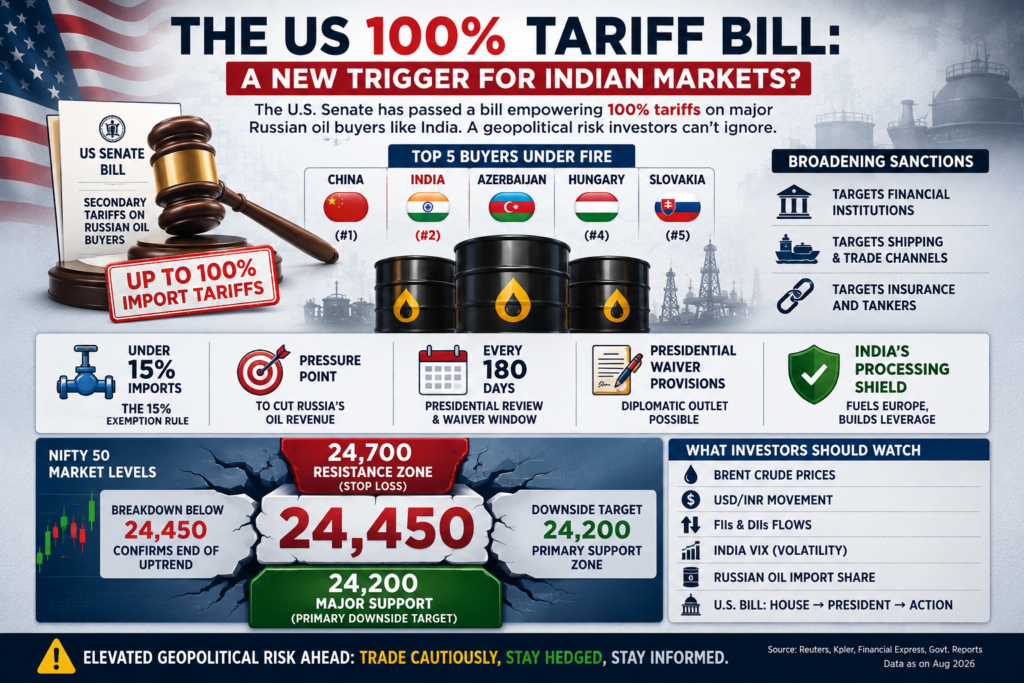
On August 7, 2026, the U.S. Senate passed the Lindsey O. Graham Sanctioning Russia and Iran Act of 2026 by 86–11. The legislation gives the U.S. President authority to impose tariffs of up to 100% on countries heavily dependent on Russian oil and gas. India and China are among the major countries that could be affected. The bill still faces the U.S. House of Representatives before it can become law.
That distinction is crucial for investors:
The 100% tariff is currently a policy risk—not an automatic tariff already imposed on India.
But the potential consequences could be significant.
1. The 100% Tariff Threat: Why India Is in Focus
The revised U.S. legislation represents a major shift in the sanctions strategy.
Instead of targeting only Russia, Washington is attempting to increase the cost for major buyers of Russian energy.
The latest version allows tariffs of up to 100% on imports from countries that are among the largest purchasers of Russian oil and gas. India and China are the most important Asian economies in the discussion.
Earlier versions of the legislation had contemplated much harsher blanket penalties. The revised proposal narrowed the third-country tariff exposure to a maximum of 100%, making it more targeted.
Why India Matters
India has become one of the world’s biggest buyers of Russian crude because Russian oil has often been available at attractive discounts.
According to Kpler data cited by Indian financial publications, Russian crude imports reached approximately 2.61 million barrels per day in June 2026, accounting for around 52.4% of India’s total crude imports.
That means the geopolitical risk is not theoretical.
India’s refining sector has become deeply connected to the Russian crude supply chain.
2. The Numbers Investors Cannot Ignore
The Russian-oil story becomes much clearer when we look at the data.
| Metric | Recent Data |
|---|---|
| Russian crude imports into India, June 2026 | ~2.61 million bpd |
| Russia’s share of India’s June crude imports | ~52.4% |
| India’s total crude imports, June | ~4.98 million bpd |
| Russian crude imports, July 2026 | ~2.5 million bpd through July 15 |
| Potential U.S. tariff authority | Up to 100% |
| U.S. Senate vote | 86–11 |
The June figure is particularly important: Russia supplied more than half of India’s crude imports, according to Kpler data.
July data showed that Russian crude remained extremely important, with imports averaging roughly 2.5 million barrels per day through July 15.
This creates a difficult equation for Indian policymakers:
Cheap Russian crude → lower refinery input costs → potentially better refining margins
but
Sanctions/tariffs → supply uncertainty → higher crude replacement costs → inflation and margin pressure.
That is the transmission mechanism investors need to watch.
3. The “100%” Headline Does Not Mean an Immediate 100% Tariff
This is one of the most important distinctions in the entire story.
The U.S. Senate legislation does not automatically mean that Indian exports will suddenly face a 100% tariff tomorrow.
The measure gives the President authority to impose tariffs of up to 100% if the legislation becomes law and the relevant conditions are met.
There is also a major political and diplomatic layer between legislation and implementation.
That creates three possible scenarios.
Scenario A — Diplomatic Resolution
India reduces Russian oil exposure or obtains a waiver.
Market impact:
Potentially limited.
Scenario B — Partial Tariff
Washington applies a smaller tariff or targeted restrictions.
Market impact:
Moderate pressure on Indian exporters, margins and sentiment.
Scenario C — Full 100% Tariff
The maximum tariff authority is actually used against India.
Market impact:
Potentially severe for India-U.S. trade, export-oriented sectors and overall risk sentiment.
Therefore, investors should focus less on the headline number and more on:
Bill → House → Presidential action → Waiver → Implementation
4. India’s Russian-Oil Dependency Is the Real Vulnerability
India’s exposure to Russian crude has increased dramatically because of price economics and global supply disruptions.
Russia accounted for approximately 52.4% of India’s crude imports in June 2026, according to Kpler data.
That dependence provides an economic advantage—but it also creates geopolitical concentration risk.
Imagine an investor looking at a company with more than 50% of its raw material coming from one supplier.
The obvious question would be:
What happens if that supplier becomes unavailable?
The same logic applies at the national level.
India can diversify its crude basket, but replacing millions of barrels per day quickly could increase procurement costs.
Saudi Arabia has already been regaining some share of India’s crude market. Kpler estimates cited by The Economic Times indicated Saudi supplies could rise to around 464,000 bpd in July, taking its share toward roughly 10%.
This suggests India is not completely locked into Russian crude.
But diversification may come at a higher cost.
5. The Refining Shield: India’s Strategic Advantage
There is another side to the story.
India is not merely consuming crude oil.
It has a large refining industry capable of converting crude into products such as diesel, gasoline,e and aviation fuel.
That creates a strategic advantage.
Indian refiners can purchase crude, refine it, and export petroleum products to international markets.
This means India’s refining infrastructure can act as a strategic buffer during geopolitical disruptions.
However, investors should avoid assuming that this makes India immune from sanctions.
If Washington increases pressure on Russian-origin crude, the key questions become:
- Can Indian refiners continue purchasing Russian crude?
- Will shipping and insurance costs rise?
- Will banks become more cautious?
- Will discounts on Russian crude increase?
- Will refined-product exports face additional scrutiny?
- Will Indian refiners shift toward Middle Eastern, U.S. or African crude?
The answers could directly affect refining margins.
6. Strait of Hormuz: The Second Oil Shock Risk
The Russian-oil issue cannot be analyzed separately from the Middle East.
The Strait of Hormuz remains one of the most important energy chokepoints in the global economy.
Any disruption around the Strait can increase:
Crude prices → Freight costs → Refining costs → Inflation expectations → Bond yields → Equity valuations
This creates a dangerous combination for India.
If Russian crude becomes harder to access at the same time that Middle Eastern supply becomes more expensive or disrupted, Indian refiners could face a double shock.
That is why investors should track:
- Brent crude
- WTI crude
- India crude import costs
- Shipping rates
- USD/INR
- OPEC+ supply
- Strait of Hormuz developments
- Russian crude discounts
7. Five Geopolitical Shifts That Could Hit Your Portfolio
Shift #1 — U.S. Secondary Tariff Risk
The biggest immediate risk is the potential use of tariffs against major Russian energy buyers.
India is specifically exposed because of its high Russian crude imports.
Potential winners:
Domestic companies with limited U.S. exposure.
Potential losers:
Export-heavy companies with significant U.S. revenue.
Shift #2 — Russian Crude Discount Could Disappear
The economics of Russian oil depend heavily on discounts.
If sanctions make transportation, insurance,ce or payment more difficult, Indian refiners may have to pay more for alternative supplies.
That could reduce refining margins.
Stocks to monitor: Indian refiners and oil marketing companies.
The key metrics are:
GRM + crude discount + inventory gains/losses + export volumes
Shift #3 — Crude Oil Inflation
If India has to replace Russian crude with more expensive supplies, the impact could travel through the economy.
Higher crude prices can affect:
- Transportation
- Aviation
- Chemicals
- Plastics
- Paints
- Tyres
- Logistics
- Manufacturing
For investors, this means the oil price becomes a macro indicator rather than simply an energy-sector variable.
Shift #4 — Rupee Pressure
India imports a large quantity of energy.
If crude prices rise sharply, India’s dollar demand can increase.
That can put pressure on the rupee.
A weaker rupee can have mixed consequences:
Negative:
Import-heavy companies face higher costs.
Positive:
Some exporters receive more rupees for their dollar revenues.
Therefore:
USD/INR is becoming just as important as crude oil for investors tracking this geopolitical risk.
Shift #5 — Global Risk Premium
Geopolitical uncertainty can change investor behaviour even before the economic damage becomes visible.
Foreign investors may reduce risk exposure.
Domestic institutions may provide some support.
Volatility can increase.
And high-beta stocks can experience sharper moves.
This is why geopolitical risk often affects valuations before earnings estimates change.
8. What Could Happen to Nifty?
The market’s reaction will depend on whether the geopolitical risk remains a headline or becomes an actual economic shock.
A useful framework is:
Bull Case
- No immediate tariff implementation
- India receives a waiver
- Russian crude continues flowing
- Brent remains controlled
- INR remains stable
Nifty: Risk premium may decline.
Base Case
- Tariff uncertainty remains
- India gradually diversifies crude sources
- Oil prices remain volatile
- Exporters face uncertainty
Nifty: Range-bound and volatile.
Bear Case
- 100% tariff is implemented
- Russian crude flows fall sharply
- Brent rises significantly
- INR weakens
- Inflation expectations increase
Nifty: Higher probability of a deeper correction.
9. Nifty Technical Levels: 24,450 Becomes the Key Zone
For short-term traders, technical levels matter because geopolitical news can create sudden volatility.
The 24,450 zone can be treated as an important pivot in the framework used for this analysis.
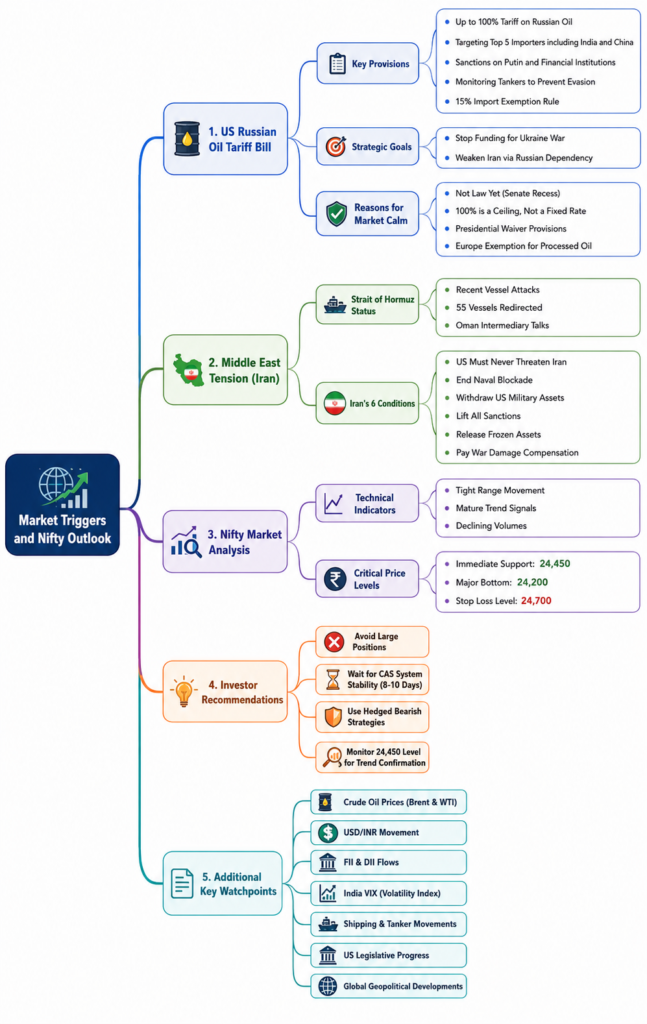
A sustained daily close below this level would weaken the near-term bullish structure and could increase the probability of a move toward the 24,200 area.
On the upside, traders should watch the 24,650–24,700 zone for evidence that buyers are regaining control.
Simple Trading Framework
| Nifty Zone | Interpretation |
|---|---|
| Above 24,700 | Bullish momentum improves |
| 24,450–24,700 | High-volatility / range zone |
| Below 24,450 | Bearish confirmation |
| Around 24,200 | Initial downside support zone |
These are technical reference levels, not guaranteed targets.
The biggest mistake during geopolitical events is trading aggressively simply because a headline looks bearish.
10. Which Indian Sectors Could Be Most Sensitive?
Oil & Gas
Risk: Higher replacement crude costs and changes in refining margins.
Watch:
- GRM
- Crude sourcing
- Russian crude exposure
- Export volumes
- Inventory gains/losses
Paints & Chemicals
Higher crude and petrochemical costs can increase input expenses.
Aviation
Higher ATF prices can quickly pressure operating margins.
Tyres
Synthetic rubber and crude-linked inputs can become more expensive.
Logistics
Fuel costs are an important operating expense.
IT
The direct oil impact is relatively limited, but the U.S. tariff/trade relationship matters because the U.S. is a major market for Indian IT companies.
Banks
Banks are indirectly affected through:
- Market volatility
- Corporate stress
- Currency movements
- Credit growth
- Interest rates
11. The Investor Dashboard: 8 Numbers to Watch
Instead of watching headlines all day, investors can monitor eight indicators.
1. Brent Crude
Above $100: geopolitical stress becomes more significant.
2. USD/INR
A sharp rupee decline can amplify imported inflation.
3. Russian Crude Share
India’s dependence on Russian crude remains a critical variable.
4. India VIX
A sudden increase indicates rising market uncertainty.
5. FII Flows
Foreign selling can amplify corrections.
6. Refining Margins
Important for understanding whether refiners are benefiting from cheap Russian crude.
7. Nifty 24,450
A key technical pivot in this framework.
8. U.S. Legislative Progress
Watch the sequence:
House → President → Waiver → Implementation
This is more important than social-media headlines about a “100% tariff.”
12. Portfolio Strategy: Don’t Confuse Geopolitical Risk With a Guaranteed Crash
One of the biggest mistakes investors make is assuming:
Geopolitical risk = immediate stock-market collapse
Markets can absorb surprisingly large geopolitical shocks when investors believe the economic consequences will remain manageable.
The more important question is:
Does the geopolitical event change corporate earnings?
If tariffs remain theoretical, the earnings impact may be limited.
If Russian crude becomes unavailable, crude prices rise, and the rupee weakens, the earnings impact becomes much more important.
Therefore, investors should focus on the transmission mechanism:
Geopolitical event
↓
Oil supply
↓
Crude price
↓
Inflation
↓
Rupee
↓
Interest rates
↓
Corporate margins
↓
Earnings
↓
Equity valuation
That is where the real risk lies.
13. The September Reckoning
The next major political milestone is the U.S. House’s response after its summer recess.
The Senate’s 86–11 vote demonstrates that the bill has significant bipartisan support. But the legislation is not yet law. Reuters reports that the House has shown resistance to expanding presidential tariff authority, meaning the outcome remains uncertain.
This creates three important dates investors should watch:
Stage 1: House consideration
Stage 2: Final legislation / presidential action
Stage 3: Actual implementation or waiver
Until those stages occur, the 100% tariff should be treated as a tail risk with potentially large consequences, not as a certainty.
Conclusion: The Real Threat Isn’t the Headline—It’s the Transmission Mechanism
The potential 100% tariff is undoubtedly important for India.
But investors should not stop at the headline.
The real questions are:
Can India maintain access to Russian crude?
Can refiners replace Russian barrels without destroying margins?
Will Brent crude rise sharply?
Will the rupee weaken?
Will inflation increase?
Will the U.S. actually impose the maximum tariff?
And most importantly:
Will geopolitical pressure translate into lower corporate earnings?
India’s Russian crude exposure is unusually high. In June 2026, Russian crude accounted for approximately 52.4% of India’s total crude imports, while July flows remained near historically high levels.
That makes the issue impossible for investors to ignore.
But it also does not mean a market crash is inevitable.
The smarter strategy is to monitor the data rather than trade the fear:
Crude Oil + USD/INR + India VIX + FII Flows + Russian Oil Share + Refining Margins + Nifty Levels + U.S. Legislative Progress
The next market move may not be determined by the tariff headline itself.
It may be determined by what happens after the headline.
Investor Checklist
Before taking a large position, ask:
☐ Has the U.S. bill actually become law?
☐ Has the President imposed the tariff?
☐ Has India received a waiver?
☐ Is Russian crude supply falling?
☐ Is Brent moving sharply higher?
☐ Is USD/INR weakening?
☐ Is India VIX rising?
☐ Are FIIs aggressively selling?
☐ Are refining margins deteriorating?
☐ Has Nifty broken 24,450 decisively?
If several of these turn negative simultaneously, the geopolitical risk is no longer just a headline—it is becoming an earnings and valuation risk.
Disclaimer
This article is for educational and informational purposes only and should not be considered investment advice, a recommendation to buy or sell securities, or a guarantee of future market movements. Geopolitical developments, legislation, crude prices, currency movements, and market conditions can change rapidly. Investors should conduct their own research and consult a SEBI-registered investment adviser before making investment decisions.
More SEO Title Options
- US 100% Tariff on India: 5 Geopolitical Risks for Nifty Investors
- 100% US Tariff Risk: How Russian Oil Could Impact Indian Stocks
- India-Russia Oil Crisis: 5 Risks That Could Hit Nifty 50
- US Tariff Shock: Russian Oil, Crude Prices and the Risk to Indian Stocks
- 100% Tariff Threat to India: What Investors Need to Know in 2026