
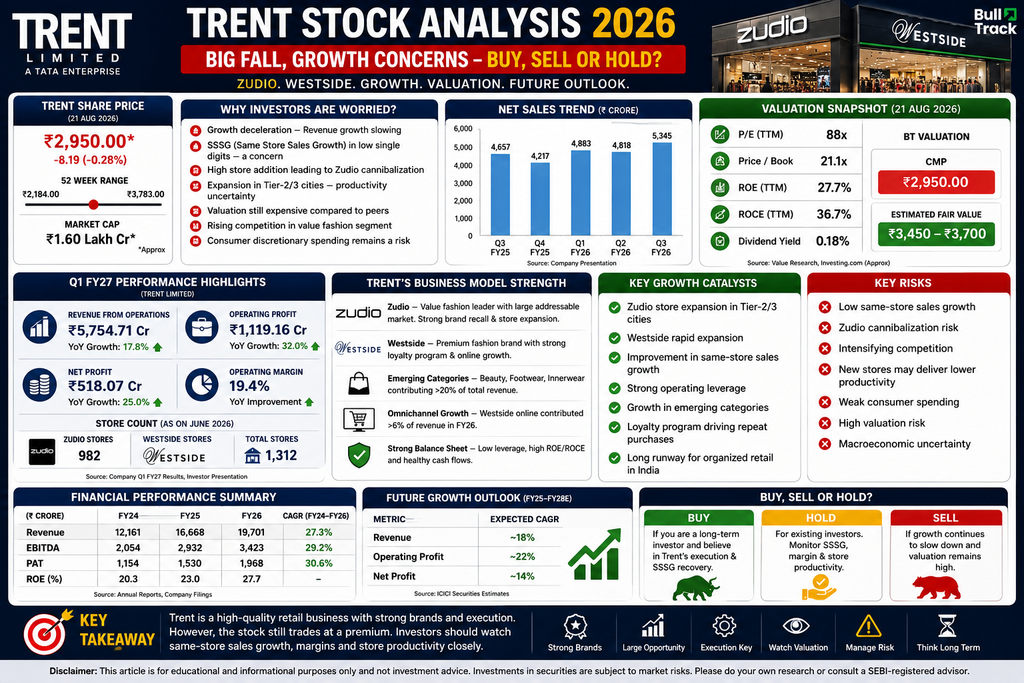
Trent Limited (NSE: TRENT) has been one of India’s strongest retail growth stories over the past few years. Its Zudio and Westside formats have helped the company deliver rapid expansion and strong profitability.
But the stock has also experienced a major valuation reset.
The important question for investors is no longer simply “Is Trent a good company?”
The bigger question is:
Has Trent’s stock fallen enough to compensate investors for the slowdown in growth and the risks associated with its premium valuation?
The answer is more nuanced than a simple Buy or Sell.
1. Trent’s Stock Has Corrected Sharply
Trent’s 52-week high was around ₹3,783, while the stock was trading around ₹2,950–₹3,000 in August 2026, representing a substantial correction from the peak. Its 52-week low was around ₹2,184.
This correction has changed the risk-reward equation.
However, investors should remember that a falling stock price does not automatically mean a stock is cheap.
Trent still trades at a significant premium to many Indian retail companies.
Recent market data puts Trent’s P/E around the high-80s, while its price-to-book ratio is above 20x.
That means the market is still pricing in substantial future growth.
2. Revenue Growth Remains Strong — But the Pace Matters
One of the biggest concerns highlighted in the presentation is growth deceleration.
The quarterly sales trend shown in the analysis was approximately:
| Quarter | Net Sales |
|---|---|
| Q3 FY25 | ₹4,657 Cr |
| Q4 FY25 | ₹4,217 Cr |
| Q1 FY26 | ₹4,883 Cr |
| Q2 FY26 | ₹4,818 Cr |
| Q3 FY26 | ₹5,345 Cr |
The important issue isn’t that Trent stopped growing.
It is that the rate of growth has been slowing.
The earlier growth trajectory was extremely high, which created very demanding expectations for the stock.
3. Latest Q1 FY27 Data Gives Investors Some Relief
The latest available Q1 FY27 numbers provide a more positive picture.
According to the reported results:
- Revenue: ₹5,754.71 crore
- YoY revenue growth: ~17.8%
- Operating profit: ₹1,119.16 crore
- YoY operating profit growth: ~32%
- Net profit: ₹518.07 crore
- YoY net profit growth: about 25%
Another reported presentation of the quarter puts revenue from operations at approximately ₹5,666 crore, with PAT around ₹532 crore, reflecting roughly 18% revenue growth and 26% PAT growth.
The difference comes from the reporting basis used by different financial-data sources, so investors should rely on Trent’s official financial statements when reconciling the exact figures. Trent publishes its quarterly results and investor presentations on its investor-relations page.
The important takeaway:
Profit growth is currently running ahead of revenue growth.
That is a positive sign because it suggests operating leverage is still working.
4. Zudio Remains the Biggest Growth Engine
The biggest reason investors continue to watch Trent is Zudio.
Zudio has transformed India’s value-fashion market by combining:
- Affordable pricing
- Fast fashion
- Frequent product refreshes
- Large-format stores
- Strong brand recognition
- Expansion into smaller cities
But rapid store expansion also creates a new problem.
Can every new store generate the same productivity as older stores?
That is the critical question.
If new stores in Tier-2 and Tier-3 markets generate lower sales per square foot, overall returns on incremental capital could decline.
5. Zudio Cannibalization Is a Major Risk
One of the key concerns highlighted in the presentation is cannibalization.
When multiple Zudio stores are opened close to each other in the same market, they can potentially compete for the same customers.
This can reduce:
- Sales per store
- Revenue per square foot
- Same-store growth
- Store-level profitability
Therefore, investors should not only track how many Zudio stores Trent opens.
They should track:
How much revenue and profit each mature store generates.
That is much more important.
6. Same-Store Sales Growth Is the Number to Watch
This could be Trent’s most important metric over the next few years.
If Trent keeps opening stores but existing stores are not growing strongly, the headline revenue growth could become misleading.
Investors should therefore monitor:
Store additions + Same-store sales growth + Sales per square foot
A healthy combination would be:
New stores ↑ + SSSG ↑ + Store productivity ↑
A weaker combination would be:
New stores ↑ + SSSG ↓ + Store productivity ↓
The second scenario would indicate that expansion is increasingly dependent on opening more stores rather than improving the economics of existing stores.
7. Westside Provides Another Growth Opportunity
Westside is another important part of Trent’s ecosystem.
The company has been increasing its Westside store footprint, while its loyalty program has also expanded significantly.
The strategy is potentially powerful:
More stores → More customers → More loyalty members → More repeat purchases → Higher sales
If the loyalty ecosystem works as expected, Westside could provide a relatively stable growth engine alongside Zudio.
8. Geographic Expansion Is Both an Opportunity and a Risk
Trent’s earlier growth was heavily concentrated in its stronger markets.
The company is increasingly expanding into:
- North India
- East India
- Tier-2 cities
- Tier-3 cities
This gives Trent a huge long-term opportunity.
India’s organized retail penetration remains relatively low compared with many developed markets.
But new markets are not automatically as profitable as established markets.
The company must prove that newer stores can achieve attractive:
- Sales per store
- Gross margins
- Store-level EBITDA
- Return on capital
9. Competition Is Getting Stronger
Trent is no longer operating in an uncontested fashion-retail market.
Competition is increasing from established and emerging players across value fashion.
The key competitors include formats from:
- Reliance Retail
- Shoppers Stop
- Other organized fashion retailers
- Local and regional fashion chains
- Online fashion platforms
The challenge is particularly important in the value-fashion segment.
If competitors become more aggressive with discounts, Trent’s margins could come under pressure.
10. Trent’s Biggest Strength: Execution
Despite the concerns, Trent has several major strengths.
Strong brand portfolio
Zudio and Westside have established significant consumer recognition.
Tata Group backing
Trent is part of the Tata Group, giving it a strong corporate ecosystem and brand credibility.
Strong profitability
Recent data shows Trent continues to generate strong returns on capital and equity relative to many businesses. Value Research recently reported ROE around 27.7% and ROCE around 36.7%.
Low leverage
Debt-to-equity has remained relatively low, which reduces balance-sheet risk.
11. But Valuation Remains the Biggest Problem
This is where investors need to be careful.
Even after the correction, Trent is not trading like a conventional value stock.
Recent data showed:
- P/E: roughly 88x
- P/B: roughly 21x
- Market capitalization: around ₹1.6 lakh crore
That valuation implies the market expects Trent to continue delivering strong growth for many years.
Therefore:
Good company ≠ automatically good stock at every price.
If earnings grow 20%+ for several years, today’s valuation could eventually look more reasonable.
But if earnings growth falls sharply, the valuation multiple could contract further.
12. Future Growth Expectations
The presentation highlighted longer-term expectations of approximately:
| Metric | FY25–FY28 Growth Expectation |
|---|---|
| Revenue | ~18% CAGR |
| Operating Profit | ~22% CAGR |
| Net Profit | ~14% CAGR |
These expectations explain why investors are willing to pay a premium valuation.
But there is an important warning:
The market may already be pricing in a significant portion of this growth.
Therefore, Trent needs to execute rather than merely grow.
13. What Could Make Trent Stock Rise?
Several catalysts could change the market’s perception.
Bull Case
1. Same-store sales growth recovers
This would be one of the strongest signals.
2. Zudio maintains strong store economics
If newer stores perform almost as well as mature stores, the expansion runway becomes extremely valuable.
3. Westside accelerates
Higher loyalty and repeat purchases could improve growth.
4. Operating margins expand
If profit grows faster than revenue, valuation becomes easier to justify.
5. Tier-2 and Tier-3 markets work
Successful geographic expansion could significantly increase Trent’s addressable market.
14. What Could Make Trent Stock Fall Further?
Bear Case
1. Same-store growth remains weak
This would challenge the core growth thesis.
2. Zudio cannibalization increases
More stores could start competing with existing stores.
3. New stores deliver weaker economics
Expansion would then create less shareholder value.
4. Competition intensifies
Aggressive discounting could hurt margins.
5. Consumer spending weakens
Fashion retail is sensitive to discretionary spending.
6. Valuation contracts
This is perhaps the biggest stock-specific risk.
Even if earnings continue increasing, the share price can fall if investors decide that 80–90x earnings is too expensive.
15. Trent Stock: Buy, Sell or Hold?
This depends heavily on the investor’s time horizon.
For existing long-term shareholders
HOLD / HOLD WITH MONITORING
The business fundamentals remain strong, and the latest quarterly numbers show that growth and profitability have not collapsed.
However, investors should closely monitor SSSG, Zudio store productivity and margins.
For new investors
WAIT FOR BETTER RISK-REWARD / ACCUMULATE GRADUALLY
The correction has improved the risk-reward compared with the peak, but Trent is still expensive on conventional valuation metrics.
Rather than buying aggressively after a fall, investors could consider staggered accumulation if the business continues to deliver.
For short-term traders
The stock remains highly sensitive to:
- Earnings
- Valuation
- Retail-sector sentiment
- Market momentum
So technical confirmation should be considered before taking a large position.
16. My Trent Investment Framework
Instead of asking:
“Trent has fallen 20–30%. Should I buy?”
Ask these five questions every quarter:
1. Is revenue growth >15%?
2. Is profit growth keeping pace with or exceeding revenue growth?
3. Is same-store sales growth improving?
4. Are new Zudio stores generating attractive returns?
5. Is the valuation falling faster than earnings expectations?
If the answers increasingly become YES, the investment thesis strengthens.
If revenue growth falls below expectations while valuation remains extremely high, the risk increases.
Final Verdict
Trent remains a high-quality Indian retail growth company, but it is not a traditional value stock.
The recent correction has made the valuation more reasonable than it was near the peak, but the company still needs to deliver strong earnings growth to justify its premium.
The most important thing to watch now is not store-count growth alone.
It is:
Same-store sales + Zudio productivity + operating margins + earnings growth + valuation.
The latest Q1 FY27 numbers are encouraging, particularly because operating profit and PAT growth are stronger than revenue growth.
For a long-term investor, Trent can remain on the watchlist/accumulation-on-correction list, but buying purely because the stock has fallen would be risky.
Business Quality: ⭐⭐⭐⭐⭐
Growth: ⭐⭐⭐⭐☆
Balance Sheet: ⭐⭐⭐⭐⭐
Competitive Position: ⭐⭐⭐⭐☆
Valuation: ⭐⭐☆☆☆
Risk-Reward: ⭐⭐⭐☆☆
Overall view: HOLD / ACCUMULATE ON DEEP CORRECTIONS
This article is for educational and informational purposes only and should not be treated as investment advice. Investors should verify the latest company filings, valuation, financial results, and their own risk tolerance before making investment decisions.
Sources: Trent’s official financial-results and annual-report resources, plus recent market/financial data.