
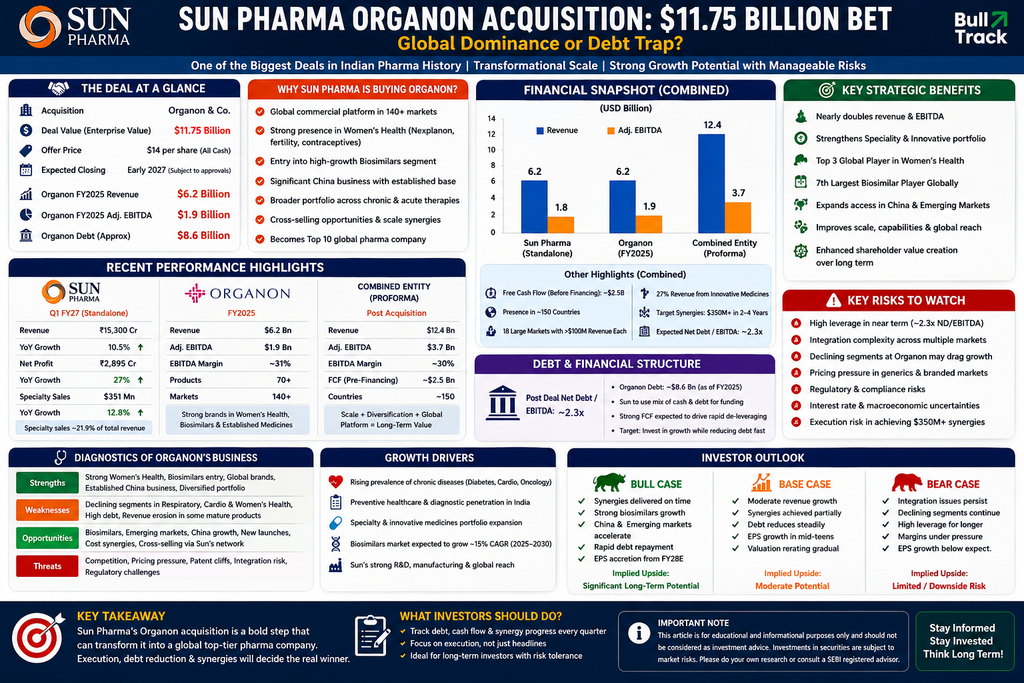
Sun Pharma’s $11.75 Billion Organon Acquisition: A Game-Changing Deal
Sun Pharmaceutical Industries has made one of the biggest strategic bets in the history of Indian pharmaceuticals.
The company agreed to acquire Organon & Co. for $14 per share in an all-cash transaction, giving the deal an enterprise value of approximately $11.75 billion. Sun Pharma described the transaction as a transformational step toward becoming a much larger global pharmaceutical company.
But the real question for investors is not simply:
“Is Organon a good company?”
The more important question is:
Can Sun Pharma integrate Organon, manage the additional debt and generate enough cash flow to justify the acquisition price?
That is where the investment story becomes interesting.
1. The Deal in Numbers
| Parameter | Details |
|---|---|
| Acquisition | Organon & Co. |
| Deal Value | $11.75 billion EV |
| Offer Price | $14/share |
| Transaction Type | All-cash |
| Organon FY2025 Revenue | $6.2 billion |
| Organon Adjusted EBITDA | $1.9 billion |
| Organon Debt | ~$8.6 billion |
| Combined Revenue | ~$12.4 billion |
| Combined EBITDA | ~$3.7 billion |
| Combined FCF before financing | ~$2.5 billion |
| Expected Closing | Early 2027 |
| Combined Presence | ~150 countries |
Sun Pharma’s investor presentation estimates that the combined company could have approximately $12.4 billion in revenue, $3.7 billion in adjusted EBITDA, and $2.5 billion in free cash flow before financing.
This means the acquisition isn’t just about adding revenue—it potentially changes Sun Pharma’s global scale.
2. Why Is Sun Pharma Buying Organon?
There are several strategic reasons.
1. Global Distribution Platform
Organon sells more than 70 products across approximately 140 countries.
After the transaction, the combined business is expected to have a presence in around 150 countries, with 18 large markets generating more than $100 million each.
This gives Sun Pharma something that would take years to build organically:
A ready-made global commercial platform.
3. The Biggest Opportunity: Biosimilars
One of the most interesting parts of the deal is Sun Pharma’s entry into the global biosimilars market.
Organon’s portfolio includes biosimilars, while Sun Pharma already has manufacturing capabilities and a growing innovative-medicines business.
Sun expects the combination to make it approximately the 7th-largest global biosimilar player.
This could become an important long-term growth engine.
Why?
Because biosimilars can potentially offer:
- Large addressable markets
- Global expansion opportunities
- Higher barriers to entry than traditional generics
- Long-term demand from healthcare systems seeking lower-cost biologic alternatives
However, biosimilars also require significant regulatory, manufacturing, and commercialization capabilities.
So this is a long-term opportunity rather than an overnight earnings boost.
4. Women’s Health: Another Major Advantage
Organon has a strong position in women’s health.
Its portfolio includes products such as Nexplanon, alongside fertility and contraceptive products.
Sun Pharma says the combined company could become a top-three player globally in Women’s Health.
This gives Sun access to an established global franchise instead of having to develop an entirely new commercial platform.
5. China Could Become a Growth Engine
China is another important piece of the acquisition.
Organon already has a significant commercial presence in China, and the company has an established revenue base there.
The strategic attraction is straightforward:
Sun gets access to Organon’s existing products, relationships,s and distribution network instead of starting from zero.
This could become particularly important if Sun successfully cross-sells its own products through Organon’s international network.
6. Sun Pharma + Organon: Revenue Could Nearly Double
This is perhaps the most important financial argument behind the deal.
According to Sun Pharma’s transaction presentation:
Sun Pharma: approximately $6.2 billion in revenue
Organon: approximately $6.2 billion in revenue
Combined: approximately $12.4 billion
Similarly:
Sun EBITDA: ~$1.8 billion
Organon EBITDA: ~$1.9 billion
Combined EBITDA: ~$3.7 billion.
In simple terms:
Sun is almost doubling the size of its business through one transaction.
That is a huge transformation.
7. But Here Comes the Biggest Problem: Debt
This is the part investors should watch very carefully.
Sun Pharma historically maintained a relatively strong balance sheet and had substantial cash resources.
The Organon acquisition changes that equation.
Sun’s management has acknowledged that the transaction requires taking on significant debt. Management indicated that the combined company’s post-transaction net debt/EBITDA could be around 2.3×, while emphasizing the intention to repay debt as early as possible.
Sun’s presentation estimates:
Post-deal Net Debt / EBITDA ≈ 2.3×
That isn’t necessarily dangerous by itself.
But it is a major change from Sun’s previous balance-sheet profile.
8. Why Debt Is the Main Risk
Organon itself had approximately $8.6 billion of debt at the end of 2025.
Therefore, investors shouldn’t look only at the $11.75 billion headline acquisition value.
They need to examine:
Debt + interest expense + integration costs + repayment speed + free cash flow.
If the combined business generates strong cash flow, leverage can decline.
But if growth disappoints, debt repayment could take longer, and interest costs could put pressure on earnings.
That is why the acquisition can simultaneously be:
A growth opportunity + a balance-sheet risk.
9. $350 Million Synergy Target
Sun Pharma expects more than $350 million of cost synergies over 2–4 years.
Potential areas include:
- Supply-chain optimization
- Manufacturing efficiencies
- Commercial integration
- API and procurement efficiencies
- Elimination of duplicated costs
- Cross-selling opportunities
If Sun successfully captures these synergies, the economics of the acquisition could improve significantly.
But investors should remember:
Synergy targets are estimates, not guaranteed profits.
Execution matters.
10. The Acquisition Is Not Yet Fully Completed
This is an important update compared with the original presentation shown in your screenshots.
Organon’s shareholders approved the merger proposal on July 23, 2026, with approximately 192.8 million votes in favour versus 2.57 million against.
Sun Pharma subsequently noted the shareholder approval on July 24.
However, the transaction still requires the remaining closing conditions and regulatory clearances.
The expected completion remains early 2027.
So investors should distinguish between:
Deal announced → shareholder approved → regulatory approvals → closing → integration.
The final stages are still important.
11. Sun Pharma’s Own Business Is Still Growing
The Organon story shouldn’t completely overshadow Sun Pharma’s existing business.
In the latest reported quarter, Sun Pharma continued to benefit from its specialty/innovative medicines portfolio.
Reuters reported that Sun Pharma’s Q1 FY27 net profit increased 27% to approximately ₹2,895 crore, while revenue rose about 10.5% to ₹15,300 crore. Specialty sales increased about 12.8% to $351 million and represented roughly 21.9% of total revenue.
This is important because Sun isn’t buying Organon simply because its own business is weak.
Rather, the strategy appears to be:
Strong existing business + global acquisition + broader product portfolio = larger global pharma platform.
12. The Specialty Medicines Strategy
Sun Pharma has increasingly moved beyond traditional generic medicines toward higher-value specialty and innovative medicines.
This includes areas such as:
- Dermatology
- Oncology
- Ophthalmology
- Immunology
- Chronic diseases
- Obesity/diabetes opportunities
Its innovative-medicines business is therefore becoming increasingly important to the overall investment thesis.
The Organon transaction is designed to accelerate that transformation.
Sun says the combined company could have 27% of revenue from Innovative Medicines.
13. What Could Go Right?
There are several potential bull-case scenarios.
Bull Case
1. Organon stabilizes its declining businesses
If Sun improves operational efficiency, some underperforming segments could recover.
2. Biosimilars become a major growth engine
Sun could use Organon’s commercial network to scale biosimilar products globally.
3. China grows faster
Existing infrastructure could provide a strong platform for expansion.
4. Synergies exceed expectations
If the $350M+ synergy target is achieved quickly, cash generation could improve.
5. Debt falls rapidly
If combined free cash flow remains strong, leverage could decline faster than expected.
6. Sun’s specialty portfolio continues growing
This would give the combined company two different growth engines.
14. What Could Go Wrong?
Now the bear case.
Bear Case
1. Debt remains elevated
Higher leverage could restrict financial flexibility.
2. Organon’s declining segments continue declining
The acquisition cannot magically fix weak products.
3. Integration becomes complicated
Sun will have to integrate businesses across multiple countries, regulatory environments,s and corporate cultures.
4. Growth dilution
If Organon’s weaker businesses grow slowly, Sun’s overall growth rate could temporarily decline.
5. Interest costs increase
Higher borrowing costs could reduce the earnings benefit.
6. Synergies arrive late
If the $350M+ target takes longer than expected, the investment thesis could weaken.
15. Sun Pharma Stock: What Investors Need to Understand
The screenshots you provided show a ₹1,810 CMP and a ₹1,295.30 model fair value.
That valuation snapshot should not be treated as today’s fair value, because the share price and company fundamentals have moved since that presentation.
As of the latest available August 21, 2026 market data, Sun Pharma was around ₹1,902–₹1,903, depending on the market-data source. The stock had recently traded below its July 31 52-week high of roughly ₹2,047.55.
Therefore, the old ₹1,295.30 valuation number from the screenshot should be treated as a historical/model output, not a current target.
16. The Real Investment Question
For long-term investors, the most important question isn’t:
“Will Sun Pharma go to ₹2,000?”
The better question is:
“Will Sun Pharma generate enough additional cash flow from Organon to justify the additional leverage and acquisition price?”
That will depend on five things:
1. Revenue growth
Can the combined company maintain strong organic growth?
2. EBITDA
Can the combined business maintain margins?
3. Free cash flow
Can cash generation remain strong after interest and investment?
4. Debt repayment
How quickly can leverage fall?
5. Organon integration
Can Sun achieve the expected synergies?
17. Investor Scorecard
| Factor | View |
|---|---|
| Business Quality | 🟢 Strong |
| Global Expansion | 🟢 Very Strong |
| Specialty Medicines | 🟢 Strong |
| Biosimilars Opportunity | 🟢 Strong |
| Women’s Health | 🟢 Strong |
| China Opportunity | 🟢 Positive |
| Cash Generation | 🟢 Positive |
| Acquisition Size | 🟠 Very Large |
| Debt Risk | 🔴 High |
| Integration Risk | 🟠 Medium–High |
| Valuation Risk | 🟠 Medium |
| Long-Term Potential | 🟢 Attractive |
| Near-Term Execution Risk | 🟠 High |
18. My Take: Global Dominance or Debt Trap?
The answer is:
Potentially both.
If Sun Pharma executes well, the Organon acquisition could transform the company into a much larger global pharmaceutical platform.
The combined business would have:
~$12.4B revenue
~$3.7B EBITDA
~$2.5B pre-financing free cash flow
150-country presence
Global Women’s Health exposure
Top-10 biosimilar positioning
and a much broader international commercial network.
But investors cannot ignore the other side:
Higher debt + integration risk + declining Organon segments + execution risk.
Therefore, the next 2–3 years could be more important than the acquisition announcement itself.
19. What Investors Should Track From 2026–2028
For anyone holding or considering Sun Pharma, these are the numbers worth monitoring every quarter:
🔎 Debt
Is Net Debt/EBITDA falling?
🔎 Free Cash Flow
Is the combined business generating enough cash?
🔎 Organon Revenue
Are declining segments stabilizing?
🔎 Biosimilars
Is biosimilar revenue accelerating?
🔎 Women’s Health
Is Nexplanon and the broader franchise maintaining growth?
🔎 China
Is the China business expanding?
🔎 Synergies
Is Sun moving toward the $350M+ target?
🔎 EPS
Does the acquisition remain EPS-accretive as management expects?
🔎 Sun’s Specialty Business
Does innovative-medicines growth remain strong?
Final Verdict
Sun Pharma’s Organon acquisition is no simple one—it is a strategic transformation.
The deal gives Sun Pharma scale, global distribution, women’s health, biosimilars, and access to new markets.
The financial potential is substantial, with the combined business expected to nearly double revenue and EBITDA compared with Sun’s standalone base.
But the price of that transformation is higher leverage and execution risk.
🟢 Long-term investor
The deal can be viewed as a potentially attractive strategic move, provided debt reduction and integration remain on track.
🟡 Existing shareholder
The logical approach is to watch execution rather than react purely to the acquisition headline.
🔴 Conservative investor
The post-deal leverage and integration risks deserve close attention before taking an aggressive position.
Bottom line:
Sun Pharma is betting that a temporary increase in financial leverage can create a permanently stronger global pharmaceutical franchise. The next 2–3 years will determine whether this becomes one of India’s best pharma acquisitions—or an expensive lesson in M&A execution.
SEO FAQ
Is Sun Pharma buying Organon?
Yes. Sun Pharma agreed to acquire Organon in an all-cash transaction at $14 per share, with an enterprise value of approximately $11.75 billion.
When will the Sun Pharma Organon deal close?
The transaction is expected to close in early 2027, subject to remaining regulatory and customary closing conditions. Organon shareholders approved the merger in July 2026.
Why is Sun Pharma buying Organon?
The key strategic reasons include global expansion, women’s health, biosimilars, China exposure, established brands and access to Organon’s international commercial network.
Will the Organon acquisition increase Sun Pharma’s debt?
Yes. Sun Pharma expects post-transaction leverage of approximately 2.3× Net Debt/EBITDA for the combined business.
Is Sun Pharma stock a buy after the Organon deal?
The acquisition alone is not enough to make a buy/sell decision. Investors should evaluate valuation, debt repayment, cash flow, integration progress, and Sun Pharma’s underlying earnings growth.
⚠️ Disclaimer
This article is for educational and informational purposes only and is not investment advice. Stock prices, valuations,s and financial conditions can change. Investors should independently verify company filings, financial statements, valuation assumptions, and risk factors before making any investment decision. Past performance does not guarantee future returns.