
Introduction: Genuine Recovery or Just a Relief Rally?
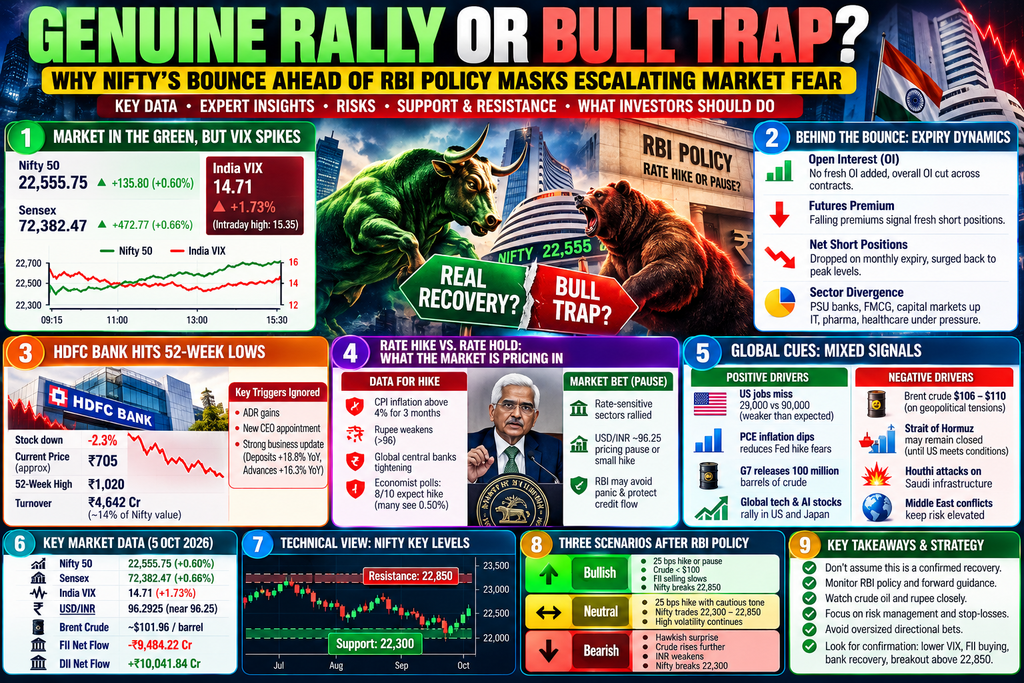
After eight consecutive weekly declines, India’s benchmark indices finally delivered some relief on October 5, 2026.
The Nifty 50 gained 0.60% to close at 22,555.75, while the Sensex rose 472.77 points, or 0.66%, to 72,382.47. This ended a brutal eight-week losing streak that had reduced the Nifty by roughly 8.7% from its recent levels.
But the important question is:
Is this the beginning of a sustainable recovery—or simply a short-covering and oversold bounce before the RBI’s October 7 policy decision?
The answer is not yet clear.
There are genuine positive signals. Crude oil has eased from recent highs, weaker-than-expected US employment data has reduced expectations of an immediate aggressive Federal Reserve hike, and several Indian financial stocks posted strong quarterly business updates.
At the same time, several risks remain:
- India VIX remains elevated.
- The rupee is around ₹96 per US dollar.
- Brent crude remains above $100.
- FIIs continue to sell Indian equities.
- HDFC Bank remains under pressure.
- The RBI is widely expected to consider a 25-basis-point rate hike.
So, the current market environment is better described as a relief rally inside a high-risk macroeconomic setup, rather than a confirmed bull-market reversal.
1. Nifty Rebounds Above 22,500—but the Bigger Trend Has Not Fully Reversed
The Nifty closed at 22,555.75 on October 5, gaining 135.80 points from the previous close of 22,419.95.
The session range was approximately 22,397–22,622, showing that volatility remained substantial even during the recovery.
Latest market snapshot
| Indicator | October 5, 2026 |
|---|---|
| Nifty 50 | 22,555.75 |
| Nifty change | +0.60% |
| Sensex | 72,382.47 |
| Sensex change | +0.66% |
| India VIX | 14.71 |
| USD/INR | 96.2925 |
| Brent crude | Around $102/barrel |
| FII net selling | ₹9,484.22 crore |
| DII net buying | ₹10,041.84 crore |
The most important point is that the index has recovered, but the macro environment has not completely normalised.
A one-day rise cannot establish a trend reversal.
For a more convincing recovery, investors should look for:
- Higher highs and higher lows.
- Sustained trading above important resistance.
- Improving market breadth.
- Falling volatility.
- Stabilisation in crude oil.
- Reduced FII selling.
- Stronger participation from index heavyweights.
Until several of these conditions appear together, the bounce should be treated cautiously.
2. India VIX Is Still Sending a Warning Signal
One of the most interesting features of the October 5 session was the behaviour of India VIX.
The VIX moved between 13.49 and 15.35 during the session and eventually closed at 14.71, up 1.73%.
This is important because the Nifty was simultaneously rising.
Why does this matter?
India VIX reflects the market’s expectation of near-term volatility based on Nifty options.
Normally, a strong and confident equity rally can be accompanied by declining volatility.
When stocks rise, but volatility remains elevated, it can indicate that traders are still paying significant premiums for protection against large price movements.
However, one should not automatically conclude that a rising VIX means the market must fall.
VIX measures expected volatility—not direction.
Simple interpretation
| Market | VIX | Possible interpretation |
|---|---|---|
| Nifty ↑ + VIX ↓ | More constructive | Confidence may be improving |
| Nifty ↑ + VIX ↑ | Caution | Recovery accompanied by uncertainty |
| Nifty ↓ + VIX ↑ | Risk-off | Strong defensive positioning |
| Nifty ↓ + VIX ↓ | Mixed | Selling may be orderly |
The October 5 combination of Nifty +0.60% and VIX +1.73% therefore deserves attention.
3. FII Selling Remains the Biggest Structural Concern
The biggest challenge for Indian equities remains foreign investor selling.
On October 5, FIIs were reported as net sellers of approximately ₹9,484 crore, while domestic institutions bought around ₹10,042 crore.
This creates an interesting battle:
FII
Selling pressure
⬇️
Foreign capital exits
⬇️
Potential currency pressure
⬇️
Lower liquidity
DII
Buying support
⬆️
Domestic mutual funds, insurers and institutions absorb supply.y
⬆️
Provides market stability
⬆️
Limits downside in some segments
The DII buying is clearly positive, but it does not necessarily mean the market has entered a new bull phase.
If FII selling continues for several weeks, domestic institutions may have to absorb substantial supply.
What would make the situation more bullish?
A stronger signal would be:
FII selling slows → DII buying continues → Nifty breaks resistance → market breadth improves.
That combination would be much more convincing than one strong session.
4. HDFC Bank Is the Elephant in the Room
One of the biggest reasons to remain cautious is the behaviour of HDFC Bank.
HDFC Bank fell around 2% on October 5, even as the broader market rallied. Reuters reported that the stock declined 2.3% during the session after investors assessed the appointment of Anup Bagchi as the bank’s new CEO.
MarketWatch reported the stock at ₹705, around 31% below its 52-week high of ₹1,020.35.
At the same time, the bank’s September business update showed:
- Deposits up 18.8% YoY
- Gross advances up 16.3% YoY
These figures show that the business continues to grow, even though the stock price remains under pressure.
Why HDFC Bank matters for Nifty
HDFC Bank has a large weight in the Nifty.
Therefore, if the stock remains weak while the index attempts a recovery, the market may struggle to sustain a strong uptrend.
This creates an important test:
Can Nifty rise sustainably while one of its major banking heavyweights continues to underperform?
That is something investors should monitor closely.
5. RBI Policy Is the Next Major Catalyst
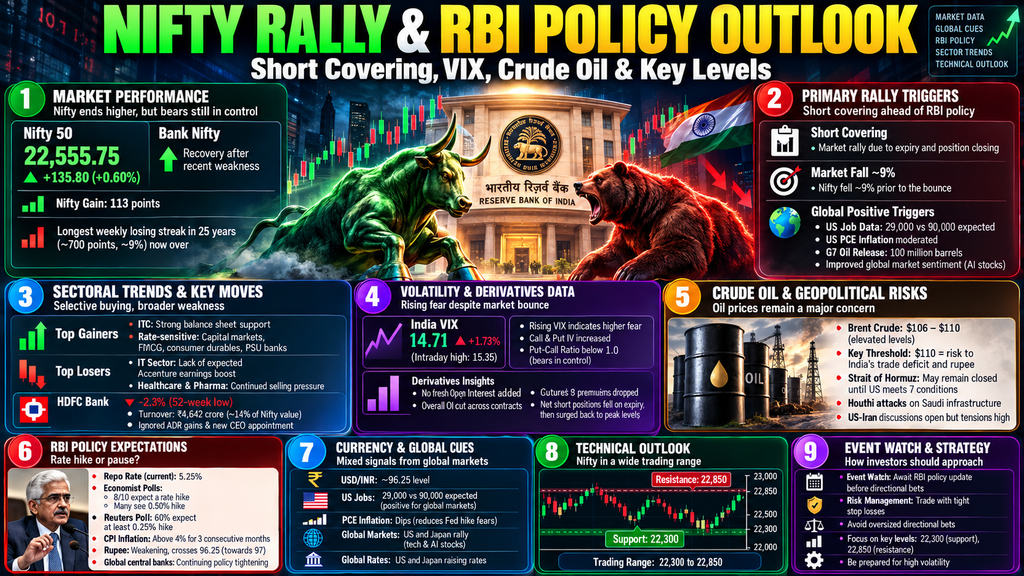
The RBI Monetary Policy Committee is meeting from October 5–7, with the policy decision expected on October 7.
The current repo rate is 5.25%.
A large majority of economists surveyed recently expect a 25-basis-point hike to 5.50%. Reuters reported that nearly 60% of economists in its poll expected a 25-bps increase.
A Financial Express poll found 80% of economists expected a 25-bps increase.
Why is the RBI considering a hike?
The major concerns include:
- Inflation rising to 4.82% in August.
- Inflation remaining above the RBI’s 4% target for three consecutive months.
- Elevated crude oil prices.
- Rupee weakness.
- Higher global interest rates.
- Strong domestic economic growth.
Three RBI scenarios
| RBI outcome | Potential market reaction |
|---|---|
| No hike | Relief rally possible, especially in rate-sensitive stocks |
| 25 bps hike | Could be initially negative but may be absorbed if already priced in |
| 50 bps hike | Potentially stronger negative reaction, particularly in rate-sensitive sectors |
The forward guidance may matter more than the headline rate decision.
If RBI hikes 25 bps but signals that the move is measured and data-dependent, markets may recover.
If RBI signals multiple additional hikes, valuation pressure could intensify.
6. Rupee at ₹96: Why Currency Risk Cannot Be Ignored
The rupee closed around ₹96.2925 per US dollar on October 5, almost unchanged from the previous session. Reuters noted that the currency was being influenced by the dollar, oil prices, es and suspected RBI intervention.
The rupee is important for the stock market because currency depreciation can influence:
- Imported inflation.
- India’s oil import bill.
- Foreign investor returns.
- Corporate input costs.
- External borrowing.
- Current-account dynamics.
A weaker rupee can benefit some exporters, particularly companies earning substantial revenue in dollars.
But it can create challenges for businesses heavily dependent on imported inputs.
Therefore, the effect of ₹96/USD is not uniformly negative for every Indian company.
7. Crude Oil Has Improved—but $100+ Remains a Risk
One positive development for Indian equities is the decline in crude oil prices from recent highs.
Brent was around $101.96 per barrel on October 5.
This is an improvement compared with the recent $106–$110 range discussed in the original analysis.
However, oil remains above the psychologically important $100/barrel level.
Why investors should care
India is a major crude importer.
If Brent remains above $100 for a prolonged period, it can create pressure through:
Higher oil prices
→ Higher import bill
→ Currency pressure
→ Imported inflation
→ Higher input costs
→ Potential margin pressure
→ RBI policy complications
Therefore, the next major positive signal for Indian equities would be sustained crude-oil moderation, rather than a one-day decline.
8. US Jobs Data Is Giving Global Markets Some Relief
Another positive factor is the latest US employment report.
US non-farm payrolls increased by only 29,000 in September, versus expectations of roughly 90,000. The unemployment rate rose to 4.2%.
This weaker labour-market data reduced expectations of an immediate aggressive Federal Reserve rate hike.
US equity markets responded positively, with technology stocks leading the recovery.
Why this matters for India
Lower expectations for US monetary tightening can potentially:
- Reduce global bond-yield pressure.
- Improve emerging-market sentiment.
- Reduce dollar strength.
- Support technology and growth stocks.
- Reduce pressure on foreign capital flows.
But there is a catch.
Weak US employment is not automatically good news.
If labour-market weakness becomes a sign of a broader US slowdown, global earnings expectations could eventually be affected.
Therefore, investors need to distinguish between:
“Fed tightening risk is falling”
and
“Global economic growth is deteriorating.”
Both can produce very different market outcomes.
9. Technical Analysis: 22,300 and 22,850 Remain Important Zones
The original trading framework identified:
Support
22,300
Resistance
22,850
These levels can be used as a practical short-term framework, but they should not be treated as guaranteed turning points.
The October 5 Nifty session traded between approximately 22,397 and 22,622, leaving the index below the 22,850 resistance zone.
Bullish confirmation
A stronger bullish setup would require:
22,850 breakout
↓
Sustained trading above the level
↓
Improving breadth
↓
Lower VIX
↓
FII selling moderates
↓
Banking stocks participate
That would make the recovery more credible.
Bearish scenario
If Nifty fails to hold the 22,300 area and selling accelerates, traders may start watching lower support zones.
The key point is that support should be treated as a zone rather than an exact number.
10. Is This a Bull Trap?
The evidence currently points to a mixed picture rather than a confirmed bull trap.
Reasons supporting the rally
✅ Nifty reclaimed 22,500.
✅ Eight-week losing streak ended.
✅ Crude oil declined from recent highs.
✅ US jobs data reduced immediate Fed-hike concerns.
✅ 13 of 16 major sectors gained on October 5.
✅ Financial stocks received some support.
Reasons for caution
⚠️ FII selling remains heavy.
⚠️ India VIX rose to 14.71 despite the Nifty gain.
⚠️ Rupee remains near ₹96/USD.
⚠️ Crude remains above $100.
⚠️ RBI policy uncertainty remains.
⚠️ HDFC Bank remains weak.
⚠️ Nifty remains below the 22,850 resistance zone.
Therefore, calling this rally a confirmed bull-market reversal would be premature.
11. Three Scenarios After the RBI Policy
🟢 Bullish Scenario
RBI delivers a moderate 25-bps hike or holds rates, while its guidance remains less hawkish than feared.
At the same time:
- Crude moves below $100.
- VIX falls.
- FIIs reduce selling.
- HDFC Bank stabilises.
- Nifty breaks 22,850.
Potential result: Relief rally gains credibility.
🟡 Neutral Scenario
RBI hikes 25 bps but signals a cautious, data-dependent approach.
Crude remains around $100–105.
FII selling continues, but DII buying absorbs some pressure.
Nifty remains between approximately 22,300 and 22,850.
Potential result: High-volatility consolidation.
🔴 Bearish Scenario
RBI delivers a more hawkish message.
Crude moves sharply higher.
Rupee weakens further.
FII selling accelerates.
HDFC Bank and other heavyweights continue falling.
Nifty breaks below 22,300.
Potential result: Another leg lower becomes possible.
These are scenarios, not forecasts or guaranteed targets.
12. What Should Investors Do Now?
For investors with a long-term horizon, the current environment is more about portfolio quality than predicting the exact Nifty bottom.
Check these five things
1. Avoid excessive leverage
High-leverage positions can become dangerous when volatility rises.
2. Review your portfolio’s banking exposure
Banking stocks may react sharply to RBI policy and bond yields.
3. Monitor crude-sensitive businesses
A prolonged oil shock can affect aviation, chemicals, paints and logistics.
4. Keep some liquidity
Avoid deploying all capital simply because the market has fallen.
5. Don’t chase the first green candle
A single-day rally after a long decline can be a technical rebound rather than a structural reversal.
Nifty Market Outlook: Key Levels to Watch
| Level / Indicator | What to watch |
|---|---|
| 22,850 | Breakout confirmation zone |
| 22,500 | Psychological level / current closing area |
| 22,300 | Key downside monitoring zone |
| India VIX 14–15+ | Elevated volatility |
| USD/INR ~96 | Currency pressure |
| Brent ~$100+ | Inflation/import-cost risk |
| RBI repo 5.25% | Current policy rate |
| Possible 5.50% | Market consensus for 25-bps hike |
Current policy expectations and macro data are based on reports available before the October 7 RBI decision. Reuters
Conclusion: Rally or Bull Trap?
The October 5 Nifty rebound is encouraging—but not yet conclusive.
The index gained 0.60%, reclaimed 22,500 and finally ended an eight-week losing streak. Crude oil eased, and weak US jobs data reduced immediate Fed-tightening concerns. These are genuine positives.
But the market still faces several major risks.
FII selling remains heavy.
India VIX is elevated.
The rupee remains around ₹96/USD.
Brent remains above $100.
HDFC Bank remains weak.
And most importantly, the RBI’s October 7 policy decision could significantly change market expectations.
Therefore, the most sensible interpretation is:
This is a relief rally that needs confirmation—not yet a confirmed trend reversal.
The next major test is whether Nifty can sustain itself above 22,500, reclaim 22,850, and do so with improving breadth, lower volatility and participation from major banking stocks.
Until then, traders should avoid oversized directional bets, while long-term investors should focus on valuation, earnings quality and portfolio risk.
Frequently Asked Questions
Is the Nifty rally on October 5 a bull trap?
It is too early to confirm. The rebound has positive macro drivers, but elevated VIX, continued FII selling, a weak rupee and RBI policy uncertainty mean confirmation is still required.
What is the key Nifty resistance level?
The current framework identifies 22,850 as an important resistance zone. A sustained breakout would make the recovery more convincing.
What is the important Nifty support?
22,300 is the key downside monitoring zone from the current technical framework.
Why is India VIX important?
India VIX measures expected near-term volatility. A higher VIX indicates greater expected market movement, but it does not predict whether Nifty will rise or fall.
What will happen if RBI hikes rates by 25 bps?
A 25-bps hike is already widely expected by economists. The market reaction may therefore depend more on RBI’s forward guidance than on the rate increase itself.
Why is HDFC Bank important for Nifty?
HDFC Bank is a major index heavyweight. Continued weakness in the stock can limit the ability of the broader index to sustain a strong recovery. The stock fell about 2.3% on October 5 despite the broader market rally.
Is crude oil above $100 a risk for India?
Yes. Sustained high crude prices can increase India’s import costs and put pressure on inflation, the rupee and margins of fuel-sensitive companies.
Disclaimer
This article is for educational and informational purposes only and does not constitute financial or investment advice. Market levels, technical analysis, policy expectations and scenario analysis are subject to change. No support, resistance level,l or market scenario mentioned here guarantees future performance. Investors should independently verify data, assess their risk tolerance and consult a qualified financial advisor before making investment decisions. Investments in stocks, futures and options are subject to market risks, including the potential loss of capital.
Data note: Market figures in this article are based on reports available through October 5, 2026. The RBI policy decision was still pending at the time of writing; therefore, the expected 25-bps hike is presented as a market/economist expectation, not as a confirmed RBI decision.
🔥 Top 10 SEO Titles
- Nifty Rebound 2026: Genuine Rally or Bull Trap Ahead of RBI Policy?
- Nifty 50 Analysis 2026: Is the Market Rebound a Bull Trap?
- Nifty Bull Trap Alert: RBI Policy, FII Selling and India VIX Explained
- Indian Stock Market Outlook 2026: Nifty Rebound, RBI Policy & FII Selling
- Nifty 50 Today: Why the Market Rebounded Despite Rising Market Fear
- Nifty Rally or Bull Trap? Key Levels, India VIX and RBI Policy Explained
- Stock Market Outlook: Nifty 22,500 Rebound and the Risks Investors Should Watch
- Nifty 50 Recovery: FII Selling, Crude Oil, Rupee and RBI Rate Hike Risks
- Nifty Technical Analysis 2026: 22,300 Support and 22,850 Resistance
- Indian Stock Market 2026: Nifty Recovery, RBI Rate Hike & Market Fear