
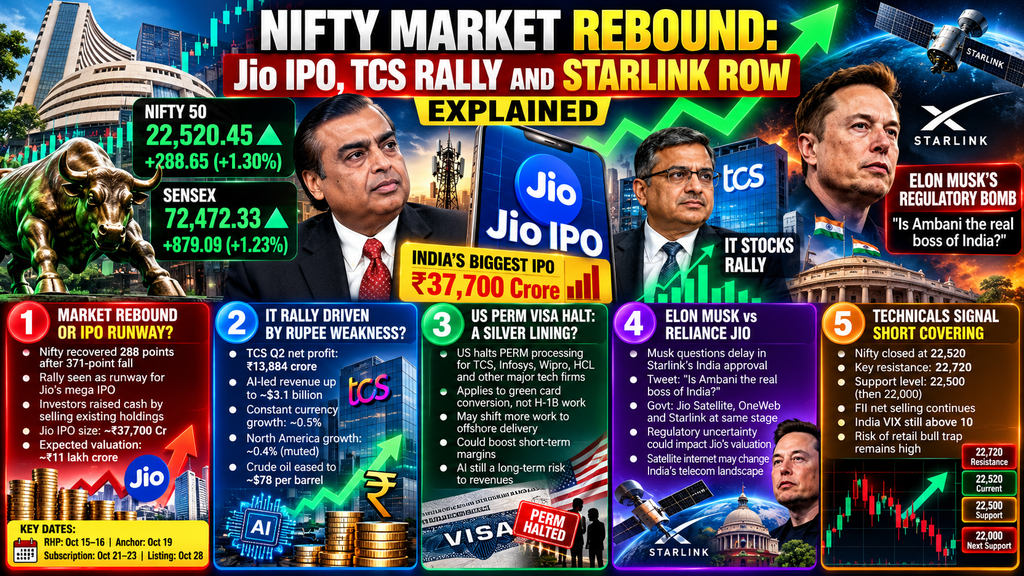
The Indian stock market staged a powerful rebound on October 9, 2026, but questions remain about the rally’s sustainability. The Nifty 50 jumped 288.65 points to close at 22,520.45, while the Sensex gained 879.09 points to finish at 72,472.33. IT stocks rallied, crude oil eased from its recent surge, and investors reassessed the outlook for India’s upcoming Jio Platforms IPO. Yet foreign institutional investors continued selling Indian equities, creating a striking disconnect between index performance and overseas investor flows.
Was this the beginning of a durable recovery, or merely a sharp relief rally after an aggressive sell-off? The answer depends on more than one green trading session. Jio’s IPO valuation, TCS earnings, new US immigration restrictions and the regulatory dispute involving Elon Musk’s Starlink business all offer important clues about the market’s next move.
This analysis examines five counterintuitive takeaways, the latest available figures and the risks investors should monitor.
Market Snapshot: What Happened on October 9, 2026?
| Market indicator | Latest reported figure |
|---|---|
| Nifty 50 closing level | 22,520.45 |
| Nifty 50 daily gain | 288.65 points (+1.30%) |
| Sensex closing level | 72,472.33 |
| Sensex daily gain | 879.09 points (+1.23%) |
| TCS share-price move | +4.71% |
| IT sector performance | Nifty IT +3.02% |
| FII/FPI net selling | Approximately ₹12,944 crore |
| Jio Platforms IPO | Expected to be among India’s largest IPOs |
Market data and IPO details are based on reports available as of October 9, 2026. IPO pricing and dates should be checked against the final prospectus before publication or investment decisions.
1. The Jio IPO Could Reshape Market Liquidity—but There Is No Proof the Rebound Was Engineered
The upcoming Jio Platforms IPO is one of the biggest corporate events on India’s financial calendar. It is expected to attract substantial attention from domestic institutions, global funds and retail investors.
However, the theory that investors deliberately sold existing shares to raise cash for the IPO—or that the broader market was intentionally supported to ensure a successful listing—remains unproven. Market movements alone cannot establish that connection.
Latest Jio Platforms IPO details
According to Reuters reporting on October 9, Jio Platforms is targeting a valuation of approximately US$106 billion, lower than the earlier reported target of around US$131 billion. The company is reported to be considering a price band of ₹1,065–₹1,119 per share and could raise approximately ₹30,213 crore through the offering. This is lower than earlier reports that discussed an IPO of approximately ₹37,700 crore, illustrating why investors should follow the latest disclosures rather than rely on preliminary estimates.
| IPO detail | Latest reported position |
|---|---|
| Company | Jio Platforms Limited |
| Indicative valuation | Approximately US$106 billion |
| Reported price band | ₹1,065–₹1,119 per share |
| Potential issue size | Approximately ₹30,213 crore in latest reporting |
| Expected subscription | October 21–23, 2026 |
| Expected listing | October 28, 2026 |
| Planned use of proceeds | Primarily repayment of borrowings at Reliance Jio Infocomm |
The dates and pricing remain subject to final offer documents and official exchange disclosures. Earlier reports had indicated an issue size of ₹37,700 crore, so investors should not treat that earlier estimate as the final amount.
Why the IPO matters for the broader market
Large IPOs can influence market liquidity in several ways:
- Portfolio rebalancing: Investors may sell existing holdings to fund IPO applications.
- Institutional allocation: Funds may reserve capital for a major offering instead of deploying it immediately into secondary-market stocks.
- Valuation comparisons: Investors may reassess the valuations of listed telecom, digital and technology companies.
- Sentiment and liquidity: A highly anticipated listing can attract attention and trading activity, but it does not guarantee that benchmark indices will rise.
The company’s draft prospectus indicates that up to ₹27,500 crore of proceeds could be used to prepay borrowings at Reliance Jio Infocomm, with the balance intended for general corporate purposes. That is a stated use of proceeds, not evidence that the IPO is responsible for recent market movements.
Investor takeaway: The Jio IPO is a genuine liquidity and valuation event to monitor. But the claim that the market rebound was engineered to support the listing should be treated as speculation unless supported by credible evidence.
2. The IT Rally Has Stronger Earnings Support Than a Simple “Optical Illusion” Suggests
IT stocks helped drive the October 9 rebound. TCS rose 4.71%, while the Nifty IT index gained approximately 3.02%, according to market reports. Yet the rally arrived alongside fresh questions about the pace of technology spending, AI-led productivity and demand in major overseas markets.
TCS’s latest quarterly results provide a useful way to separate genuine operating performance from the impact of currency movements and market sentiment.
TCS Q2 FY2027: Key numbers
Tata Consultancy Services reported results for the quarter ended September 30, 2026, on October 8.
| TCS metric | Reported figure |
|---|---|
| Q2 revenue | US$7.642 billion |
| Revenue growth, year over year in US dollars | 2.4% |
| Revenue growth, quarter over quarter in constant currency | 0.5% |
| Operating margin | 24.0% |
| Net profit | Approximately US$1.45 billion |
| Annualised AI revenue | US$3.1 billion |
| Total contract value of deals | US$9.6 billion |
TCS reported that its annualised AI revenue had crossed US$3.1 billion. It also announced a five-year strategic partnership with Porsche AG and a deal to transition Best Buy’s global capability centre in India into an AI capability centre. These developments point to opportunities in AI and enterprise transformation, even as near-term growth remains moderate.
Why currency movements matter
Indian IT companies earn a substantial portion of their revenue overseas but report results in rupees. A weaker rupee can increase the rupee value of overseas revenue, potentially supporting reported results.
However, currency benefits do not automatically mean that underlying demand is improving. Investors should distinguish between:
- Revenue growth in reported currency.
- Constant-currency growth, which helps assess operating momentum.
- Operating margins and wage costs.
- New contract wins and actual revenue conversion.
- AI revenue growth and its effect on traditional billable services.
TCS reported 0.5% quarter-on-quarter constant-currency growth and a 24% operating margin. That combination suggests positive but measured growth—not proof of a broad-based acceleration in IT spending.
Investor takeaway: The IT rally has a real earnings and AI-investment backdrop. Its sustainability will depend on future demand, margins, deal conversion and whether AI creates enough new revenue to offset pressure on traditional services.
3. The US PERM Suspension Is a Serious Immigration Issue—but Not an Immediate Ban on H-1B Work
On October 8–9, reports emerged that the US Department of Labor had suspended several major technology companies from participating in the Permanent Labor Certification Program, known as PERM. The named firms include TCS, Infosys, Wipro, HCL, Cognizant, Capgemini, Microsoft and Adobe. The department has reportedly stopped accepting new applications and processing pending applications involving these companies while investigations continue.
PERM is typically an important step in an employer-sponsored employment-based green-card process. It is not the same as the H-1B visa programme.
What could be affected?
- Green-card processing: Employees whose cases depend on PERM applications may face delays or uncertainty.
- Workforce planning: Employers may need to reassess immigration support and staffing arrangements.
- Employee retention: Longer waits for permanent residency could influence decisions by some workers and families.
- Compliance costs: Companies may face additional legal, administrative and workforce-management expenses.
Does the suspension improve Indian IT companies’ margins?
Not necessarily.
The argument that a PERM suspension automatically pushes more work offshore—and therefore improves margins—is too simplistic. Companies may adjust staffing, but the outcome depends on client contracts, the availability of skilled workers, local hiring costs, project requirements, and the duration of the restrictions.
The suspension also does not, by itself, establish that existing H-1B work authorisation has been cancelled. Its direct focus is the PERM labour-certification process, although affected employees could face longer-term immigration complications.
Investor takeaway: This is a meaningful regulatory risk for Indian IT firms and their employees. The immediate financial impact on company earnings is uncertain and should be assessed using company disclosures rather than assumed margin benefits.
4. Elon Musk’s Starlink Dispute Creates a Regulatory Wildcard for Jio and Reliance
The Jio IPO story is not just about valuation and telecom subscribers. India’s evolving satellite-communications market has introduced another source of uncertainty.
Elon Musk publicly questioned the delay in regulatory approval for Starlink’s Indian launch, asking on social media: “Is Ambani the real boss of India?” His comments followed claims that powerful domestic interests were obstructing Starlink’s entry. Indian authorities rejected the suggestion that one company was receiving preferential treatment and said operators were at a similar stage of the approval process, with security compliance and spectrum-related matters still to be addressed.
Why this matters for Reliance and Jio
Satellite broadband and traditional mobile networks serve overlapping but different markets. Satellite services could become important for remote areas, enterprise connectivity, disaster response and locations where terrestrial networks are difficult to deploy.
For investors, the relevant questions include:
- How quickly will satellite broadband receive the necessary clearances?
- What spectrum and security conditions will operators need to satisfy?
- Will satellite internet complement existing telecom networks or compete for selected customers?
- How will pricing, coverage and capital expenditure affect the economics of connectivity?
- Could regulatory uncertainty alter long-term expectations for the Indian telecom sector?
The dispute could influence how investors think about competition and the future digital-services landscape. However, public allegations do not establish that Reliance has blocked Starlink or that Jio’s valuation will necessarily be reduced.
Investor takeaway: Regulatory uncertainty is a factor to monitor, but the long-term impact on Jio depends on actual market entry, spectrum policy, competition and commercial performance—not social-media commentary alone.
5. The Nifty Rebound Looks Powerful—but FII Selling Raises Questions About Its Durability
The October 9 rally followed a sharp decline on October 8, when the Nifty lost 371.25 points to close at 22,231.8,0 and the Sensex fell 1,045.46 points to 71,593.24. On October 9, the Nifty recovered 288.65 points to 22,520.45, while the Sensex advanced 879.09 points.
The rebound reclaimed much of the previous session’s losses. But one strong session is not enough to establish a new bullish trend.
The counter-intuitive FII signal
Market reports put foreign institutional investor net selling at approximately ₹12,944 crore on October 9, even as the benchmarks rose. This divergence matters because it shows that the rally did not require foreign investors to become net buyers on the day. Domestic institutions, short-covering activity, stock-specific buying and changes in global conditions can all influence index performance.
But it would be incorrect to conclude from one day’s cash-flow figures alone that the rally was entirely short covering or that institutions were deliberately supporting the market. A proper assessment would require futures and options positioning, cash-market flows, turnover, market breadth and follow-through over subsequent sessions.
Technical levels to watch
The Nifty’s close at 22,520.45 puts the 22,500 area back in focus. This is a useful reference level, but it should not be treated as guaranteed support.
| Level | Why it matters |
|---|---|
| 22,500 | Near-term psychological level to monitor |
| 22,520 | October 9 closing level |
| 22,720 | Potential resistance area to watch if the rebound continues |
| 22,230 | Approximate October 8 closing level, now a recent reference point |
| 22,000 | Psychological downside level if selling returns |
These are indicative chart levels, not predictions. Their significance depends on subsequent price action, trading volume and market breadth.
What would confirm a sustainable recovery?
Investors can monitor the following signals:
- Follow-through: The Nifty holds its gains over multiple sessions rather than reversing immediately.
- Broader participation: Mid-cap and small-cap stocks participate instead of a few heavyweight shares doing most of the work.
- Improving institutional flows: Foreign selling moderates or domestic buying remains strong enough to absorb supply.
- Lower macro pressure: Crude oil, bond yields and the rupee stabilise.
- Earnings confirmation: Corporate results support valuations instead of relying entirely on technical rebounds.
Investor takeaway: The October 9 rally is a meaningful recovery from the previous day’s decline, but its durability remains unconfirmed. Investors should avoid treating one green session as proof that the broader downtrend has ended.
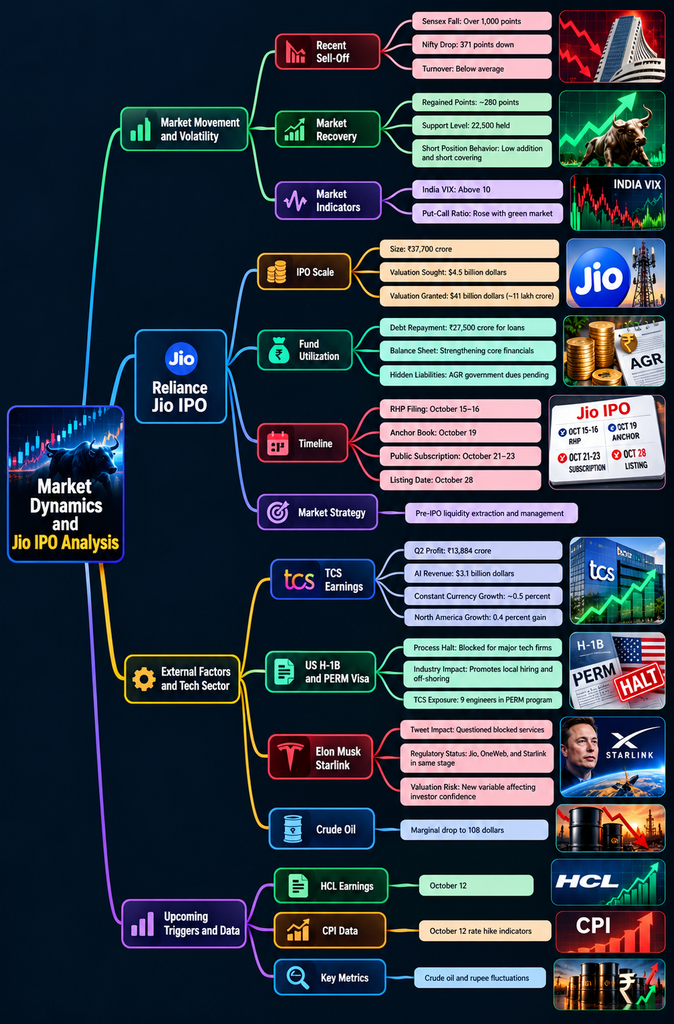
What Should Investors Watch After the Rebound?
The next phase of market direction will likely depend on several overlapping developments.
- Jio Platforms IPO: Final issue size, price band, valuation, subscription data and listing disclosures.
- IT earnings: Revenue growth, margins, AI monetisation and demand across North America and Europe.
- US immigration policy: Further official clarification about the PERM suspension and its implications for affected employers and workers.
- Starlink regulation: Security approvals, spectrum allocation and official decisions affecting satellite broadband.
- Global macroeconomics: Crude oil, US Treasury yields, the rupee and geopolitical developments.
- Market internals: FII/DII flows, derivatives positioning, turnover and advances versus declines.
Investors should not assume that the Jio IPO will necessarily drain secondary-market liquidity or that the market will rise simply because a large listing is approaching. The relationship depends on the offering’s final structure, investor allocations, market conditions and the behaviour of both domestic and foreign capital.
Conclusion: A Relief Rally, Not Yet a Confirmed Bull-Market Reversal
The October 9, 2026, rebound in Indian equities offered relief after the previous session’s sharp sell-off. The Nifty regained the 22,500 area, IT stocks rallied on the back of TCS-led gains, and Jio Platforms’ upcoming IPO remained a major focus for investors.
At the same time, FII selling, moderate constant-currency IT growth, uncertainty around US immigration rules and the Starlink regulatory dispute underline the risks beneath the headline recovery.
The most defensible conclusion is not that the market has been engineered to support an IPO, but that several large events are interacting with an already volatile market. Jio’s listing could reshape capital allocation and valuation discussions, but its success will depend on investor demand, pricing and fundamentals.
For investors, discipline matters more than guessing the motive behind every market move. Track confirmed disclosures, earnings quality, institutional flows and price action before deciding whether the rebound marks a durable recovery or a temporary pause in a wider correction.
Frequently Asked Questions (FAQs)
1. Why did the Nifty rise on October 9, 2026?
The Nifty gained 288.65 points, supported by a rebound in IT and FMCG shares, including a strong rise in TCS, alongside easing crude oil prices and softer global-market pressures.
2. Is the Jio Platforms IPO expected in October 2026?
Reports indicate an expected subscription window of October 21–23 and a possible listing on October 28. Investors should confirm the final dates and price band in the official offer documents.
3. What is the latest reported Jio IPO valuation?
Reuters reported on October 9 that Jio Platforms was targeting a valuation of approximately US$106 billion, below an earlier reported target of around US$131 billion. The final valuation will depend on the confirmed offer price and share count.
4. Does the US PERM suspension cancel H-1B visas?
No. PERM is a labour-certification step associated with certain employment-based green-card applications. A PERM suspension is not, by itself, a blanket cancellation of existing H-1B work authorisation. Affected employees should follow official guidance and consult qualified immigration counsel.
5. Does the market rebound prove that institutional investors are buying?
No. Index gains can occur even when foreign investors are net sellers. Cash-market flows alone cannot determine whether a rally is driven by short covering, domestic buying or broader institutional accumulation.
6. Is 22,500 a guaranteed support level for the Nifty?
No. It is a psychological and technical reference level. Investors should watch whether the index holds above it, how market breadth behaves, es and whether the rally receives follow-through in subsequent sessions.
7. Is the current rebound a good time to buy stocks?
That depends on an investor’s time horizon, valuation, risk tolerance and individual stock fundamentals. A single rebound does not guarantee a sustained recovery. Investors should avoid leveraged trades based solely on a short-term index move.
Disclaimer
This article is for educational and informational purposes only. It is not investment advice or a recommendation to buy or sell any security. Market levels, IPO details,ils and regulatory developments can change. Verify the latest official disclosures before making financial decisions. Investing in equities involves market risk, and readers should consult a qualified financial adviser when necessary.
Top 10 SEO Titles
- Nifty Market Rebound: Jio IPO, TCS Rally and Starlink Row Explained
- Indian Stock Market Outlook 2026: Jio IPO, IT Rally and FII Selling
- Jio Platforms IPO 2026: Valuation, Dates and Impact on the Stock Market
- Nifty Rebound Today: 5 Key Takeaways on Jio IPO and TCS Rally
- TCS Q2 Results 2026: AI Revenue, IT Stocks Rally and Growth Outlook
- Jio IPO vs Market Crash: Is India’s Biggest IPO Changing Investor Sentiment?
- Elon Musk vs Reliance Jio: Starlink Regulatory Dispute Explained
- FII Selling Despite Nifty Recovery: What Indian Investors Should Know
- US PERM Suspension Explained: Impact on TCS, Infosys, Wipro and HCL Tech
- Nifty 50 Forecast 2026: Jio IPO, IT Stocks and Key Market Levels