

Global AI stocks are facing renewed volatility, semiconductor valuations are under pressure, and foreign investors are returning aggressively to Indian equities. Is the world witnessing a major capital rotation from AI-linked technology stocks towards emerging markets like India? Explore the November 2026 market shift, FII inflows, Anthropic’s mega-IPO, US Treasury yields, gold, crude oil and the future of the Indian stock market.
Introduction: The Great Global Asset Shuffle of November 2026
November 2026 has delivered an interesting development across global financial markets.
After months of uncertainty surrounding expensive artificial intelligence valuations, technology-sector capital expenditure and the profitability of AI infrastructure, global investors have started reassessing their portfolio allocations.
At the same time, Indian equities have experienced a remarkable recovery.
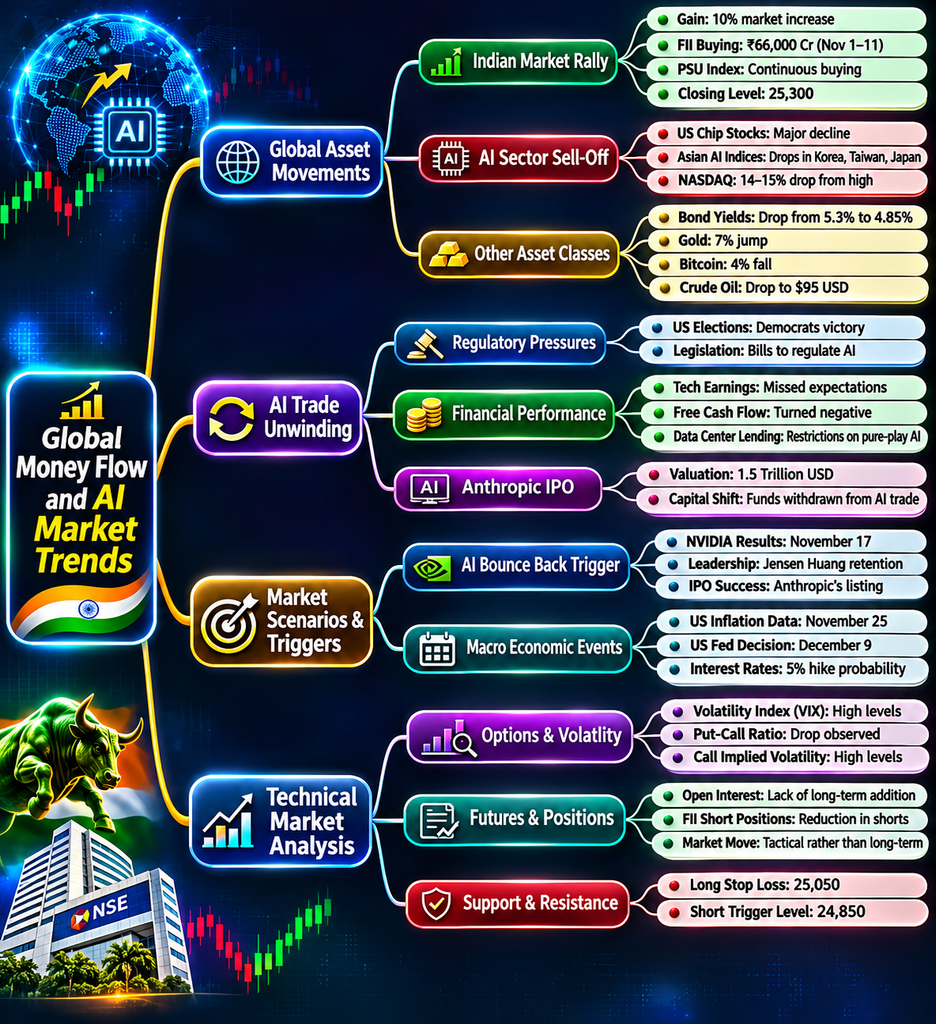
The Nifty 50 reached 25,387.40 on November 17, 2026, its highest closing level since late February. The index gained approximately 10.1% during November, while the Sensex advanced around 10.8%.
One of the most significant drivers has been the return of foreign portfolio investors.
According to Reuters, foreign investors purchased approximately $9.53 billion of Indian equities during November, marking a record monthly inflow. Including debt investments, total foreign portfolio inflows reached approximately $10.33 billion.
This is particularly important because overseas investors had sold approximately $31.41 billion of Indian equities through October 2026.
The reversal raises an important question:
Are global investors reducing their exposure to expensive AI-related investments and increasing allocations to Indian equities?
There are signs of shifting global preferences, but the specific portfolio strategies driving the flows are not publicly disclosed. This article examines market evidence and distinguishes verified developments from possible explanations involving institutional trading.
November 2026 Global Market Snapshot
| Asset / Indicator | November 2026 development |
|---|---|
| Nifty 50 | Closed at 25,387.40 on November 17 |
| Nifty monthly performance | Approximately +10.1% |
| Sensex monthly performance | Approximately +10.8% |
| FPI equity inflows | $9.53 billion |
| Total FPI inflows including debt | $10.33 billion |
| FPI equity selling through October | $31.41 billion |
| Brent crude | Around $93 per barrel on November 17 |
| AI and semiconductor stocks | Experiencing renewed volatility |
| Anthropic IPO | Approximately $1.3 trillion targeted valuation |
Market figures refer to the reported dates and should not be interpreted as live prices.
1. The Unwinding of the ‘Short India, Long AI’ Investment Thesis
For several months, global investors faced an interesting allocation dilemma.
Indian equities offered exposure to financial services, consumption, infrastructure and domestic economic growth. Meanwhile, Asian semiconductor companies and US technology leaders offered direct exposure to the expanding artificial intelligence industry.
A possible institutional strategy was to remain bullish on AI hardware companies while maintaining relatively cautious positions in Indian equities.
This type of positioning can take the form of a relative-value or pair-trading strategy.
How the strategy works
Imagine a hypothetical global hedge fund:
- It purchases shares of semiconductor companies in Taiwan and South Korea.
- It maintains short positions in selected Indian stocks or index futures.
- It expects AI-related companies to outperform Indian equities.
- If the relative performance changes, the fund may close both sides of the trade.
Closing an existing short position requires buying securities.
This buying activity can contribute to an Indian market rally even when investors are not necessarily initiating large new long-term positions.
Short covering versus fresh buying
| Market activity | What happens | Potential market impact |
|---|---|---|
| Short covering | Existing short positions are closed | Creates buying pressure |
| Fresh long build-up | New bullish positions are opened | Can support sustained momentum |
| Long unwinding | Existing bullish positions are closed | Can create selling pressure |
| Short build-up | New bearish positions are opened | Can increase downside pressure |
The important distinction is that a short-covering rally and a long-term investment rally are not the same thing.
The original research suggests that FII short covering contributed to the Indian market’s recovery. However, publicly available aggregate FPI cash-flow figures cannot establish that a specific global ‘Short India, Long AI’ strategy was responsible.
What the actual FPI numbers show
| Indicator | Reported value |
|---|---|
| November equity inflows through November 16 | $9.53 billion |
| Total foreign portfolio inflows | $10.33 billion |
| Equity outflows through October | $31.41 billion |
| November 17 Nifty close | 25,387.40 |
These numbers demonstrate a genuine reversal in foreign equity flows.
Investment lesson: Investors should examine whether foreign buying is accompanied by fresh long positions, improving market breadth and stronger futures premiums. These signals provide more information than headline buying figures alone.
2. The AI Valuation Challenge: Revenue Growth Versus Capital Expenditure
The artificial intelligence industry continues to experience enormous growth.
However, the financial market is increasingly asking a difficult question:
Can AI companies generate enough sustainable cash flow to justify the enormous investments required to build their infrastructure?
AI development requires substantial investment in:
- High-performance GPUs.
- Advanced semiconductor manufacturing.
- Data-centre infrastructure.
- Electricity and cooling systems.
- Cloud computing capacity.
- Networking and memory technology.
- AI model training and inference.
Companies may report impressive revenue growth while simultaneously spending billions on infrastructure.
This creates an important distinction between revenue growth and sustainable profitability.
Why AI infrastructure investment creates financial pressure
A company building an AI data centre must finance equipment, construction, energy infrastructure and long-term computing commitments.
The business may take several years to generate sufficient cash flows from those investments.
For investors, the key financial indicators include:
| Financial metric | Why it matters |
|---|---|
| Revenue growth | Measures customer demand |
| Gross margin | Indicates pricing power and direct service economics |
| Operating margin | Measures operating profitability |
| Free cash flow | Shows cash remaining after capital expenditure |
| Capital expenditure | Indicates infrastructure investment intensity |
| Net debt | Measures financial leverage |
| Return on invested capital | Evaluates the productivity of invested money |
A company with rapidly growing revenue but consistently negative free cash flow may need additional equity or debt financing.
This does not automatically mean that the AI business model is failing. It means investors must evaluate the relationship between growth, investment requirements, and eventual returns.
3. Anthropic’s Mega-IPO: A Major Test for AI Market Valuations
One of the most important developments in the global AI market is the proposed public listing of Anthropic, the company behind Claude AI.
Anthropic was founded in 2021 and has become one of the major competitors in the generative AI industry.
Its proposed IPO could become one of the largest technology listings in financial-market history.
Anthropic IPO: Key reported figures
According to its regulatory filing and Associated Press reporting:
| IPO metric | Reported information |
|---|---|
| Company | Anthropic, PBC |
| Product | Claude AI |
| Founded | 2021 |
| Proposed ticker | ANT |
| Exchange | Nasdaq Global Select Market |
| Shares offered | 825 million |
| Proposed price range | $70–$78 |
| Potential capital raised | More than $61 billion |
| Reported targeted valuation | Approximately $1.3 trillion |
| First-half 2026 revenue | More than $16 billion |
The proposed offering price and valuation remain subject to the final IPO process and market conditions.
Why Anthropic’s IPO matters
Anthropic’s public listing could provide investors with their first direct opportunity to evaluate the market value of a major standalone frontier AI company.
It also creates a benchmark for comparing:
- AI revenue growth.
- Enterprise customer demand.
- Infrastructure expenditure.
- Gross margins.
- Cash-flow generation.
- Long-term profitability.
The liquidity question
A mega-IPO can influence market liquidity because investors may sell existing holdings to finance subscriptions or rebalance portfolios.
However, it would be incorrect to conclude that the Anthropic IPO directly caused global AI selling or Indian FII inflows.
The IPO is one important market event among several. Its direct influence on global asset allocation would require additional evidence.
Investor takeaway: Do not evaluate an AI company only on revenue growth or its IPO valuation. Examine the infrastructure costs, financing structure, profitability and cash-flow outlook.
4. The Flight to Quality: Gold, Government Bonds and Bitcoin
When investors become uncertain about expensive growth stocks, they often reconsider their exposure to different asset classes.
This can create changes in correlations between equities, government bonds, precious metals and cryptocurrencies.
Why US Treasury bonds matter
US Treasury securities are among the most liquid government bond markets globally.
During periods of uncertainty, investors may increase exposure to government bonds.
When bond prices rise, their yields generally fall.
A decline in US Treasury yields can also influence:
- The relative attractiveness of emerging-market equities.
- The US dollar.
- Gold prices.
- Global borrowing costs.
- Technology-stock valuations.
Gold versus Bitcoin
Gold and Bitcoin are sometimes grouped as alternative stores of value. However, their market behaviour can differ substantially.
| Feature | Gold | Bitcoin |
|---|---|---|
| Asset type | Precious metal | Digital asset |
| Historical market role | Traditional safe-haven asset | High-volatility alternative asset |
| Supply | Limited physical resource | Protocol-defined maximum supply |
| Volatility | Generally lower than Bitcoin | Typically significantly higher |
| Institutional use | Reserve and portfolio diversification | Speculative and investment exposure |
The important lesson is that Bitcoin should not automatically be treated as a substitute for gold during every market crisis.
During periods of liquidity stress, investors may sell highly volatile assets to raise cash.
The original draft mentioned a 7% gold rise, a 4% Bitcoin decline and a Treasury-yield fall from 5.30% to 4.85%. These precise movements require matching-date historical price verification and have therefore not been presented as confirmed figures here.
5. The Semiconductor Cold War: Why Chip Sovereignty Matters
Artificial intelligence is not simply a software industry.
Its future depends heavily on semiconductor design, advanced manufacturing, high-bandwidth memory and global computing infrastructure.
Countries increasingly view semiconductor technology as a strategic economic and national-security priority.
The global semiconductor ecosystem
| Company | Main area of importance |
|---|---|
| NVIDIA | AI GPUs and accelerated computing |
| TSMC | Advanced semiconductor manufacturing |
| Samsung Electronics | Memory and semiconductor manufacturing |
| SK Hynix | High-bandwidth memory |
| AMD | CPUs and AI accelerators |
| Broadcom | Networking and custom silicon |
| Micron | Memory and storage technology |
These businesses operate at different stages of the semiconductor value chain.
A disruption in advanced chip manufacturing, export controls, or memory supply can affect the entire AI infrastructure ecosystem.
Why governments are involved
Semiconductors are essential for:
- AI model training.
- Cloud computing.
- Military technology.
- Telecommunications.
- Industrial automation.
- Automotive electronics.
- Consumer electronics.
This creates geopolitical competition around chip manufacturing capabilities, technology transfer,r and supply-chain security.
For investors, semiconductor companies offer exposure to a long-term structural growth theme, but their valuations can also become vulnerable when market expectations become excessive.
6. Behind India’s Rally: Short Covering or Genuine Institutional Accumulation?
The Indian market’s November recovery has been supported by strong foreign investor flows.
However, the sustainability of this rally depends on more than just FPI buying.
Market performance on November 17, 2026
| Indicator | Value |
|---|---|
| Nifty 50 close | 25,387.40 |
| Nifty daily gain | 0.38% |
| Sensex close | 82,532.19 |
| Sensex daily gain | 0.52% |
| Nifty November gain | Approximately 10.1% |
| Sensex November gain | Approximately 10.8% |
| Advancing major sectors | 11 out of 16 |
| Small-cap index movement | -0.2% |
| Mid-cap index movement | Approximately +0.3% |
The market data shows an interesting divergence.
Large-cap indices performed strongly, but small-cap participation remained weaker.
This means investors should not automatically assume that every individual stock or portfolio experienced the same improvement as the benchmark index.
How to identify a sustainable rally
A stronger institutional rally may show the following characteristics:
- Foreign investors continue buying cash equities.
- Futures data shows fresh long positions.
- Futures premiums expand sustainably.
- More sectors participate in the rally.
- Mid-cap and small-cap indices confirm the advance.
- Market breadth improves alongside index performance.
A rally supported mainly by short covering may lose momentum when the existing short positions have been closed.
Derivatives indicators investors should monitor
| Indicator | Bullish interpretation | Warning signal |
|---|---|---|
| FII futures positioning | Fresh long build-up | Only short covering |
| Futures premium | Sustainable expansion | Weak or declining premium |
| India VIX | Controlled volatility | Rising volatility during an advance |
| Put-Call Ratio | Balanced positioning | Sudden deterioration |
| Market breadth | Broad participation | Narrow index leadership |
| Trading volume | Strong participation | Repeated rejection at highs |
No individual derivatives indicator should be used in isolation.
For example, a high India VIX does not independently prove that institutional investors are buying protection. Its interpretation requires options prices, implied volatility, positioning, n,g and market conditions.
7. Indian Market Trading Levels: Risk Management Before Prediction
The original research identified two important technical reference levels:
| Level | Original research reference | Possible interpretation |
|---|---|---|
| Immediate support | 25,050 | Short-term risk reference |
| Structural breakdown | 24,850 | Potential trend deterioration |
These are levels from the supplied research, not independently recalculated live technical levels. Traders should update them using the latest Nifty chart before placing orders.
Three possible market scenarios
Bullish scenario
- Nifty sustains above its recent breakout zone.
- FPI buying continues.
- Banking and other heavyweight sectors participate.
- Fresh long positions increase.
- Market breadth improves.
Consolidation scenario
- Foreign buying slows.
- Index leadership becomes concentrated.
- Stock-specific opportunities continue.
- Market participants wait for new earnings and macroeconomic data.
Bearish scenario
- Nifty breaks important support levels.
- Foreign investors return to selling.
- AI and semiconductor volatility spreads globally.
- US yields and the dollar rise.
- Market breadth deteriorates.
Investors should prepare for all three scenarios rather than attempting to predict one outcome with certainty.
8. Upcoming Global Market Catalysts
The following events deserve attention because they can influence global risk appetite and technology valuations.
| Event | Date / Status | Why it matters |
|---|---|---|
| NVIDIA earnings | November 17, 2026 | AI demand, guidance and semiconductor sentiment |
| US CPI inflation | November 25, 2026 | Federal Reserve policy expectations |
| Federal Reserve decision | December 8–9, 2026 | Global interest-rate outlook |
| Anthropic IPO | Proposed November listing | AI valuation and investor demand |
| Semiconductor export controls | Ongoing policy developments | Global chip supply-chain risk |
The NVIDIA earnings announcement is particularly important because investors are looking for evidence that AI infrastructure spending is translating into sustainable demand.
Revenue growth alone will not be enough. Guidance, margins, supply constraints and customer spending plans will also matter.
9. What Should Indian Investors Do?
The current environment presents both opportunities and risks.
Investors should avoid treating every foreign buying session as a permanent change in market direction.
Long-term investors
- Focus on companies with strong balance sheets.
- Prefer sustainable free cash flow.
- Evaluate return on capital.
- Avoid paying excessive valuations.
- Diversify across sectors and geographies.
Swing traders
- Track Nifty and Bank Nifty market structure.
- Confirm breakouts with volume.
- Monitor FII futures positioning.
- Define stop-loss levels before entering.
- Avoid oversized positions during major global events.
Investors interested in AI stocks
- Separate semiconductor manufacturers from AI software companies.
- Analyse capital expenditure and cash generation.
- Examine customer concentration.
- Track debt and financing commitments.
- Avoid assuming that every AI company will become profitable.
Final Verdict: Is Global Capital Leaving AI and Returning to India?
November 2026 has clearly demonstrated a significant change in international investment flows.
Foreign investors have returned to Indian equities, crude oil prices have eased, and the Nifty 50 has experienced a strong recovery.
At the same time, global technology shares have faced renewed volatility, and investors are paying closer attention to the financial sustainability of AI infrastructure spending.
However, the available evidence does not prove that the entire rally was caused by a single coordinated ‘Short India, Long AI’ trade unwind.
Several forces may be operating together:
- Changing global portfolio allocations.
- Improved foreign investor sentiment towards India.
- Lower crude oil prices.
- Resilient corporate earnings.
- Short covering in Indian derivatives.
- Reassessment of AI-sector valuations.
- Changing expectations around interest rates and liquidity.
The most important lesson is that markets are driven by both fundamentals and positioning.
AI remains a major long-term technological opportunity, while India continues to offer exposure to domestic economic growth. But investors must distinguish between a short-term capital rotation and a sustainable improvement in business fundamentals.
The next few weeks will be important in determining whether the November rally develops into a stronger structural trend or enters a period of consolidation.
Frequently Asked Questions
1. Why are FIIs buying Indian stocks in November 2026?
Foreign investors have purchased approximately $9.53 billion of Indian equities during November, according to Reuters. Lower crude prices, resilient earnings and changing global investment allocations have supported the improvement in sentiment.
2. What is the ‘Short India, Long AI’ strategy?
It is a hypothetical relative-value investment strategy in which a fund buys AI-related technology stocks while maintaining bearish positions in Indian equities. If the strategy is reversed, closing Indian short positions can generate buying pressure.
3. Did ₹66,000 crore of FII buying happen between November 1 and November 11?
The supplied research mentions this amount, but the exact figure and date range could not be independently verified. Reuters reported $9.53 billion of November equity inflows through November 16. These figures should not be treated as interchangeable.
4. What is Anthropic’s proposed IPO valuation?
Associated Press reported a targeted valuation of approximately $1.3 trillion. The proposed offering includes 825 million shares at $70–$78 per share, subject to the IPO process.
5. Why are semiconductor stocks important for AI?
Semiconductors power AI model training, inference, data centres and high-performance computing. Companies involved in GPUs, advanced manufacturing and memory technology are therefore central to the AI ecosystem.
6. Is India’s November rally sustainable?
Its sustainability depends on continued foreign buying, earnings growth, broad market participation and supportive macroeconomic conditions. A rally driven primarily by short covering may be less durable than one supported by fresh long-term investment.
7. Should investors buy Indian stocks after the November rally?
Investors should evaluate individual company valuations, earnings quality and risk exposure. Staggered investing and portfolio diversification can help manage the risk of entering after a sharp market advance.
Disclaimer
This article is for educational and informational purposes only and does not constitute investment advice or a recommendation to buy or sell securities. Market data is time-sensitive and should be independently verified. Investors should consult official exchange disclosures, company filings,s and regulatory announcements before making investment decisions.
Top 10 SEO Titles
- The Great AI Unwinding: How $89.5 Billion in FII Buying Changed India’s Market
- AI Stock Market Crash 2026: Why Global Investors Are Moving Towards India
- FII Buying in November 2026: Is India Benefiting from the Global AI Sell-Off?
- The Great AI Market Rotation: Anthropic IPO, Semiconductor Stocks and Indian Equities
- Indian Stock Market Rally 2026: The Hidden Connection Between AI Stocks and FII Buying
- Anthropic IPO 2026: Is the AI Boom Facing Its Biggest Valuation Test?
- Global Capital Rotation 2026: Why FIIs Are Returning to Indian Stocks
- AI Bubble Warning? Semiconductor Sell-Off, Gold Rally and India’s Stock Market
- Nifty 50 Rally Explained: FII Short Covering or Fresh Institutional Buying?
- AI Unwinding and India’s Bull Run: 7 Global Market Signals Investors Must Watch