
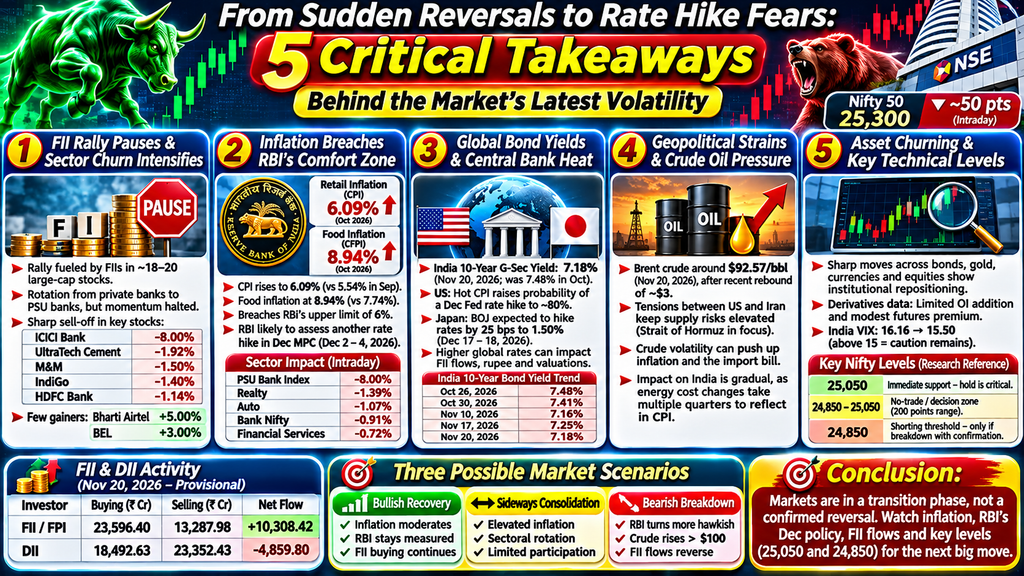
India’s stock market is facing a fresh volatility test as retail inflation rises above the RBI’s 6% tolerance ceiling, bond yields remain elevated, and global central banks reconsider their interest-rate outlook. After a powerful November rally, investors are questioning whether the Nifty 50 is preparing for another recovery or a deeper correction. Here are five important market signals, backed by the latest available data.
Introduction: Is the November Rally Losing Momentum?
After an aggressive market recovery, investors are once again confronting an uncomfortable reality: strong rallies do not eliminate macroeconomic risks.
A sharp intraday sell-off, sector rotation,n and uncertainty surrounding institutional positioning can quickly change market sentiment.
The bigger concern is that India’s October inflation data has delivered an unwelcome surprise. Retail inflation increased to 6.09%, crossing the RBI’s upper tolerance limit of 6%. Food inflation climbed to 8.94%, adding further pressure to household budgets and monetary-policy expectations.
At the same time, global bond markets, crude oil prices and central-bank decisions are creating additional uncertainty.
However, one important distinction must be made: foreign institutional investors have not completely stopped buying Indian equities. Provisional exchange data for November 20 showed substantial net FII buying.
This suggests that the market may be experiencing changing sector preferences and uneven participation rather than a confirmed institutional exit.
Let’s examine five critical developments.
1. FII Buying, Sector Rotation and the First Signs of Market Weakness
One of the most important drivers of the November market rally has been foreign institutional investor participation.
During the recovery, institutional buying appeared concentrated in selected large-cap stocks, particularly financial services and banking companies.
The market also witnessed changing preferences between private-sector banks and public-sector banks.
However, a rally dominated by a limited number of heavyweight stocks can become vulnerable when institutional demand slows.
Latest FII and DII data
The provisional NSE cash-market data for November 20, 2026, showed:
| Investor category | Buying (₹ crore) | Selling (₹ crore) | Net flow |
|---|---|---|---|
| FII / FPI | 23,596.40 | 13,287.98 | +10,308.42 |
| DII | 18,492.63 | 23,352.43 | -4,859.80 |
The data reveals that foreign investors were net buyers while domestic institutions were net sellers on that particular trading day.
This is an important development because it challenges the assumption that FIIs have completely withdrawn their buying support.
However, daily cash-market flows cannot independently establish whether investors are building fresh long-term positions or closing existing short positions.
What investors should monitor
| Indicator | Bullish signal | Warning signal |
|---|---|---|
| FII cash activity | Consistent net buying | Repeated net selling |
| FII futures positioning | Fresh long build-up | Long unwinding |
| Bank Nifty | Strong sector participation | Weakness in heavyweight banks |
| Market breadth | More advancing stocks | Index gains concentrated in a few stocks |
| Trading volume | Strong participation | Weak volume during recovery |
Why market breadth matters
A market index can remain relatively strong even when a large number of individual stocks are declining.
For example, a few heavyweight banking and technology stocks can support the Nifty while mid-cap and small-cap stocks remain under pressure.
Investors should therefore monitor market breadth alongside index performance.
Key takeaway: A sustainable rally requires more than foreign buying. It requires broader participation, earnings support and fresh institutional investment.
2. India’s Retail Inflation Crosses 6%: Why the RBI Faces a Difficult December Decision
The biggest fundamental concern in the current market environment is India’s October 2026 inflation data.
According to the Ministry of Statistics and Programme Implementation, India’s consumer price inflation increased to 6.09% in October 2026, compared with 5.54% in September.
Food inflation increased even more sharply.
India’s latest inflation data
| Inflation indicator | September 2026 | October 2026 |
|---|---|---|
| Combined CPI inflation | 5.54% | 6.09% |
| Food inflation (CFPI) | 7.74% | 8.94% |
| Rural CPI inflation | 6.08% | 6.63% |
| Urban CPI inflation | 4.88% | 5.41% |
October figures are provisional.
The RBI’s inflation target is 4%, with a tolerance band of 2% on either side. Therefore, the upper tolerance limit is 6%.
October’s 6.09% reading has moved marginally above that upper limit.
Which food items are creating pressure?
The official October CPI release highlighted particularly high inflation in several food-related items.
| Item | October 2026 inflation |
|---|---|
| Onion | 116.22% |
| Garlic | 60.74% |
| Ginger | 48.32% |
| Lemon | 47.30% |
| Silver jewellery | 52.39% |
These figures represent year-on-year item-level inflation, not the contribution of each item to the overall CPI rate.
The food inflation increase is particularly significant because food prices directly affect household consumption and inflation expectations.
Will the RBI increase interest rates in December?
The RBI’s next Monetary Policy Committee meeting is scheduled for December 2–4, 2026.
The previous October policy decision increased the repo rate by 25 basis points to 5.50%, with the policy stance changing to calibrated tightening.
This makes the December meeting especially important.
However, an inflation reading above 6% does not automatically guarantee another rate increase.
The RBI will also consider:
- Whether food inflation is persistent.
- Core inflation trends.
- Economic growth.
- Liquidity conditions.
- Global crude oil prices.
- Currency-market stability.
- Inflation expectations.
Which sectors could face pressure?
| Sector | Interest-rate sensitivity | Potential impact |
|---|---|---|
| PSU Banks | Funding costs and bond-market exposure | Higher volatility |
| Private Banks | Deposit costs and credit demand | Margin pressure |
| Realty | Home-loan affordability | Demand sensitivity |
| Auto | Vehicle financing costs | Potential demand pressure |
| Financial Services | Cost of capital | Valuation sensitivity |
Investor takeaway: The RBI’s December decision could become an important market catalyst. Investors should avoid treating a rate hike as certain before the official announcement.
3. Global Bond Yields and Central Banks: Why International Monetary Policy Matters
India’s inflation problem is developing alongside changing global interest-rate expectations.
When major central banks maintain restrictive monetary policies, global investors reassess the attractiveness of equities, government bonds and emerging-market assets.
This can influence capital flows into India.
India’s 10-year government bond yield
The Indian 10-year government bond yield closed at approximately 7.18% on November 20, 2026, according to historical market data.
The yield had moved above 7.4% in late October before easing during November.
| Date | India 10-year bond yield |
|---|---|
| October 26, 2026 | 7.48% |
| October 30, 2026 | 7.41% |
| November 10, 2026 | 7.16% |
| November 17, 2026 | 7.25% |
| November 20, 2026 | 7.18% |
Bond yields and bond prices generally move in opposite directions.
Higher yields can increase borrowing costs and influence equity valuations, particularly for companies whose valuations depend heavily on future earnings.
Japan’s monetary-policy challenge
Japan is also facing inflation and currency-related challenges.
A Reuters poll published on November 19 found that 86% of surveyed economists expected the Bank of Japan to raise its policy rate by 25 basis points to 1.50% at its December 17–18 meeting.
If implemented, this would represent its third rate increase of 2026.
A higher Japanese interest rate can influence global investment strategies, particularly trades that borrow in low-interest-rate currencies to invest in higher-return assets elsewhere.
However, the impact depends on currency movements, investor positioning and the pace of policy changes.
Why global rate expectations matter for Indian equities
| Global development | Possible impact on India |
|---|---|
| Higher US interest rates | Pressure on emerging-market capital flows |
| Higher Japanese interest rates | Potential changes in global carry trades |
| Stronger US dollar | Pressure on the Indian rupee |
| Higher global bond yields | Potential valuation compression |
| Lower global inflation | Could improve risk appetite |
The important point is that global monetary tightening can influence Indian markets even when domestic economic conditions remain relatively stable.
4. Crude Oil and Geopolitical Risks: The Inflation Connection
Crude oil remains one of India’s most important macroeconomic variables.
India imports a substantial portion of its petroleum requirements, making the economy sensitive to international oil prices.
Higher crude prices can increase:
- Fuel and transportation costs.
- Industrial input costs.
- Fertiliser-related expenses.
- Import bills.
- Inflationary pressure.
- Pressure on the current account and currency.
Latest crude oil development
On November 20, 2026, Brent crude settled at approximately $92.57 per barrel.
Although prices recovered slightly during the session, Brent was still heading towards its third consecutive weekly decline.
Geopolitical risks remained elevated because of tensions involving the United States, Israel and Iran, along with renewed concerns about maritime security near the Strait of Hormuz.
The Strait of Hormuz is strategically important because a significant proportion of global oil shipments traditionally passes through this waterway.
Three crude oil scenarios for India
| Scenario | Brent crude assumption | Possible Indian market impact |
|---|---|---|
| Bullish for India | Below $85 | Lower import-cost pressure |
| Neutral | $85–$100 | Manageable but elevated energy costs |
| Bearish for India | Above $100 | Greater inflation and currency risks |
These are illustrative scenario ranges, not price forecasts.
Why crude oil has a delayed inflation impact
A decline in international crude prices does not immediately translate into lower consumer inflation.
The transmission depends on:
- Domestic fuel pricing.
- Government taxes.
- Refining and distribution costs.
- Transportation contracts.
- Industrial input inventories.
- Currency movements.
Therefore, even when crude oil prices begin declining, the effect on the broader economy may take time to become visible.
Key takeaway: Investors should monitor crude oil and the rupee together rather than evaluating either variable in isolation.
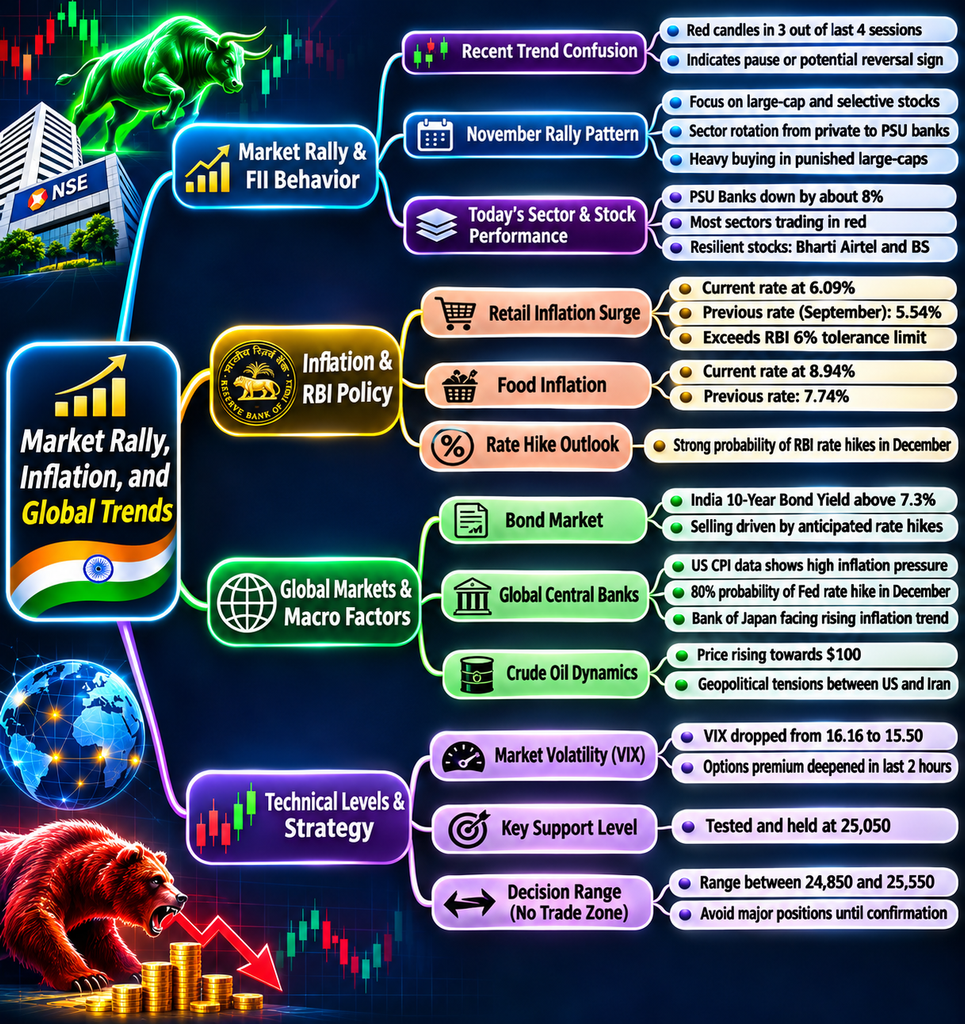
5. Technical Levels, India VIX and Derivatives: How Traders Should Navigate Volatility
The final piece of the market puzzle is technical positioning.
Even when fundamental concerns increase, markets do not necessarily decline in a straight line.
Short covering, institutional rebalancing and options-related activity can create sharp intraday recoveries.
This is why traders should combine technical analysis with derivatives data.
Important Nifty levels from the original market analysis
| Nifty level | Interpretation | Trading consideration |
|---|---|---|
| Above 25,050 | Potential short-term recovery zone | Look for confirmation |
| 25,050 | Immediate support reference | Monitor price action |
| 24,850–25,050 | Decision-making range | Avoid impulsive directional trades |
| Below 24,850 | Potential bearish breakdown | Confirm with volume and positioning |
These are technical levels from the supplied market analysis, not independently recalculated November 21 support and resistance levels.
India VIX: Why volatility matters
India VIX measures the market’s expectation of near-term volatility derived from Nifty options prices.
A higher VIX generally indicates greater expected volatility.
A lower VIX generally indicates relatively calmer options pricing.
However, VIX does not predict market direction.
| India VIX movement | Possible interpretation |
|---|---|
| Rising VIX with falling Nifty | Increasing downside anxiety |
| Falling VIX with rising Nifty | Improving market sentiment |
| Rising VIX with rising Nifty | Uncertain or hedged rally |
| Falling VIX with falling Nifty | Lower expected volatility despite weakness |
The original analysis mentioned a decline in India VIX from 16.16 to 15.50. These values should be checked against the exact trading dates before publication.
Derivatives indicators to watch
1. Open Interest
Increasing futures open interest alongside rising prices can indicate fresh long positions. Falling open interest during a rally may indicate short covering.
2. Futures Premium
A healthy futures premium can indicate stronger bullish demand. A declining premium may suggest weaker conviction.
3. Put-Call Ratio
PCR can provide information about options positioning, but its interpretation depends on whether it is calculated using open interest or trading volume.
4. India VIX
A sudden increase in implied volatility can indicate rising uncertainty and higher option premiums.
5. Market Breadth
A broad advance is generally healthier than a rally supported by a handful of heavyweight stocks.
6. Three Possible Market Scenarios for the Coming Weeks
Instead of predicting one market direction, investors should prepare for multiple outcomes.
Scenario A: Bullish Recovery
Conditions:
- Inflation begins moderating.
- RBI avoids an unexpectedly aggressive policy response.
- FII buying continues.
- Crude oil remains below $100.
- Banking and other heavyweight sectors recover.
Possible market outcome: Nifty attempts to resume its upward trend.
Scenario B: Sideways Consolidation
Conditions:
- Inflation remains elevated.
- Investors wait for the RBI policy announcement.
- FII buying becomes selective.
- Market breadth remains mixed.
- Global bond yields remain volatile.
Possible market outcome: Nifty moves within a broad trading range.
Scenario C: Bearish Breakdown
Conditions:
- Inflation remains above the RBI’s tolerance limit.
- RBI signals further tightening.
- Crude oil rises sharply.
- Global risk appetite deteriorates.
- FII flows reverse into sustained selling.
Possible market outcome: Nifty breaks important support zones and experiences a deeper correction.
7. What Should Investors Do Now?
The current market environment requires a balance between opportunity and capital protection.
For long-term investors
- Focus on businesses with strong balance sheets.
- Avoid companies with excessive debt and weak cash flows.
- Evaluate earnings growth and valuation together.
- Accumulate quality companies in staggered investments.
- Maintain adequate portfolio diversification.
For swing traders
- Avoid entering trades only because the market has fallen.
- Wait for price confirmation around support levels.
- Use predefined stop-losses.
- Monitor FII cash and derivatives positioning.
- Reduce position size during major event risk.
For options traders
- Monitor implied volatility before buying options.
- Understand time decay and expiry risk.
- Avoid oversized positions around RBI and global central-bank announcements.
- Calculate maximum loss before entering a trade.
- Do not interpret a high PCR or low PCR as a standalone trading signal.
Conclusion: Is This a Temporary Correction or a Structural Market Reversal?
India’s market volatility is being influenced by several interconnected factors.
The most important concern is the rise in October retail inflation to 6.09%, accompanied by food inflation of 8.94%.
The RBI’s December 2–4 policy meeting will therefore be closely watched by equity, bond and currency-market participants.
At the same time, global monetary-policy developments, crude oil prices and institutional positioning will influence the direction of Indian equities.
However, the latest provisional FII data shows that foreign investors were still net buyers on November 20. This means that a complete institutional exit has not been established.
The next phase of the market will depend on whether inflation moderates, foreign buying remains consistent and market participation broadens beyond a small group of large-cap stocks.
The most important lesson for investors is simple: do not confuse a temporary market bounce with a confirmed trend reversal, and do not confuse one weak trading session with the beginning of a market crash.
A disciplined investment strategy, sensible position sizing and clear risk management remain essential during periods of uncertainty.
Frequently Asked Questions
1. Why is the Indian stock market volatile in November 2026?
The market is responding to higher retail inflation, changing interest-rate expectations, global bond yields, crude oil movements and institutional positioning.
2. What is India’s October 2026 retail inflation rate?
India’s provisional CPI inflation rate was 6.09% in October 2026, compared with 5.54% in September.
3. What is India’s October 2026 food inflation rate?
Food inflation based on the Consumer Food Price Index was 8.94% in October 2026.
4. When is the RBI’s next monetary policy meeting?
The RBI’s Monetary Policy Committee is scheduled to meet from December 2 to December 4, 2026.
5. Will the RBI increase interest rates in December?
A rate increase is a possibility, but it is not guaranteed. The MPC will consider inflation persistence, growth, liquidity, and the overall economic outlook.
6. What is the current India 10-year government bond yield?
Historical market data showed the yield closing at approximately 7.18% on November 20, 2026.
7. What happens if crude oil rises above $100?
A sustained rise could increase India’s import bill, create inflationary pressure,e and affect the rupee, corporate margins, ins and market sentiment.
8. What are the important Nifty support levels in this analysis?
The supplied technical framework identifies 25,050 as an immediate support reference and 24,850 as a potential bearish breakdown level. These should be revalidated against the latest chart before trading.
Disclaimer
This article is for educational and informational purposes only. It does not constitute investment advice or a recommendation to buy or sell any security, index, derivative or commodity. Market data and technical levels are time-sensitive. Investors should verify official exchange data, RBI announcements, and company disclosures before making investment decisions.
Top 10 SEO Titles
- India Stock Market Volatility 2026: 5 Warning Signals Every Investor Must Watch
- RBI December 2026 Policy: Will Rising Inflation Trigger Another Rate Hike?
- Indian Stock Market Crash Warning? 5 Reasons Behind the Latest Nifty Volatility
- India Inflation Hits 6.09%: What It Means for Nifty 50 and Investors
- FII vs DII November 2026: Are Foreign Investors Changing Their Market Strategy?
- Nifty 50 Prediction 2026: Key Support Levels, Inflation and FII Activity
- Crude Oil, Bond Yields and RBI Rates: 5 Risks Facing India’s Stock Market
- India VIX Above 15: Is the Stock Market Preparing for a Bigger Correction?
- RBI Rate Hike Fears: Which Indian Sectors Could Face the Biggest Pressure?
- Nifty 50 Market Outlook: Temporary Correction or Major Trend Reversal?