
Introduction: When a Record High Turns Into a Market Warning
The Indian stock market delivered a dramatic lesson on November 23, 2026.
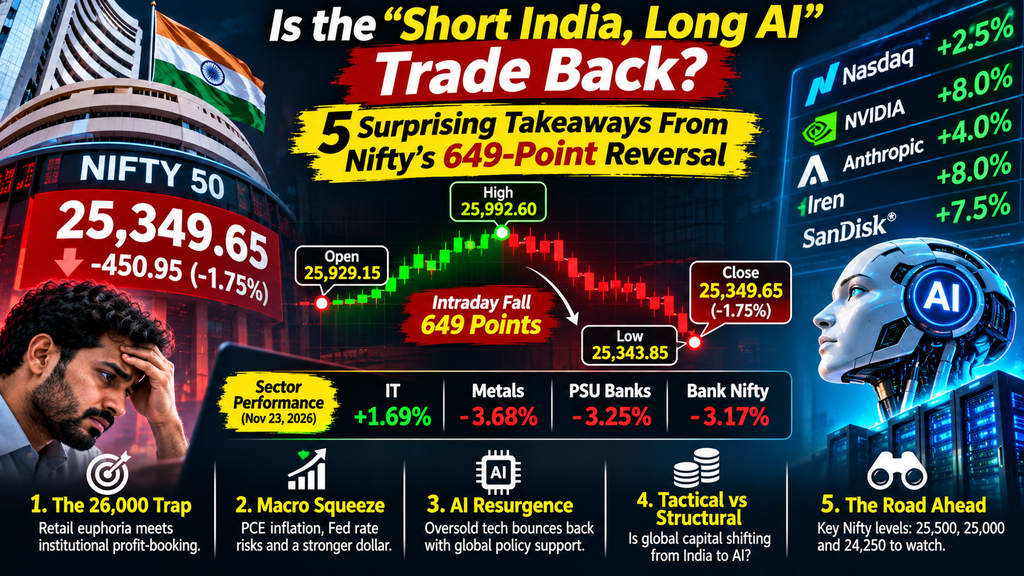
The Nifty 50 opened at 25,929.15 and climbed to an intraday high of 25,992.60, coming remarkably close to the psychological 26,000 milestone.
For a brief period, the market appeared ready to extend its bullish momentum.
Then the situation changed.
Selling pressure accelerated across banking, financial services and metal stocks. The index eventually touched an intraday low of 25,343.85 before closing at 25,349.65.
The numbers tell the story:
- Previous close: 25,800.60.
- Opening level: 25,929.15.
- Intraday high: 25,992.60.
- Intraday low: 25,343.85.
- Closing level: 25,349.65.
- Closing loss: 450.95 points or 1.75%.
The intraday high-to-low decline was approximately 649 points.
The Sensex also declined 1,483.72 points, closing at 82,435.99.
But the most interesting development was not simply the decline in Indian equities.
While banking and metal stocks came under pressure, technology stocks demonstrated relative strength. Meanwhile, global investors were debating whether the massive artificial intelligence investment cycle could generate sufficient returns to justify current valuations.
This raises an important question:
Is the “Short India, Long AI” trade returning, or was November 23 simply a sharp profit-booking session after an extended rally?
Let’s examine five important takeaways.
Nifty 50 Market Snapshot: November 23, 2026
| Market Indicator | Closing Level | Change |
|---|---|---|
| Nifty 50 | 25,349.65 | -1.75% |
| Sensex | 82,435.99 | -1.77% |
| Bank Nifty | 62,585.35 | -3.17% |
| Nifty IT | 31,850.80 | +1.69% |
| Nifty Metal | 11,819.25 | -3.68% |
| Nifty PSU Bank | 9,559.65 | -3.25% |
| India VIX | 17.86 | +3.11% |
The market’s sectoral performance revealed an important divergence.
Technology stocks gained while banking, metals and financial services experienced considerable selling pressure.
This divergence deserves more attention than the headline index decline alone.
1. The 26,000 Trap: Why a Strong Opening Failed to Produce a Strong Closing
At first glance, the Nifty’s opening suggested that bullish momentum remained intact.
However, the index failed to sustain its move towards 26,000.
The rejection was especially important because the market had already experienced a substantial rally over the preceding four weeks.
According to Reuters, the benchmarks remained approximately 10% higher for November despite Monday’s correction.
What Happened Across Different Sectors?
| Sector | November 23 Change |
|---|---|
| Nifty IT | +1.69% |
| Nifty Consumer Durables | +0.59% |
| Nifty Realty | +0.31% |
| Nifty FMCG | -0.46% |
| Nifty Financial Services | -2.49% |
| Nifty Bank | -3.17% |
| Nifty PSU Bank | -3.25% |
| Nifty Metal | -3.68% |
Only 12 Nifty 50 stocks advanced, while 38 declined.
This is an important breadth warning.
The index decline was not simply the result of one or two heavyweight stocks. Selling pressure was concentrated across several economically sensitive sectors.
The Tata Steel–APL Apollo Transaction
One of the biggest corporate developments of the session involved Tata Steel and APL Apollo Tubes.
Tata Steel announced a complex strategic transaction involving:
- Acquisition of approximately 26.38% of APL Apollo for ₹15,510.61 crore.
- An open offer for up to another 26% stake worth approximately ₹16,756 crore.
- Sale of its steel tubes business and entire stake in Tata Steel Colors to APL Apollo for approximately ₹28,000 crore.
The combined transaction value was approximately ₹32,266 crore.
Tata Steel shares declined approximately 8.43%, while APL Apollo fell approximately 21.29%.
The sharp market reaction reflected concerns about transaction financing, potential debt, and the restructuring of the companies’ downstream operations.
This example illustrates why corporate announcements can produce very different market reactions even when the strategic rationale appears attractive.
Key takeaway: A strong opening does not guarantee a strong market. Investors must monitor sector participation, institutional positioning and the ability of major stocks to sustain their gains.
2. The Macro Squeeze: Why the Federal Reserve and US Inflation Matter to Indian Investors
Indian equities do not operate independently of global liquidity conditions.
Changes in US interest-rate expectations can influence:
- Foreign portfolio investment.
- Dollar strength.
- Emerging-market valuations.
- Commodity prices.
- Currency movements.
- Institutional risk appetite.
The December Federal Reserve Meeting
The US Federal Reserve’s December 8–9, 2026 meeting is an important upcoming event.
Investors will be monitoring inflation, employment, and financial conditions to understand the future direction of monetary policy.
However, claims that the Fed has already reached a consensus to raise rates, or that a December hike has a 95% probability, should not be treated as confirmed without a reliable dated market-implied probability source.
The PCE Inflation Indicator
Personal Consumption Expenditures (PCE) inflation is one of the most important measures followed by the Federal Reserve.
The September 2026 BEA release reported:
- Headline PCE inflation: 3.6% year over year.
- Core PCE inflation: 3.1% year over year.
- Monthly headline PCE increase: 0.5%.
The next scheduled release, covering October 2026, is November 25.
This report could influence expectations about the Fed’s December decision.
Why a Strong Dollar Can Pressure Indian Equities
When US yields rise relative to emerging-market returns, international investors may reassess their allocation to emerging markets.
A stronger US dollar can also put pressure on the Indian rupee.
This can create several challenges:
- Foreign investors may demand higher returns to compensate for currency risk.
- Imported commodities become more expensive in rupee terms.
- Companies with foreign-currency liabilities can face additional pressure.
- Valuations of emerging-market equities may become less attractive relative to US assets.
However, dollar strength alone does not guarantee foreign selling.
Investors must examine actual FPI flows, currency movements and earnings expectations together.
3. The AI Resurgence: Why Technology Stocks Recovered While Indian Banks Fell
Perhaps the most interesting part of November 23 was the divergence between Indian equities and global technology markets.
The previous week had been extremely difficult for AI-linked stocks.
Reuters reported that the Nasdaq had suffered approximately a 10% weekly decline, its worst weekly fall since March 2020.
Investors were questioning whether enormous investments in AI data centres would generate enough future revenue and cash flow to justify the associated borrowing and valuations.
The AI Investment Debate
The global AI industry has two opposing forces.
Bullish argument:
- Enterprise AI adoption continues expanding.
- Demand for advanced processors remains substantial.
- Cloud computing infrastructure is growing.
- AI coding tools are changing software development.
- Data-centre construction creates demand for power, cooling and networking.
Bearish argument:
- Data-centre construction requires enormous capital.
- Electricity and infrastructure costs are rising.
- AI companies face substantial competition.
- Future revenue may not justify current investment.
- Borrowing costs can reduce expected returns.
The central investment question is not whether AI will grow.
It is whether AI businesses can generate attractive returns on the capital being deployed.
What Happened on November 23?
Global equity futures rebounded following the previous week’s technology selloff.
Reports indicated that Nasdaq 100 futures advanced approximately 3.5% and S&P 500 futures gained around 2.8% during Monday’s rebound.
Nvidia shares also recovered sharply.
Meanwhile, South Korea prepared to deploy market-stabilisation funds if market conditions deteriorated further, while Taiwan tightened short-selling rules.
These actions demonstrate that governments increasingly consider semiconductor and AI infrastructure strategically important.
Why This Matters for India
India is developing its own AI and data-centre ecosystem.
However, global capital allocation can influence how investors value different opportunities.
For example:
| Global AI Development | Potential Indian Market Impact |
|---|---|
| Semiconductor demand expands | Positive for selected technology supply-chain businesses |
| Data-centre investments accelerate | Potential demand for power and infrastructure |
| AI valuations correct sharply | Pressure on high-valuation technology businesses |
| US restrictions on overseas data centres | Greater uncertainty for offshore infrastructure projects |
| AI spending produces stronger returns | Improved long-term confidence in the sector |
The US administration’s November warning about potentially penalising American companies that construct AI data centres overseas adds another policy risk.
The proposal’s implementation and actual effect remain uncertain.
Key takeaway: The AI investment opportunity is real, but investors should distinguish between companies benefiting from AI spending and companies capable of earning sustainable profits from it.
4. Tactical Rally vs Structural Growth: Is the Long India Trade Being Questioned?
The sharp correction has reopened an important debate about the quality of India’s recent market rally.
Was the market rising because corporate earnings and economic fundamentals were improving?
Or was it benefiting from a temporary reallocation of international capital?
The answer is unlikely to be entirely one or the other.
The Evidence Supporting India’s Market
Reuters reported approximately $13 billion in foreign inflows during November, a record monthly amount.
The market also benefited from improving earnings and economic momentum.
The four-week rally created substantial gains in banks and financial companies before Monday’s correction.
This suggests that India had attracted significant international interest.
The Evidence Supporting Caution
There are nevertheless reasons to remain careful.
1. Valuation sensitivity
After a strong rally, even a modest disappointment in earnings or policy expectations can trigger substantial profit booking.
2. Private capital expenditure
Investors need to monitor whether corporate investment translates into productive capacity, employment and earnings growth.
3. Consumption and employment
Household income growth and employment conditions are important determinants of sustainable domestic demand.
4. Banking exposure
Banks are sensitive to credit quality, loan growth, funding costs and economic conditions.
5. Global competition
Indian technology, manufacturing and infrastructure businesses must compete for capital against rapidly growing global AI supply chains.
Is “Short India, Long AI” Actually Happening?
It is a useful market hypothesis, but it is not yet a proven explanation for the entire correction.
To establish whether the trade is genuinely returning, investors should examine:
- FPI sector-wise holdings.
- Daily FPI cash-market flows.
- Foreign ownership changes in Indian banking and metal stocks.
- Institutional allocations to global semiconductor and AI businesses.
- Relative performance of Nifty IT against Nifty Bank and Nifty Metal.
- Currency and bond-yield movements.
A single day’s divergence between Indian banks and technology stocks is insufficient to establish a structural capital rotation.
Key takeaway: India’s long-term growth story and the global AI opportunity can coexist. A tactical shift in portfolio allocations does not automatically invalidate India’s structural investment case.
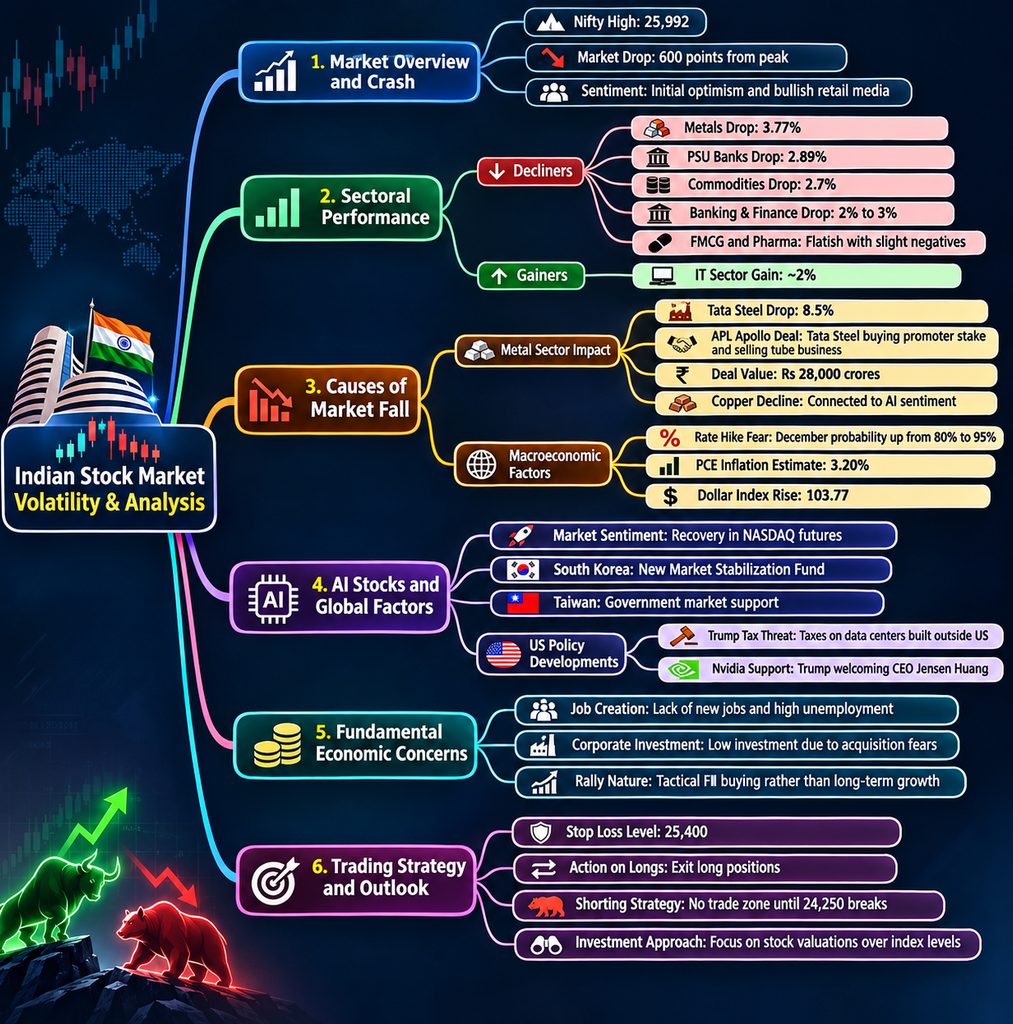
5. Stop Chasing the Index: A More Disciplined Nifty Trading Framework
The November 23 correction demonstrates why traders should avoid chasing the index near important resistance levels.
The Nifty approached 26,000 but failed to sustain the breakout.
The subsequent decline showed how quickly market sentiment can change.
Important Nifty Levels to Monitor
The following levels are based on the supplied market analysis and observed November 23 price action. They are reference zones, not guaranteed support or resistance.
| Level | Technical Interpretation |
|---|---|
| 26,000–26,000+ | Psychological resistance zone |
| 25,800–25,993 | Recent breakout and intraday supply zone |
| 25,400–25,500 | Immediate recovery and decision zone |
| 25,343 | November 23 intraday low, rounded |
| 25,000 | Important psychological support |
| 24,250 | Deeper bearish confirmation level from the original framework |
| 22,000 | Long-term lower boundary of the proposed range |
Bullish Scenario
A bullish recovery becomes more convincing if:
- Nifty reclaims 25,500.
- The index sustains above 25,800.
- Bank Nifty stabilises.
- Market breadth improves.
- Financial and metal stocks begin participating.
A sustained move above 26,000 would provide stronger evidence of a renewed breakout.
Bearish Scenario
The bearish case strengthens if:
- Nifty fails to recover 25,500.
- The November 23 low breaks decisively.
- Bank Nifty continues underperforming.
- Market breadth deteriorates further.
- India VIX rises alongside additional selling.
A move below 25,000 would make the next major support zone increasingly important.
The No-Trade Zone
When the market is moving violently between support and resistance, waiting for confirmation can be more sensible than entering immediately.
Traders should avoid short positions simply because the index has fallen sharply.
Likewise, a gap-up opening should not automatically be treated as a buying opportunity.
Stock-Specific Strategy
Instead of focusing entirely on the Nifty, examine individual companies.
Consider:
- Debt and interest coverage.
- Revenue growth.
- Operating margins.
- Cash-flow generation.
- Return on capital employed.
- Valuation relative to earnings.
- Institutional ownership changes.
A fundamentally strong company can remain attractive even when the broader market corrects. However, valuation and entry price still matter.
What Should Investors Watch Next?
The next few sessions will help determine whether November 23 was a temporary correction or the beginning of a deeper consolidation.
| Date | Event | Market Importance |
|---|---|---|
| November 24 | Indian market holiday | No regular cash-market trading |
| November 25 | US October PCE release | Inflation and Fed expectations |
| December 8–9 | Federal Reserve policy meeting | Global liquidity expectations |
| December | Domestic earnings and macroeconomic updates | Indian corporate fundamentals |
| December 2026 | Global AI and semiconductor earnings updates | Technology investment sentiment |
The most important variables are not simply the dates.
They are the actual data released, the market’s expectations, and how asset prices react.
Conclusion: Is the Short India, Long AI Trade Back?
November 23 was an important reminder that market momentum can reverse rapidly.
Nifty’s decline of 450.95 points, Bank Nifty’s 3.17% correction,n and Nifty Metal’s 3.68% decline demonstrated the vulnerability of sectors that had benefited from the preceding rally.
At the same time, Nifty IT advanced 1.69%, highlighting the sectoral divergence.
However, the available evidence does not establish that foreign investors have abandoned India for AI stocks. Record November foreign inflows and improving domestic earnings momentum provide an important counterargument.
The better interpretation is that investors are becoming more selective.
Capital is increasingly sensitive to valuations, earnings quality, infrastructure spending, global liquidity and the expected returns on AI investments.
For retail investors, the lesson is straightforward:
Do not chase an index simply because it is approaching an all-time high. Do not short a market simply because it has experienced a sharp correction.
Focus on price, valuation, earnings and risk management.
The next major market direction will depend on whether Indian corporate earnings can support valuations while global investors reassess the economics of the AI investment cycle.
The real question is not whether India or AI will win. It is which businesses can generate the strongest sustainable returns on capital.
Frequently Asked Questions
1. Why did Nifty fall on November 23, 2026?
Nifty fell after an extended rally, with profit booking in banking, financial services and metal stocks. Derivatives positioning, the upcoming market holiday and weak global sentiment also contributed.
2. How much did Nifty fall on November 23?
Nifty closed at 25,349.65, down 450.95 points or 1.75%. Its intraday high-to-low decline was approximately 649 points.
3. Why did Nifty IT rise while Bank Nifty fell?
Technology stocks benefited from relative strength in the global technology recovery, while banking stocks faced profit booking after a substantial preceding rally. The two sectors had different market drivers.
4. What is the Short India, Long AI trade?
It describes a hypothetical relative-allocation strategy involving bearish exposure to Indian equities and bullish exposure to global AI and technology businesses. It should not be confused with proof of actual institutional positioning.
5. What are the important Nifty support levels?
The November 23 analysis highlights 25,343–25,400, 25,000 and 24,250 as important reference zones. These levels require confirmation from subsequent price action.
6. Why is the Federal Reserve important for Indian stocks?
Changes in US interest-rate expectations can influence the dollar, global bond yields, foreign portfolio flows and emerging-market valuations.
7. Is this the beginning of a Nifty bear market?
One sharp correction does not establish a bear market. Follow-through selling, deteriorating market breadth, earnings trends and sustained breaks of important support levels should be monitored.
Disclaimer: This article is for educational purposes only and is not a recommendation to buy, sell, long, ll or short any security or derivative. Markets involve substantial risk, and scenario levels are not guaranteed predictions.
Top 10 SEO titles
- Nifty Crash Today: Is the Short India, Long AI Trade Back in 2026?
- Nifty 50 Falls 450 Points: 5 Reasons Behind the November 23 Market Crash
- Short India, Long AI: Why Indian Stocks Fell While Tech Stocks Rebounded
- Nifty 26,000 Rejection: Is a Bigger Stock Market Correction Coming?
- Indian Stock Market Crash 2026: FII Flows, AI Rally and Fed Rate Risks
- Nifty 600-Point Intraday Fall: What Investors Need to Know
- Why Bank Nifty Crashed 3.17% While Nifty IT Gained on November 23
- Nifty Market Outlook 2026: Key Support, Resistance and Trading Strategy
- FII Money Flow: Are Global Investors Moving From India to AI Stocks?
- India vs AI Stocks: 5 Market Signals Every Investor Should Watch