
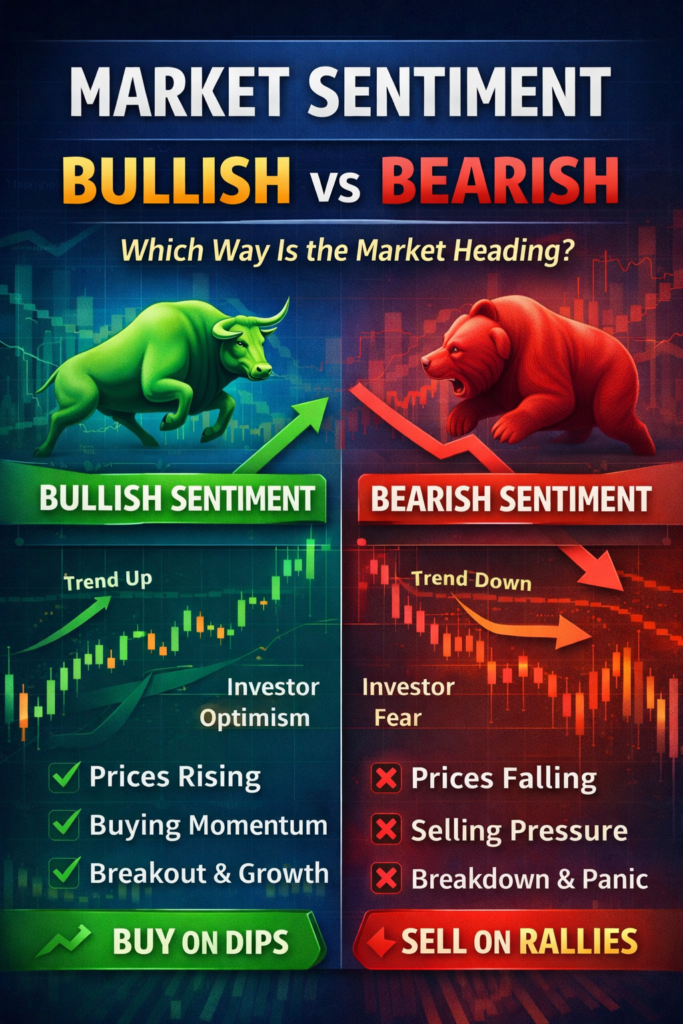
Market sentiment is one of the most important concepts in trading and investing. It reflects the overall mood or psychology of market participants—whether they are optimistic (bullish) or pessimistic (bearish). Understanding market sentiment can help traders make better decisions, manage risk, and improve profitability.
What Is Market Sentiment?
Market sentiment refers to the collective attitude of investors toward a particular market or asset. It is driven by emotions, news, economic data, and price action rather than just fundamentals.
In simple terms:
👉 If most investors expect prices to rise → Bullish Sentiment
👉 If most investors expect prices to fall → Bearish Sentiment
🟢 Bullish Market Sentiment
A bullish market occurs when investors are confident and expect prices to increase. This leads to higher demand and rising stock prices.
Key Characteristics:
- Higher Highs and Higher Lows
- Strong buying volume
- Breakout above resistance levels
- Positive news and earnings growth
Example Scenario:
When companies report strong quarterly results or the economy shows growth, investors start buying aggressively, pushing prices upward.
Trading Strategy in Bullish Market:
- Buy on dips
- Follow the trend
- Focus on growth stocks
- Use trailing stop-loss
🔴 Bearish Market Sentiment
A bearish market occurs when investors expect prices to decline. Selling pressure increases, leading to falling stock prices.
Key Characteristics:
- Lower Highs and Lower Lows
- Breakdown below support levels
- Negative news or economic slowdown
- Panic selling
Example Scenario:
During a recession or global crisis, investors lose confidence and start selling stocks, causing the market to fall.
Trading Strategy in Bearish Market:
- Sell on rise
- Avoid aggressive buying
- Focus on defensive stocks
- Hold cash for opportunities
⚖️ Neutral Market Sentiment (Sideways Market)
Sometimes the market moves in a range without a clear direction. This is called a sideways or neutral market.
Key Characteristics:
- Price moves between support and resistance
- Low volatility
- No clear trend
Strategy:
- Range trading (Buy at support, Sell at resistance)
- Avoid overtrading
Indicators to Identify Market Sentiment
To understand whether the market is bullish or bearish, traders use several indicators:
- Price Action (Trend analysis)
- Volume (Buying vs Selling pressure)
- Moving Averages (50 DMA, 200 DMA)
- VIX (Volatility Index)
- News and macroeconomic data
Why Market Sentiment Matters
Understanding market sentiment helps you:
- Identify the trend early
- Avoid emotional trading
- Manage risk effectively
- Improve entry and exit timing
Conclusion
Market sentiment plays a crucial role in financial markets. Whether bullish or bearish, recognizing the current sentiment allows traders to align their strategies with market conditions.
Golden Rule:
“Trade with the trend, not against it.”