
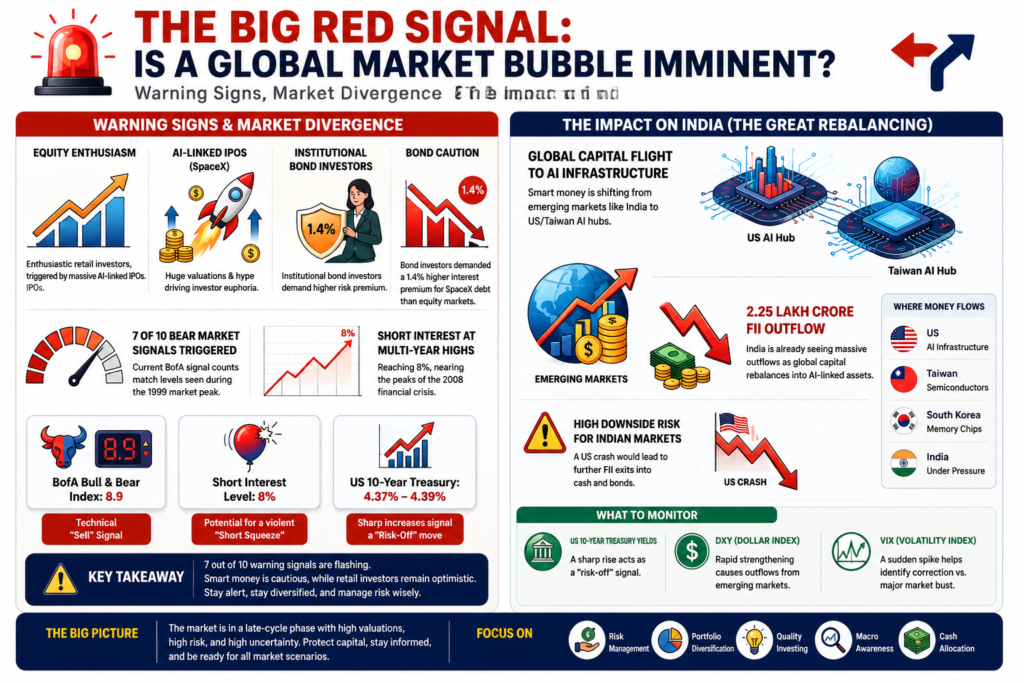
The global stock market is once again celebrating the Artificial Intelligence (AI) revolution. Technology giants continue to dominate headlines, semiconductor companies remain among the world’s most valuable businesses, and investors believe AI will drive the next decade of economic growth.
However, beneath this optimism, institutional investors are becoming increasingly cautious.
Rising US Treasury yields, weakening global liquidity, aggressive capital rotation, record short positions, and slowing corporate earnings are creating conditions that deserve close attention. While retail investors continue chasing momentum, professional money managers are focusing on risk management.
The biggest question for investors is no longer “Will AI grow?”
Instead, it is:
“Has the market already priced in years of future growth?”
Why Institutional Investors Are Becoming More Defensive
Unlike retail investors, institutions don’t simply chase headlines.
They monitor capital flows, bond yields, valuations, liquidity, and macroeconomic trends.
Several recent developments suggest that global markets are entering a more complex phase.
Key concerns include:
- Rising US Treasury yields
- Higher cost of capital
- Expensive AI valuations
- Slowing earnings growth
- Global portfolio rebalancing
- Continued FII selling in emerging markets
This doesn’t necessarily imply an imminent market crash, but it does indicate that risk management is becoming increasingly important.
Global Capital Is Rotating Toward AI Infrastructure
One of the biggest themes in 2026 is the massive investment flowing into AI infrastructure.
Instead of allocating fresh capital equally across global markets, investors are prioritizing:
- AI Data Centers
- Cloud Infrastructure
- Semiconductor Manufacturing
- High-performance Computing
- Power Infrastructure
- AI Networking Equipment
Countries attracting most of these investments include:
| Country | Major Theme |
|---|---|
| USA | AI Infrastructure |
| Taiwan | Semiconductor Manufacturing |
| South Korea | Memory Chips |
| Japan | Robotics & Automation |
| India | Digital Services & Power Infrastructure |
This capital rotation explains why emerging markets sometimes experience FII selling despite healthy domestic fundamentals.
Why Bond Markets Matter More Than Stock Markets
Experienced investors often say:
“Bond investors worry first. Equity investors react later.”
When bond yields rise, borrowing becomes more expensive.
Higher interest rates affect:
- Corporate expansion
- Startup funding
- AI infrastructure spending
- Technology valuations
- Consumer demand
This is why global investors carefully monitor the US 10-Year Treasury Yield.
Historically, sustained increases in yields have often pressured high-growth technology stocks.
AI Stocks Face Higher Expectations Than Ever
The AI revolution remains one of the strongest long-term investment themes.
However, expectations have become extremely high.
Investors are now assuming:
- Continued explosive cloud spending
- Massive GPU demand
- Rapid enterprise AI adoption
- Strong corporate earnings
- Low financing costs
If even one of these assumptions weakens, expensive AI stocks may experience higher volatility.
This doesn’t mean AI is over.
It simply means expectations have become more demanding.
Why India Has Been Relatively Resilient
Unlike many developed markets, India has a different sector composition.
Nifty is dominated by:
- Financial Services
- Banking
- IT Services
- Consumer Businesses
- Industrials
Unlike Nasdaq, India has limited direct exposure to semiconductor manufacturing.
This structural difference has helped Indian markets remain relatively stable during periods of global chip-sector weakness.
What FIIs Are Watching Before Returning
Foreign investors usually evaluate four important factors before increasing exposure.
1. Valuation
Reasonable earnings multiples create a larger margin of safety.
2. Bond Yields
Lower global yields generally improve equity attractiveness.
3. Dollar Strength
A weaker US Dollar often supports emerging markets.
4. Earnings Growth
Consistent corporate earnings remain the strongest long-term driver of stock prices.
📊 Quick Market Snapshot
| Indicator | Current Trend | Market Signal |
|---|---|---|
| FII Flow (India) | ₹2.25 Lakh Cr Outflow | Risk-Off |
| AI Stocks | Expensive Valuation | Caution |
| US 10Y Bond Yield | Above 4.3% | Liquidity Pressure |
| Dollar Index (DXY) | Strong | EM Negative |
| VIX | Low but Vulnerable | Volatility Risk |
| Global Tech | Leadership Narrowing | Bubble Risk |
🌎 Global Capital Rotation
Global Liquidity

        │
        ▼

AI Infrastructure Boom
        │
        ▼

US Mega Tech
SpaceX
OpenAI
NVIDIA
Microsoft
        │
        ▼

Global Capital Flows
        │
        ▼

FII Selling in EM
        │
        ▼

India
Taiwan
Korea
🚀 SpaceX Capital Raise Explained
SpaceX

IPO
$8.6 Billion
      │
      ▼

11 Days Later

Bond Issue
$2.5 Billion
      │
      ▼

Higher Bond Premium
      │
      ▼

Institutional Investors
Demand Higher Risk Premium
📈 Why Bond Markets Matter More
| Equity Investors | Bond Investors |
|---|---|
| Growth Focus | Risk Focus |
| Optimistic | Conservative |
| Momentum | Cash Flow |
| Story | Credit Quality |
When bond yields rise faster than stock valuations, institutional money becomes more cautious.
📉 Bank of America Bear Signals
10 Market Warning Signals

███████□□□

7 / 10 Active

Historically

Higher Warning Signals
        │
        ▼
Higher Market Risk
💰 Why FIIs Continue Selling India
| Reason | Impact |
|---|---|
| Higher US Bond Yield | Negative |
| Strong Dollar | Negative |
| AI Capital Spending | Liquidity Shift |
| Rich Indian Valuations | Selling Pressure |
| Better Developed Market Returns | Capital Rotation |
⚠ Professional Risk Dashboard
| Indicator | Bullish | Bearish |
|---|---|---|
| US 10Y Yield | Below 4.2% | Above 4.4% |
| Dollar Index | Weak | Strong |
| VIX | Below 18 | Above 22 |
| FII Flow | Buying | Selling |
| Nasdaq Breadth | Broad Rally | Narrow Leadership |
📊 Bubble Cycle
Innovation

      │
      ▼

Excitement

      │
      ▼

Massive Capital Flow

      │
      ▼

High Valuation

      │
      ▼

Speculation

      │
      ▼

Reality Check

      │
      ▼

Correction
🌏 Impact on India
US AI Boom
      │
      ▼

Higher US Yields
      │
      ▼

Dollar Strength
      │
      ▼

FII Selling
      │
      ▼

Pressure on Indian Equities
📌 Smart Money Checklist
✅ Watch US Treasury Yields daily.
✅ Monitor Dollar Index (DXY).
✅ Track VIX for volatility spikes.
✅ Observe FII and DII flows.
✅ Focus on earnings quality instead of market hype.
📊 Key Numbers
| Metric | Value |
|---|---|
| India FII Outflow | ₹2.25 Lakh Crore |
| SpaceX IPO (Scenario) | $8.6 Billion |
| Bond Raise (Scenario) | $2.5 Billion |
| Bank of America Bear Signals | 7 / 10 |
| Critical US 10Y Yield Zone | 4.37%–4.39% |
Note: Some figures in your narrative—such as the SpaceX IPO/bond issuance scenario, specific Bank of America signal counts, and projected June 2026 events—appear to be hypothetical or forward-looking rather than established historical facts. If you’re publishing this as an analysis article, clearly label them as scenario analysis, market projections, or illustrative examples to maintain credibility and avoid presenting speculation as confirmed events.
📈 Infographic Layout Suggestion
THE AI BUBBLE WARNING

LEFT PANEL
🌍 Global Capital Rotation
• FII Outflow
• AI Boom
• US Bond Yield
• Dollar Strength

CENTER
🚀 SpaceX
IPO
↓
Bond Issue
↓
Higher Risk Premium
↓
Institutional Warning

RIGHT PANEL
📉 Smart Money Indicators
• US 10Y Yield
• DXY
• VIX
• FII Flow
• Nasdaq Breadth

BOTTOM
✔ Risks
✔ Opportunities
✔ India Impact
✔ Bubble Checklist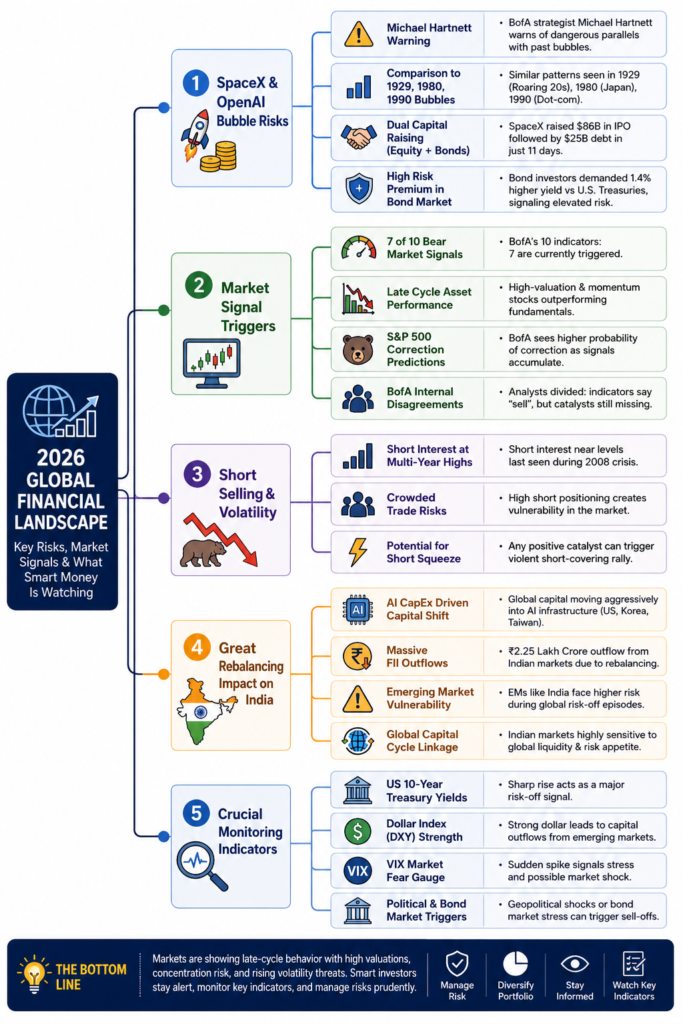
Key Indicators Every Investor Should Track
Rather than reacting to daily news, investors should monitor leading indicators.
| Indicator | Why It Matters |
|---|---|
| US 10-Year Treasury Yield | Measures global financing costs |
| US Dollar Index (DXY) | Influences FII flows |
| India VIX | Indicates market volatility |
| FII/DII Data | Shows institutional positioning |
| Nifty PE Ratio | Helps assess valuations |
| Corporate Earnings | Confirms business fundamentals |
Portfolio Strategy for a High-Uncertainty Market
In uncertain environments, diversification becomes increasingly important.
A balanced portfolio may include:
- Large-cap equities
- Quality mid-cap companies
- Gold ETFs
- Fixed-income investments
- International exposure
- Cash for future opportunities
The focus should remain on companies with:
- Strong cash flow
- Low debt
- High ROE
- Consistent earnings growth
- Competitive advantages
- Reasonable valuations
Risks That Could Influence Markets
Investors should continue monitoring:
- US Federal Reserve policy
- Inflation trends
- Global bond yields
- AI spending by large technology companies
- Semiconductor demand
- Geopolitical developments
- Energy prices
- Corporate earnings seasons
Any combination of these factors could increase short-term market volatility.
Final Thoughts
Artificial Intelligence remains one of the most transformative technologies of this decade. Yet history reminds us that even revolutionary innovations can experience periods of excessive optimism followed by valuation adjustments.
For long-term investors, the objective should not be to predict the exact market top. Instead, it is to build resilient portfolios capable of navigating both bull markets and corrections.
The smartest investors don’t try to time every market move—they prepare for multiple outcomes.
As global capital continues to shift, the most important question is not whether AI will change the future.
It’s whether your portfolio is prepared for the journey.
🔥 SEO Title Ideas (Best)
- AI Bubble Alert: 7 Warning Signs Smart Money Is Watching Before the Next Market Crash
- Is the AI Boom Nearing Its Peak? What SpaceX, Bond Markets & FIIs Reveal
- The Great AI Bubble? Why Smart Money Is Quietly Preparing for a Market Correction
- SpaceX, AI Stocks & the Next Crash: 7 Warning Signals Investors Can’t Ignore
- Global AI Bubble 2026: Why Bond Markets Are Flashing a Serious Warning
- Why Smart Money Is Selling While Retail Investors Keep Buying AI Stocks
- The AI Bubble Explained: Bond Yields, SpaceX & the Global Market Risk
- Is the AI Rally Running Out of Fuel? 7 Red Flags Every Investor Should Know
- The Great Rebalancing: Why Global Money Is Leaving India for AI Infrastructure
- AI Bubble vs Reality: The Hidden Signals Behind Today’s Global Market Rally