
Why Gen Z Is Shaking Global Markets: The Hidden Link Between Youth Unrest and FII Selling
The Invisible Force Moving Global Markets
For decades, investors focused on interest rates, inflation, GDP growth, and corporate earnings to understand market direction. Today, another variable is rapidly becoming impossible to ignore—social stability.
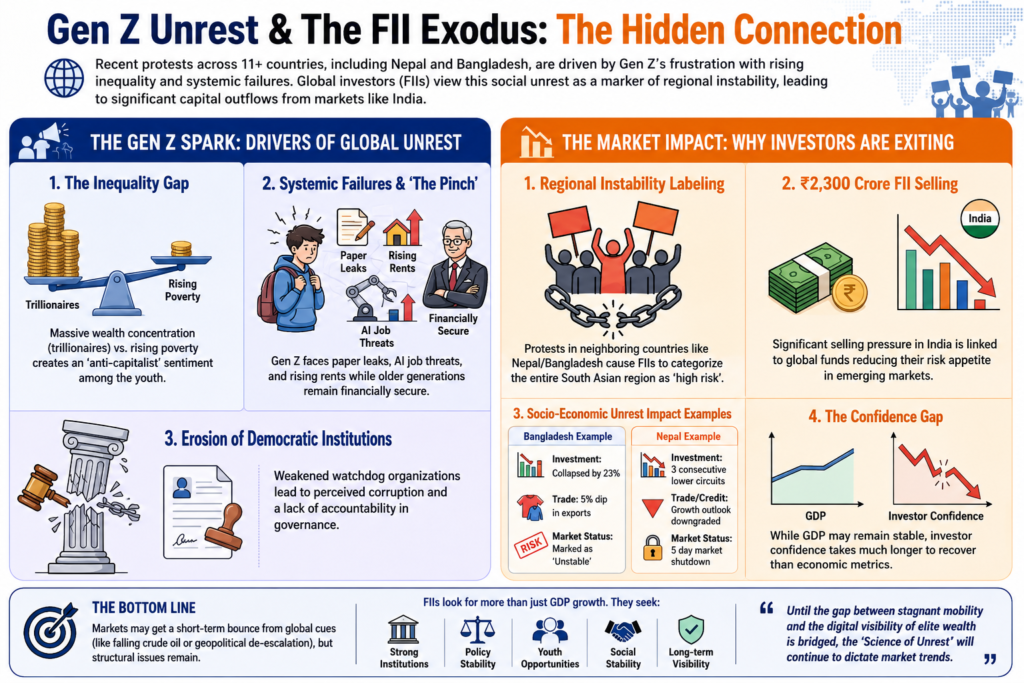
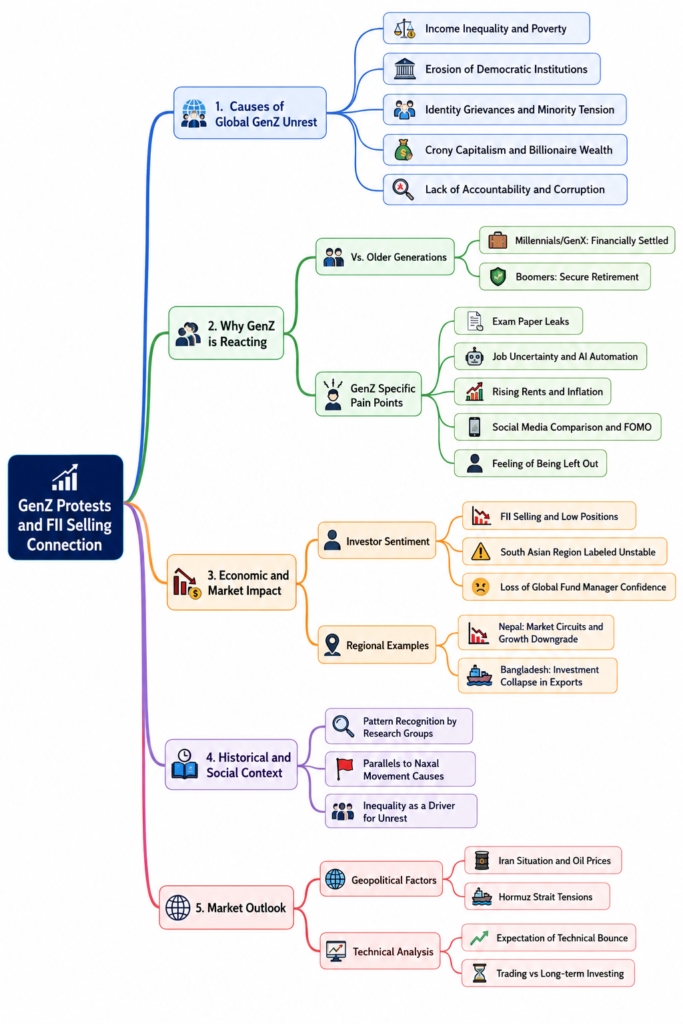
Across Asia, Africa, and Latin America, youth-led protests have emerged as one of the most closely watched indicators of economic risk. What appears to be isolated political unrest often reflects deeper structural issues including unemployment, inequality, housing affordability, and declining economic opportunities.
For global institutional investors, these developments are not merely social events—they represent potential investment risks that can influence capital allocation decisions.
Why Investors Are Watching Youth Unrest
Modern investment firms increasingly incorporate political and social risk into country analysis. Alongside economic indicators, they monitor factors such as:
- Political stability
- Regulatory consistency
- Institutional quality
- Social cohesion
- Labor market conditions
- Demographic pressures
Large financial institutions purchase political-risk research from specialized firms to better understand these dynamics before allocating capital.
Youth unrest becomes particularly significant because younger populations often experience economic stress first through:
- High unemployment
- Underemployment
- Rising education costs
- Housing affordability challenges
- Limited upward mobility
These pressures can eventually affect business confidence, investment activity, and consumer spending.
Why Gen Z Faces Different Economic Challenges
Gen Z entered adulthood during a period marked by several global disruptions:
- COVID-19
- High inflation
- Rapid technological change
- AI-driven workplace transformation
- Rising housing costs
- Increased competition for skilled jobs
Compared with previous generations, many young adults face greater uncertainty about long-term career growth.
This has contributed to growing frustration in numerous countries.
Understanding Relative Deprivation
Economists and sociologists often discuss the concept of relative deprivation.
The theory suggests that dissatisfaction is driven not only by absolute income but also by comparisons with others.
Social media has dramatically increased exposure to displays of wealth and luxury lifestyles.
As a result, income inequality becomes more visible, potentially increasing feelings of exclusion among young people even when overall economic growth remains positive.
Why Social Stability Matters to FIIs
Foreign Institutional Investors (FIIs) generally seek environments that provide:
- Predictable policy
- Stable governance
- Legal certainty
- Consistent economic reforms
- Low political risk
When uncertainty increases, investors may reduce exposure until risks become clearer.
However, FII flows are influenced by many factors simultaneously, including:
- US interest rates
- Dollar strength
- Global liquidity
- Corporate earnings
- Valuations
- Currency movements
- Domestic policy
- Geopolitical developments
Therefore, youth unrest should be viewed as one potential risk factor among many, rather than the sole explanation for investment flows.
Can Regional Instability Affect Neighboring Markets?
Global investors often evaluate countries within broader regional frameworks.
For example, emerging-market funds may allocate capital across multiple countries within South Asia or Southeast Asia.
Political or economic instability in one country can sometimes increase perceived regional risk, although the extent varies depending on:
- Country-specific fundamentals
- Market size
- Economic diversification
- Policy responses
- Global macroeconomic conditions
India, because of its large economy and deep capital markets, is often assessed on its own merits as well as within emerging-market portfolios.
Why Institutions Matter
Strong institutions help improve investor confidence by supporting:
- Rule of law
- Contract enforcement
- Transparency
- Regulatory consistency
- Public accountability
Countries with credible institutions often recover investor confidence more quickly after periods of uncertainty.
Institutional strength remains one of the most important long-term factors influencing investment decisions.
The Economic Cost of Social Unrest
Extended periods of instability can affect economies through:
- Delayed investments
- Lower business confidence
- Reduced tourism
- Supply-chain disruptions
- Higher borrowing costs
- Currency volatility
- Slower job creation
The magnitude of these effects depends on the duration and severity of the unrest and the broader economic environment.
History Shows the Same Pattern
History demonstrates that prolonged economic inequality combined with limited opportunity can contribute to social movements.
While each movement has unique political and historical circumstances, recurring themes often include:
- Youth unemployment
- Regional inequality
- Limited access to opportunity
- Economic exclusion
Digital technology has changed how movements organize and communicate, but underlying economic frustrations remain an important factor in many cases.
What Should Investors Watch?
Rather than focusing on headlines alone, long-term investors should monitor:
Economic Indicators
- Employment growth
- Wage growth
- Inflation
- GDP expansion
Market Indicators
- FII flows
- DII participation
- Currency stability
- Bond yields
Structural Indicators
- Governance reforms
- Ease of doing business
- Infrastructure investment
- Education quality
- Job creation
Social Indicators
- Youth employment
- Consumer confidence
- Public trust in institutions
- Social stability
The Bottom Line
Global markets increasingly reflect more than corporate earnings and central bank policy.
Demographics, social cohesion, institutional quality, and long-term economic opportunity are becoming important considerations for investors evaluating country risk.
At the same time, investment decisions are rarely driven by a single factor. FII inflows and outflows result from a combination of domestic fundamentals, global financial conditions, valuation, geopolitical developments, and investor sentiment.
Understanding these broader structural forces can help investors build a more balanced perspective on emerging markets and long-term capital flows.
Frequently Asked Questions (FAQ)
Why is Gen Z important for global markets?
Gen Z represents a large share of the future workforce and consumer base. Employment, education, and income trends within this generation can influence long-term economic growth and investor confidence.
Does youth unrest always lead to FII selling?
No. Social unrest is only one of several factors investors consider. Monetary policy, valuations, global risk appetite, corporate earnings, currency movements, and geopolitical developments also play major roles.
Why do institutional investors monitor political stability?
Political stability helps reduce uncertainty, making long-term investment planning more predictable and improving confidence in future economic performance.
Is India affected by regional instability?
Regional developments can influence investor sentiment, but India’s investment outlook is also shaped by its own economic fundamentals, policy environment, market size, and corporate performance.
Alternative SEO Titles
- How Gen Z Protests Are Driving FII Selling and Reshaping Global Markets
- Gen Z Youth Unrest Explained: Why Foreign Investors Are Pulling Money from Emerging Markets
- The Hidden Connection Between Gen Z Protests, FII Selling, and Global Market Volatility
- Why Global Investors Fear Gen Z Unrest More Than Inflation
- Gen Z Economic Crisis: The Real Reason Behind FII Selling in Emerging Markets
- Youth Unrest and Stock Markets: How Gen Z Is Influencing Global Capital Flows
- Why FIIs Are Selling: The Growing Impact of Gen Z Protests on Emerging Markets
- From Youth Protests to Market Panic: How Gen Z Is Changing Global Investing
- The Science of Youth Unrest: Why Global Investors Are Watching Gen Z Closely
- Gen Z vs Global Markets: The Economic Crisis Investors Can’t Ignore