
The Market Bounce: Relief Rally or a Strategic Trap Before July 29?
Is This Stock Market Rally Real or Just Another Bull Trap?
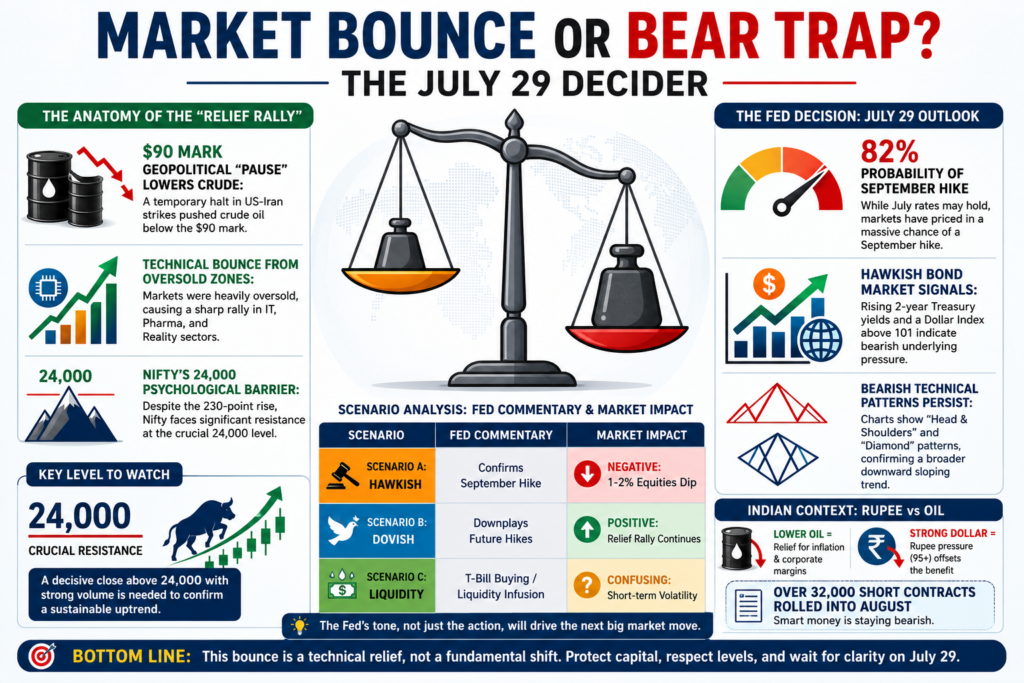
After several painful trading sessions, global equity markets have staged an impressive recovery. India’s Sensex jumped more than 700 points, while the Nifty reclaimed the psychologically important 24,000 level.
For many investors, this appears to be the beginning of another bullish phase. However, experienced market participants know that powerful rallies during bear markets are often the most dangerous.
The critical question is simple:
Is this the beginning of a sustainable uptrend, or merely a relief rally before another decline?
The answer may arrive after the Federal Reserve’s July 29 policy decision.
Why the Market Suddenly Rebounded
The recent recovery wasn’t entirely unexpected.
Several technical indicators suggested the market had reached extremely oversold conditions.
Most notably:
- Put-Call Ratio (PCR) near 0.80
- Heavy short positioning
- Extreme bearish sentiment
- Oversold momentum indicators
Historically, these conditions often trigger sharp short-covering rallies.
However, one important warning sign remains:
Trading volumes have been relatively weak.
When markets rise without strong institutional participation, the sustainability of the rally becomes questionable.
US-Iran Tensions: Temporary Calm or Strategic Pause?
One of the biggest catalysts behind the recent rally has been the apparent reduction in military tensions between the United States and Iran.
Markets welcomed reports suggesting both sides had temporarily paused direct military escalation.
But investors should understand the difference between:
- Tactical pause
- Permanent peace agreement
Currently, there is no comprehensive diplomatic settlement.
Without a formal agreement, geopolitical risks remain elevated.
Any renewed conflict could immediately push energy prices higher and reverse market sentiment.
Strait of Hormuz Still Remains a Global Risk
Although crude oil prices cooled briefly, shipping activity around the Strait of Hormuz remains closely monitored by global investors.
This region transports a significant share of the world’s oil supply.
Any disruption can rapidly affect:
- Oil prices
- Inflation
- Shipping costs
- Global economic growth
For emerging markets like India, rising crude prices typically increase inflationary pressure and weaken corporate profitability.
Why the July Fed Meeting Matters So Much
The July Federal Reserve meeting has become one of the most anticipated policy events of the year.
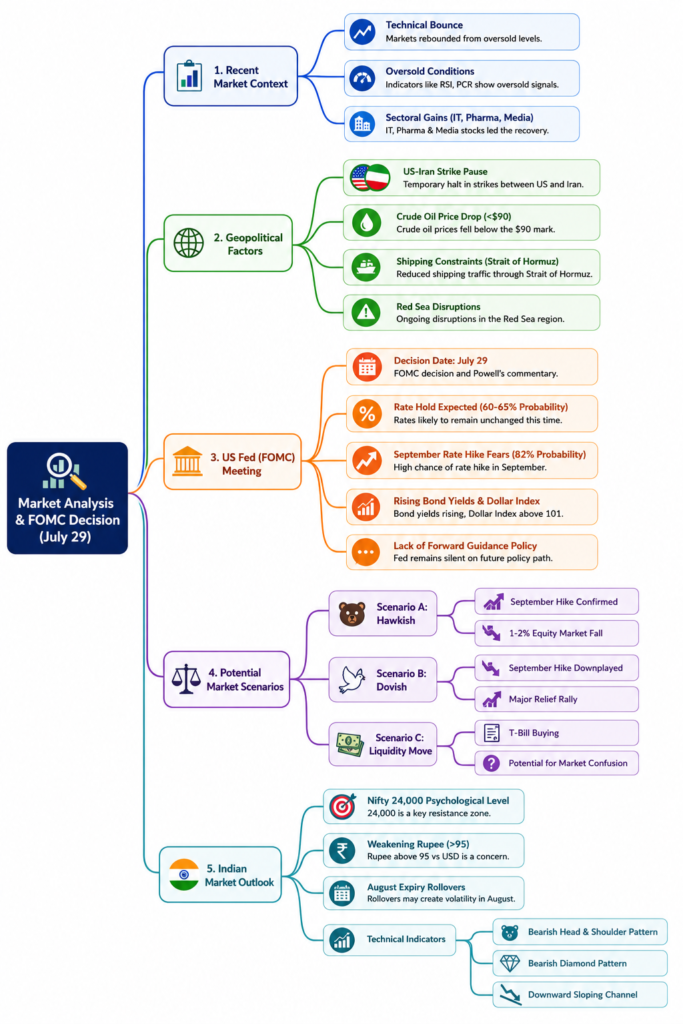
Markets generally expect interest rates to remain unchanged.
However, investors are far more interested in:
- Future inflation outlook
- Economic projections
- Policy guidance
- Comments regarding future rate decisions
Even if rates remain unchanged, a hawkish tone could significantly impact global financial markets.
Bond Markets Are Sending a Different Message
One interesting feature of the current rally is the disagreement between stocks and bonds.
While equities have rallied strongly:
- Treasury yields remain elevated
- The US Dollar remains firm
- Bond investors continue pricing tighter financial conditions
Historically, sustained market rallies become more challenging when bond yields continue rising.
This divergence deserves careful attention.
Why Nifty 24,000 Is the Most Important Level
From a technical perspective, Nifty 24,000 has become an important psychological and chart resistance.
If the index:
Closes decisively above 24,000 with strong volume
The probability of extending the rally increases.
Fails near 24,000
The recent recovery could simply become another bear market rally.
Volume confirmation will be just as important as price.
Indian Markets Face a Double Challenge
India currently faces two opposing forces.
Positive
- Lower oil prices reduce inflation pressure.
- Better corporate margins.
- Improved macro stability.
Negative
- Strong US Dollar.
- Pressure on the Indian Rupee.
- Potential FII outflows.
- Higher imported inflation if oil rebounds.
The balance between these factors will likely determine market direction during the coming weeks.
What Investors Should Watch Next
Instead of reacting emotionally to every rally, investors should monitor several key indicators:
- Federal Reserve commentary
- US Treasury yields
- Dollar Index (DXY)
- Brent Crude Oil
- India VIX
- FII and DII activity
- Nifty’s behavior around 24,000
- Global geopolitical developments
These indicators often provide better clues than daily price movements alone.
Investment Strategy During Uncertain Markets
During periods of elevated uncertainty:
- Avoid chasing sharp rallies.
- Maintain disciplined position sizing.
- Focus on quality businesses.
- Respect stop-loss levels.
- Wait for confirmation before assuming a new bull market has begun.
Capital preservation remains more valuable than chasing short-term momentum.
Final Thoughts
The recent market recovery has certainly improved investor sentiment, but several macroeconomic and geopolitical risks remain unresolved.
While oversold technical conditions justified a bounce, confirmation of a sustainable bull trend will require stronger participation, improving macro data, and greater policy clarity.
Until then, investors should remain disciplined, monitor key global indicators, and avoid confusing temporary optimism with a lasting change in market direction.
Whether this rally becomes the foundation of a new uptrend—or another classic bull trap—will depend on how markets respond to upcoming policy decisions and global developments.
FAQ
Is the current stock market rally a bull trap?
It may be. Strong technical rebounds often occur during broader market corrections. Confirmation requires sustained buying and higher trading volumes.
Why is the July Fed meeting important?
Investors are focused on the Federal Reserve’s outlook for inflation and future interest rates, which can influence global equity markets.
Why is Nifty 24,000 significant?
It is an important technical resistance level. A decisive breakout above it could improve bullish momentum, while repeated rejection may signal continued weakness.
How do oil prices affect Indian markets?
Lower oil prices generally reduce inflation and improve corporate margins, while higher oil prices can pressure the economy and weaken market sentiment.
Yahan high-CTR
- Market Bounce or Bull Trap? Why July 29 Could Decide the Next Big Stock Market Move ⭐ (Recommended)
- Relief Rally or Bull Trap? Complete Nifty & Global Market Analysis Before July 29
- Is the Stock Market Rally Fake? Why Investors Should Watch July 29 Closely
- Nifty at 24,000: Relief Rally or Strategic Trap? Expert Market Outlook
- Why This Market Bounce May Be a Bull Trap Before the Fed’s July Decision
- Stock Market Rally Explained: Fed, Oil, Iran & Nifty 24,000 Analysis
- The Truth Behind the Market Bounce: Relief Rally or Bigger Crash Ahead?
- Nifty 24,000 Analysis: Should Investors Buy the Rally or Stay Cautious?
- Global Market Bounce: Is This the Start of a Bull Market or a Dead Cat Bounce?
- Fed, Oil & Nifty: Why the Current Stock Market Rally Could Be a Strategic Trap