
China’s Chip Breakthrough Sparks Global Market Sell-Off: What Every Investor Needs to Know
Introduction
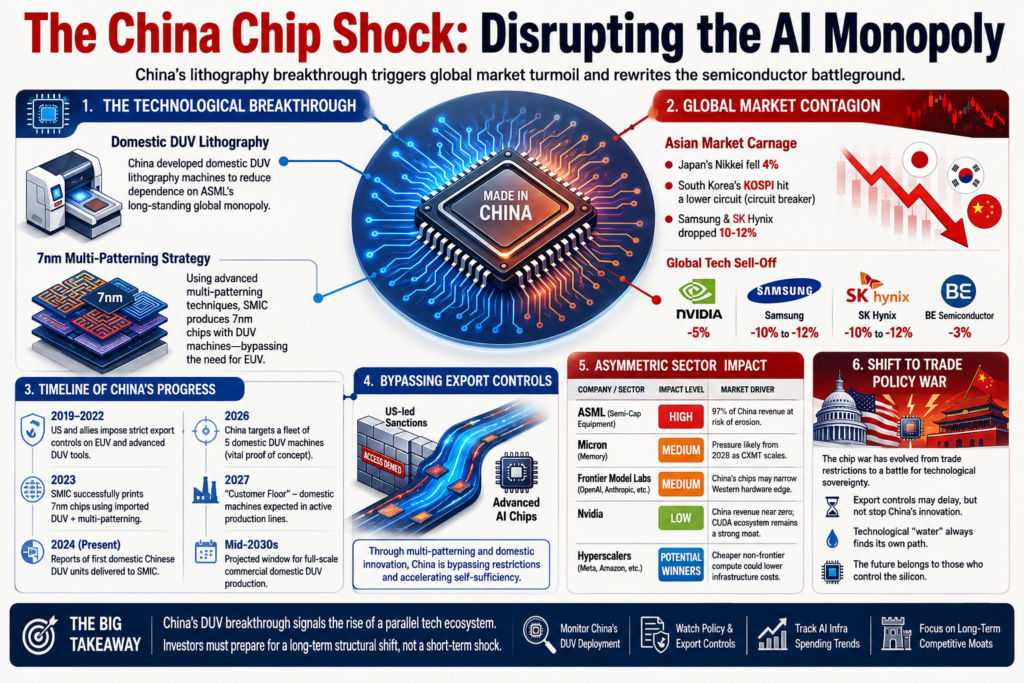
Global markets were expecting stability after easing geopolitical tensions in the Middle East. Instead, investors woke up to an entirely different shock—China’s reported breakthrough in semiconductor lithography.
The announcement triggered heavy selling across technology stocks worldwide. The Nasdaq declined sharply, Japan’s Nikkei suffered one of its biggest daily drops, South Korean semiconductor giants came under intense pressure, and AI-related stocks experienced widespread profit booking.
The reason wasn’t another interest rate decision or geopolitical conflict.
It was silicon.
China’s progress toward domestic semiconductor manufacturing represents one of the biggest strategic developments in the global technology race, with implications that could reshape artificial intelligence, semiconductor supply chains, and global investment trends over the next decade.
China’s DUV Lithography Breakthrough Explained
Lithography machines are the most critical equipment in semiconductor manufacturing.
Often described as the “printing presses” of the digital economy, these machines project microscopic circuit patterns onto silicon wafers to create computer chips.
For years, the Dutch company ASML has dominated this industry, supplying the overwhelming majority of advanced lithography systems worldwide.
China’s latest announcement suggests that domestic manufacturers have successfully developed indigenous DUV (Deep Ultraviolet) lithography systems capable of supporting advanced semiconductor production without relying entirely on foreign suppliers.
While these systems remain less advanced than EUV technology, they represent a major strategic milestone in China’s pursuit of semiconductor independence.
Why Markets Reacted So Aggressively
The market reaction wasn’t driven by today’s production numbers.
It was driven by tomorrow’s competitive landscape.
Investors suddenly had to consider the possibility that Western export restrictions may no longer permanently limit China’s semiconductor ambitions.
If China successfully scales domestic lithography production, Western equipment manufacturers could gradually lose one of their largest long-term markets.
That possibility alone was enough to trigger broad selling across semiconductor stocks.
How China Is Producing Advanced Chips Without EUV
One of the most fascinating aspects of China’s semiconductor strategy is the use of Multi-Patterning.
Instead of relying exclusively on cutting-edge EUV machines, Chinese manufacturers have optimized existing DUV technology by exposing silicon wafers multiple times with extraordinary precision.
This approach allows the production of advanced process nodes that were previously believed impossible without EUV equipment.
Although the process is slower, more expensive, and technically demanding, it demonstrates that engineering innovation can sometimes compensate for hardware limitations.
Timeline of China’s Semiconductor Progress
2019–2022
Western governments imposed strict export controls restricting China’s access to advanced lithography equipment.
2023
Chinese foundry SMIC demonstrated production of advanced 7nm chips using DUV multi-patterning.
2024
Reports indicated deliveries of China’s first domestically developed DUV lithography systems.
2026
China aims to expand domestic lithography deployment with multiple production-ready systems.
2027
Commercial integration into active semiconductor manufacturing lines is expected.
Early 2030s
Large-scale domestic production could significantly reduce dependence on foreign equipment suppliers.
Global Market Impact
Technology-focused markets reacted immediately.
Major semiconductor companies experienced sharp declines as investors reassessed long-term competitive dynamics.
Key developments included:
- Nasdaq technology stocks declined sharply.
- Japan’s Nikkei recorded a major one-day loss.
- South Korea’s semiconductor sector suffered intense selling pressure.
- Nvidia experienced notable weakness.
- Semiconductor equipment manufacturers underperformed the broader market.
Rather than reacting to immediate earnings changes, investors were pricing in structural shifts that could reshape the semiconductor industry over the coming decade.
Who Faces the Biggest Risk?
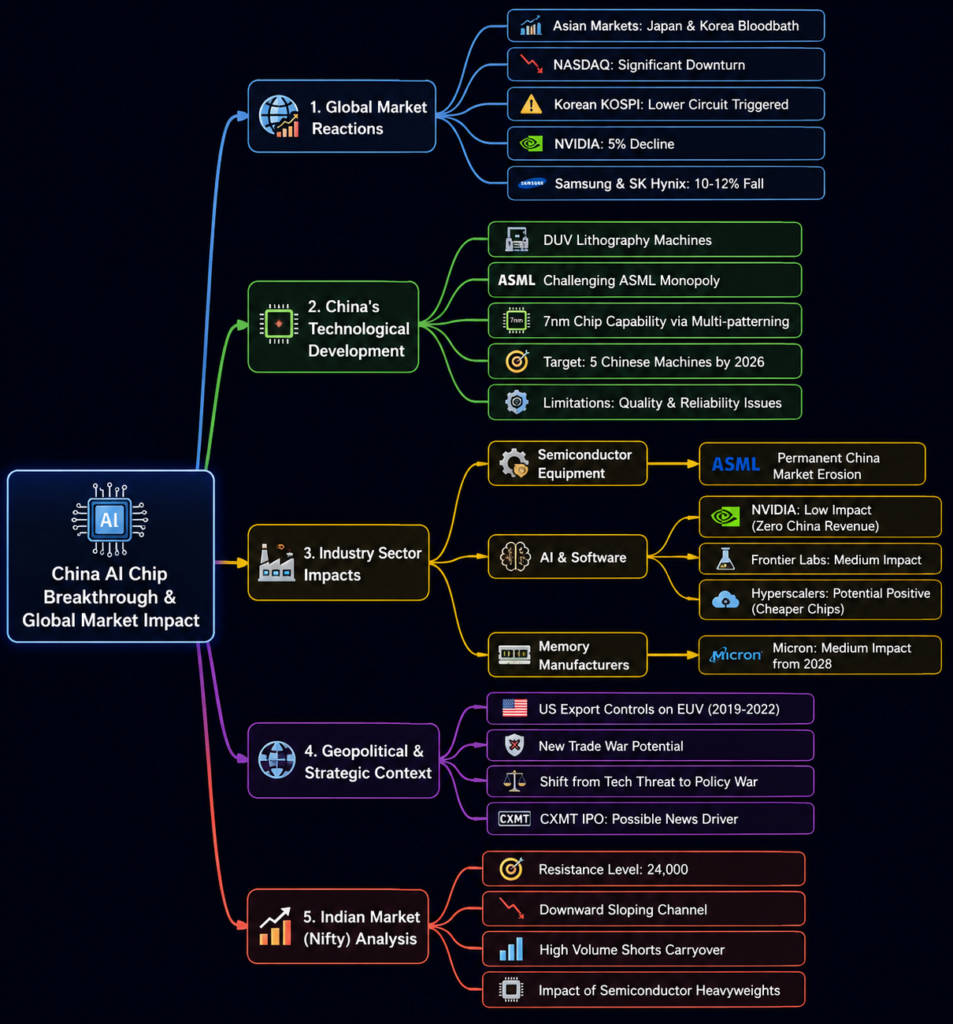
ASML
The greatest long-term pressure falls on lithography equipment manufacturers.
If China increasingly adopts domestic equipment, foreign suppliers could permanently lose a significant portion of future demand.
Semiconductor Equipment Companies
Businesses dependent on Chinese capital expenditure may face slower long-term growth as domestic alternatives mature.
Memory Manufacturers
Companies competing directly with Chinese memory producers may encounter stronger pricing competition later this decade as China’s manufacturing capacity expands.
Why Nvidia May Still Be Protected
Despite market volatility, Nvidia retains several powerful competitive advantages.
Its CUDA software ecosystem remains deeply integrated into AI development worldwide.
Developers, enterprises, and research institutions have invested years building applications around Nvidia’s architecture.
Even if Chinese chips become increasingly competitive on hardware costs, replicating Nvidia’s software ecosystem will take considerably longer.
For this reason, many analysts believe Nvidia’s greatest competitive moat is no longer hardware—it is software.
Is This a Genuine Technological Revolution?
The answer is nuanced.
China’s breakthrough is unquestionably significant.
However, independent verification of manufacturing efficiency, yield rates, throughput, reliability, and production scalability remains limited.
Current domestic machines are widely believed to trail leading Western systems in several important performance metrics.
Markets often react to future expectations long before those expectations become operational reality.
What Investors Should Watch
Over the next few years, investors should closely monitor:
- Commercial deployment of Chinese DUV systems
- Production yields from domestic fabrication plants
- Future U.S. export control policies
- Progress toward indigenous EUV development
- AI infrastructure spending trends
- Semiconductor capital expenditure globally
- Competitive positioning of Nvidia, ASML, TSMC, Samsung, and SMIC
Final Thoughts
The semiconductor industry has entered a new strategic era.
What began as a trade dispute has evolved into a global contest for technological sovereignty.
China’s progress in lithography suggests that export restrictions may delay innovation—but they may not prevent it entirely.
For investors, this means semiconductor analysis must extend beyond quarterly earnings.
Policy decisions, supply chain resilience, technological independence, and geopolitical strategy are now just as important as financial performance.
The next decade won’t simply determine which company builds the fastest chip.
It will determine which nation controls the future of artificial intelligence.
SEO FAQ
Is China’s DUV lithography breakthrough comparable to ASML’s EUV technology?
No. China’s DUV technology still trails ASML’s EUV systems in capability, but it significantly reduces dependence on foreign suppliers.
Why did semiconductor stocks fall?
Investors fear China’s progress could reduce future demand for Western semiconductor equipment and increase long-term competition.
Is Nvidia at risk?
In the near term, Nvidia remains relatively protected due to its dominant CUDA software ecosystem and strong AI market leadership.
What does this mean for long-term investors?
Investors should monitor semiconductor policy, AI infrastructure spending, export controls, and technological developments rather than focusing solely on quarterly earnings.
Yeh rahe high-CTR, Google SEO-friendly title options:
- China’s Chip Breakthrough Sends Global Markets into Panic: Is the AI Chip War Entering a New Era?
- China’s DUV Breakthrough Shakes Nvidia, ASML & Global Semiconductor Stocks
- The Chip War Just Changed Forever: China’s Tech Breakthrough Rocks Global Markets
- China vs The West: How a Semiconductor Breakthrough Triggered a Global Market Sell-Off
- China’s Lithography Breakthrough Explained: Why AI Stocks and Global Markets Crashed
- AI Chip War Escalates: China’s Semiconductor Breakthrough Threatens ASML’s Monopoly
- China’s Semiconductor Revolution: What It Means for Nvidia, ASML, and Global Investors
- Why China’s Chip Technology Breakthrough Is the Biggest Threat to Western Semiconductor Giants
- Global Markets Tumble After China’s Chip Breakthrough: Winners, Losers & Investment Outlook
- The Silicon War Has Begun: China’s DUV Breakthrough Could Reshape the Global AI Industry