
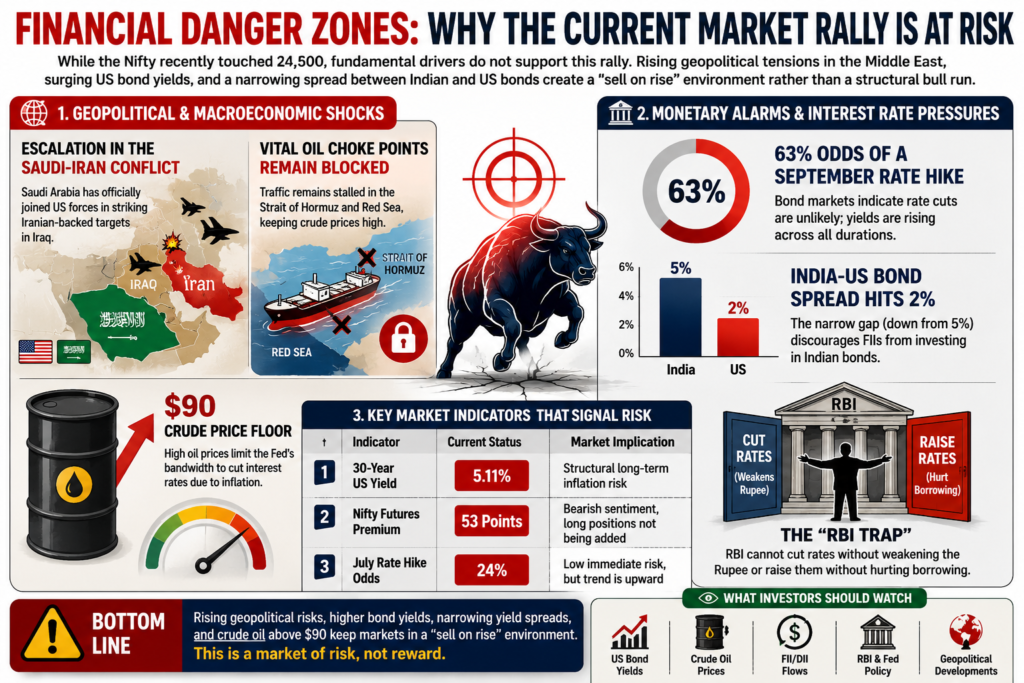
Is This Nifty Rally a Bull Trap? 5 Hidden Warnings from the Bond Market and Global Conflicts
Introduction: The 24,000 Puzzle
After a brutal 1,000-point correction from the 24,500 zone, the Nifty has once again climbed above the psychologically important 24,000 mark. Retail investors are beginning to believe that the worst may be over and that a fresh bull run has begun.
However, experienced market participants know that every strong rebound isn’t necessarily the beginning of a new uptrend. Sometimes, it is simply a bull trap—a temporary rally that attracts buyers before another wave of selling begins.
The biggest concern today isn’t the Nifty chart itself. It’s the growing disconnect between Indian equities and the global macro environment. Rising US bond yields, persistent inflation fears, geopolitical tensions in the Middle East, and continued foreign institutional selling all suggest investors should remain cautious.
So, is this recovery genuine, or are markets ignoring major warning signs?
1. The “Ghost Rally”: Why Markets Are Rising Without Strong Global Support
One of the most unusual developments in recent weeks has been India’s relative strength compared to global markets.
While Nifty recovered sharply, major international indices including the Nasdaq, Nikkei, and South Korean markets have remained under pressure.
This divergence raises an important question.
If global growth concerns remain unchanged, why is India rallying?
One possible explanation is short-term positioning by institutional investors ahead of important global central bank decisions. Instead of reflecting improving fundamentals, the rally could simply represent temporary buying before renewed selling pressure emerges.
When domestic markets move independently from global trends for extended periods, investors should carefully evaluate whether the move is supported by earnings, liquidity, and macroeconomic conditions.
2. Rising Geopolitical Risks Could Increase Market Volatility
The Middle East remains one of the biggest external risks for global financial markets.
Any disruption to major shipping routes or energy supplies can significantly affect inflation expectations worldwide.
Higher geopolitical uncertainty generally pushes investors toward safer assets while increasing volatility across equity markets.
For India, which imports a significant portion of its crude oil requirements, prolonged geopolitical tensions could increase inflationary pressure and widen the current account deficit.
Even if equity markets initially ignore geopolitical developments, energy prices often become the transmission mechanism through which these risks eventually affect corporate earnings and investor sentiment.
3. The Bond Market Is Sending a Different Message
Equity markets often receive most of the media attention.
Professional investors, however, closely monitor the bond market because it frequently provides earlier signals about economic conditions.
When government bond yields rise sharply across multiple maturities, markets may be pricing expectations of:
- Higher inflation
- Higher borrowing costs
- Larger fiscal deficits
- Higher interest rates for longer
If these expectations persist, equity valuations—particularly growth and technology stocks—can come under pressure because future cash flows are discounted at higher interest rates.
The bond market and the stock market do not always move together.
When they send conflicting messages, investors should pay close attention.
4. The “2% Yield Trap”: Why FIIs Could Remain Cautious
Foreign Institutional Investors allocate capital globally by comparing both returns and risks.
One important consideration is the yield difference between Indian government bonds and US Treasury securities.
If that yield advantage narrows significantly while the US dollar strengthens, investing in emerging markets becomes relatively less attractive.
Currency depreciation can quickly offset any additional bond yield earned in India.
This is one reason why sustained FII inflows cannot be taken for granted, especially during periods of rising US interest rates and global uncertainty.
Meanwhile, Domestic Institutional Investors (DIIs) have continued supporting Indian equities, partially offsetting foreign selling.
The key question is whether domestic liquidity alone can continue supporting valuations if global capital flows remain weak.
5. Crude Oil Could Decide the Next Market Trend
Oil remains one of the most important macroeconomic variables for India.
Higher crude prices affect:
- Inflation
- Corporate profit margins
- Transportation costs
- Government finances
- Consumer spending
If geopolitical tensions keep crude oil elevated for an extended period, central banks may find it difficult to reduce interest rates even if economic growth slows.
This creates a challenging environment where inflation remains high while growth weakens—a combination that financial markets generally dislike.
Technical Analysis: Is the V-Shaped Recovery Sustainable?
The recent rebound resembles a classic V-shaped recovery.
Although visually impressive, V-shaped recoveries often face challenges because markets typically require time to build strong support before beginning sustainable uptrends.
Professional traders generally look for confirmation through:
- Strong market breadth
- Rising volumes
- Increasing institutional participation
- Healthy derivatives positioning
If these supporting indicators remain weak, sharp rallies can quickly lose momentum.
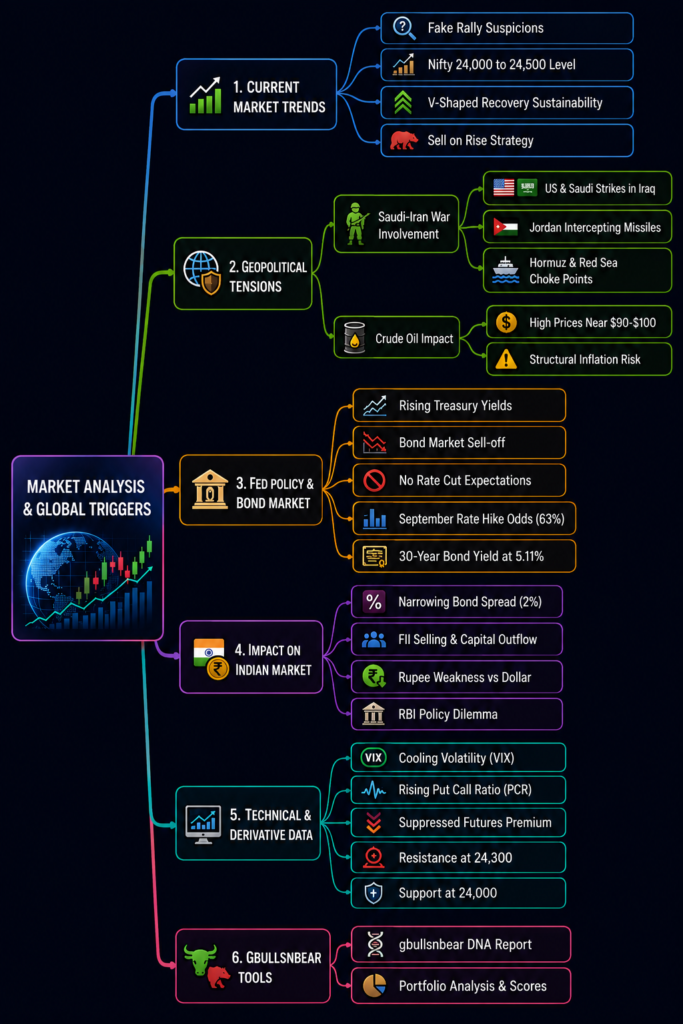
Key technical levels remain critical.
Resistance Zone: 24,300–24,500
Support Zone: 24,000–24,230
A decisive move beyond either zone may determine the next major market direction.
RBI’s Difficult Policy Balancing Act
The Reserve Bank of India faces competing priorities.
Lower interest rates could support economic growth but may also increase pressure on the Indian Rupee if global interest rate differentials narrow.
Keeping rates elevated may help stabilize the currency but could slow borrowing, investment, and consumption.
Balancing inflation, currency stability, and economic growth will remain one of the RBI’s biggest challenges over the coming quarters.
Investment Strategy: What Should Investors Do?
Instead of reacting emotionally to every market rally, investors should focus on managing risk.
A balanced approach may include:
- Maintaining diversified portfolios.
- Monitoring global bond yields and crude oil prices.
- Watching FII and DII investment trends.
- Avoiding excessive leverage during uncertain market conditions.
- Focusing on fundamentally strong businesses rather than chasing short-term momentum.
Markets often reward patience more than prediction.
Final Thoughts
The recent recovery above 24,000 has certainly improved market sentiment.
However, sentiment alone does not guarantee a sustained bull market.
Global bond yields remain elevated, geopolitical tensions continue to create uncertainty, crude oil prices remain sensitive to supply disruptions, and foreign investors are still evaluating global risk-reward opportunities.
Whether this rally becomes the beginning of a new uptrend or merely another temporary bounce will depend less on optimism and more on how these macroeconomic forces evolve in the coming weeks.
For investors, this may be the right time to stay disciplined, focus on risk management, and avoid confusing a short-term rebound with a long-term trend reversal.
Frequently Asked Questions (FAQs)
Is the current Nifty rally a bull trap?
It is difficult to say with certainty. While the rebound has improved sentiment, investors should also monitor global bond yields, crude oil prices, FII flows, and earnings before concluding that a new bull market has begun.
Why are rising US bond yields important for Indian markets?
Higher US yields can attract global capital toward US assets, reducing investment flows into emerging markets like India and increasing borrowing costs worldwide.
How does crude oil affect the Indian stock market?
India imports a large portion of its crude oil. Rising oil prices can increase inflation, reduce corporate profitability, weaken the rupee, and influence RBI policy.
Why are FIIs important?
Foreign Institutional Investors contribute significantly to liquidity in Indian markets. Sustained buying or selling by FIIs often influences market direction and investor sentiment.
What should investors watch next?
Key factors include RBI policy decisions, US Federal Reserve guidance, global bond yields, crude oil prices, corporate earnings, and FII/DII activity.
Alternative High-CTR SEO Titles
- Nifty Above 24,000: Real Bull Run or a Dangerous Bull Trap?
- Bond Market vs Stock Market: Why This Rally Could End in a Sharp Correction
- 5 Hidden Risks Behind the Nifty Rally That Most Investors Are Ignoring
- Why the Bond Market Is Flashing Warning Signs Despite Nifty’s Recovery
- Nifty’s 24,000 Rally Explained: Bond Yields, Oil Prices & Global War Risks
- Bull Trap Alert? The Truth Behind Nifty’s Recovery and Rising Bond Yields
- Global Markets, Bond Yields & Middle East War: Is the Stock Market Ignoring Reality?
- Why FIIs Are Selling India Despite the Market Rally
- Nifty Rebounds Above 24,000: Here’s Why Smart Money Isn’t Celebrating Yet
- The Bond Market Just Sent a Warning—Is India’s Stock Market Listening?