
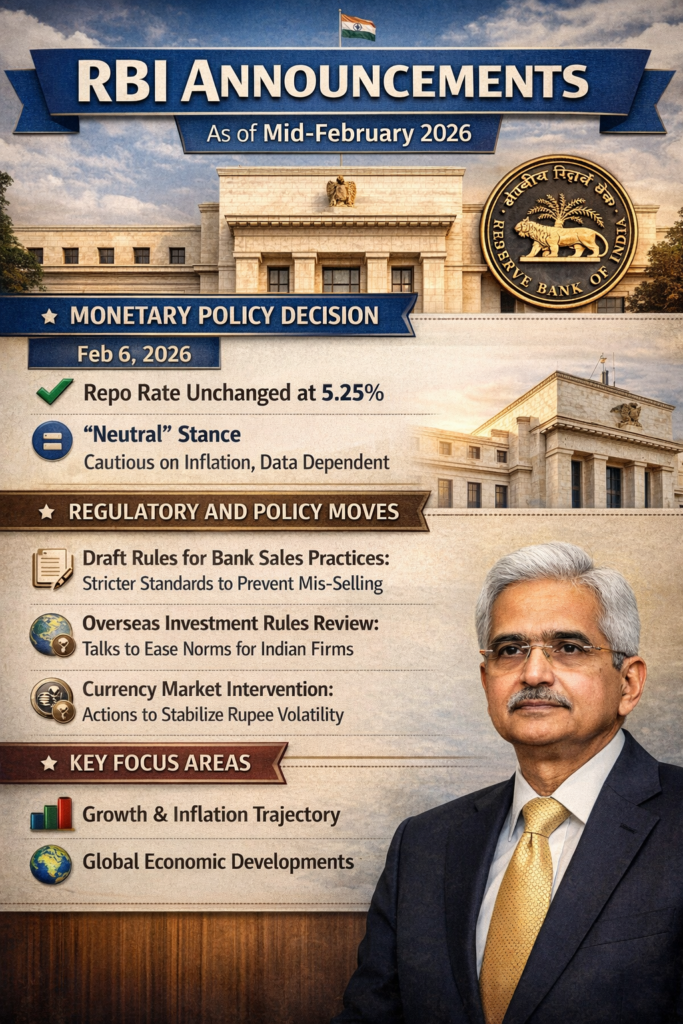
The Reserve Bank of India (RBI) is India’s central bank, responsible for regulating monetary policy, issuing currency, and ensuring financial stability. Established in 1935 under the Reserve Bank of India Act, 1934, it plays a central role in managing the Indian rupee, banking regulation, and economic growth initiatives.
Key facts
- Founded: April 1, 1935
- Headquarters: Mumbai, Maharashtra
- Governor (2025): Sanjay Malhotra
- Ownership: Government of India (nationalized 1949)
- Primary legislation: Reserve Bank of India Act (1934)
Historical background
Initially headquartered in Kolkata, the RBI moved to Mumbai in 1937. It was privately owned until its nationalization in 1949, after which it became fully owned by the Government of India. The RBI has since guided India through major financial transformations, including independence, liberalization, and the digital payments revolution.
Structure and governance
The RBI is governed by a Central Board of Directors, appointed by the government. It includes the Governor, up to four Deputy Governors, and nominated directors representing various sectors. As of 2025, Deputy Governors include M. Rajeshwar Rao, T. Rabi Sankar, Swaminathan J., and Dr. Poonam Gupta . Key committees such as the Monetary Policy Committee, Board for Financial Supervision, and Payments Regulatory Board oversee critical policy areas.
Core functions
The RBI formulates and implements India’s monetary policy to balance price stability with growth. It regulates banks and non-banking finance companies under the Banking Regulation Act, 1949, manages foreign exchange under the Foreign Exchange Management Act, 1999, and issues and destroys currency notes. It also acts as banker to the government and to commercial banks .
Subsidiaries and institutions
Wholly owned subsidiaries include:
- Deposit Insurance and Credit Guarantee Corporation (DICGC) – deposit insurance;
- Bharatiya Reserve Bank Note Mudran Pvt. Ltd. (BRBNMPL) – currency printing;
- Reserve Bank Information Technology Pvt. Ltd. (ReBIT) – cybersecurity;
- Indian Financial Technology and Allied Services (IFTAS) – payment networks;
- Reserve Bank Innovation Hub (RBIH) – financial innovation .
Role and impact
The RBI’s decisions directly influence inflation, credit availability, and exchange-rate stability. Its regulatory oversight underpins confidence in India’s financial system, making it a cornerstone of the nation’s economic and monetary framework.