
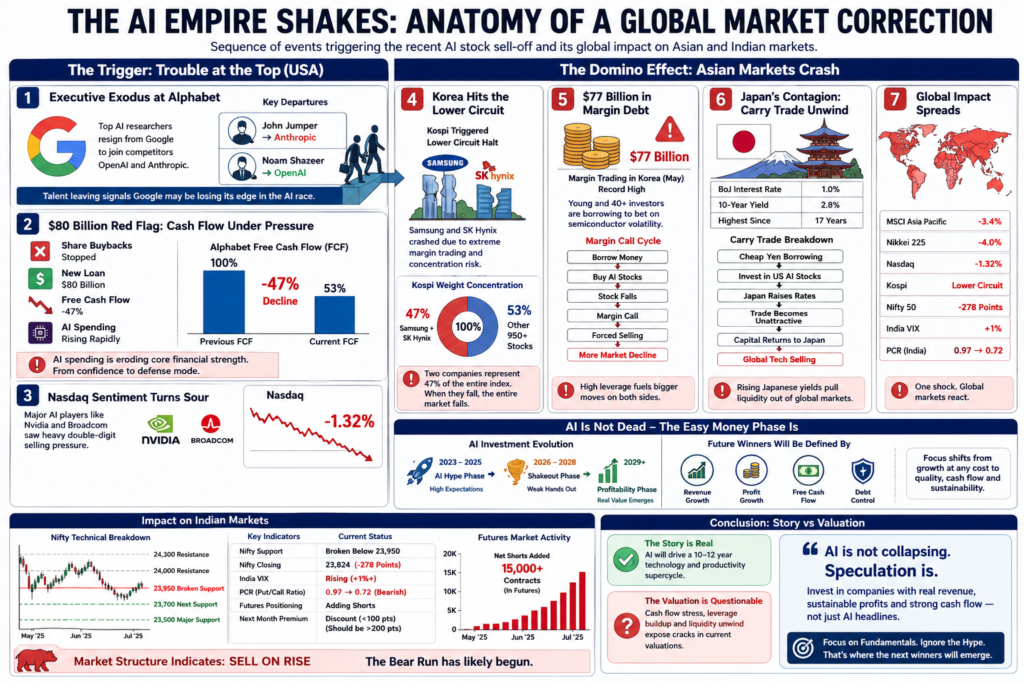
Market Snapshot
| Market | Change |
|---|---|
| MSCI Asia Pacific | -3.4% |
| Nikkei 225 | -4.0% |
| Nasdaq | -1.32% |
| Kospi | Lower Circuit Triggered |
| Nifty 50 | -278 Points |
| India VIX | +1% |
| PCR | 0.97 → 0.72 |
Global Market Heatmap
MSCI Asia Pacific  ████████████ -3.4%

Nikkei 225         ███████████████ -4.0%

Nasdaq             ████ -1.32%

Nifty 50           ███████ -1.15%
Why Are Markets Falling Despite Positive Geopolitical News?
Normally ceasefires and reduced geopolitical tensions boost markets.
This time investors ignored diplomacy and focused on something much bigger:
The Cracking AI Narrative
The market is beginning to question whether current AI valuations are justified by actual profits.
Investors are now asking:
✅ Where is the revenue?
✅ Where is the cash flow?
✅ When will AI investments become profitable?
Google’s AI Brain Drain
Key Talent Departures
| Executive | Moved To |
|---|---|
| John Jumper | Anthropic |
| Noam Shazeer | OpenAI |
AI Leadership Shift
Google DeepMind
      ↓
Talent Exodus
      ↓
Investor Fear
      ↓
Stock Pressure
For investors, top researchers leaving is often a stronger signal than quarterly earnings.
The concern is simple:
Google created much of today’s AI revolution, but competitors may now be attracting the best talent.
The $80 Billion Red Flag
Alphabet’s Financial Warning Signs
| Metric | Situation |
|---|---|
| Share Buybacks | Stopped |
| New Loan | $80 Billion |
| Free Cash Flow | -47% |
| AI Spending | Rising Rapidly |
Cash Flow Chart
Previous FCF

████████████████████████ 100%

Current FCF

█████████████ 53%
A 47% decline in Free Cash Flow is significant because cash flow ultimately funds innovation, acquisitions and shareholder returns.
South Korea’s Dangerous Concentration Risk
Kospi Weight Distribution
| Company Group | Weight |
|---|---|
| Samsung + SK Hynix | 47% |
| Remaining 950+ Stocks | 53% |
Market Concentration Diagram
Samsung + SK Hynix
███████████████████████ 47%

Other 950+ Stocks
██████████████████████████ 53%
When two companies dominate nearly half an index, any weakness in semiconductors can destabilize the entire market.
Margin Trading: Fuel Behind the Crash
Korean Retail Leverage Explosion
| Metric | Value |
|---|---|
| Margin Trading Balance | 77 Billion Won |
| Major Participants | Young Traders & 40+ Investors |
Margin Call Cycle
Borrow Money
      ↓
Buy AI Stocks
      ↓
Stock Falls
      ↓
Margin Call
      ↓
Forced Selling
      ↓
More Market Decline
This feedback loop amplified the market decline.
Japan’s Silent Trigger: The Carry Trade Unwind
Bank of Japan Policy Shift
| Indicator | Level |
|---|---|
| Interest Rate | 1.0% |
| 10-Year Yield | 2.8% |
| Highest Since | 17 Years |
Carry Trade Breakdown
Cheap Yen Borrowing
        ↓
Invest In US AI Stocks
        ↓
Japan Raises Rates
        ↓
Trade Becomes Unattractive
        ↓
Capital Returns To Japan
        ↓
Global Tech Selling
This mechanism quietly removed liquidity from technology markets.
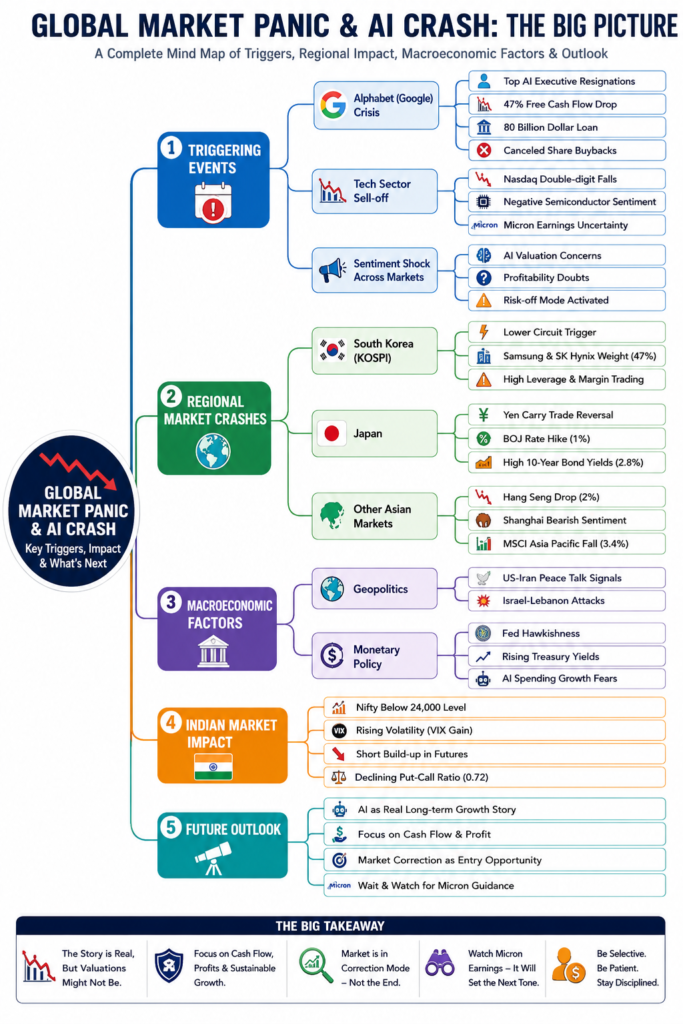
AI Is Not Dead — The Easy Money Phase Is
AI Investment Evolution
2023-2025
AI Hype Phase
       ↓
2026-2028
Shakeout Phase
       ↓
2029+
Profitability Phase
Future winners will likely be companies showing:
| Metric | Importance |
|---|---|
| Revenue Growth | High |
| Profit Growth | Very High |
| Free Cash Flow | Critical |
| Debt Control | Critical |
Impact on Indian Markets
Nifty Technical Damage
| Indicator | Status |
|---|---|
| Nifty Support | Broken Below 23,950 |
| Closing Level | 23,824 |
| India VIX | Rising |
| PCR | Bearish (0.72) |
| Futures Positioning | Short Build-up |
Nifty Outlook
24,300 Resistance
       ▲

24,000 Resistance
       ▲

23,950 Broken Support
       ▼

23,700 Next Support
       ▼

23,500 Major Support
Current market structure favors a Sell on Rise strategy until strong buying emerges.
Conclusion: Story vs Valuation
The AI revolution remains real.
What investors are questioning is not the technology, but the valuation attached to it.
Google’s talent departures, collapsing free cash flow, Korea’s leverage problem and Japan’s carry-trade unwind have exposed the first major cracks in the AI investment narrative.
Key Takeaway
AI is not collapsing. Speculation is.
The next phase of investing will reward companies generating real revenue, sustainable profits and strong cash flow—not just AI headlines.
Focus on business fundamentals, not hype. That’s where the next generation of market winners will emerge.
1. AI Bubble Burst? Why Global Tech Stocks Are Crashing Despite Peace TalksIs
2. the AI Empire Crumbling? Google Crisis, Korea Crash & the Global Tech Sell-Off Explained
3. AI Stocks in Trouble: Google’s $80 Billion Warning and the Hidden Risks Investors Missed
4. Global Market Crash 2026: AI Hype, Google Exodus and the Beginning of a Bear Run
5. From AI Boom to AI Shakeout: Why Tech Stocks Are Suddenly Falling Worldwide
AI Panic Spreads Worldwide: Korea Crashes 10%, Nasdaq Slides and All Eyes Turn to Micron Earnings
Global Market Crash 2026: Is the AI Empire Finally Facing Reality?
The global stock market witnessed one of its sharpest technology-led sell-offs in recent months on 23 June 2026. While geopolitical tensions appeared to be easing due to reports of diplomatic progress in the Middle East, investors focused on a much bigger concern: the sustainability of the AI boom.
From Wall Street to Seoul, from Tokyo to Mumbai, markets turned red as investors questioned whether current AI valuations are supported by real profits and cash flows.
What Triggered the Global Sell-Off?
The first warning sign emerged from Alphabet (Google), one of the biggest beneficiaries of the AI revolution.
Key Concerns at Alphabet
- Several top AI researchers moved to competitors such as OpenAI and Anthropic.
- Free Cash Flow reportedly dropped by 47%.
- Alphabet secured an $80 billion loan.
- Share buyback activity slowed significantly.
These developments created fears that AI spending is becoming increasingly expensive and may be putting pressure on profitability.
The market’s message was clear:
Investors are no longer impressed by AI promises alone. They want profits, cash flow, and sustainable growth.
AI Stocks Under Heavy Pressure
The technology and semiconductor sectors faced intense selling pressure.
Major Declines
| Stock | Performance |
|---|---|
| Nvidia | Sharp Decline |
| AMD | Heavy Selling |
| Tesla | Significant Weakness |
| Qualcomm | Negative |
| Micron | Under Pressure Before Earnings |
Micron’s earnings report has now become one of the most important events for global investors because it could reveal whether AI-driven demand remains strong or is beginning to slow.
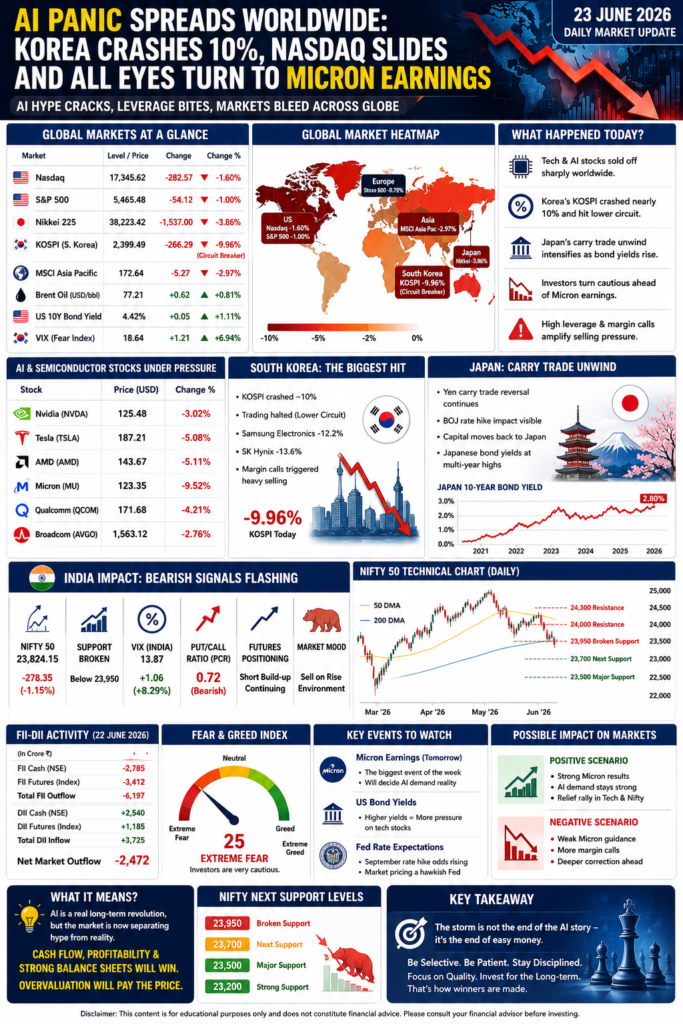
South Korea: The Biggest Casualty
South Korea became the epicenter of the global market panic.
What Happened?
- KOSPI plunged nearly 10%.
- Circuit breakers were triggered.
- Samsung and SK Hynix experienced major declines.
- Margin trading and leverage accelerated the sell-off.
The Korean market faces a concentration problem. Samsung and SK Hynix account for a very large portion of the index, making the entire market highly sensitive to semiconductor weakness.
When chip stocks fall, the whole market falls.
Japan’s Carry Trade Unwind
Another major factor behind the sell-off came from Japan.
Key Developments
- Bank of Japan raised interest rates.
- 10-year bond yields reached multi-year highs.
- The Yen Carry Trade started reversing.
For years, investors borrowed cheap Japanese Yen and invested in high-growth assets such as US technology stocks.
Now that Japanese yields are rising, investors are pulling money back to Japan, reducing liquidity available for global AI and technology stocks.
Geopolitics Failed to Support Markets
Normally, positive developments in geopolitical conflicts help stock markets.
However, this time investors largely ignored:
- US-Iran diplomatic signals
- Middle East peace discussions
- Reduced war concerns
The reason was simple:
The market is now more concerned about earnings, valuations, and cash flow than geopolitical headlines.
Impact on Indian Markets
Indian markets were not spared.
Nifty Technical Breakdown
| Indicator | Status |
|---|---|
| Nifty 50 | Below 23,950 |
| India VIX | Rising |
| PCR | 0.72 (Bearish) |
| Futures Positioning | Short Build-up |
| Market Mood | Sell on Rise |
The breach of the 23,950 level indicates that traders have become increasingly cautious.
Important Support Levels
- 23,950 – Broken
- 23,700 – Next Support
- 23,500 – Major Support
- 23,200 – Strong Support
Institutional traders are adding short positions while volatility continues to rise.
Fear and Greed Indicator Signals Extreme Caution
Market sentiment has shifted dramatically.
Investors are becoming defensive due to:
- AI valuation concerns
- Rising bond yields
- Semiconductor weakness
- Global liquidity tightening
The Fear & Greed Index currently reflects extreme caution among market participants.
Why Micron Earnings Matter So Much
Micron has become the most important stock for the AI sector this week.
Positive Scenario
If Micron reports:
- Strong demand for AI memory chips
- Higher future guidance
- Improving margins
Then markets may stabilize and technology stocks could rebound.
Negative Scenario
If Micron reports:
- Weak guidance
- Lower AI demand expectations
- Margin pressure
Then the correction could deepen globally.
Is AI Dead?
Absolutely not.
AI remains one of the most powerful technological trends of the next decade.
However, the market is entering a new phase.
Phase 1 (2023-2025)
AI Hype and Speculation
Phase 2 (2026-2028)
Shakeout and Reality Check
Phase 3 (2029+)
Profitable AI Business Models
The winners will likely be companies that can demonstrate:
- Real Revenue Growth
- Sustainable Profits
- Strong Cash Flow
- Healthy Balance Sheets
Conclusion: The Story Is Real, But Valuations Matter
The global sell-off is not the end of the AI revolution.
It is the end of easy money.
Investors are beginning to separate genuine AI leaders from companies that benefited primarily from hype.
The recent crash in Korea, weakness in Nasdaq, rising Japanese bond yields, and pressure on Alphabet all point to the same conclusion:
The AI story remains powerful, but future winners will be determined by cash flow, profitability, and execution—not headlines.
For long-term investors, market corrections often create opportunities. For short-term traders, risk management remains the most important strategy.
The next major clue will come from Micron earnings, which may determine whether this correction becomes a buying opportunity or the beginning of a deeper global technology slowdown.