
Why Your Portfolio Is Bleeding While Markets Hit Record Highs: The Great Rotation Explained
Every day, financial news celebrates record-breaking highs in the stock market. The S&P 500 is touching new peaks, global indices remain resilient, and artificial intelligence continues dominating headlines.
Yet many retail investors are asking the same question:
“If markets are making new highs, why is my portfolio still in the red?”
The answer lies in one of the biggest yet least understood investment trends of recent years—The Great Rotation.
This isn’t a market crash. It isn’t panic selling. Instead, it is a strategic shift where institutional investors are moving billions of dollars from expensive growth stocks into undervalued sectors with stronger cash flows and long-term potential.
What Is the Great Rotation?
Imagine visiting a vegetable market.
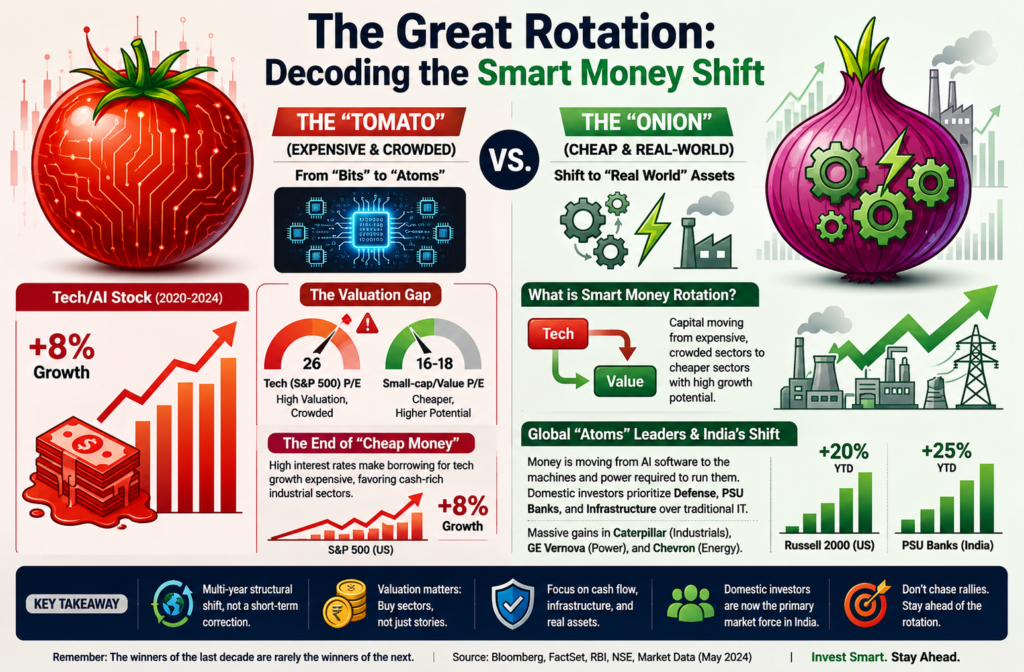
For several years, everyone wanted tomatoes. Demand exploded, pushing prices from ₹30 to ₹200 per kilogram.
Eventually, experienced traders realized tomatoes had become too expensive.
Instead of buying more tomatoes, they quietly started purchasing onions selling for just ₹20.
Nothing changed about the total money in the market.
Only the destination of that money changed.
The stock market works the same way.
Today’s “Tomatoes” are expensive AI and technology stocks.
Today’s “Onions” are sectors like:
- Industrials
- Power
- Defence
- Energy
- PSU Banks
- Manufacturing
- Infrastructure
Money isn’t leaving equities.
It’s simply moving somewhere else.
Smart Money Is Selling Expensive Growth Stocks
The world’s largest investors rarely buy what everyone else is buying.
Instead, they search for sectors where valuations remain attractive.
Over the past year, hedge funds, pension funds, sovereign wealth funds, and institutional investors have gradually reduced exposure to expensive technology names while increasing investments in traditional industries.
The reason is simple.
Valuation matters.
When companies become extremely expensive, future returns naturally become smaller.
Meanwhile, neglected sectors often provide better risk-reward opportunities.
Small Caps Are Quietly Winning Again
One of the biggest stories investors are overlooking is the remarkable comeback of small-cap companies.
For years, mega-cap technology stocks dominated global markets.
Today, that leadership is beginning to change.
Small-cap companies have started outperforming many famous technology giants because their valuations remain significantly lower.
While many large technology companies trade at premium earnings multiples, numerous small-cap businesses continue trading at far more reasonable valuations.
History shows that these valuation gaps rarely last forever.
Eventually, capital rotates.
From AI Software to Physical Infrastructure
The first phase of the AI revolution rewarded companies building software.
The second phase is rewarding companies building the infrastructure behind artificial intelligence.
Every AI model requires:
- Massive data centers
- Electricity
- Power transmission
- Semiconductor manufacturing
- Industrial equipment
- Cooling systems
Without physical infrastructure, artificial intelligence simply cannot scale.
This explains why industrial companies, engineering firms, power producers, utilities, and infrastructure businesses have suddenly become investor favorites.
Ironically, the AI boom itself is fueling demand for the “old economy.”
India’s Structural Transformation
India is experiencing its own version of the Great Rotation.
Foreign Institutional Investors (FIIs) have reduced exposure in several sectors, particularly technology.
Historically, this would have triggered a major market decline.
This time was different.
Domestic Institutional Investors (DIIs) stepped in aggressively.
For the first time, domestic investors became the primary support for Indian equities.
This structural change has reduced India’s dependence on foreign capital while creating opportunities across domestic-focused sectors.
Industries such as:
- Defence
- Railways
- Capital Goods
- PSU Banks
- Infrastructure
- Manufacturing
have attracted increasing institutional interest.
Energy Has Become the New Gold
Artificial Intelligence consumes enormous amounts of electricity.
Every AI query requires computing power.
Every computing cluster requires electricity.
Every data center requires reliable energy.
This has transformed traditional utility companies into critical AI enablers.
Instead of chasing AI software alone, institutional investors have started investing in the companies that provide electricity, power equipment, transformers, and energy infrastructure.
This is known as the Pick and Shovel Strategy.
During a gold rush, the biggest fortunes were often made by selling shovels—not digging for gold.
Today, electricity has become the shovel powering the AI revolution.
Why High Interest Rates Changed Everything
The previous decade was built on cheap money.
Low interest rates allowed technology companies to borrow aggressively and prioritize rapid expansion over profitability.
Today’s environment is very different.
Higher borrowing costs have forced investors to focus on:
- Cash flow
- Profitability
- Strong balance sheets
- Sustainable earnings
- Dividend growth
Companies producing real cash today are receiving greater attention than companies promising future profits.
The investment rulebook has changed.
How Retail Investors Can Avoid the Rotation Trap
Many retail investors make the same mistake.
They buy sectors only after headlines celebrate their success.
By then, institutions may already be preparing to exit.
Instead of chasing recent winners, investors should focus on:
Diversify Across Sectors
Avoid concentrating your portfolio entirely in technology.
Maintain exposure across multiple industries.
Follow Valuation
Quality businesses purchased at excessive prices often produce disappointing returns.
Always compare valuation with future growth potential.
Watch Cash Flow
Companies generating strong free cash flow usually survive changing market cycles better than speculative businesses.
Invest Gradually
Systematic investing helps reduce emotional decision-making during periods of market rotation.
The Future Belongs to Balanced Portfolios
Technology is not disappearing.
Artificial intelligence is not ending.
But market leadership is changing.
The next decade may reward investors who combine exposure to:
- Artificial Intelligence
- Energy
- Industrials
- Defence
- Infrastructure
- Manufacturing
- High-quality Value Stocks
Rather than relying on a single theme.
The biggest investment opportunities often appear where the crowd isn’t looking.
Final Thoughts
The Great Rotation is more than a temporary market trend.
It represents a structural shift in how global capital is allocated.
Smart money is moving beyond hype and focusing on valuation, cash flow, and real economic assets.
For investors, the lesson is simple:
Don’t judge the market only by the index.
Sometimes markets reach new highs while individual portfolios struggle because leadership has quietly changed beneath the surface.
The winners of the next decade may not be yesterday’s market leaders.
The smartest investors won’t ask “Which stock is popular?”
They’ll ask:
“Where is the money flowing next?”
Frequently Asked Questions (FAQ)
What is the Great Rotation in the stock market?
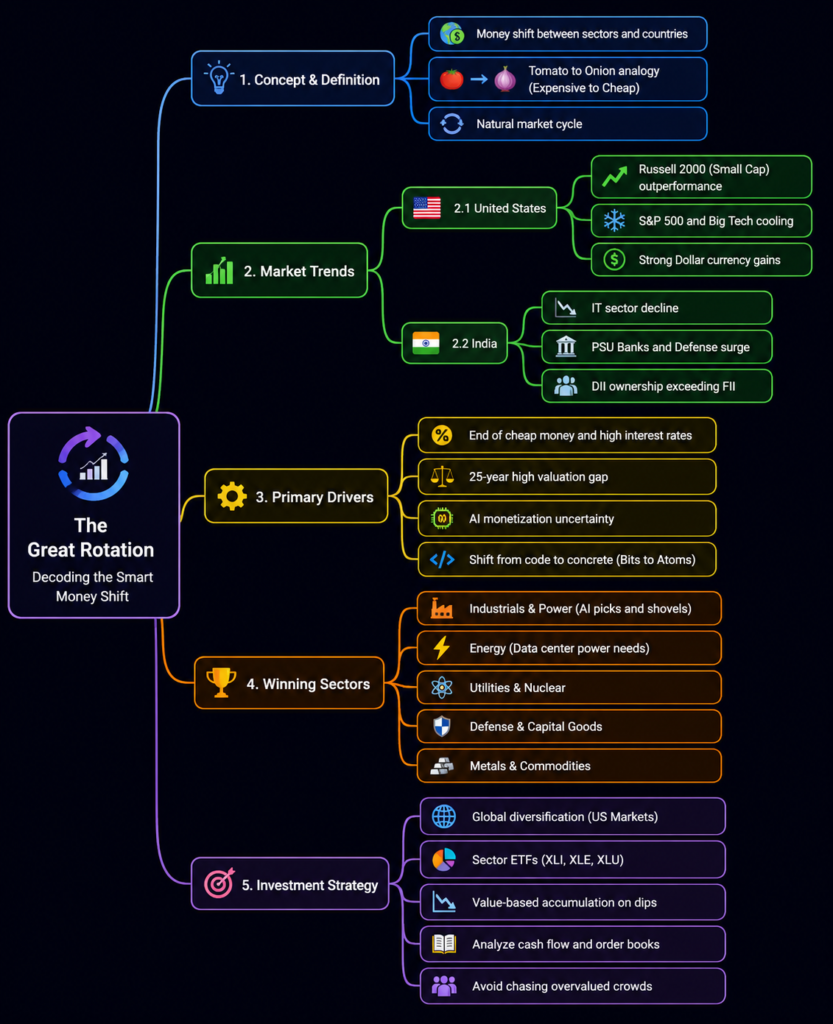
The Great Rotation refers to institutional investors shifting money from expensive growth sectors like technology into undervalued sectors such as industrials, energy, infrastructure, defence, and value stocks.
Why is my portfolio falling even though the market is rising?
Market indices are often driven by a handful of large companies, while many individual stocks may decline due to sector rotation and changing investor preferences.
Is AI investing over?
No. AI remains a long-term growth theme. However, investors are increasingly focusing on companies with strong cash flow and the physical infrastructure supporting AI rather than speculative growth alone.
Which sectors are benefiting from the Great Rotation?
Industrials, power, defence, infrastructure, manufacturing, utilities, energy, and selected small-cap companies are attracting increased institutional interest.
How should retail investors respond?
Avoid chasing recent winners, diversify across sectors, focus on valuations and cash flow, and invest systematically for the long term.
Best SEO Titles
- Why Your Portfolio Is Bleeding While Markets Hit Record Highs: The Great Rotation Explained
- The Great Rotation: Why Smart Money Is Leaving AI Stocks for Value Stocks
- Markets Are at Record Highs, So Why Is Your Portfolio Falling?
- The Great Rotation 2026: Why AI Stocks Are Losing Momentum
- Why Your Stocks Are Falling Despite Record High Markets
- The Great Rotation Explained: Where Smart Money Is Investing Now
- From AI to Industrials: The Great Rotation Every Investor Must Understand
- The Hidden Reason Your Portfolio Is Underperforming in a Bull Market
- Smart Money Is Rotating Out of Tech—Should You Follow?
- The Great Rotation: How Institutional Investors Are Changing the Market