
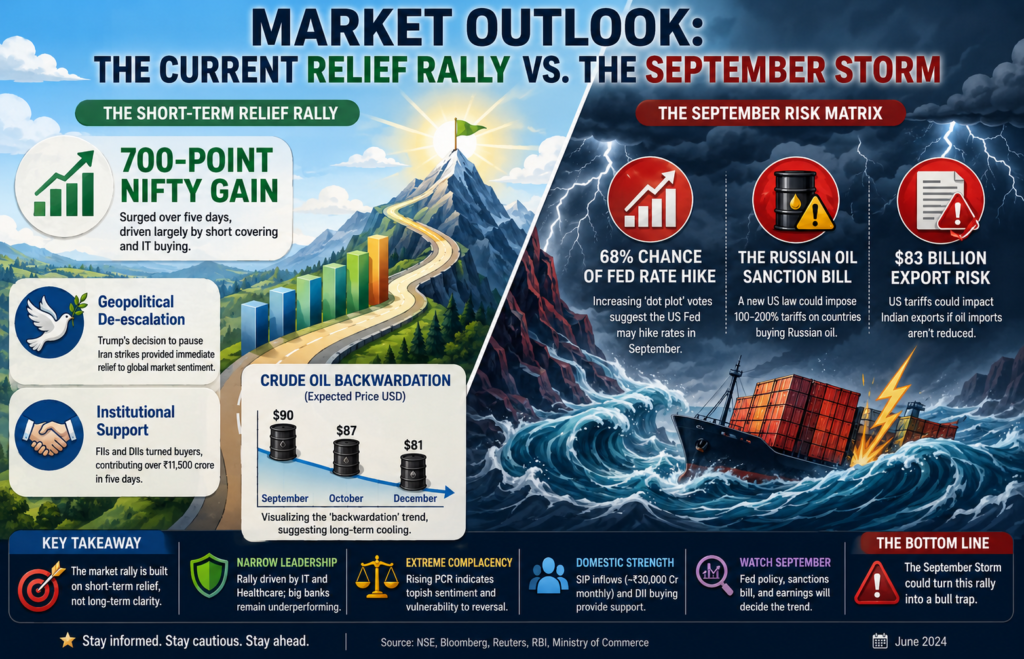
The September Storm: Why the Current Market Rally Could Be a Bull Trap
The Indian stock market has staged an impressive comeback.
After weeks of uncertainty, the Nifty 50 has recovered hundreds of points; investors are celebrating another “Green Monday,” and optimism has returned across Dalal Street.
But beneath the surface, the rally appears far less convincing than the headlines suggest.
While benchmark indices are climbing, market breadth remains weak, banking stocks are underperforming, and several major geopolitical risks continue to build in the background.
Could this rally be nothing more than a classic bull trap before a volatile September?
Let’s examine the bigger picture.
A Relief Rally Built on Hope
Markets often react faster to expectations than reality.
The recent rebound was fueled by optimism surrounding easing geopolitical tensions in the Middle East after renewed diplomatic discussions involving the United States and Iran.
Investors interpreted the reduced probability of immediate military escalation as a positive signal for global markets.
However, geopolitical uncertainty hasn’t disappeared.
Instead, it has merely been postponed.
History shows that temporary diplomatic breakthroughs can quickly reverse if negotiations fail or regional tensions escalate again.
For investors, that means risk remains elevated despite improving sentiment.
Why Crude Oil Still Matters
India imports the majority of its crude oil requirements.
Every sharp movement in oil prices directly affects:
- Inflation
- Corporate earnings
- Government finances
- Rupee stability
- Current account deficit
Although oil futures have eased from recent highs, prices remain well above the levels that supported global growth over the past few years.
Markets are currently assuming that supply disruptions will remain limited.
If geopolitical tensions return, energy prices could rise rapidly once again, placing additional pressure on emerging markets like India.
The US Senate Could Become the Biggest Market Trigger
While investors focus on daily market movements, an important policy risk continues developing in Washington.
Proposed legislation targeting countries purchasing Russian energy could significantly reshape global trade if implemented.
For India, the issue is particularly important because Russian crude has become an important part of the country’s energy imports.
If stricter sanctions or tariffs are introduced, several industries could face higher costs, export uncertainty, and increased geopolitical pressure.
Although the outcome remains uncertain, policy developments deserve close monitoring because they have the potential to influence market sentiment far beyond domestic factors.
Why This Rally Looks Narrow
One of the healthiest signs of a bull market is broad participation.
That isn’t happening today.
Recent gains have largely been driven by a limited number of sectors, particularly information technology and healthcare.
Meanwhile, several economically sensitive sectors continue to lag.
A healthy bull market typically requires participation from:
- Banking
- Financial Services
- Capital Goods
- Auto
- Industrials
- Midcaps
- Small Caps
Without broader leadership, rallies often become vulnerable to sudden reversals.
Bank Nifty Is Sending a Warning Signal
Historically, banking stocks have led major market uptrends.
Banks represent the backbone of India’s economy.
When Bank Nifty underperforms while the broader market rallies, professional investors pay attention.
Weak banking participation often indicates:
- Cautious institutional positioning
- Slower credit expectations
- Limited confidence in economic acceleration
Until financial stocks begin confirming the broader rally, market strength may remain fragile.
Investor Sentiment Is Becoming Too Comfortable
Contrarian investors understand an important principle:
Markets become most dangerous when everyone feels safe.
Indicators measuring options positioning and market sentiment suggest optimism has increased significantly during the recent rebound.
Excessive optimism doesn’t automatically trigger market declines.
However, it often reduces the margin of safety because expectations become difficult to exceed.
When markets price in perfect outcomes, even small disappointments can trigger sharp corrections.
Domestic Liquidity Is Supporting the Market
One of the strongest pillars supporting Indian equities today is consistent domestic investment.
Monthly SIP contributions continue providing steady inflows into mutual funds.
Domestic Institutional Investors (DIIs) have increasingly balanced periods of Foreign Institutional Investor (FII) selling.
This structural change has made Indian markets more resilient than in previous decades.
However, liquidity alone cannot permanently offset weak earnings, expensive valuations, or major geopolitical shocks.
Eventually, fundamentals regain control.
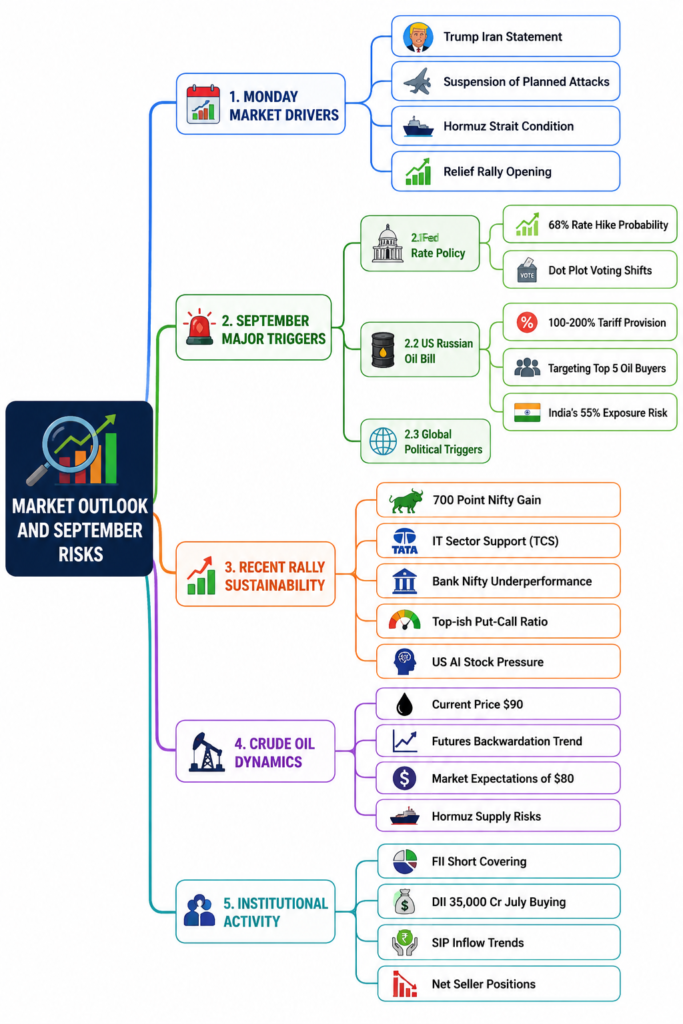
What Investors Should Watch in September
Several important events could influence market direction during September.
Federal Reserve Policy
Interest-rate expectations remain one of the largest drivers of global capital flows.
Any change in the Fed’s outlook could affect:
- Dollar strength
- Emerging-market inflows
- Technology valuations
- Foreign investment
Geopolitical Developments
Markets will continue monitoring developments involving:
- Middle East tensions
- Energy markets
- Russia-related sanctions
- Global trade policy
Corporate Earnings
Strong earnings remain essential for sustaining current valuations.
Without earnings growth, market multiples become increasingly difficult to justify.
Banking Sector Performance
If Bank Nifty begins participating, market confidence could strengthen.
If banking weakness continues, caution becomes increasingly warranted.
How Investors Can Prepare
Instead of reacting emotionally to short-term headlines, investors should focus on disciplined risk management.
Consider the following principles:
- Diversify across sectors.
- Maintain sufficient cash for opportunities.
- Avoid chasing momentum after sharp rallies.
- Focus on companies with strong earnings and cash flow.
- Review portfolio risk rather than index performance alone.
Market leadership often changes quickly.
Preparation matters more than prediction.
Final Thoughts
The current rally has undoubtedly improved investor confidence.
But confidence and confirmation are not the same.
Several important risks—including geopolitical uncertainty, energy prices, global monetary policy, and sector participation—remain unresolved.
Rather than assuming the correction is over, investors should remain flexible and allow market evidence to guide decisions.
If September delivers stronger earnings, broader participation, and supportive global conditions, the rally may continue.
If not, today’s optimism could prove to be nothing more than a temporary bull trap.
The smartest investors don’t chase every rally.
They prepare for every possibility.
Frequently Asked Questions (FAQ)
What is a bull trap in the stock market?
A bull trap occurs when markets appear to resume an uptrend but quickly reverse lower, trapping investors who bought during the rally.
Why is Bank Nifty important?
Banking stocks often lead economic growth. Strong participation from Bank Nifty usually supports sustainable bull markets.
How do crude oil prices affect Indian markets?
Higher oil prices increase inflation, pressure the rupee, raise import costs, and can reduce corporate profitability.
Why are geopolitical events important for investors?
Wars, sanctions, and trade policies influence commodity prices, investor confidence, currency movements, and global capital flows.
What should investors do during uncertain markets?
Maintain diversification, focus on fundamentally strong companies, avoid chasing rallies, and keep a long-term investment perspective.
Best SEO Titles
- The September Storm: Why the Current Market Rally Could Be a Bull Trap
- Bull Trap Ahead? Why the Indian Stock Market Rally May Not Last
- September Market Crash or Bull Run? The Hidden Risks Investors Must Watch
- Why This Stock Market Rally Could End in September: A Bull Trap Explained
- Nifty’s Rally Looks Strong—But Is a September Selloff Coming?
- The September Storm: 7 Hidden Risks That Could Shake the Indian Stock Market
- Is the Nifty Rally a Bull Trap? Here’s What Smart Investors Are Watching
- Why Smart Money Isn’t Trusting This Market Rally Yet
- September Could Change Everything: The Bull Trap Nobody Is Talking About
- Indian Stock Market Outlook: Why September Could Be the Most Dangerous Month