
Gold Crash 2026: Why the Correction May Not Mean the Gold Story Is Over
Gold has entered a new and unusually volatile phase.
After an extraordinary rally in 2025, the precious metal experienced a sharp correction in 2026. The move triggered a familiar question among investors:
Is the gold bull market over—or is this simply a major correction inside a longer-term structural trend?
The answer may become clearer when we look beyond short-term price movements and examine what central banks, reserve managers and institutional investors are actually doing.
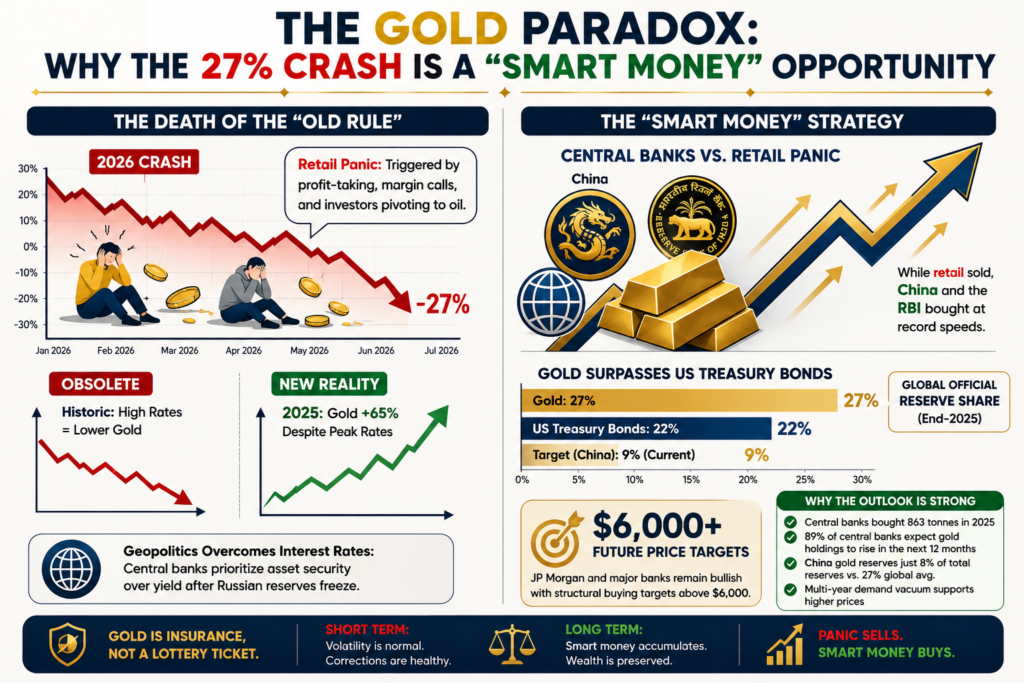
Gold recorded 53 new all-time highs during 2025, while total global gold demand exceeded 5,000 tonnes for the first time, according to the World Gold Council. The total value of annual gold demand reached approximately $555 billion, up 45% year over year.
At the same time, central banks continued to accumulate gold.
That creates an important divergence:
Retail investors often focus on price. Central banks focus on reserves, diversification and long-term financial security.
And that difference could be one of the most important themes in the gold market for the rest of 2026.
Gold Market 2025–2026: The Numbers Investors Should Know
Here are some of the most important data points:
| Gold Market Data | Latest Data |
|---|---|
| New gold all-time highs in 2025 | 53 |
| Global gold demand in 2025 | 5,000+ tonnes |
| Value of gold demand in 2025 | ~$555 billion |
| Central-bank net buying in 2025 | 863 tonnes |
| Global official reserve share of gold | 27% at end-2025 |
| U.S. Treasuries share | 22% |
| PBoC gold purchase in June 2026 | 15 tonnes |
| China gold reserves, June 2026 | 2,346 tonnes |
| China gold share of reserves | ~8% |
| Central banks expecting global gold holdings to rise | 89% |
The data suggests that gold is no longer simply a traditional safe-haven asset. It is increasingly being treated as a strategic reserve asset.
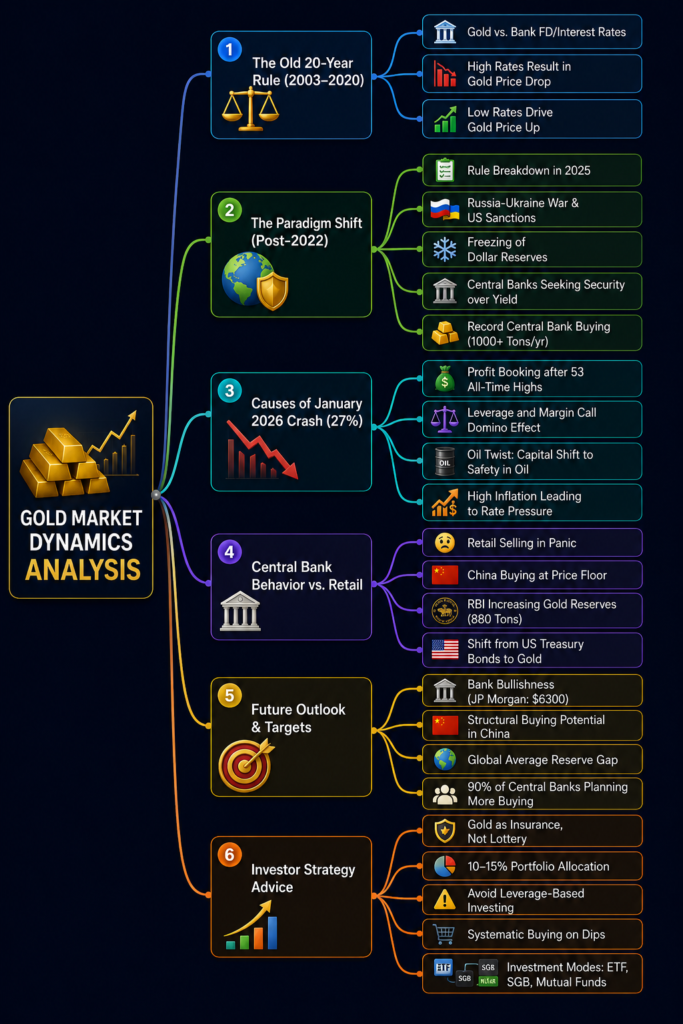
1. The Old Gold–Interest Rate Relationship Is Changing
For decades, investors primarily viewed gold through the lens of interest rates.
The logic was simple:
Higher real yields → gold becomes less attractive
Lower real yields → gold becomes more attractive
Gold doesn’t generate interest or dividends, so investors often compare it with bonds, bank deposits, and other yield-producing assets.
But the 2025 gold rally challenged this traditional framework.
Gold achieved 53 new record highs during 2025, despite an environment in which the old interest-rate model would have suggested much greater pressure on the metal.
This suggests that another factor has become increasingly important:
Reserve diversification.
Central banks are not buying gold because it pays interest.
They are buying it because gold can provide:
- Reserve diversification
- No issuer or corporate counterparty
- High global liquidity
- Protection against currency risk
- A hedge against geopolitical uncertainty
- Long-term wealth preservation
This is a fundamentally different reason to own gold.
2. Why Central Banks Care About Gold More Than Retail Investors
One of the biggest changes in global finance occurred after the freezing of Russian foreign-exchange reserves following the Russia-Ukraine conflict.
The episode highlighted an uncomfortable issue for reserve managers:
Financial assets can carry geopolitical and counterparty risks.
Physical gold is different.
Gold does not depend on the solvency of a company or government to retain its intrinsic value.
That doesn’t mean gold is risk-free. Its market price can fall sharply, as 2026 has demonstrated.
But from a reserve-management perspective, gold provides something valuable:
It is an asset without an issuer.
That characteristic is becoming increasingly important in an environment of geopolitical fragmentation.
3. Central Banks Are Still Buying Gold
This is perhaps the most important part of the gold story.
According to the World Gold Council, central banks purchased 863 tonnes of gold in 2025. While this was below the exceptional 1,000-tonne-plus levels seen during the previous three years, it remained far above the 2010–2021 annual average of 473 tonnes.
So the correct interpretation isn’t:
“Central banks stopped buying gold.”
It is:
“Central banks remained major buyers even at extremely high prices.”
And the 2026 survey indicates that the trend could continue.
The World Gold Council found that 89% of reserve managers expect global central-bank gold holdings to increase over the next 12 months, while 45% expect their own institutions to increase gold holdings.
That is a significant signal.
4. Gold Has Become a Major Reserve Asset
One of the biggest structural changes is happening inside global foreign-exchange reserves.
According to the European Central Bank, gold represented approximately 27% of total official foreign reserves at the end of 2025.
That was higher than:
- U.S. Treasuries: 22%
- Euro: 15%
However, the ECB makes an important qualification: the increase in gold’s share was partly caused by the huge rise in gold prices, which mechanically increased the market value of gold reserves.
Therefore, investors should not interpret the 27% figure as meaning central banks physically replaced all their Treasury holdings with gold.
But the direction is still important.
Gold’s strategic importance has clearly increased.
5. China Is One of the Biggest Gold Stories in 2026
China provides perhaps the clearest example of strategic gold accumulation.
The People’s Bank of China purchased 15 tonnes of gold in June 2026, its largest monthly purchase since October 2023.
That pushed China’s official gold reserves to approximately 2,346 tonnes.
Even more interesting:
China has now increased its official gold holdings for 20 consecutive months.
But there is another important number.
Gold represents only around 8% of China’s total official foreign-exchange assets.
That is much lower than the global reserve share of around 27%.
This doesn’t guarantee that China will aggressively buy gold until it reaches 27%.
But it demonstrates why China has potentially significant room to increase gold’s role in its reserves.
6. The June 2026 Gold Correction Was a Major Test
The 2026 correction was important because it tested whether the gold narrative could survive a major price decline.
Gold didn’t behave like a perfect safe-haven asset.
Instead, the market became highly sensitive to:
- U.S. interest-rate expectations
- Real yields
- Dollar movements
- Inflation
- Oil prices
- Geopolitical developments
- ETF flows
- Investor positioning
- Profit-taking
This is an important lesson for investors.
Gold can be a long-term hedge and still experience large short-term drawdowns.
That distinction is critical.
A safe-haven asset is not necessarily an asset that rises every time the world becomes uncertain.
7. The China “Buy the Dip” Signal
The most interesting development came during the correction.
While investors were reducing exposure to gold, China’s central bank continued accumulating.
In June 2026, the PBoC purchased 15 tonnes, its largest monthly purchase since October 2023.
Meanwhile, Chinese gold ETFs experienced significant outflows during June, with assets under management falling to approximately RMB 243 billion ($36 billion).
This creates an interesting contrast:
Some investors were selling.
The central bank was still buying.
That doesn’t mean every dip in gold is automatically a buying opportunity.
But it does show that institutional reserve managers can have a much longer time horizon than leveraged traders and short-term investors.
8. The Gold–Oil Relationship Matters
One reason gold can behave strangely during geopolitical crises is that investors don’t simply choose between “risk assets” and “gold.”
They also react to inflation.
Suppose a geopolitical crisis pushes oil prices sharply higher.
Higher oil prices can create inflation concerns.
If inflation expectations rise, investors may expect interest rates to remain higher for longer.
Higher real yields can then pressure gold.
This creates an unusual chain:
Geopolitical crisis → Oil ↑ → Inflation fears ↑ → Rate expectations ↑ → Real yields ↑ → Gold ↓
Therefore, geopolitical uncertainty alone is not enough to predict gold prices.
Investors must watch the entire macroeconomic chain.
9. Gold’s Biggest Risk: Valuation
The bullish gold story has a major weakness:
Price.
Gold has already experienced an extraordinary multi-year rally.
When an asset rises sharply, even strong long-term fundamentals don’t prevent corrections.
The World Gold Council’s data shows that central banks themselves moderated buying during periods of exceptionally high prices in 2025.
This is important.
Central banks are bullish on gold—but they are not price-blind buyers.
That means investors shouldn’t blindly chase gold after every major rally.
A better strategy may be:
Wait for corrections → accumulate gradually → maintain position sizing discipline.
10. Gold Outlook 2026: Could $6,000 Become Possible?
The long-term bullish case for gold is based on several structural factors:
1. Central-bank accumulation
Reserve managers continue to view gold as an important diversification asset.
2. Geopolitical uncertainty
Trade conflicts, sanctions and geopolitical fragmentation can encourage countries to diversify reserve assets.
3. Currency diversification
Emerging-market central banks have an incentive to reduce excessive dependence on a single reserve currency.
4. China
China’s gold holdings remain relatively small as a percentage of total reserves compared with the global share.
5. Investment demand
Gold ETF holdings increased by 801 tonnes in 2025, while bar and coin demand reached a 12-year high.
These factors support the long-term case.
However, a $6,000 gold price should be viewed as a scenario, not a guaranteed target.
11. What Could Stop Gold From Reaching $6,000?
A serious gold analysis must also consider the bearish case.
Gold could remain under pressure if:
- U.S. real yields rise significantly
- The dollar strengthens sharply
- Inflation falls faster than expected
- Central-bank buying slows
- ETF investors continue selling
- Geopolitical tensions ease
- Global economic growth improves
- Investors rotate aggressively into equities and other risk assets
In other words:
The gold bull market is not guaranteed.
The structural story is powerful—but valuation and macroeconomic conditions still matter.
12. Gold vs Dollar: The Bigger Structural Story
The most important question isn’t whether gold rises next month.
The bigger question is:
Is the global reserve system gradually becoming more diversified?
The evidence suggests that it is.
Gold’s share of official reserves reached approximately 27% at the end of 2025, above the reported share of U.S. Treasuries at 22%, according to the ECB.
Meanwhile, the World Gold Council’s 2026 central-bank survey shows that 84% of respondents expect gold to represent a higher share of total reserves five years from now.
This is potentially more important than any single gold-price target.
13. What Should Indian Investors Watch?
Indian investors shouldn’t focus only on international gold prices.
They should track at least six variables:
Global Gold Price
International bullion prices remain the primary driver.
USD/INR
A weaker rupee can increase domestic gold prices even if international gold is flat.
RBI Gold Holdings
The RBI’s reserve strategy is an important indicator of India’s approach to reserve diversification.
U.S. Real Yields
Gold generally faces stronger competition when real yields rise.
Central Bank Purchases
Continued official-sector buying supports the long-term demand thesis.
Gold ETF Flows
ETF inflows and outflows help measure investor positioning.
14. Should Investors Buy Gold After a Crash?
The answer depends on the investment horizon.
For a short-term trader, a large correction does not automatically mean “BUY.”
For a long-term investor, however, a correction can provide an opportunity to accumulate gradually if the underlying thesis remains intact.
Instead of investing the entire amount at once, investors can consider a staggered approach:
Correction → Small allocation
Further correction → Additional allocation
Major panic → Reassess fundamentals
This reduces the risk of entering at the exact wrong price.
15. Gold Should Be Viewed as Insurance, Not a Lottery Ticket
Gold has two very different roles.
Wrong mindset:
“Gold will definitely double.”
Better mindset:
“Gold can protect my portfolio if the financial system becomes more volatile.”
That distinction matters.
Gold doesn’t generate corporate earnings.
It doesn’t pay dividends.
It doesn’t produce cash flow.
Its main value is its role as a store of wealth, diversification asset, and reserve instrument.
That is why gold should generally complement productive assets rather than replace them.
Final Verdict: Is the Gold Crash a Buying Opportunity?
The 2026 gold correction has changed the market—but it hasn’t necessarily destroyed the long-term gold thesis.
The data tells a more nuanced story:
- Gold recorded 53 all-time highs in 2025.
- Global gold demand exceeded 5,000 tonnes.
- Central banks bought 863 tonnes in 2025.
- Gold represented around 27% of global official reserves at end-2025.
- 89% of reserve managers surveyed by the World Gold Council expect global central-bank gold holdings to rise over the next year.
- China’s PBoC purchased 15 tonnes in June 2026, extending its buying streak to 20 consecutive months.
So the most important conclusion is not:
“Gold crashed, therefore buy.”
It is:
Gold corrected sharply, but the structural demand story from central banks and reserve diversification remains alive.
As of early August 2026, gold had recovered strongly from its mid-year weakness, with Comex gold closing at about $4,340.70/oz on August 7, while still remaining below its January 2026 record.
That is why investors should think in terms of allocation, valuation,n and risk management, rather than trying to predict the exact bottom.
The real question isn’t:
“Will gold go up tomorrow?”
The better question is:
“Why are the world’s reserve managers continuing to want gold even after such a massive rally?”
That is the question that could define the next phase of the global gold market.
Investor Takeaway
Gold Bull Case:
Central-bank buying + reserve diversification + geopolitical uncertainty + currency risk + investment demand.
Gold Bear Case:
High valuation + rising real yields + stronger dollar + slowing ETF demand + reduced geopolitical risk.
Best approach:
For long-term investors, consider gold as a portfolio diversification and insurance asset, not as a guaranteed high-return investment.
Bottom line:
Don’t chase gold. Accumulate strategically on weakness, maintain position sizing discipline, and watch central-bank demand, real yields, USD/I, and ETF flows.
Disclaimer
This article is for educational and informational purposes only. It is not investment advice, financial advice, or a recommendation to buy or sell gold, gold ETFs, futures, stocks, or any other financial instrument. Gold prices can be highly volatile and may fall significantly. Investors should conduct their own research and consider their risk tolerance, investment horizon, and financial objectives before making investment decisions.
Other strong options:
- Gold Crash 2026: Central Banks Are Buying the Dip—Should You?
- Gold Price 2026: Why Smart Money Is Buying After the Crash
- Gold Crash Explained: Central Banks, China & the $6,000 Gold Outlook
- Why Gold Crashed 27% in 2026—and What Investors Should Know
- Gold Outlook 2026: The Hidden Strategy Behind Central Bank Buying
- Gold vs Dollar: Why Central Banks Are Increasing Gold Reserves
- Gold Investment 2026: Is the Crash a Buying Opportunity?