
Airtel vs Jio: Who Is the Better Telecom Investment?
India’s telecom industry has entered a new phase.
The competition is no longer simply about who has more subscribers. For investors, the bigger questions are:
- Who can increase ARPU?
- Who has the better customer mix?
- Who has stronger pricing power?
- Who can monetise 5G?
- Who can grow EBITDA and free cash flow?
- Which company can create better long-term shareholder value?
The two dominant players are Bharti Airtel and Reliance Jio.
Jio has the advantage of scale, subscriber base, 5G adoption, and a broad digital ecosystem. At the same time, Airtel has built a strong investment case around premium customers, higher ARPU, pricing power, and monetisation.
Airtel vs Jio: The Key Difference
The simplest way to understand the two companies is:
Airtel = Premiumisation + ARPU + Monetisation
Jio = Scale + 5G + Digital Ecosystem
That difference is extremely important for investors.
1. Airtel’s Biggest Strength: Higher ARPU
ARPU (Average Revenue Per User) is one of the most important metrics in telecom.
Airtel has focused heavily on moving customers toward higher-value 4G/5G plans and premium services.
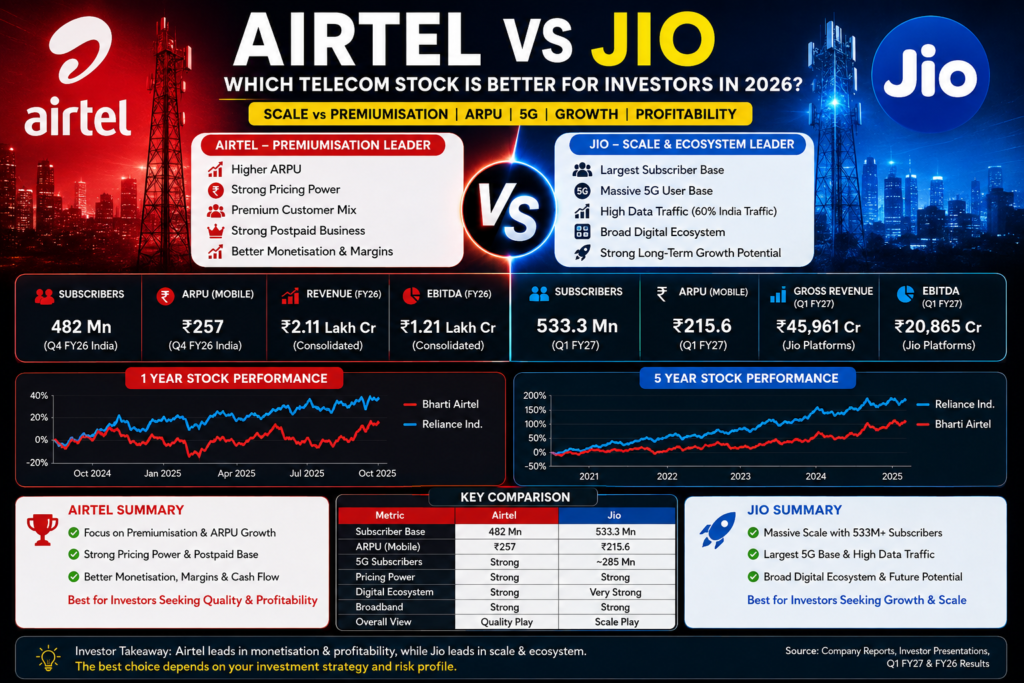
In Q4 FY26, Airtel’s India mobile ARPU reached approximately ₹257, compared with ₹245 a year earlier. Its India customer base was around 482 million.
For investors, this is important because:
Subscriber Growth + ARPU Growth = Higher Revenue Quality
Airtel therefore does not necessarily need explosive subscriber growth if it can continue increasing revenue per customer.
Why Airtel’s ARPU story matters
- Premium customer base
- Strong postpaid presence
- 4G/5G migration
- Potential tariff increases
- Better customer monetisation
- Improving operating leverage
2. Jio’s Biggest Strength: Massive Scale
Jio has a different advantage: scale.
In Q1 FY27, Jio added approximately 8.9 million subscribers, taking its customer base to around 533.3 million.
Jio’s ARPU increased from ₹214 to approximately ₹215.6.
Jio also had around 285 million 5G subscribers, demonstrating the enormous scale of its 5G ecosystem.
Jio’s major strengths
- Largest subscriber base
- Massive 5G user base
- High data consumption
- JioFiber
- JioAirFiber
- Digital services
- Cloud and IoT opportunities
- Strong ecosystem advantage
According to Reliance’s own disclosures, Jio had 533.3 million subscribers in Q1 FY27 and handled approximately 60% of India’s data traffic.
Airtel vs Jio: Investor Comparison
| Factor | Bharti Airtel | Reliance Jio | Advantage |
|---|---|---|---|
| Subscriber Scale | Very Strong | Largest | 🏆 Jio |
| ARPU | Higher | Lower but rising | 🏆 Airtel |
| Premium Customers | Strong | Improving | 🏆 Airtel |
| 5G Scale | Strong | Massive | 🏆 Jio |
| Pricing Power | Strong | Strong | 🏆 Airtel |
| Digital Ecosystem | Strong | Very Strong | 🏆 Jio |
| Customer Monetisation | Strong | Improving | 🏆 Airtel |
| Broadband | Strong | Strong | ⚔️ Close |
| Long-Term Scale | Strong | Very Strong | 🏆 Jio |
| Growth Optionality | Strong | Very Strong | 🏆 Jio |
3. Jio Is More Than Just a Telecom Company
One of the biggest mistakes investors can make is analysing Jio purely as a mobile operator.
Reliance has built Jio into a broader digital ecosystem covering:
- Mobile connectivity
- 5G
- Broadband
- JioFiber
- JioAirFiber
- Entertainment
- Cloud
- IoT
- Digital services
- Commerce
- Financial services
Jio Platforms reported Q1 FY27 gross revenue of approximately ₹45,961 crore, up 12% year over year. EBITDA was approximately ₹20,865 crore, while PAT increased 9.2% to around ₹7,764 crore.
This makes the Jio investment story potentially much broader than traditional telecom.
4. Why Airtel’s Business Quality Is Different
Airtel’s investment thesis is strongly linked to premiumisation.
The basic strategy is:
2G → 4G → 5G → Higher-value plans
As users migrate toward smartphones and higher-speed services, Airtel has an opportunity to increase ARPU.
Its postpaid customer base is another important advantage.
Premium customers can potentially:
- Spend more
- Stay longer
- Adopt family plans
- Use more data
- Generate higher revenue
Therefore, Airtel’s customer quality may matter more than simply counting subscribers.
5. The Real Telecom Game: Tariff Hikes
For telecom investors, one of the most important variables is tariff pricing.
If Airtel and Jio successfully raise tariffs, industry revenue could increase significantly.
The ideal scenario is:
Tariff ↑ + ARPU ↑ + Churn remains controlled
That creates a powerful earnings-growth combination.
However:
Tariff ↑ + Customer Churn ↑↑
could reduce the benefit.
Therefore, investors should track ARPU and churn together.
Jio reported monthly churn of around 1.6% in Q1 FY27, highlighting the importance of customer retention alongside subscriber growth.
6. 5G: Growth Opportunity or Just Capex?
5G is not automatically positive for shareholders.
The key question is:
Can telecom companies turn 5G investment into higher revenue and cash flow?
Jio has achieved enormous 5G scale, with approximately 285 million 5G subscribers in Q1 FY27.
But 5G also requires significant investment in:
- Spectrum
- Network infrastructure
- Capex
- Technology
- Depreciation
Therefore, investors should not focus only on 5G subscriber numbers.
The more important metric is:
5G Monetisation
Can 5G customers eventually generate higher ARPU?
That is where the long-term shareholder value could emerge.
7. Airtel vs Jio: Which One Is Better for Investors?
The answer depends on what type of investment thesis you prefer.
If you prefer Quality + Monetisation
Airtel has an edge.
Reasons:
- Higher ARPU
- Premium customer mix
- Strong postpaid business
- Pricing power
- Strong telecom franchise
- Broadband opportunity
- Potential margin expansion
If you prefer Scale + Growth
Jio has an edge.
Reasons:
- 533+ million subscribers
- Massive 5G base
- Huge data traffic
- Broadband expansion
- Digital ecosystem
- Strong long-term growth optionality
8. Don’t Judge the Stocks Only by Their Charts
The screenshots show the historical price performance of Reliance Industries and Bharti Airtel.
But stock investors should not make a decision based only on price charts.
A proper telecom stock analysis should examine:
Revenue Growth → EBITDA Growth → PAT Growth → Free Cash Flow → Debt → ROE → Valuation → Future Growth
For example, Airtel reported consolidated revenue of roughly ₹2.11 lakh crore in FY26, with EBITDA of around ₹1.21 lakh crore.
Reliance Industries is different because it is a diversified conglomerate rather than a pure telecom company. Its Q1 FY27 revenue was approximately ₹3.40 lakh crore, with EBITDA of around ₹54,067 crore and PAT of approximately ₹23,196 crore.
Therefore:
Bharti Airtel vs Reliance Industries is not a pure telecom comparison.
Investors buying Reliance are getting exposure to multiple businesses, while Airtel provides a much more direct telecom investment thesis.
9. Key Risks for Investors
Bharti Airtel Risks
- High valuation
- Delayed tariff hikes
- Competition from Jio
- High spectrum/network capex
- Regulatory and AGR-related uncertainty
- Africa business risks
Jio/Reliance Risks
- High 5G investment
- Higher depreciation
- Financing costs
- Telecom price competition
- Expectations surrounding a potential Jio IPO
- Reliance’s complex conglomerate valuation
10. Investor Scorecard
If we focus specifically on telecom business quality, an illustrative scorecard could look like this:
| Category | Airtel | Jio |
|---|---|---|
| Customer Quality | ⭐⭐⭐⭐⭐ | ⭐⭐⭐⭐ |
| ARPU | ⭐⭐⭐⭐⭐ | ⭐⭐⭐⭐ |
| Subscriber Scale | ⭐⭐⭐⭐ | ⭐⭐⭐⭐⭐ |
| 5G Scale | ⭐⭐⭐⭐ | ⭐⭐⭐⭐⭐ |
| Pricing Power | ⭐⭐⭐⭐⭐ | ⭐⭐⭐⭐ |
| Digital Ecosystem | ⭐⭐⭐⭐ | ⭐⭐⭐⭐⭐ |
| Profitability Potential | ⭐⭐⭐⭐⭐ | ⭐⭐⭐⭐ |
| Growth Potential | ⭐⭐⭐⭐ | ⭐⭐⭐⭐⭐ |
| Capital Efficiency | ⭐⭐⭐⭐ | ⭐⭐⭐⭐ |
| Overall Telecom Score | 8.5/10 | 8.4/10 |
Important: This is a qualitative business scorecard, not a stock recommendation or target price.
11. The ₹300 ARPU Opportunity
One of Airtel’s biggest long-term opportunities is further ARPU expansion.
If the industry gradually moves toward:
₹250 → ₹275 → ₹300 ARPU
telecom companies could potentially increase revenue and EBITDA without requiring massive subscriber growth.
That creates an important investment thesis:
Future telecom growth may come not only from acquiring new customers, but also from generating more revenue from existing customers.
However, ₹300 ARPU should be treated as a potential target, not a guaranteed outcome. It depends on tariff hikes, competition, customer mix, and regulatory conditions.
Final Verdict: Airtel or Jio?
The Indian telecom sector is increasingly becoming a story of monetisation rather than just subscriber acquisition.
Airtel Investment Thesis
Premium Customers → Higher ARPU → Better Monetisation → Strong Margins → Cash Flow
Jio Investment Thesis
Massive Scale → 5G Leadership → Data Growth → Broadband → Digital Services → Ecosystem Expansion
Therefore:
🏆 Airtel
Quality + ARPU + Pricing Power + Monetisation
🚀 Jio
Scale + 5G + Digital Ecosystem + Growth Optionality
For investors focused on business quality and monetisation, Airtel can look more attractive.
For investors focused on scale, 5G and long-term ecosystem growth, Jio can offer a compelling opportunity.
But the final investment decision should not be based on subscriber numbers alone.
The most important dashboard is:
ARPU + Subscriber Growth + Churn + 5G Monetisation + EBITDA Margin + Free Cash Flow + Debt + Valuation
That combination can help investors identify who is simply growing bigger—and who is actually creating more shareholder value.
Disclaimer
Disclaimer: This article is for educational and informational purposes only and does not constitute investment advice, financial advice, or a recommendation to buy, sell, or hold any stock or security. The information and data presented are based on publicly available company reports, investor presentations, market data, and other sources believed to be reliable, but they may contain errors, omissions, or become outdated. Past stock performance does not guarantee future returns. Investors should conduct their own research, evaluate their risk tolerance, and consult a SEBI-registered investment adviser before making any investment decision.