
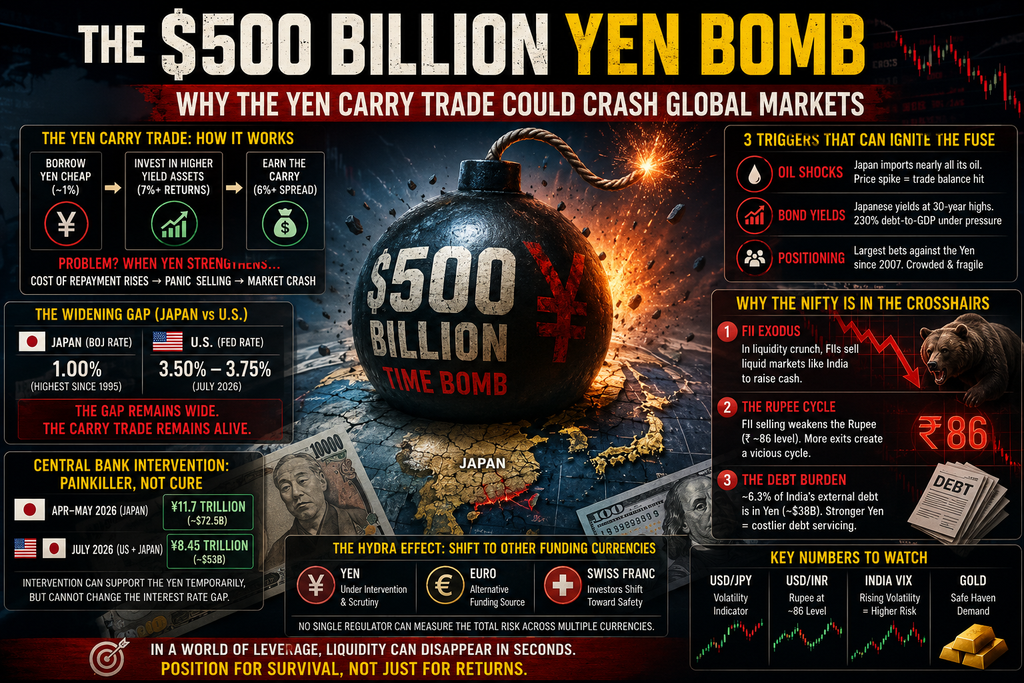
The Hook: A Financial Shock That Started in Japan
On August 5, 2024, global markets experienced one of the clearest demonstrations of how a seemingly obscure currency strategy can suddenly become an equity-market problem.
Japan’s Nikkei 225 plunged roughly 12% in a single session, while volatility exploded across global markets. The move was not caused by a conventional banking collapse or a military conflict. Instead, investors were dealing with a violent repricing of leveraged positions linked partly to the Japanese yen.
The mechanism was simple but powerful:
Borrow cheaply → invest in higher-return assets → yen strengthens → leveraged positions lose money → investors sell assets → buy yen → more selling → more volatility.
That is the basic anatomy of a yen carry-trade unwind.
UBS estimated in August 2024 that the dollar-yen carry trade could have reached at least $500 billion at its peak, with roughly $200 billion already unwound at that stage. However, the Bank for International Settlements (BIS) has repeatedly warned that the true size of carry trades is difficult to measure because many positions sit across derivatives, offshore entities and different balance sheets. One BIS measure put yen-denominated loans to non-banks outside Japan at about ¥40 trillion, or $250 billion, while broader cross-border bank claims linked to offshore structures exceeded ¥80 trillion, roughly $500 billion.
So the “500 billion yen bomb” should not be interpreted as a precisely measurable single trade.
It is better understood as a symbol for a much larger web of leveraged positions connected to cheap yen funding.
And in 2026, that risk has not disappeared.
It has changed shape.
1. What Exactly Is the Yen Carry Trade?
Imagine you can borrow money at 1% and invest it in an asset yielding 7%.
Your theoretical gross interest advantage is:
7% − 1% = 6%
Now scale that trade using billions of dollars and leverage.
This is essentially the logic behind a carry trade.
Japan became one of the world’s most important funding sources because the country spent decades operating with extremely low interest rates.
Investors could:
- Borrow yen.
- Convert yen into dollars or another currency.
- Buy bonds, equities, commodities, or other assets.
- Earn the difference between funding costs and investment returns.
- Repeat the process using leverage.
The strategy works beautifully when:
- Japanese rates remain low.
- The yen remains weak or stable.
- Global volatility stays low.
- Risk assets continue rising.
The problem begins when these assumptions reverse.
2. The Real Enemy Is Not the Interest Rate — It’s the Exchange Rate
This is the part many investors miss.
Suppose a hedge fund borrows ¥10 billion.
When the yen is weak, repayment may look relatively cheap in dollar terms.
But if the yen suddenly appreciates 10%, the fund needs substantially more dollars to buy back the yen required to repay the loan.
That creates a dangerous feedback loop.
The Carry Trade Unwind
Yen strengthens
↓
Cost of repaying yen debt rises.
↓
Leveraged investors reduce positions
↓
Stocks, bonds and crypto are sold.
↓
Cash is raised
↓
Investors buy yen
↓
Yen strengthens further
↓
More carry trades become unprofitable.
↓
More selling
This is why a currency move can suddenly become an equity-market event.
The BIS identified exactly this kind of procyclical deleveraging during the August 2024 turmoil.
3. August 2024 Was the Warning Shot
The August 2024 episode is important because it showed how quickly leverage can move across asset classes.
The BIS noted that carry trades were hit by deleveraging pressures and that volatility was amplified by margin increases and forced position reductions. It also highlighted the difficulty of accurately measuring the overall size of these trades.
Another BIS analysis found that the incentives for yen-funded carry trades had increased substantially before the 2024 shock. Its estimated measure of net yen supply available to market participants increased by approximately ¥66 trillion, equivalent to about $435 billion at Q1 2024 exchange rates, between the end of 2021 and Q1 2024.
That is an important lesson:
The danger is not simply the amount of money borrowed.
The danger is the combination of:
Leverage + currency movement + low volatility + crowded positioning.
4. Why the “Bomb” Is Back in Focus in 2026
The global monetary landscape has changed dramatically.
The Federal Reserve’s target range currently stands at 3.50%–3.75%, according to the latest official data available from the Fed. At its July 2026 meeting, the FOMC kept the range unchanged, although three members voted for a 25-basis-point hike.
That means the U.S.-Japan interest-rate relationship remains a major variable for currency traders.
But something else has changed:
Japan is no longer willing to watch the yen weaken indefinitely.
In 2026, Japanese authorities have already demonstrated a willingness to intervene aggressively in the currency market.
5. Japan Has Already Spent Tens of Billions Defending the Yen
This is one of the biggest differences between today’s environment and the old carry-trade regime.
During April-May 2026, Japan spent approximately ¥11.7 trillion, or around $72.5 billion, supporting the yen.
The largest single operation was approximately ¥6.28 trillion, or about $39.6 billion, on April 30.
Then came another major development.
In late July 2026, the United States and Japan coordinated an intervention designed to support the yen. Japanese authorities reportedly bought approximately ¥8.45 trillion, around $53 billion, while the United States also participated.
That is extraordinary because it tells markets something very important:
The yen has become a policy issue, not merely a market issue.
6. Intervention Is a Painkiller — Not a Cure
Currency intervention can temporarily change supply and demand.
But intervention does not automatically eliminate the economic incentives behind carry trades.
If investors can still:
- borrow cheaply,
- invest elsewhere,
- earn higher returns,
- and expect the yen to remain weak,
the carry trade can return.
This is why intervention creates a difficult policy dilemma.
Japan wants:
A stable yen + manageable inflation + competitive exports + sustainable interest rates.
Markets want:
Maximum return with minimum currency risk.
Those objectives do not always align.
And if traders believe that Japanese authorities will defend specific exchange-rate levels, intervention can itself become part of the trading strategy.
7. The Carry Trade Is Becoming a Multi-Currency Problem
This is where the story becomes more complicated.
The yen has historically been one of the most important funding currencies.
But investors do not have to borrow only yen.
They can potentially use:
- Japanese yen
- Swiss franc
- Euro
- other low-yielding currencies
Recent market reporting shows investors increasingly looking toward the Swiss franc as another funding currency following renewed Japanese intervention. Reuters reported on August 19, 202,6 that investors were shifting attention toward the franc as a potential carry-trade funding currency.
This creates what can be called the “Hydra Effect.”
Cut one head, and another appears.
If yen funding becomes more expensive or politically dangerous, capital can migrate toward another low-cost funding currency.
That makes the overall risk harder to measure.
8. The Biggest Risk: Volatility
Carry trades do not necessarily require an extremely large interest-rate gap to work.
They require the gap to remain attractive relative to currency volatility.
Consider two situations.
Scenario A: Low Volatility
Currency moves only 1–2%.
A trader earns a large interest differential.
The strategy looks attractive.
Scenario B: High Volatility
The funding currency suddenly appreciates 5–10%.
The interest income may become irrelevant.
The currency loss overwhelms the carry.
This is why volatility is the real enemy.
A sudden rise in:
- VIX
- FX volatility
- bond volatility
- oil volatility
can cause leveraged investors to reduce positions simultaneously.
9. The Three Triggers That Could Ignite the Yen Bomb
Trigger #1: Another Sharp Yen Rally
A sudden yen appreciation would immediately hurt short-yen positions.
The more crowded the positioning, the greater the potential liquidation.
The August 2024 episode demonstrated how quickly this can spill into global equities.
Trigger #2: Japanese Bond Yields
Japan’s government debt burden makes the domestic bond market extremely important.
Higher Japanese yields can create two effects.
First:
Japanese assets become more attractive.
Second:
The opportunity cost of keeping money abroad increases.
That can encourage Japanese capital to return home and make yen-funded positions less attractive.
At the same time, higher Japanese yields increase pressure on the government’s enormous debt burden.
This creates a difficult balancing act:
Raise rates too slowly → yen weakness.
Raise rates too quickly → bond-market and economic stress.
Trigger #3: Oil Shock
Japan imports most of the energy it consumes.
A major oil-price spike can therefore create a negative shock to Japan’s trade balance.
The chain reaction can look like:
Oil ↑
→ Japan’s import bill ↑
→ trade balance deteriorates
→ yen comes under pressure
→ authorities intervene
→ market volatility rises
→ carry traders reassess positions
A geopolitical oil shock therefore has the potential to become a currency-market shock.
10. Why the Indian Nifty Is in the Blast Zone
This is where Indian investors should pay attention.
The Nifty does not need Japanese investors to directly own Indian stocks for a yen carry unwind to affect India.
Global funds operate through interconnected portfolios.
When leverage is reduced, investors often sell the assets that are:
- liquid,
- profitable,
- easy to hedge,
- easy to convert into cash.
India’s large-cap equities fit that description.
So a global deleveraging event can create selling pressure even when India’s domestic fundamentals remain relatively strong.
11. The FII Exit Channel
Imagine a global hedge fund has:
- Japanese yen liabilities
- U.S. equity positions
- Indian equity positions
- emerging-market currency exposure
- bond positions
- derivatives
Suddenly the yen appreciates sharply.
The fund needs cash.
It does not necessarily sell the asset with the worst fundamentals.
It may sell the asset with the best liquidity.
That means Indian large caps can become a source of emergency liquidity.
This is one reason why:
Strong fundamentals do not guarantee immunity from global liquidity shocks.
12. The Rupee Could Become the Second Pressure Point
There is another potential feedback loop.
If foreign investors sell Indian assets, they may convert rupees into dollars.
That increases demand for dollars and can put downward pressure on the rupee.
Then:
FII selling → Rupee weakness → foreign investors’ dollar losses increase → additional hedging/selling
This is not guaranteed to happen in every correction, but it is one of the mechanisms investors should monitor.
13. India’s Yen-Denominated External Debt Is a Hidden Variable
There is a real yen connection inside India’s external debt structure.
According to the Government of India’s latest quarterly external-debt report available for December 2025, Japanese yen-denominated debt represented 6.3% of India’s external debt. U.S.-dollar debt accounted for 54.8%, rupee debt 30.1%, SDRs 4.,3% and euro debt 3.7%.
This is important.
If the yen appreciates sharply, the rupee value of yen-denominated liabilities can increase.
However, investors should not interpret the entire 6.3% as direct corporate exposure to a yen carry trade. External debt includes different borrowers, structures and hedging arrangements.
The correct conclusion is:
A stronger yen can increase the servicing burden on some Indian borrowers with unhedged or inadequately hedged yen liabilities.
14. The “Double Carry Trade” Problem
There is another layer.
Global investors can construct carry trades across several emerging-market currencies.
That means a single global volatility shock can hit:
Yen → Yuan → Rupee → Emerging Markets
simultaneously.
The August 2024 sell-off demonstrated that the impact of carry-trade deleveraging can spread well beyond Japan. The BIS noted that investment currencies in emerging markets also weakened as funding currencies such as the yen appreciated.
That is why investors should not look at USD/JPY in isolation.
The bigger picture is:
USD/JPY + USD/INR + CNH + VIX + U.S. yields + JGB yields
15. The Most Important Indicator: USD/JPY
For Indian investors, USD/JPY can act as an early warning indicator.
If USD/JPY rises steadily:
The yen is weakening.
Carry trades may remain attractive.
If USD/JPY suddenly collapses:
The yen is strengthening.
Short-yen positions may start losing money.
If USD/JPY falls rapidly while VIX rises:
This becomes much more dangerous.
That combination can signal a broader deleveraging event.
16. Watch These 7 Indicators Before Panicking
Investors don’t need to predict the exact day of a crash.
They need to monitor the conditions that make a crash more likely.
Global Carry-Trade Risk Dashboard
| Indicator | What to Watch | Risk Signal |
|---|---|---|
| USD/JPY | Sharp yen appreciation | 🔴 High |
| India VIX | Sudden volatility spike | 🔴 High |
| U.S. 10Y Yield | Rapid rise/fall | 🟠 Elevated |
| JGB Yields | Fast increase | 🟠 Elevated |
| FII Flows | Heavy equity selling | 🔴 High |
| USD/INR | Sudden rupee weakness | 🟠 Elevated |
| Gold | Strong safe-haven buying | 🟡 Warning |
The most dangerous combination would be:
Yen ↑ + VIX ↑ + FII selling ↑ + Rupee ↓
That is the environment where a carry-trade unwind can turn into an emerging-market equity correction.
17. What Could Happen to the Nifty?
Nobody can accurately predict the exact Nifty decline from a future carry-trade unwind.
But we can think in scenarios.
Scenario 1 — Mild Unwind
Yen appreciates gradually.
Central banks communicate clearly.
Volatility stays contained.
Potential result:
Short-term correction in risk assets, followed by stabilization.
Scenario 2 — Medium Unwind
Yen appreciates rapidly.
VIX rises.
FIIs start selling emerging markets.
Rupee weakens.
Potential result:
Nifty faces significant volatility and high-PE stocks underperform.
Scenario 3 — Severe Global Deleveraging
Yen spikes sharply.
U.S. bond yields become unstable.
VIX surges.
Carry trades across yen, franc and other currencies unwind simultaneously.
FIIs sell emerging-market assets.
Potential result:
The market can experience a disorderly correction where fundamentals temporarily become secondary to liquidity.
That is the real “yen bomb.”
18. Gold Could Become the Shock Absorber
Gold is increasingly important in this environment because the risk is not limited to equities.
The current macro environment combines:
- geopolitical uncertainty,
- elevated sovereign debt,
- currency intervention,
- volatile bond markets,
- inflation uncertainty,
- central-bank policy divergence.
Recent market moves have again shown strong demand for traditional and alternative safe-haven assets during bond and currency stress. Reuters reported that gold surged alongside other safe-haven assets during recent market volatility.
But gold should not be treated as a guaranteed hedge.
It can also experience short-term corrections when investors are forced to raise cash.
19. What Should Long-Term Indian Investors Do?
The answer is not to sell everything.
It is to understand liquidity risk.
1. Avoid Extreme Valuations
Companies trading at very high multiples can experience disproportionate declines when global liquidity disappears.
A good company can still be a bad investment at the wrong valuation.
2. Prefer Strong Balance Sheets
During liquidity crises, debt becomes dangerous.
Look for:
- manageable debt
- strong operating cash flow
- sustainable margins
- reasonable valuations
- strong competitive advantages
3. Reduce Unnecessary Leverage
The most dangerous portfolio during a global volatility shock is not necessarily a stock portfolio.
It is a leveraged stock portfolio.
Futures, options, and margin positions can magnify a normal correction into a permanent capital loss.
4. Keep Liquidity
Cash is not exciting.
But during a forced-selling event, liquidity becomes an asset.
Investors with cash can buy when leveraged investors are forced to sell.
5. Watch FII Flows — But Don’t Trade Them Blindly
FII selling alone does not mean a crash is coming.
But FII selling combined with:
Rupee weakness + rising VIX + yen strength + falling global equities
is much more important.
20. The Bigger Lesson: This Is Not Just a Yen Story
The biggest mistake would be to think:
“I don’t trade the yen, so this doesn’t affect me.”
Modern financial markets are interconnected.
A hedge fund can borrow in Tokyo, hedge in London, buy Treasuries in New York and own equities in Mumbai.
One currency movement can therefore affect several markets simultaneously.
That is exactly why carry trades can create cross-asset contagion.
The BIS described the August 2024 event as an example of volatility being amplified by procyclical deleveraging and margin increases.
21. The $500 Billion Number Needs a Big Asterisk
There is an important distinction investors should understand.
T500 billion ” yen-yen carry trade” is not an official central-bank balance-sheet figure.
UBS used the figure as an estimate of the size of the dollar-yen carry trade at its peak in 2024.
The BIS, meanwhile, has shown that the observable components of yen funding can produce different estimates depending on what is included.
For example:
- UBS estimated the carry trade at at least $500 billion.
- BIS estimated a rough $250 billion middle ballpark for FX carry trades going into the August 2024 event.
- BIS also identified more than $500 billion in cross-border yen bank claims on certain offshore segments, although those claims were not synonymous with carry trades.
Therefore, the most accurate way to describe the risk is:
The yen-funded leverage ecosystem may be hundreds of billions of dollars in scale, but its exact size cannot be measured precisely.
That uncertainty is itself part of the risk.
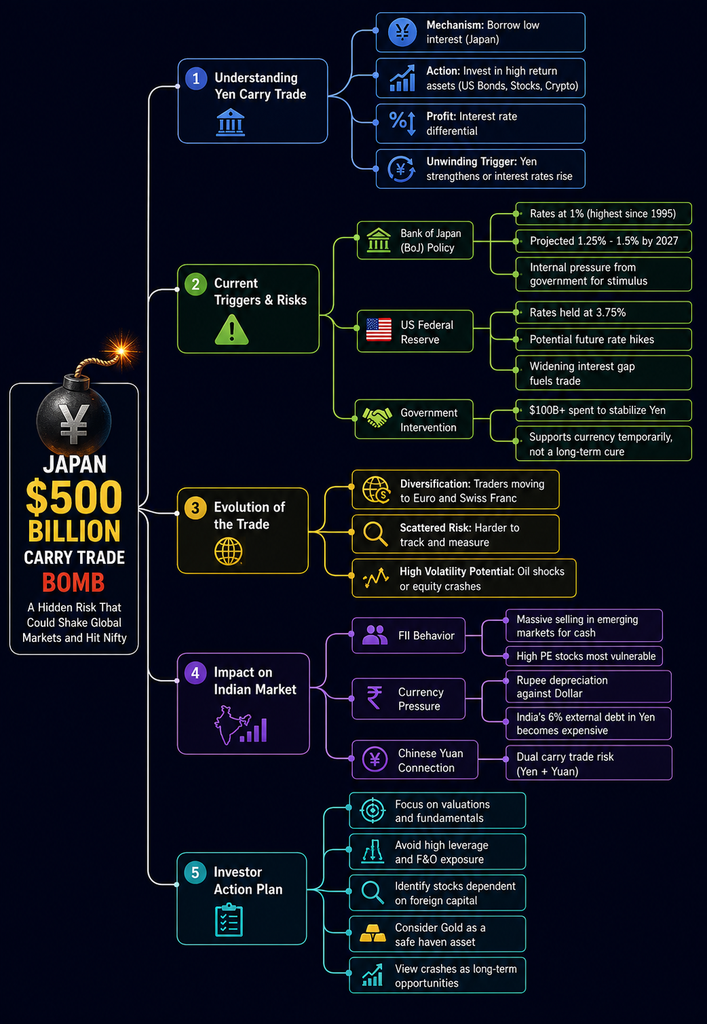
22. The Real “Bomb” Is the Feedback Loop
The biggest threat isn’t necessarily $500 billion disappearing from the market.
The bigger threat is forced deleveraging.
Imagine:
Yen +5%
↓
Carry trade loses money.
↓
Hedge funds sell equities.
↓
Equity volatility rises
↓
Margin requirements increase
↓
Funds sell more assets
↓
Emerging-market currencies weaken
↓
Rupee falls
↓
More hedging
↓
More selling
↓
Global volatility rises again
That is a feedback loop.
And feedback loops are what turn ordinary market corrections into financial accidents.
23. Final Warning for Nifty Investors
The yen carry trade is not a prediction that the Nifty will crash.
It is a risk framework.
The key question is not:
“Will the yen bomb explode?”
The better question is:
“What happens if the yen suddenly strengthens while global volatility rises?”
If that happens at the same time as:
- U.S. bond yields become unstable,
- Japanese yields rise,
- FIIs sell aggressively,
- USD/INR weakens,
- VIX jumps,
- and global equities fall,
then the probability of a severe liquidity-driven correction increases.
The August 2024 episode proved that these cross-market mechanisms can move extremely quickly.
Conclusion: Don’t Fear the Bomb — Understand the Fuse
The $500 billion figure should not be treated as an exact countdown clock.
It is a reminder that the global financial system has accumulated enormous amounts of leverage around interest-rate differences and currency stability.
Japan has already demonstrated in 2026 that it is willing to intervene heavily to defend the yen. The United States has now participated in coordinated action. At the same time, investors are exploring alternative funding currencies such as the Swiss franc.
That means the carry trade is evolving rather than simply disappearing.
For Indian investors, the lesson is simple:
Don’t build a portfolio that requires perfect global liquidity conditions to survive.
Focus on:
Quality + Valuation + Cash Flow + Low Leverage + Liquidity + Risk Management.
Because when the global carry trade begins to unwind, the market does not ask:
“Is this company fundamentally good?”
For a brief period, it asks:
“Who needs cash right now?”
And that is when even the strongest portfolios can get caught in the blast zone.
SEO FAQ
What is the yen carry trade?
The yen carry trade involves borrowing Japanese yen at relatively low funding costs and investing the proceeds in higher-yielding assets or currencies. Investors profit from the interest-rate differential as long as currency movements and volatility do not erase the gains.
How big is the yen carry trade?
Its exact size cannot be measured precisely. UBS estimated that the dollar-yen carry trade reached at least $500 billion at its peak in 2024, while BIS estimates based on different datasets produce smaller or broader figures.
Why does a stronger yen hurt global stocks?
A stronger yen can make yen-funded borrowing more expensive to repay. Leveraged investors may then sell equities and other risk assets to raise cash and buy yen, creating a potential feedback loop.
Can a yen carry-trade unwind crash the Nifty?
It can contribute to a sharp correction, especially if it occurs alongside rising global volatility, heavy FII selling, rupee weakness and falling global equities. It does not automatically mean the Nifty will crash.
What should Indian investors watch?
The most useful indicators include USD/JPY, USD/INR, India VIX, FII flows, U.S. Treasury yields, Japanese government bond yields and gold.
Is the 500 billion yen bomb real?
The $500 billion figure is an estimate rather than an officially measured single position. The underlying yen-funded leverage ecosystem is real, but its precise size is difficult to calculate because positions are distributed across banks, derivatives, offshore entities and different asset classes.
Risk Disclaimer: This article is for educational and informational purposes only. It is not investment advice, a recommendation to buy or sell securities, or a prediction of future market prices. Carry-trade and macroeconomic risks can evolve rapidly, and investors should conduct their own research and consider their risk tolerance before making investment decisions.
Top 10 titles :
- The 500 Billion Yen Bomb: Why the Yen Carry Trade Could Crash Global Markets
- Yen Carry Trade 2026: The $500 Billion Risk That Could Hit Nifty 50
- The 500 Billion Yen Carry Trade: Why Your Portfolio Is in the Blast Zone
- Yen Carry Trade Unwind: Why Nifty 50 and Global Stocks Could Face a Shock
- Japan’s Yen Bomb Is Back: The Carry Trade Risk Every Indian Investor Must Watch
- Yen Carry Trade Explained: How Japan’s Cheap Money Could Trigger a Global Sell-Off
- $500 Billion Carry Trade Warning: Why Nifty Investors Should Watch the Yen
- The Yen Carry Trade Crisis: How Japan Could Trigger the Next Global Market Shock
- Yen Carry Trade 2026 Explained: Why India’s Nifty Could Be in the Crosshairs
- Japan’s 500 Billion Yen Bomb: 7 Warning Signs Indian Investors Can’t Ignore