
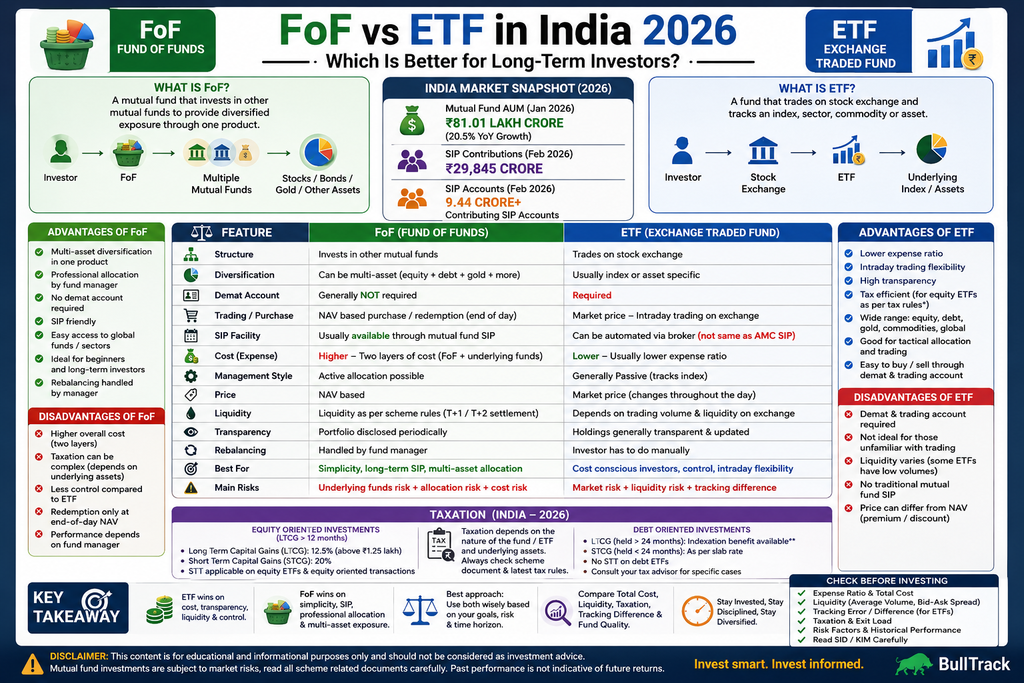
FoF vs ETF: The Investment Choice Every Indian Investor Should Understand
Indian investors today have more investment choices than ever before. You can invest directly in stocks, mutual funds, index funds, Exchange Traded Funds (ETFs) and Fund of Funds (FoFs).
But two products are increasingly confusing retail investors:
FoF vs ETF.
Both can provide diversification. Both can give exposure to equities, bonds, gold or international markets. But their structure, costs, liquidity, taxation and investor experience can be very different.
The Indian mutual fund industry itself has expanded rapidly. AMFI data shows that mutual fund industry AUM reached approximately ₹81.01 lakh crore in January 2026, up 20.5% year-on-year. SIP contributions were around ₹29,845 crore in February 2026, with about 9.44 crore contributing SIP accounts.
That makes understanding the difference between FoFs and ETFs more important than ever.
What Is a Fund of Funds (FoF)?
A Fund of Funds is a mutual fund scheme that invests primarily in units of other mutual funds or schemes.
Instead of selecting individual stocks yourself, the FoF can allocate money across underlying funds.
For example:
Investor → FoF → Multiple Mutual Funds → Stocks/Bonds/Gold
A multi-asset FoF could potentially provide exposure to equity, debt and gold through one investment product.
SEBI describes FoFs as schemes that invest primarily in other mutual fund schemes, allowing investors to achieve diversification through a single scheme.
Why investors choose FoFs
FoFs can be attractive for investors who want:
- Simplicity
- Professional allocation
- Diversification
- SIP investing
- Exposure to multiple asset classes
- Less need for manual portfolio management
However, there is an important cost consideration.
A FoF can have two layers of expenses—the FoF itself and the underlying funds. AMFI notes that FoF expenses are regulated, with different TER limits depending on the underlying investments.
What Is an ETF?
An Exchange Traded Fund is a fund that trades on a stock exchange like a share.
Instead of buying or redeeming units directly from the AMC in the same way as a normal mutual fund, investors generally buy and sell ETF units through the exchange.
The basic structure is:
Investor → Stock Exchange → ETF → Underlying Index/Assets
For example, an ETF may track:
- Nifty 50
- Sensex
- Nifty Next 50
- Banking indices
- Gold
- Silver
- Government bonds
- International indices
SEBI explains that ETFs trade on stock exchanges and their prices can change throughout the trading day. ETF investing requires a demat and trading account.
AMFI also notes that ETFs are passively managed and designed to track an underlying index or asset with relatively low administrative costs.
FoF vs ETF: The Biggest Difference
The simplest way to understand the difference is:
FoF = convenience + professional allocation
ETF = low cost + control + exchange liquidity
A FoF is generally better suited to investors who want someone else to manage the allocation between underlying funds.
An ETF is more suitable for investors who want direct control over when and at what market price they buy or sell.
FoF vs ETF Comparison
| Feature | FoF | ETF |
|---|---|---|
| Structure | Invests in other funds | Trades on stock exchange |
| Diversification | Can be multi-asset | Usually index/asset specific |
| Demat | Generally not required | Required |
| Trading | NAV-based purchase/redemption | Intraday exchange trading |
| SIP | Usually available, subject to scheme | Can be automated through broker, but not the same as AMC mutual-fund SIP |
| Cost | Usually higher | Usually lower |
| Management | Active allocation possible | Generally passive |
| Price | NAV-based | Market price |
| Liquidity | Scheme redemption rules | Depends on exchange trading volume |
| Transparency | Portfolio/fund disclosures | Holdings generally transparent |
| Rebalancing | Can be handled by fund manager | Investor generally does it |
| Best for | Simplicity | Cost-conscious investors |
| Main risk | Underlying funds + allocation + costs | Market + liquidity + tracking difference |
1. Cost: ETF Has the Advantage
One of the strongest arguments for ETFs is cost efficiency.
Because ETFs generally follow an index instead of trying to generate active alpha, their operating costs can be relatively low.
AMFI explains that passive products such as index funds and ETFs generally have lower expense ratios than active funds.
FoFs have a structural disadvantage here.
You can potentially pay:
FoF expenses + expenses of underlying funds
This doesn’t automatically make every FoF expensive, but investors must check the total expense structure rather than looking only at the headline TER.
AMFI specifically states that FoFs have two levels of expenses.
Long-term compounding makes cost important
Consider a hypothetical ₹10 lakh investment.
If two portfolios generate the same gross return but one costs 0.50% more every year, the difference can become significant over 10–20 years because the investor loses both the annual cost and the compounding on that lost money.
Small costs can become high costs over long periods.
2. Liquidity: ETF Has Intraday Advantage
This is another major difference.
ETF
An ETF can be bought or sold during market hours.
Therefore, investors can potentially:
- Buy during a market correction
- Sell during market hours
- Use limit orders
- React to market conditions
- Control the execution price
But there is a catch.
Not every ETF has good liquidity.
A low-volume ETF can have:
- Wider bid-ask spreads
- Lower trading depth
- Larger price deviations from NAV
Therefore, investors should not simply select an ETF because its expense ratio is low.
Liquidity matters.
3. FoF Liquidity Works Differently
An open-ended FoF is generally bought and redeemed based on its NAV, subject to the scheme’s applicable cut-off, settlement and exit-load rules.
This is fundamentally different from exchange trading.
SEBI explains that open-ended mutual funds allow investors to purchase or redeem units at NAV on business days.
So:
FoF: NAV-based mutual-fund transaction
ETF: Exchange-based market transaction
This distinction is extremely important during volatile markets.
4. Diversification: FoF Can Be More Convenient
Suppose an investor wants:
- 50% equity
- 30% debt
- 20% gold
Building this portfolio manually may require several products and periodic rebalancing.
A suitable multi-asset FoF may provide a simpler structure.
That is one of the biggest advantages of FoFs.
ETF approach
An investor could instead build the same broad allocation using multiple ETFs.
For example:
Equity ETF + Debt ETF + Gold ETF
But then the investor becomes responsible for:
- Asset allocation
- Rebalancing
- ETF selection
- Liquidity checking
- Tracking difference monitoring
Therefore:
FoF = convenience
ETF = control
5. SIP: FoF Is Simpler
FoFs can generally be used through the traditional mutual-fund SIP framework, depending on the individual scheme.
This is particularly useful for investors who want to invest a fixed amount every month without worrying about market timing.
ETF investing can also be automated through a broker, but buying ETF units on the exchange is not identical to an AMC mutual-fund SIP.
This distinction is important.
For beginners, the traditional mutual-fund SIP mechanism can therefore feel much simpler.
And SIP adoption in India is already massive.
AMFI reported approximately ₹29,845 crore of SIP contributions in February 2026, with 9.44 crore contributing SIP accounts.
6. Taxation: Don’t Assume All FoFs Are Taxed Like Equity ETFs
This is one area where investors need to be particularly careful.
A common mistake is:
“ETF = equity taxation and FoF = debt taxation.”
That is too simplistic.
Tax treatment depends on the nature and structure of the specific fund.
For equity-oriented investments meeting the relevant tax conditions, current capital-gains rules include:
- 20% STCG for specified equity-oriented transactions
- 12.5% LTCG for specified long-term gains
- The relevant LTCG exemption threshold under Section 112A is ₹1.25 lakh per financial year, subject to applicable conditions.
But not every FoF automatically qualifies for the same equity-oriented treatment.
AMFI itself has highlighted the taxation issue surrounding FoFs investing in equity-oriented mutual funds and sought greater parity in taxation.
Therefore, before investing:
Check the scheme’s:
- Tax classification
- Underlying assets
- Holding period rules
- Applicable capital-gains rate
- STT applicability
- Current tax rules
Never choose between FoF and ETF purely on a generic taxation chart.
7. Transparency: ETF Usually Wins
ETF investors generally know what index or asset the ETF is designed to track.
For example:
Nifty 50 ETF → Nifty 50
Gold ETF → Gold
Nifty Bank ETF → Banking index
The investor can monitor the underlying benchmark and ETF performance.
However, ETFs can experience tracking difference/error.
AMFI defines tracking error as the difference between the scheme’s returns and those of its underlying benchmark.
So an ETF with a low expense ratio isn’t automatically the best ETF.
Investors should also check:
- Tracking difference
- Tracking error
- AUM
- Average trading volume
- Bid-ask spread
- Fund history
- Underlying index
- Fund house
8. FoF Risk: The Fund Manager Still Matters
A FoF may appear diversified, but investors should look deeper.
Suppose a FoF invests heavily in only two underlying funds.
It may look like a diversified product at the top level while still having significant concentration underneath.
Therefore, investors should examine:
FoF → Underlying funds → Actual stocks/securities
This is sometimes called look-through analysis.
The name of the FoF alone doesn’t tell you the real risk.
9. ETF Risk: Low Cost Doesn’t Mean Low Risk
This is another major misconception.
An ETF can be very cheap and still fall sharply.
For example:
Nifty ETF
If Nifty falls 20%, a Nifty ETF will generally experience a broadly similar decline, subject to tracking difference and costs.
Similarly:
Sector ETF
can experience much greater concentration risk than a broad-market ETF.
AMFI notes that mutual fund investments are subject to market, liquidity and other investment risks and that returns are not guaranteed.
So:
Low cost ≠ Low risk
10. Which Is Better for a Beginner?
For a beginner, the answer depends on the investor.
Choose FoF if you:
- Want simplicity
- Prefer SIP investing
- Don’t want to manage multiple funds
- Want professional asset allocation
- Don’t have much experience with trading platforms
- Prefer NAV-based mutual-fund investing
- Want a single product for diversified exposure
Choosean ETF if you:
- Already have a demat account
- Understand market orders and limit orders
- Want low costs
- Want direct control
- Prefer passive investing
- Can monitor liquidity
- Are comfortable rebalancing your portfolio
11. What About Long-Term Wealth Creation?
For long-term investors, the most important factors are not simply FoF vs ETF.
You should consider:
1. Cost
Lower costs can improve long-term compounding.
2. Asset allocation
A diversified portfolio can be more important than choosing between two wrappers.
3. Tracking quality
For passive ETFs, tracking difference matters.
4. Taxation
Tax treatment can materially affect post-tax returns.
5. Behaviour
The best investment is useless if the investor repeatedly buys high and sells low.
12. A Better 2026 Strategy: Don’t Think Only in Black and White
Instead of asking:
“FoF or ETF?”
A better question is:
“Which part of my portfolio should be FoF and which part should be ETF?”
For example, a hypothetical investor could use:
Core Portfolio
Broad-market ETF
↓
Diversification
Multi-asset FoF
↓
Satellite Allocation
Sector/commodity/international ETF
This creates a hybrid structure.
But the exact allocation should depend on:
- Risk tolerance
- Investment horizon
- Income stability
- Existing portfolio
- Tax situation
- Financial goals
FoF vs ETF: My Verdict for 2026
There is no universal winner.
🏆 ETF wins on:
- Cost
- Transparency
- Intraday liquidity
- Investor control
- Passive exposure
- Long-term cost efficiency
🏆 FoF wins on:
- Simplicity
- Professional allocation
- SIP convenience
- Multi-asset diversification
- Less portfolio maintenance
The important point is that the product wrapper isn’t the investment thesis.
A cheap ETF tracking a poor or highly concentrated index may be less suitable than a well-designed FoF.
Likewise, a convenient FoF with high underlying costs and weak performance may be inferior to a low-cost broad-market ETF.
Final Takeaway
The Indian investment landscape is changing rapidly.
With mutual-fund AUM already above ₹81 lakh crore and monthly SIP flows close to ₹30,000 crore, Indian investors are increasingly building long-term portfolios through pooled investment products.
The real decision isn’t simply:
FoF vs ETF.
It is:
Cost + Tax + Liquidity + Diversification + Risk + Behaviour.
If you want maximum simplicity, a suitable FoF can make sense.
If you want maximum control and lower costs, ETFs can be powerful.
And for many investors, a carefully constructed hybrid approach can combine the strengths of both.
Don’t buy a fund because it is cheap. Don’t buy a FoF because it is convenient. Understand what is underneath, what it costs, how it is taxed and how it behaves during a market crash.
That is what ultimately determines whether the investment helps you build wealth.
SEO FAQ
Is FoF better than ETF?
Not necessarily. FoFs offer greater convenience and can provide multi-asset allocation, while ETFs generally offer lower costs and exchange-based trading.
Is an ETF cheaper than a FoF?
Generally, ETFs can have lower ongoing expenses because they usually track an index. FoFs can involve expenses at both the FoF and underlying-fund levels.
Does an ETF require a demat account?
Yes. SEBI and AMFI state that ETF units are traded on exchanges and require demat/trading infrastructure.
Does FoF require a demat account?
Generally, no. Mutual fund investors can invest without holding units in demat form, although demat holding may be available as an option depending on the platform/scheme.
Can I do SIP in an ETF?
You can automate recurring ETF purchases through a broker, but this is different from a conventional mutual-fund SIP because ETF units are purchased on the exchange at market prices.
Which is better for long-term investment: ETF or FoF?
For investors focused on low costs and passive investing, ETFs can be attractive. For investors prioritising simplicity and professional allocation, FoFs may be more suitable.
Important corrections I made from your screenshots
Your original presentation says “FoF = guaranteed at NAV”. I would change this to “NAV-based purchase/redemption, subject to scheme terms” because mutual funds are not guaranteed-return products.
Also, don’t write “all FoFs are taxed unfavourably”. Taxation depends on the specific FoF’s structure and applicable tax classification. The blanket statement can mislead readers.
And instead of saying “ETF SIP = no”, write “Traditional AMC SIP is different; ETF purchases can be automated through a broker.”
This makes the article much more accurate for 2026.
Disclaimer
Disclaimer: This article is for educational and informational purposes only and should not be considered investment, financial, tax, legal, or trading advice. The information presented about FoFs, ETFs, taxation, costs, risks, returns, and market conditions is based on publicly available information and is subject to change.
Mutual funds, ETFs, and other market-linked investments are subject to market risks, and past performance does not guarantee future returns. Investors may lose part or all of their invested capital. ETF prices may differ from their NAV, while FoFs may involve additional costs and risks through their underlying funds.
Before investing, readers should independently evaluate the scheme’s expense ratio, taxation, liquidity, tracking difference/error, portfolio holdings, risk factors, exit load, and applicable regulations and read the relevant Scheme Information Document (SID) and Key Information Memorandum (KIM).
GBullsNBears does not guarantee any specific return or investment outcome. Investors should consult a SEBI-registered investment adviser or qualified financial professional if they require personalised investment advice.
Investing decisions are solely the responsibility of the investor.