
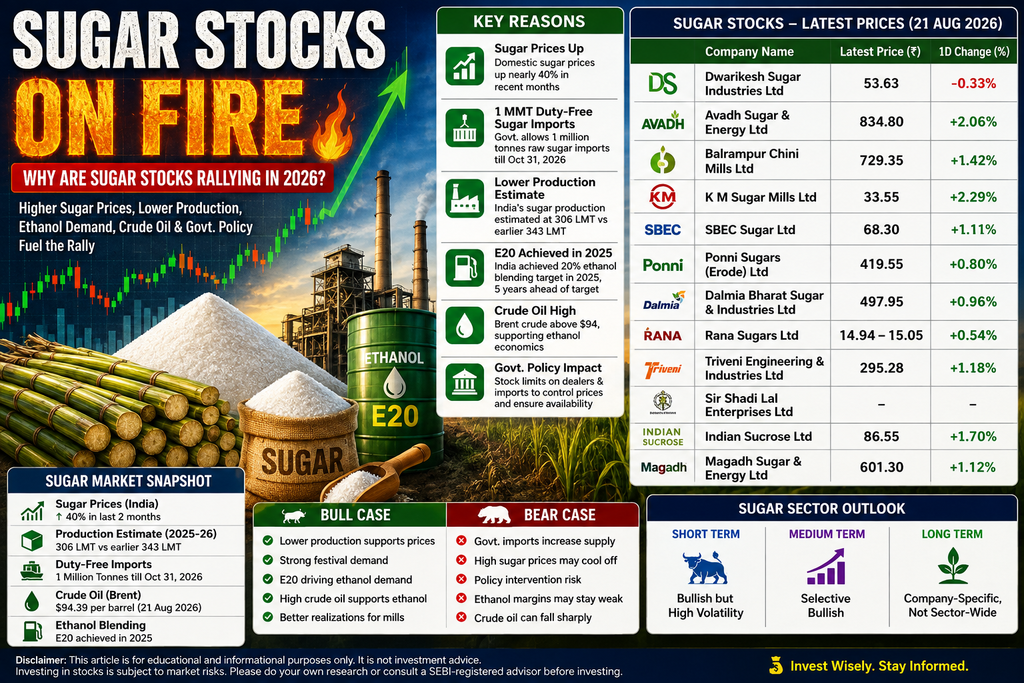
Sugar Stocks on Fire: What Is Driving the Rally?
Indian sugar stocks have become one of the most closely watched pockets of the stock market in August 2026.
Several sugar companies have delivered sharp rallies in recent sessions, with stocks such as Dwarikesh Sugar, Avadh Sugar & Energy, Balrampur Chini Mills, KM Sugar Mills, SBEC Sugar, Ponni Sugars, Dalmia Bharat Sugar and Triveni Engineering attracting strong investor interest.
But the big question is:
Is this the beginning of a sustainable sugar-cycle recovery, or is the sector heading into another speculative rally?
The answer is more complicated than simply saying “sugar prices are rising.”
Recent developments show a combination of higher domestic sugar prices, lower production expectations, festival-season demand, ethanol economics, crude oil prices and government policy intervention.
At the same time, investors need to be careful because the government has already allowed 1 million tonnes of duty-free raw sugar imports to increase domestic availability and cool prices.
Sugar Stocks: Latest Prices
The following are the latest available closing prices as of 21 August 2026:
| Sugar Stock | Latest Price ₹ | Recent Situation |
|---|---|---|
| Dwarikesh Sugar Industries | ₹53.63 | Strong rally but highly volatile |
| Avadh Sugar & Energy | ₹834.80 | Very strong momentum |
| Balrampur Chini Mills | ₹729.35 | Large-cap sector leader |
| K M Sugar Mills | ₹33.55 | Strong momentum, higher volatility |
| SBEC Sugar | ₹68.30 | Very strong recent performance |
| Ponni Sugars (Erode) | ₹419.55 | Strong recovery |
| Dalmia Bharat Sugar & Industries | ₹497.95 | Strong sector momentum |
| Rana Sugars | ₹14.94–15.05 | Small-cap/high-risk play |
| Triveni Engineering & Industries | ₹295.28 | Large sector player; strong recent move |
| Sir Shadi Lal Enterprises | No normal current quote | Trading affected by corporate scheme |
| Indian Sucrose | ₹86.55 | Sharp recent rally |
| Magadh Sugar & Energy | ₹601.30 | Strong momentum, high volatility |
Dwarikesh closed at ₹53.63 on August 21, while Balrampur Chini closed at ₹729.35. Avadh Sugar closed at ₹834.80 after another strong session, while Triveni Engineering closed around ₹295.28.
KM Sugar was around ₹33.55, SBEC Sugar around ₹68.30 and Ponni Sugars around ₹419.55.
Dalmia Bharat Sugar closed around ₹497.95, while Indian Sucrose was ₹86.55 and Magadh Sugar was around ₹601.30.
Sir Shadi Lal Enterprises should be treated differently: the company has been involved in a composite scheme with Triveni Engineering, so its trading status is not comparable with the other actively traded sugar stocks.
Why Are Sugar Stocks Rising?
1. Domestic Sugar Prices Have Surged
One of the biggest changes compared with the earlier sugar-stock thesis is the sharp rise in Indian sugar prices.
Sugar prices have increased substantially in recent months because of concerns around domestic production, weather conditions, and strong seasonal demand.
Reuters reported that Indian sugar prices had risen nearly 40% over two months, prompting the government to intervene.
This matters because higher realization can potentially improve the revenue and margins of sugar mills.
However, higher sugar prices also create a problem for the government because sugar is a politically sensitive food commodity.
That is why policy intervention is now becoming a major factor for sugar investors.
2. India Has Allowed 1 Million Tonnes of Duty-Free Sugar Imports
This is one of the most important developments investors should not ignore.
India announced permission for 1 million metric tonnes of duty-free raw sugar imports, with the quota available until October 31, 2026.
The objective is to increase domestic supply and prevent sugar prices from rising excessively before the festival season.
What does this mean for sugar stocks?
It creates a double-edged situation.
Positive:
- Higher domestic sugar prices improve mill realization.
- Lower inventory pressure can support cash flow.
- Strong sugar prices can improve sentiment.
- Export opportunities could improve if policy allows.
Negative:
- Imports increase domestic supply.
- Higher supply can eventually reduce sugar prices.
- Government intervention can limit upside.
- Sugar mills may not be able to fully benefit from a sharp rise in consumer prices.
Therefore, high sugar prices are not automatically bullish for sugar stocks forever.
3. Government Production Estimate Has Changed
Another major development is India’s revised sugar production outlook.
The government now expects current-season sugar production of around 306 lakh tonnes, compared with the earlier estimate of approximately 343 lakh tonnes.
That represents an estimated reduction of around 11% from the earlier projection.
This is important because the earlier thesis of “massive Indian sugar overproduction” is no longer as straightforward.
Lower production can support domestic prices if demand remains strong.
4. E20 Is Already Here — This Is an Important Correction
The original presentation suggests that investors are positioning for a future E20 mandate.
That needs to be updated.
India already achieved the 20% ethanol-blending target in 2025, five years ahead of the original 2030 target.
E20 availability has subsequently become part of India’s fuel system, with 20% blending reached during November 2025–June 2026.
So the investment thesis should not be:
“E20 will arrive in late 2026.”
Instead, it should be:
“India’s established E20 policy creates structural ethanol demand, but the profitability of sugar mills depends on ethanol pricing, feedstock economics, sugar realization and government policy.”
That is a much stronger and more accurate investment argument.
5. Crude Oil Is Adding Another Layer
Crude oil has also become an important part of the sugar-stock story.
Brent crude closed around $94.39 per barrel on August 21, 2026, supported by continuing geopolitical tensions and supply concerns.
When crude prices rise, ethanol can become economically more attractive as a fuel alternative.
This creates an indirect connection:
Higher crude → stronger ethanol economics → potentially better ethanol demand → positive sentiment for ethanol-producing sugar companies.
But investors should remember that this relationship is not one-to-one.
Sugar companies are affected by:
- Sugar realization
- Ethanol realization
- Cane procurement cost
- Government pricing
- Export policy
- Inventory
- Working capital
- Interest costs
Therefore, a high crude price alone cannot justify buying every sugar stock.
The Biggest Risk: Government Intervention
The sugar industry is different from many other industries because the government plays a major role in the economics.
The government has already imposed stockholding restrictions on sugar dealers to discourage hoarding and speculative inventory accumulation.
And now it has opened the door for duty-free imports.
This tells investors something important:
The government wants sugar prices to remain under control.
Therefore, if sugar prices continue rising too quickly, additional policy intervention cannot be ruled out.
Is This a Sugar Rally or an Ethanol Rally?
The answer is:
It is becoming a combination of both.
The earlier thesis that sugar stocks were simply an “energy proxy” is incomplete.
There are currently three major forces:
1. Sugar Price Cycle
Lower expected domestic production + strong seasonal demand can support sugar prices.
2. Ethanol Structural Demand
E20 has already been implemented, creating a long-term structural market for ethanol.
3. Energy Prices
Elevated crude prices can improve the relative attractiveness of ethanol.
Together, these factors can create a powerful narrative for sugar stocks.
But the narrative can change quickly if:
- Sugar imports increase substantially
- Domestic sugar prices fall
- Ethanol prices remain weak
- Cane costs rise
- Government changes procurement policy
- Crude oil falls sharply
What About the “8.3 MMT Global Sugar Surplus”?
This is another area where the earlier presentation needs correction.
The 8.3 million tonne figure should not be presented as the confirmed current ISO 2025/26 global surplus.
An ISO forecast published earlier in 2026 pointed to a much smaller 1.218 million tonne surplus for 2025/26, with global production forecast around 181.3 million tonnes.
Therefore, using “8.3 MMT global surplus” as a definitive current ISO number would be misleading.
Better interpretation:
Global sugar supply remains an important risk, but the current Indian market is being driven heavily by domestic supply, weather, production estimates, festival demand, and government policy.
Bull Case vs Bear Case
| Factor | Bull Case | Bear Case |
|---|---|---|
| Sugar prices | Stay elevated | Government intervention caps prices |
| Domestic production | Lower output supports prices | Production recovers |
| Ethanol | Strong structural demand | Margins remain weak |
| Crude oil | Stays above $90 | Falls sharply |
| Government policy | Better mill economics | Imports increase supply |
| Festival demand | Strong | Demand normalizes |
| Stocks | Sector rerating continues | Rally becomes overextended |
| Small caps | Momentum continues | Sharp profit booking |
Which Sugar Stocks Deserve the Most Attention?
Not every sugar stock has the same risk profile.
1. Balrampur Chini Mills
One of the more established names in the sector.
Latest price: ₹729.35
The company is significantly larger than many small-cap sugar names and therefore may be better suited for investors looking for a relatively established sugar-sector exposure.
2. Triveni Engineering
Latest price: ₹295.28
Triveni is another major listed player with exposure to sugar and related businesses. Its recent price action has been strong, although the stock remains well below its 52-week high of around ₹490.
3. Dalmia Bharat Sugar
Latest price: ₹497.95
The stock has participated strongly in the sector rally and remains an important company to monitor for investors looking at the larger sugar names.
4. Avadh Sugar & Energy
Latest price: ₹834.80
This is one of the most aggressive movers in the group.
Its one-month return was reported at more than 53% by August 21, showing just how quickly momentum has accelerated.
But that also means the risk of profit booking is much higher.
5. Dwarikesh Sugar
Latest price: ₹53.63
Dwarikesh has also seen a dramatic move. On August 20 alone, the stock gained about 14.7% before correcting on August 21.
This is a classic example of why sugar stocks should not be chased purely because of momentum.
The Real Warning: Momentum Is Becoming Extreme
Some sugar stocks have moved very quickly.
For example, Avadh Sugar moved from the ₹300 region earlier in the year to above ₹800, while Dwarikesh has also delivered a huge move from its previous levels.
That creates a major difference between:
A good company at a reasonable price
and
A good story at a high price.
Investors should therefore examine:
- P/E ratio
- Debt-to-equity
- Interest coverage
- Free cash flow
- Sugar inventory
- Ethanol production
- EBITDA margin
- Promoter holding
- Quarterly profit growth
- Cane cost
- Current valuation
before buying.
Sugar Stocks: What Could Happen Next?
Bull Scenario
If:
- Brent remains elevated,
- domestic sugar production remains below expectations,
- festival demand stays strong,
- sugar prices remain high,
- ethanol economics improve,
- and government policy remains supportive,
then sugar stocks could remain strong in the short term.
Bear Scenario
But if:
- duty-free imports increase supply,
- sugar prices start falling,
- crude falls sharply,
- ethanol margins remain weak,
- or the government introduces additional price-control measures,
then the sector could experience a sharp correction.
This is especially important for small-cap sugar stocks where liquidity can disappear quickly during a sell-off.
Final Verdict: Bullish Sector, But Don’t Chase the Rally
The sugar-stock rally in India is real, but the reason is more complex than the simple “oil is expensive, therefore sugar stocks will rise” narrative.
The latest data suggest that the market is responding to:
Lower Indian production expectations + higher domestic sugar prices + festival demand + established E20 demand + elevated crude oil + policy expectations.
At the same time, duty-free imports and government price-control measures are important risks.
Therefore:
Short Term:
Bullish but highly volatile
Medium Term:
Selective bullish
Long Term:
Company-specific, not sector-wide
The biggest mistake investors can make now is to assume that every sugar stock will continue rising simply because the sector is in the news.
The next phase of the rally will likely separate companies with strong balance sheets, ethanol capacity, and sustainable cash flows from highly leveraged momentum stocks.
Sugar Stocks Investor Checklist
Before buying any sugar stock, check:
- Sugar realization
- Ethanol production capacity
- EBITDA margin
- Debt
- Interest cost
- Free cash flow
- Cane procurement cost
- Inventory
- Government policy
- Current valuation
- Promoter holding
- Quarterly earnings
Bottom Line
Sugar stocks are currently a high-interest sector, but this is not a risk-free rally.
The sector has genuine fundamental support from domestic supply constraints and structural ethanol demand, but government intervention and high valuations can create sudden reversals.
For investors, the better strategy is to separate strong businesses from pure momentum plays rather than buying the entire sugar sector blindly.
Disclaimer
This article is for educational and informational purposes only. It is not investment advice, a recommendation to buy or sell any security, or a guarantee of future returns. Sugar stocks can be highly volatile and are affected by commodity prices, government policy, weather, ethanol economics, debt,t and global supply-demand conditions. Investors should conduct their own research or consult a SEBI-registered investment adviser before making investment decisions.
Top 10 SEO Titles
- Sugar Stocks 2026: Why Are Sugar Stocks Rallying? Best Stocks to Watch
- Sugar Stocks on Fire: Top Sugar Stocks in India to Watch in 2026
- Best Sugar Stocks 2026: Latest Prices, Ethanol Boom & Future Outlook
- Sugar Stock Rally 2026: What’s Driving Dwarikesh, Avadh, Balrampur & Triveni?
- Sugar Stocks India 2026: Ethanol, Sugar Prices & Government Policy Explained
- Sugar Stocks Rally: Is This a New Bull Run or a Bull Trap?
- Top Sugar Stocks in India 2026: Prices, Fundamentals, Risks & Outlook
- Why Sugar Stocks Are Rising in 2026: Ethanol, Crude Oil & Sugar Prices
- Sugar Stocks vs Ethanol Stocks: Which Could Win the 2026 Rally?
- Sugar Stocks 2026 Outlook: Bullish Opportunity or Dangerous Bull Trap?