
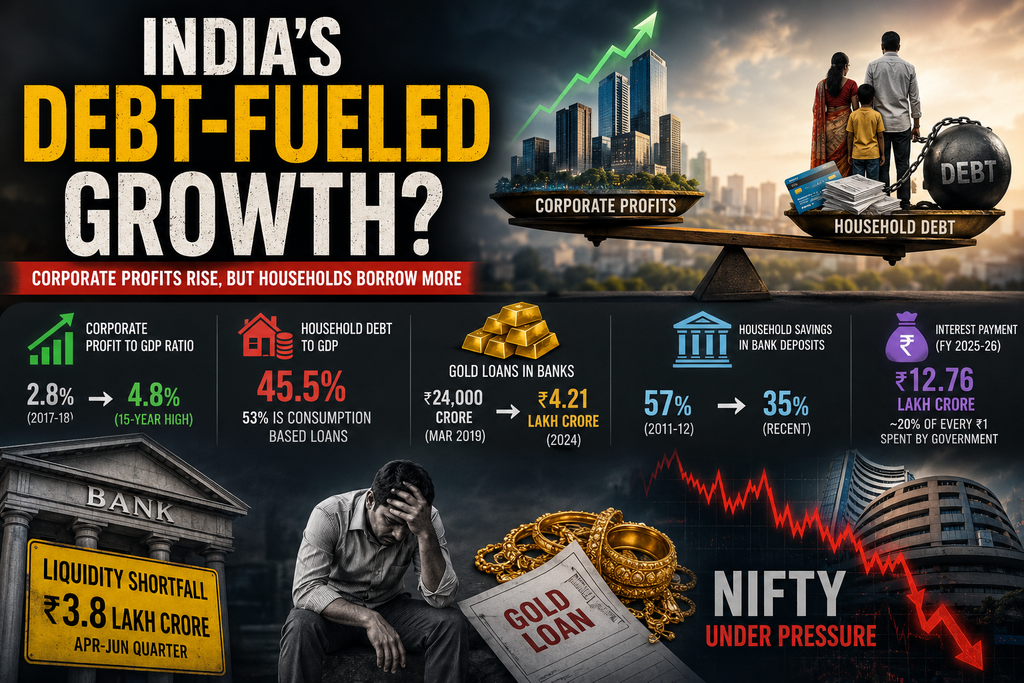
Introduction: India’s Growth Story Has Another Side
India continues to present one of the strongest growth stories among major economies. Corporate profitability has improved, capital expenditure is recovering, and the financial system is considerably stronger than it was a decade ago.
But beneath that headline is another story.
Household borrowing has increased, financial savings have shifted, gold loans have expanded,d and corporate margins have remained remarkably resilient.
That creates an important question for investors:
Is India’s consumption boom being driven primarily by rising incomes—or increasingly by credit, financial-asset reallocation and higher household leverage?
The answer is more complicated than either extreme.
There is genuine economic growth in India. But there are also pockets where corporate profitability and household financial health move in opposite directions.
And that divergence deserves much more attention.
1. Corporate Profits Are Rising Faster Than the Broader Income Story
One of the most interesting developments in India’s economy has been the improvement in corporate profitability.
Research from SBI covering roughly 4,000 listed companies found that in FY24, sales grew by around 6%, EBITDA increased by nearly 28%, and profit after tax rose by around 32%. Employee expenses, meanwhile, increased about 13%.
That difference matters.
When profits grow substantially faster than employee expenses, corporate margins naturally improve.
SBI’s analysis also found that Indian Inc. maintained an average EBITDA margin of around 22% over the previous four years, while the average wage-bill growth was around 12%.
This doesn’t automatically mean companies are exploiting workers.
Higher productivity, automation, operating leverage, commodity-cost changes and better pricing power can all improve margins.
But it raises an important macroeconomic question:
If corporate profits grow faster than wages for an extended period, where does the additional purchasing power come from?
One possible answer is credit.
2. The Rise of Credit-Funded Consumption
India’s household balance sheet has changed dramatically over the last few years.
RBI household financial-flow data shows that household financial liabilities increased substantially in FY2023-24. Household financial liabilities were equivalent to around 6.4% of GDP in that year’s flow, compared with 5.9% in FY2022-23.
At the same time, bank credit has remained strong.
RBI data shows scheduled commercial-bank credit grew 15.3% year-on-year during 2023-24, excluding the merger effect.
This creates a powerful economic mechanism:
Income → borrowing → consumption → corporate revenue → corporate profit
That cycle can support economic activity for years.
But borrowing has a limitation.
Debt brings future repayments.
Therefore, today’s consumption can sometimes come at the expense of tomorrow’s disposable income.
3. Household Savings Are Changing
This may be one of the most important structural changes for India’s financial system.
RBI data shows that households continue to accumulate financial assets, but the composition of those assets is changing.
In FY2023-24, households added approximately:
- ₹15.52 lakh crore in net financial assets
- ₹18.79 lakh crore in financial liabilities
- Bank deposits remained a major component of financial assets
- Mutual funds, equities, insurance and pension assets continued to attract household money.
The important point is not simply that Indians are “leaving banks.”
It is that households increasingly have more financial choices.
Money can move into:
- Mutual funds
- SIPs
- Direct equities
- Insurance
- Pension products
- Small savings
- Gold
This creates a challenge for banks because traditional low-cost deposits are extremely important for lending profitability.
4. SIPs Are Not Necessarily a Sign of Financial Distress
This part needs nuance.
It would be incorrect to say that Indians are investing through SIPs only because they are desperate to escape low bank returns.
SIPs have grown because of:
- Financial awareness
- Digital investing
- Demographic changes
- Equity-market participation
- Tax-efficient investment products
- Long-term wealth creation goals
However, the shift is still significant for banks.
When households diversify away from deposits, banks potentially have to compete harder for funding.
And that can influence their:
Deposit rates → Cost of funds → Lending rates → Credit growth → Corporate investment
So the migration of household savings into market-linked products is not simply an investor story.
It is also a banking-system story.
5. The Gold-Loan Warning Signal
Gold loans deserve special attention.
Gold is deeply embedded in Indian household wealth, particularly in rural and semi-urban India.
Borrowing against gold can be productive when the loan is used for:
- Business expansion
- Agriculture
- Education
- Working capital
- Temporary cash-flow requirements
But it can also become a form of emergency liquidity.
That distinction is critical.
RBI itself recognises that gold loans can be used for both consumption and income-generation purposes.
Therefore, rising gold loans alone cannot prove that households are experiencing financial distress.
However, when gold borrowing rises alongside weak income growth, higher living costs and increased household leverage, it becomes a metric worth monitoring.
The RBI has also maintained prudential requirements around loan-to-value ratios for gold-backed lending.
The real risk isn’t simply:
“People are taking gold loans.”
The bigger risk is:
“Are households using appreciating assets to finance recurring consumption?”
That is a much more important question.
6. The Wage-Profit Gap
This is perhaps the most interesting part of the entire story.
SBI’s research indicates that approximately 4,000 listed companies experienced:
| Indicator | FY24 Growth |
|---|---|
| Net Sales | ~6% |
| Employee Expenses | ~13% |
| EBITDA | ~28% |
| Profit After Tax | ~32% |
The numbers show that profitability improved much faster than revenue.
That suggests significant operating leverage.
But investors should distinguish between profitability improvement and household exploitation.
Companies can increase profits through:
- Productivity
- Automation
- Lower raw-material costs
- Better capacity utilisation
- Pricing power
- Cost optimisation
- Financial leverage
The concern arises when corporate margins remain elevated while household real purchasing power struggles to keep pace.
Because eventually there is a limit.
Consumers cannot borrow indefinitely.
7. The Banking System: Deposits vs Credit
India’s banking model depends heavily on deposits.
Banks collect deposits and transform them into loans.
Therefore, when credit grows faster than deposits, the banking system must find alternative sources of funding.
That can include:
- Higher deposit rates
- Wholesale funding
- Certificates of deposit
- Bonds
- External funding
- RBI liquidity operations
RBI data also shows that lending rates have remained relatively elevated. In February 2024, the weighted-average lending rate on outstanding rupee loans was approximately 9.83%, while the weighted-average domestic term-deposit rate on outstanding deposits was around 6.86%.
This spread is critical for bank profitability.
But it also shows why higher household leverage can become dangerous.
If interest rates remain high for long enough, borrowers eventually feel the pressure.
8. The Government’s Interest Bill Is Getting Bigger
There is another layer to the story:
Government debt.
The Union Budget for FY2025-26 estimated interest payments at approximately ₹12.76 lakh crore.
The government’s own budget presentation showed interest payments accounting for approximately 20% of every rupee spent in the FY2025-26 budget framework.
That is a huge number.
But the statement that “₹1 out of every ₹4 in taxes goes directly to bondholders” needs to be handled carefully because the ratio depends on whether we compare interest payments with gross tax revenue, net tax revenue, or total receipts.
The safer conclusion is:
A significant portion of government resources is committed to servicing existing debt, reducing the flexibility available for other spending priorities.
And this matters to investors because government borrowing influences:
Bond yields → Bank funding costs → Corporate borrowing costs → Equity valuations
9. India’s GDP Story Is Changing Too
There is another important development that investors should understand.
In February 2026, MoSPI released India’s new national accounts series with 2022-23 as the base year, replacing the previous 2011-12 base year.
The government says the revision incorporates:
- New data sources
- Structural changes in the economy
- Improved estimation methodology
- Better sectoral coverage
- A more recent normal-year benchmark
Therefore, investors should be cautious about simplistic claims that the new base year “artificially inflated GDP.”
A base-year revision changes the measurement framework; it does not automatically mean economic growth is fake.
However, it does mean that historical comparisons need to be made using the new consistent series.
That distinction is extremely important.
10. The Real Risk: A Credit Ceiling
This is where the entire thesis comes together.
Imagine the following cycle:
Wages grow slowly
↓
Household expenses rise
↓
Consumers use savings
↓
Consumers borrow
↓
Consumption remains strong
↓
Corporate revenues remain strong.
↓
Margins remain high
↓
Corporate profits rise
At first, everyone wins.
But eventually:
Debt servicing rises
↓
Disposable income falls
↓
New borrowing slows
↓
Consumption slows
↓
Corporate revenue growth weakens.
↓
Operating leverage reverses
↓
Profit growth falls
This is the potential credit ceiling.
And it is much more important than simply asking whether GDP is growing at 6%, 7% or 8%.
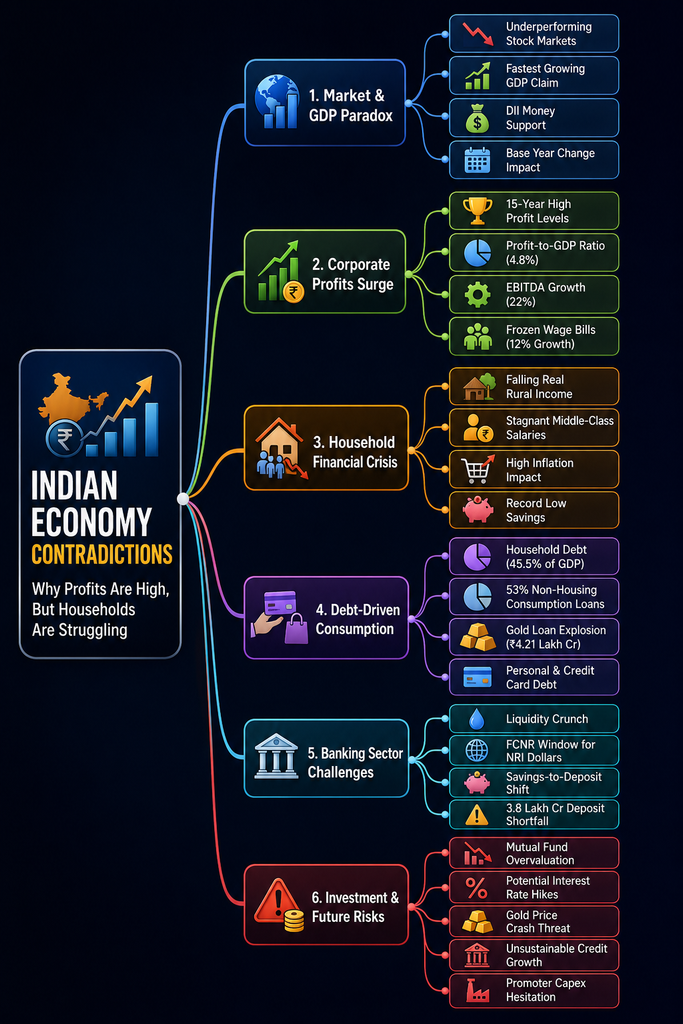
11. What This Could Mean for the Nifty
For equity investors, this is where the macro story becomes relevant.
The Nifty doesn’t fall simply because household debt rises.
Markets care about the interaction between:
Earnings
Are corporate profits still growing?
Valuation
How much are investors paying for those profits?
Liquidity
Is money flowing into equities?
Interest Rates
Is the cost of capital rising or falling?
Consumption
Can households continue spending?
Credit
Can banks continue expanding loans?
Foreign Flows
Are global investors buying or selling Indian equities?
A slowdown in household consumption combined with expensive valuations can become particularly dangerous.
Because when earnings expectations fall, investors may simultaneously experience:
Earnings downgrade + P/E compression
That combination can produce a much larger market correction than the headline economic slowdown alone would suggest.
12. But There Is Another Side to the Story
The bearish thesis should not be overstated.
India has several structural advantages:
- Large domestic consumer market
- Strong digital infrastructure
- Rising formalisation
- Improving tax compliance
- Manufacturing investment
- Infrastructure spending
- Growing financial participation
- Relatively strong banking capitalisation
- Expanding services exports
RBI’s Financial Stability Report continues to provide an important framework for assessing the resilience of the financial system rather than suggesting that the entire banking system is on the verge of collapse.
So this is not a prediction of an imminent economic collapse.
It is a warning about imbalances.
13. The Three Numbers Investors Should Watch
If this thesis is correct, three indicators could become particularly important.
1. Household Financial Liabilities
If liabilities continue increasing faster than financial assets, household balance sheets could become more vulnerable.
2. Corporate Wage Growth vs Profit Growth
If EBITDA and PAT continue growing much faster than employee expenses, margins may remain strong—but questions about sustainable consumption become more important.
3. Deposit Growth vs Credit Growth
If loan growth consistently outruns deposit growth, banks may face increasing competition for funding.
These three numbers can tell us much more about the health of the economy than a single GDP headline.
14. The Bigger Question: Who Owns the Future Income?
This may be the most important question for investors.
When households borrow today, they are effectively bringing future income into the present.
That money can immediately become:
Consumer spending → Corporate revenue → Corporate profit
But the borrower must eventually repay:
Principal + Interest
Therefore, an economy can temporarily experience strong consumption even when household income growth isn’t equally strong.
The problem begins when future income has already been pledged too many times.
That’s when the system reaches its debt ceiling.
Conclusion: The Building Has Cracks—but It Has Not Collapsed
The Indian economy isn’t a simple story of:
“Everything is booming.”
Nor is it:
“India is heading for collapse.”
The reality is somewhere between the two.
Corporate profitability is strong.
Banking-sector resilience has improved.
Investment and infrastructure spending remain important growth drivers.
But at the same time, household liabilities are rising, savings are changing composition, credit remains an important consumption driver,r and corporate margins have remained substantially stronger than wage growth.
RBI data shows household financial liabilities rose to 6.4% of GDP in FY2023-24, while SBI’s corporate analysis shows EBITDA and PAT growth far outpaced employee-expense growth in FY24.
That divergence deserves attention.
Because the real question for investors isn’t:
“Is India’s GDP growing?”
The better question is:
“Is the growth translating into sustainable household purchasing power, or are households increasingly borrowing against tomorrow’s income to support today’s consumption?”
If income growth eventually catches up, the current cycle can remain healthy.
If credit growth becomes the substitute for income growth, however, the system becomes increasingly fragile.
And that is the debt-fueled illusion investors should watch.
Investor Takeaway
Before assuming that strong corporate earnings automatically mean a strong stock market, watch these indicators:
Household debt ↑
Credit-card/personal-loan growth ↑
Gold-backed borrowing ↑
Deposit growth ↓ relative to credit
Wage growth ↓ relative to corporate profits
Consumption growth ↓
Interest burden ↑
If several of these move in the wrong direction simultaneously, the risk to corporate earnings and equity valuations rises.
The market doesn’t usually break when the first crack appears.
It breaks when investors realise that the crack is structural.
Disclaimer
This article is for educational and informational purposes only and should not be considered investment advice, financial advice, or a recommendation to buy or sell any security. Economic data, corporate earnings, household debt, BT, and market valuations can change over time. Investors should conduct their own research and consider their risk tolerance before making investment decisions.
10 SEO titles:
- India’s Debt-Fueled Growth: Why Corporate Profits Are Rising While Households Borrow More
- The Debt-Fueled Illusion: Why India Inc. Is Profiting While Households Struggle
- India’s Economic Growth Illusion: Rising Corporate Profits, Debt and Falling Savings
- Corporate Profits vs Household Debt: The Hidden Risk in India’s Economy
- Is India’s Growth Fueled by Debt? The Hidden Truth Behind Rising Corporate Profits
- India’s Household Debt Crisis: Why Corporate Profits May Be Hiding a Bigger Problem
- India Economy 2026: Corporate Profits Rise as Household Debt and Borrowing Surge
- The Hidden Cost of India’s Growth: Debt, Corporate Profits and the Household Squeeze
- India Inc. Is Booming, But Are Indian Households Paying the Price?
- Nifty, Corporate Profits & Household Debt: The Economic Risk Investors Must Watch