
Introduction: The Market Was Calm—Until Liquidity Became the Story
For a few sessions, the Indian equity market appeared to be stabilising around the 24,000–24,200 zone.
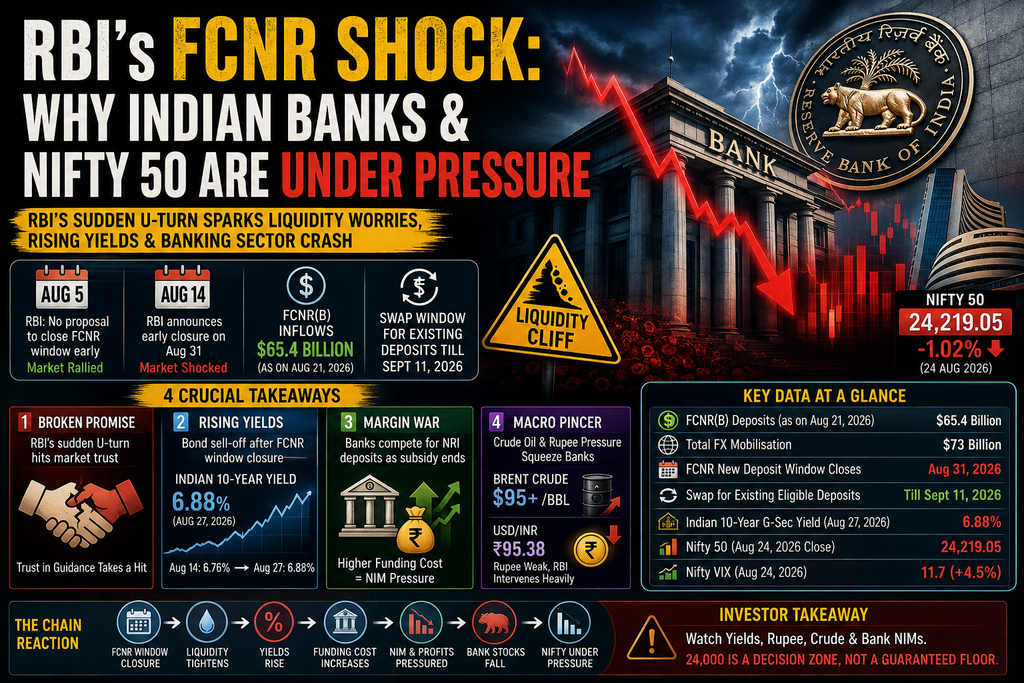
On August 24, the Nifty 50 closed at 24,219.05, while banking and financial stocks led the decline. Nifty VIX also rose about 4.5% to 11.7, signalling a modest rise in market anxiety.
But the real story wasn’t simply technical.
Behind the market weakness was a much bigger macroeconomic question:
What happens to Indian banks when an unusually large source of foreign-currency liquidity suddenly approaches its deadline?
That question became important after the Reserve Bank of India unexpectedly brought forward the closure of its special FCNR(B) dollar-rupee swap facility from September 30 to August 31, 2026.
At the time of the announcement, FCNR(B) deposits had already generated $52.3 billion of inflows. By August 21, FCNR(B) mobilisation had risen to about $65.4 billion, with total foreign-currency mobilisation under the broader facilities reaching $73 billion.
This is not a small number.
It is large enough to influence:
Bank liquidity → deposit costs → bond demand → rupee liquidity → currency hedging → NIMs → bank earnings → equity valuations
And that is why the FCNR story matters.
1. What Exactly Did the RBI Change?
The special FCNR(B) swap facility was launched in June 2026 to encourage fresh foreign-currency inflows into Indian banks.
The mechanism was relatively straightforward:
NRIs provide foreign-currency deposits
↓
Indian banks receive dollars.
↓
Banks swap the dollars withthe RBI.
↓
Banks receive rupee liquidity.
↓
The foreign-currency funding becomes cheaper/more attractive.e
The facility was originally supposed to remain available for new FCNR(B) deposits until September 30, 2026.
But on August 14, the RBI announced that new FCNR(B) deposits eligible under the facility would be limited to those mobilised up to August 31.
Importantly, the swaps against deposits already mobilised could still be undertaken with the RBI until September 11.
So technically, this was not an overnight cancellation of existing funding.
It was an early closure of the window for new deposits.
That distinction matters.
2. Why Did the RBI Do It?
This is where the narrative becomes more interesting.
On August 5, RBI Governor Sanjay Malhotra had said there was no proposal to close the FCNR(B) window early and that the liquidity generated by the strong inflows was expected to be temporary.
Nine days later, the RBI announced the early closure.
The reason officially given was strong demand and unexpectedly large foreign-currency inflows.
By August 13, FCNR(B) deposits alone had already generated $52.3 billion.
By August 21, that number had reached $65.4 billion.
So the apparent “U-turn” can be interpreted in two ways.
Bearish interpretation
Markets may worry that:
- policy guidance has become less predictable;
- banks cannot rely on the special funding window;
- future dollar liquidity may become more expensive;
- hedging costs could rise;
- bank margins could come under pressure.
Bullish/neutral interpretation
The RBI may simply have concluded that:
The facility had already achieved its objective much faster than expected.
The Finance Ministry itself said the programme had achieved its objective ahead of schedule after attracting $73 billion across the relevant facilities.
Therefore, calling the decision purely a “policy failure” would be too strong.
The bigger issue is how the market interprets the change.
3. The $65 Billion Number Changes Everything
This is perhaps the most important new data point.
As of August 21:
| Parameter | Data |
|---|---|
| Total FX mobilisation | $73 billion |
| FCNR(B) deposits | $65.4 billion |
| Original FCNR deadline | September 30 |
| Revised new-deposit deadline | August 31 |
| FCNR swap availability for existing eligible deposits | Until September 11 |
| 2013 FCNR mobilisation | ~$26 billion |
The scale is extraordinary.
The 2026 programme has already attracted substantially more foreign currency than the approximately $26 billion raised through the 2013 FCNR(B) swap scheme.
This tells us something important:
The problem is not a shortage of dollars entering India.
The immediate issue is what happens after the special incentive disappears.
4. The Liquidity Cliff
This is where banks enter the picture.
The FCNR programme provided banks with a mechanism to convert foreign-currency deposits into rupee liquidity.
That liquidity helped strengthen the banking system’s funding position.
Reuters reported that average banking-system surplus liquidity had risen above ₹3.4 lakh crore in August, with the possibility of liquidity exceeding ₹5 lakh crore in September because of FCNR inflows and other factors.
So the story isn’t simply:
“RBI removed liquidity.”
In fact, the system currently has substantial surplus liquidity.
The more accurate question is:
How will banks manage the transition once this extraordinary source of foreign-currency funding stops growing?
That is the potential liquidity cliff.
5. The NIM Problem: Cheap Funding Won’t Last Forever
This is particularly important for bank investors.
Banks make money from the difference between:
Interest earned on loans
and
Interest paid on deposits/funding
That difference is broadly reflected in the Net Interest Margin (NIM).
The FCNR facility helped banks mobilise foreign-currency deposits under concessional swap conditions.
But once banks have to compete for funding without the same subsidy, the economics change.
A recent banking-sector analysis estimated that FCNR inflows could eventually cause 3–15 basis points of NIM dilution for banks, depending on how the deposits are priced and deployed.
That may sound tiny.
But for a large bank, even a few basis points can materially affect earnings.
The chain looks like this:
Funding cost ↑
↓
NIM ↓
↓
Profitability ↓
↓
ROA/ROE pressure
↓
Bank valuation pressure
This is why the FCNR story has become an equity-market issue.
6. The Bond Market Adds Another Layer of Risk
The second major transmission channel is the government bond market.
Indian 10-year government bond yields moved sharply higher after the FCNR announcement.
On August 14, the benchmark yield was around 6.76%.
By August 17, it reached approximately 6.81%.
By August 21, it had moved to 6.85%, and by August 27 it was around 6.88% in market data.
That is a significant move in a relatively short period.
Reuters also reported that the benchmark 10-year yield had risen 9 basis points in the week ending August 21, reaching 6.8495%.
Why should banks care?
Because banks hold large portfolios of government securities.
And bond prices move inversely to yields.
Yield ↑
↓
Bond price ↓
↓
Portfolio valuation pressure
↓
Potential MTM impact
However, one should avoid saying that every rise in bond yields automatically becomes a massive immediate loss for every bank.
Accounting classification matters.
Banks classify securities such as:
- Amortised Cost
- FVOCI
- FVTPL
Therefore, the impact on reported profits depends on where and how the securities are held.
That’s a much more accurate way to describe the risk.
7. India’s Bond Yield Is Not Moving in Isolation
The domestic bond market is also reacting to global factors.
The US Treasury market remains important because global investors compare Indian yields with US risk-free yields.
The US 10-year yield has remained elevated amid concerns around inflation, fiscal policy and long-duration bond supply.
At the same time, the US Treasury announced in August that it would increase the size of its long-end buyback operations, raising the maximum size of certain operations from $2 billion to at least $4 billion from September 9.
Therefore, the original claim that Treasury buybacks simply “shifted toward short-term debt and caused the 10-year yield to 4.7%” is too simplistic.
The actual Treasury market is more complicated.
For Indian investors, the important transmission mechanism is:
US yields ↑
→
Global bond yields ↑
→
EM funding becomes relatively less attractive.
→
Currency pressure ↑
→
Indian bond yields can face upward pressure
That is the real macro connection.
8. The Rupee Is the Next Pressure Point
The rupee remains another major variable.
On August 17, the rupee closed around ₹95.61 per US dollar, while on August 18 it remained around ₹95.68.
By August 28, it closed around ₹95.38/$, with market participants estimating thatthe RBI had sold more than $8 billion through spot and offshore markets in recent sessions to prevent excessive volatility.
That tells us something important.
The RBI isn’t simply watching the rupee.
It is actively managing volatility.
And that creates a difficult balancing act:
Oil ↑
US yields ↑
Dollar demand ↑
Rupee pressure ↑
↓
RBI intervention
↓
Forex liquidity management
↓
Domestic liquidity consequences
This is the macro pincer affecting Indian markets.
9. Crude Oil Is the Wild Card
For India, crude oil is particularly important because the country remains heavily dependent on imported energy.
When crude rises sharply:
Import bill ↑
↓
Trade deficit pressure ↑
↓
Dollar demand ↑
↓
Rupee pressure ↑
↓
Inflation risk ↑
↓
Interest-rate expectations ↑
That is why bond traders are watching crude so closely.
Recent August trading saw Brent crude move sharply around Middle East developments, at times approaching the $90–95 per barrel zone, before retreating. Reuters reported Brent around $94 during the week ending August 21, while it subsequently dropped below $90.
The danger isn’t simply high oil.
It is high oil + weak rupee + elevated bond yields occurring simultaneously.
10. The Banking Sector Is Facing a Three-Way Squeeze
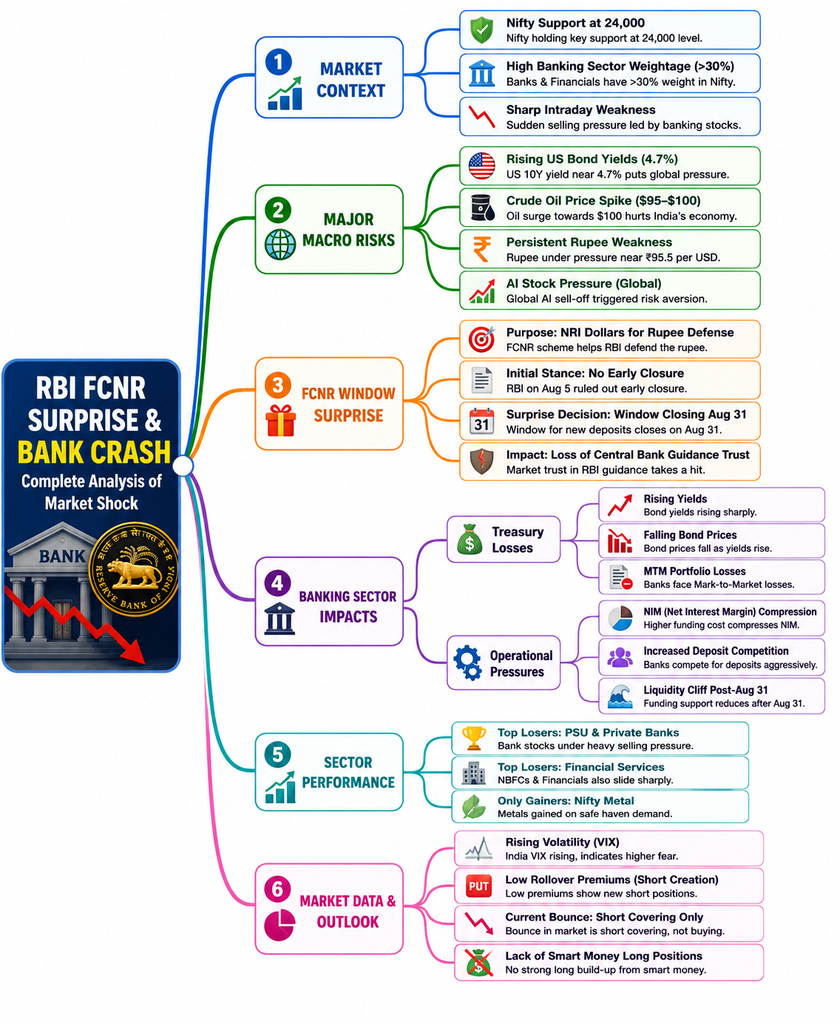
The current setup can be summarised in three pressures.
Pressure #1 — Funding
The FCNR incentive is ending.
Funding competition → Potentially higher cost
Pressure #2 — Bonds
Bond yields have risen.
Yield ↑ → Bond prices ↓ → Potential valuation pressure
Pressure #3 — Currency
The rupee remains under pressure.
Dollar demand + oil → RBI intervention
Together:
Funding pressure + bond-market volatility + currency risk = higher uncertainty for banks.
That doesn’t mean Indian banks are fundamentally broken.
It means their near-term earnings and valuation sensitivity has increased.
11. Another Important Data Point: Credit-Deposit Ratio
There is a useful number investors should monitor.
As of August 15, the banking system’s credit-deposit ratio was around 81.72%, slightly lower than 81.96% at the end of July.
This is important because it shows that the banking system isn’t currently facing a straightforward “loans are exploding while deposits are disappearing” crisis.
In fact, banks have used the FCNR inflows partly to manage their funding structure.
Business Standard reported that banks appeared to be reducing some high-cost bulk deposits while using FCNR money to manage funding costs.
Therefore, the FCNR story is more nuanced than a simple liquidity shortage.
It is fundamentally about the cost and composition of liquidity.
12. Why Bank Stocks React So Quickly
Financial stocks are extremely sensitive to changes in:
- Interest rates
- Bond yields
- Deposit growth
- Credit growth
- NIM
- Asset quality
- Currency
- Liquidity
That makes banks a kind of macro proxy for the Indian economy.
When investors become concerned about the economic cycle, they often sell banks before the economic data actually deteriorates.
Why?
Because banking earnings are leveraged to the cycle.
Example:
If deposit costs rise:
Funding cost ↑
If loan pricing cannot adjust equally:
NIM ↓
If bond yields rise:
Treasury pressure ↑
If the economy slows:
Credit growth ↓
If borrowers struggle:
Slippages ↑
So investors start pricing in problems before they appear in quarterly results.
13. What Does This Mean for the Nifty 50?
Now we reach the most important question.
Is 24,000 strong support?
Technically, the 24,000–24,200 zone remains important because the market has repeatedly reacted around this area.
On August 24, Nifty closed at 24,219.05.
But support isn’t guaranteed.
The market needs confirmation from:
Bullish confirmation
- Bank Nifty stabilises
- Bond yields stop rising
- Rupee stabilises
- Crude falls
- FII selling slows
- Nifty sustains above 24,200
- Breadth improves
Bearish confirmation
- Nifty breaks 24,000 decisively
- Banking stocks continue underperforming
- 10-year yield moves toward/above 6.90%
- Rupee weakens sharply
- Crude returns toward $95–100
- VIX rises
- Financial stocks lead the decline
If the second combination appears, 24,000 could shift from support to resistance.
14. The “Short-Covering” Theory Needs Confirmation
The claim that any bounce is automatically short-covering should also be treated carefully.
Short-covering can certainly produce sharp rallies during weak markets.
But it should be confirmed through:
- Price + volume
- Open interest changes
- Futures basis
- Put-call positioning
- India VIX
- Bank Nifty relative strength
- FII index futures positioning
A rally without strong participation can be fragile.
But a rally accompanied by:
OI reduction in shorts + fresh long build-up + improving breadth + falling VIX
would represent a much stronger bullish signal.
So traders should avoid declaring:
“Every bounce is short-covering.”
The data needs to confirm it.
15. The Bigger Picture: This Isn’t Just an FCNR Story
The FCNR deadline is only one piece of the puzzle.
The broader market is currently balancing:
Global Factors
- US Treasury yields
- Federal Reserve expectations
- Dollar strength
- Global risk appetite
Domestic Factors
- RBI liquidity
- FCNR inflows
- Bond yields
- Deposit growth
- Credit growth
Commodity Factors
- Brent crude
- Middle East tensions
- Import inflation
Equity Factors
- Nifty valuation
- Bank earnings
- FII flows
- Derivatives positioning
This is why a seemingly technical banking issue can quickly turn into a Nifty-wide macro event.
16. What Investors Should Watch Next
The next few sessions are particularly important because the FCNR new-deposit window closes on August 31.
Watch these seven indicators:
| Indicator | Bullish for Market | Bearish for Market |
|---|---|---|
| Nifty | Above 24,200 | Below 24,000 |
| 10Y G-Sec | <6.80% | >6.90% |
| USD/INR | Stable | Sharp depreciation |
| Brent | <90 | >95–100 |
| Bank Nifty | Outperforming | Underperforming |
| VIX | Falling | Rising |
| Bank NIM | Stable | Compression |
This framework is more useful than focusing on one headline.
Conclusion: The RBI Didn’t Create a Banking Crisis—It Created a Repricing Event
The early closure of the FCNR(B) swap window should not automatically be interpreted as evidence that India’s banking system is in crisis.
The facts actually show something more nuanced.
The programme was extraordinarily successful.
It attracted:
$65.4 billion of FCNR(B) deposits
and approximately:
$73 billion of total foreign-currency mobilisation.
That success is precisely why the RBI moved the deadline forward.
But markets are now asking a different question:
What happens when this extraordinary source of foreign-currency funding stops expanding?
That question affects:
Liquidity
→ Funding costs
→ Bank NIMs
→ Bond yields
→ Rupee
→ Corporate earnings
→ Nifty valuations
And that is why the FCNR decision matters far beyond the banking sector.
The real risk is not the end of FCNR.
The real risk is what happens to funding costs, bond yields, the rupee and crude oil after the extraordinary liquidity support fades.
If yields stabilise, crude retreats and the rupee remains orderly, banks could absorb the transition relatively comfortably.
But if:
Crude ↑ + US yields ↑ + INR weakens + Indian G-Sec yields ↑ + Bank NIM ↓
then the market could face a much more serious earnings-and-valuation problem.
For Nifty investors, therefore, 24,000 should be treated as a decision zone—not a guaranteed floor.
Investor Takeaway
Don’t trade the FCNR headline alone.
Track the entire chain:
FCNR → Liquidity → Bond Yield → Rupee → Bank Funding Cost → NIM → Bank Earnings → Nifty
That chain will tell investors much more about the next major market move than a single day’s candle.
The market is no longer asking whether the RBI has enough dollars.
It is asking what the cost of liquidity will be after the special window closes.
Disclaimer
This article is for educational and informational purposes only and is not investment advice or a recommendation to buy or sell any security. Market conditions, RBI policy, bond yields, crude prices, currency rates, and derivatives positioning can change rapidly. Investors should conduct independent research and consider their own risk tolerance before making investment decisions.
High CTR Top 10:
- 🔥 RBI’s FCNR Shock: Why Indian Banks and Nifty 50 Are Under Pressure
- RBI FCNR U-Turn Explained: What It Means for Indian Banks, Rupee and Nifty
- RBI’s Surprise FCNR Move: 5 Risks Facing Indian Banks and the Stock Market
- Why RBI Closed the FCNR Swap Window Early: The Hidden Risk for Indian Banks
- Indian Banks Under Pressure: How RBI’s FCNR Decision Could Impact Nifty 50
- RBI FCNR Swap Window Ends Early: What Happens to Banks, Rupee and Bond Yields?
- RBI’s FCNR Decision Sparks Market Fear: Liquidity, Yields and Rupee Explained
- The RBI Liquidity Shock: Why Bank Stocks Could Face More Pressure Ahead
- FCNR Swap Closure: The Hidden Threat to Bank NIMs, Bond Yields and Nifty
- RBI vs Liquidity: Why the FCNR Decision Could Reshape India’s Banking Market