
The Fed’s Midnight Hour: Why Tonight Could Be a Turning Point for Dalal Street
The global financial market is entering one of the most important monetary-policy events of September 2026.
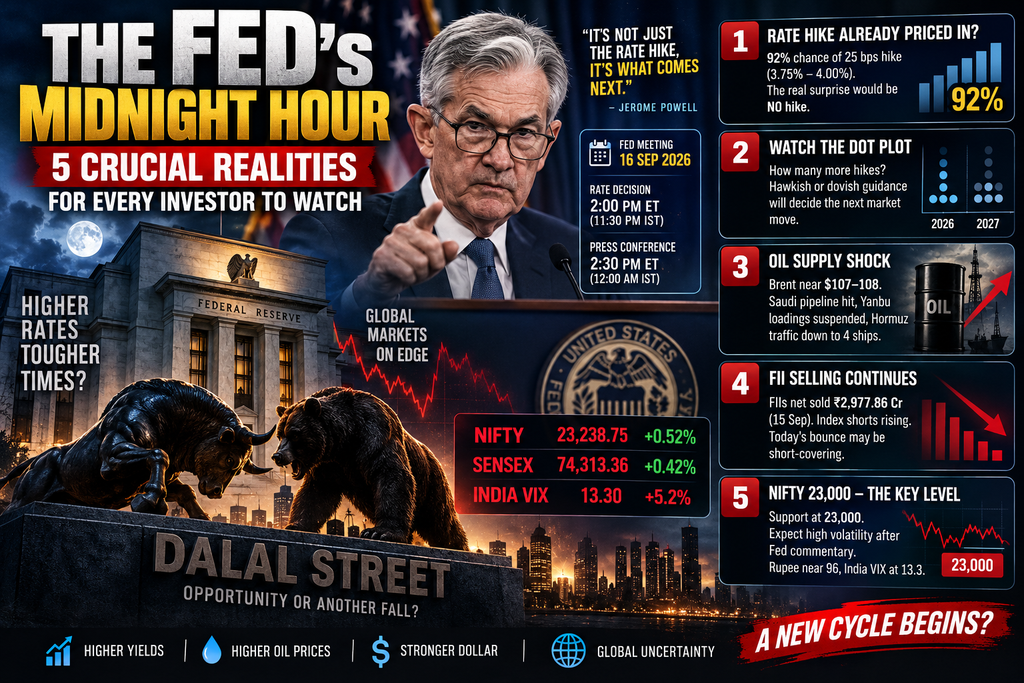
The US Federal Reserve is scheduled to announce its interest-rate decision on September 16, with the decision due at 2:00 PM ET, followed by the Chair’s press conference at 2:30 PM ET. For Indian investors, that means the key communication arrives between 11:30 PM and midnight IST.
Markets are heavily positioned for a 25-basis-point rate hike.
Current market pricing puts the probability at around 92%, meaning the rate hike itself is largely anticipated.
But this creates an important distinction:
The market may not react to the rate hike. It may react to what the Fed says next.
And that is why tonight’s Dot Plot, inflation outlook, growth projections, and forward guidance could matter more than the headline 25-basis-point move.
1. The 92% Probability Problem: When a Rate Hike Is Already Priced In
The first question is simple:
Will the Fed hike rates?
Current market pricing strongly points toward 25 basis points.
The expected move would take the federal funds target range to approximately 3.75%–4.00%. Market participants are treating this as the base-case outcome rather than a major surprise.
That creates three possible market reactions.
Scenario A: Expected 25-bps hike + balanced guidance
The market could treat the decision as a “known event”.
That could remove some uncertainty and potentially support risk assets.
Scenario B: 25-bps hike + hawkish guidance
This could be more problematic.
If the Fed signals that additional hikes may be required because inflation remains persistent, bond yields and the dollar could move higher.
That would potentially increase pressure on emerging markets such as India.
Scenario C: No hike
A hold would be a significant deviation from current expectations and could trigger a sharp repricing.
The key lesson is:
The bigger the difference between expectations and reality, the bigger the potential market reaction.
2. The Real Event: Watch the Fed Dot Plot
Forget the headline for a moment.
The most important document tonight could be the Fed’s Summary of Economic Projections and Dot Plot.
The Dot Plot shows where policymakers expect interest rates to move in the future.
For investors, the critical question is not:
“Did the Fed hike 25 bps?”
It is:
“How many more hikes does the Fed think it needs?”
Current market commentary indicates that traders are looking for clues about whether tonight’s hike is the beginning of a longer tightening cycle.
Three possible interpretations
| Fed signal | Possible market interpretation |
|---|---|
| One additional hike | Relatively less hawkish |
| Multiple additional hikes | More tightening pressure |
| Hike + strong inflation warning | Bond yields/dollar could rise |
| Hike + softer future guidance | Relief for risk assets |
| Hold + hawkish statement | Potential volatility |
| Hold + dovish statement | Potential liquidity relief |
These are scenario descriptions, not predictions.
3. The Bond Market Is Already Sending a Warning
One of the biggest developments before the Fed meeting has been the rise in US Treasury yields.
The US 10-year Treasury yield touched 5.04%, its highest level since 2007, before easing back toward the 5% area.
That number matters enormously.
Why?
Because the Treasury yield becomes the benchmark against which investors evaluate riskier assets.
The chain looks like this:
US Treasury yield ↑
↓
Risk-free return ↑
↓
Equity valuation pressure ↑
↓
Emerging-market attractiveness ↓
↓
Potential FII selling ↑
This is particularly important for India because foreign investors have to consider both:
- Indian equity returns
- Currency risk against the US dollar
If US yields rise while the rupee weakens, the relative attractiveness of Indian assets can deteriorate.
4. Crude Oil Has Become the Fed’s Uninvited Guest
The Fed’s inflation problem is being complicated by the energy market.
Brent crude recently moved above $108 per barrel, although prices eased on September 16 as Saudi Arabia found alternative export routes and US crude inventories rose unexpectedly. Reuters reported Brent around $107.45 and WTI around $103.87 during Wednesday trading.
This remains an enormous problem for India.
India is highly dependent on imported crude.
Therefore:
Crude ↑ → Import bill ↑ → Rupee pressure ↑ → Inflation risk ↑
And if inflation remains elevated, central banks have less room to aggressively ease monetary policy.
That is why crude oil has become one of the most important variables for Indian equities.
5. The Saudi Pipeline Shock: Why Oil Risk Is Different This Time
The recent disruption at Saudi Arabia’s East-West pipeline and Yanbu export infrastructure has added another layer of uncertainty.
Reuters reported that Brent jumped to $108.75 on September 15, while WTI closed at $105.83, after Saudi Arabia suspended some crude loadings at Yanbu and cancelled some shipments to European customers.
The disruption is particularly important because the East-West pipeline became more strategically important after the Strait of Hormuz was disrupted.
Reuters reported that vessel traffic through Hormuz had fallen to four commodity vessel movements on Monday, according to preliminary Kpler data.
However, there is an important counterpoint.
On September 16, Saudi Arabia arranged additional crude exports through Oman, helping ease some immediate supply concerns. Brent consequently fell from the previous day’s levels.
So the current situation should be described as:
A severe supply-risk premium—not necessarily a permanent loss of global oil supply.
That distinction matters.
6. Nifty Is Trying to Defend the 23,000 Zone
Indian markets have already experienced substantial pressure.
On September 15:
Nifty 50: 23,118.60
Sensex: 74,003.82
Nifty fell 1.19%, reaching a roughly five-month low, while financials and automobiles were among the weaker sectors.
Then on September 16, the market staged a modest recovery.
The Nifty closed around 23,238.75, while Sensex finished around 74,313.36.
That means the 23,000 area remains an important psychological reference point.
Key technical zones
| Nifty zone | Market significance |
|---|---|
| 23,000 | Major psychological support |
| 23,100–23,150 | Immediate support area |
| 23,300 | First recovery hurdle |
| 23,500 | Important resistance |
| 23,650+ | Stronger recovery zone |
These are technical reference levels, not guaranteed future targets.
7. FIIs Are Still Selling
This is one of the most important pieces of data for Indian investors.
On September 15, FIIs were net sellers of ₹2,977.86 crore, while DIIs bought approximately ₹2,686.05 crore.
September 15 institutional flows
| Investor | Net flow |
|---|---|
| FII/FPI | -₹2,977.86 Cr |
| DII | +₹2,686.05 Cr |
This tells us something important.
Domestic institutions are providing some buying support, but foreign selling remains a significant source of pressure.
The market therefore has two competing forces:
FII selling → downward pressure
versus
DII buying → support
The Fed decision could influence which side becomes stronger.
8. The Rupee Is Another Pressure Point
The rupee has been trading around the ₹96 per US dollar area.
On September 16, reports placed it around ₹95.96/$.
That creates another potential feedback loop:
Crude ↑
US yields ↑
Dollar ↑
↓
Rupee ↓
↓
Imported inflation ↑
↓
Pressure on Indian monetary policy ↑
This is why the Fed meeting cannot be analyzed in isolation.
For Indian investors, the real equation is:
Fed + Dollar + Oil + Rupee + FII flows
9. India VIX: Volatility Is the Hidden Variable
The India VIX is another indicator traders should watch closely.
During the September 16 session, India VIX was around the 13.3 area in market data.
A rising VIX generally indicates that options markets are pricing greater expected volatility.
For traders, that can mean:
- wider intraday swings,
- higher option premiums,
- faster stop-loss triggers,
- larger overnight gaps,
- increased event risk.
This is especially relevant when the market is waiting for a major central-bank announcement.
10. What Happens to Indian Stocks After the Fed?
The impact will not necessarily be uniform across sectors.
Banking & Financials
Sensitive to:
- bond yields,
- funding costs,
- credit growth,
- global liquidity.
IT
A stronger dollar can sometimes provide a revenue translation benefit for Indian IT companies, although global growth and technology spending remain separate variables.
Oil-sensitive sectors
Higher crude can increase input costs and pressure margins for businesses heavily dependent on transportation, fuel or petrochemical inputs.
Oil & Gas
Higher crude prices can have very different effects across upstream, refining and downstream companies.
Therefore, investors should avoid treating “oil up = every oil stock up” as a universal rule.
11. The Four Numbers That Matter Tonight
If you are watching the Fed event from India, keep these four numbers on your screen:
1. Fed policy rate
Expected:
+25 bps
2. US 10-year Treasury
Recent peak:
5.04%
3. Brent crude
Current region:
~$107–108
4. USD/INR
Current region:
~₹96
These four numbers can tell you much more about the global risk environment than the Fed headline alone.
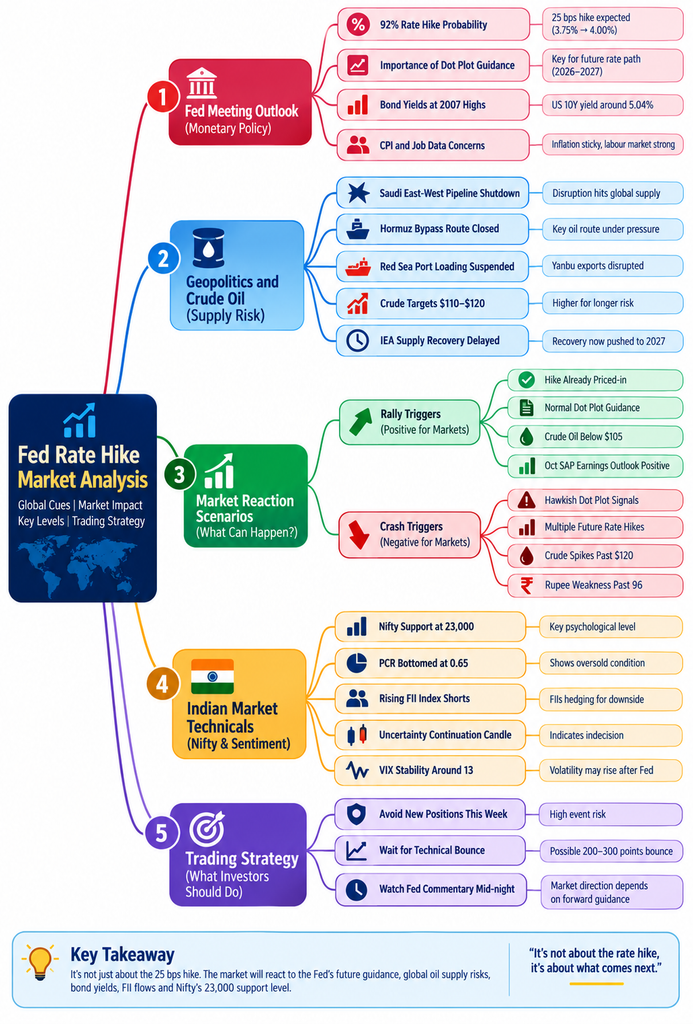
12. The Three Market Scenarios
🟢 Scenario 1: Relief
25-bps hike + softer guidance
Potential market interpretation:
- uncertainty clears,
- Treasury yields ease,
- dollar cools,
- crude remains contained,
- risk assets receive relief.
This could support a short-term recovery.
🟡 Scenario 2: High Volatility
25-bps hike + mixed Dot Plot
The market could initially rally and then reverse.
This is the classic:
“Buy the headline, sell the details”
environment.
The press conference becomes critical.
🔴 Scenario 3: Hawkish Shock
25-bps hike + stronger future tightening signal
Potential consequences could include:
- US yields higher,
- dollar stronger,
- emerging-market currencies under pressure,
- FII selling pressure,
- higher equity volatility.
In this scenario, Nifty’s 23,000 zone would become particularly important to monitor.
13. One Important Correction: Don’t Assume the Fed Hike Automatically Means a Crash
This is perhaps the most important point for investors.
A rate hike does not automatically equal a stock-market crash.
Markets price expectations continuously.
If investors already expect a 25-bps hike, the actual hike may produce a relatively limited reaction.
The bigger move can occur when:
Actual policy ≠ expected policy
or
Future guidance ≠ expected guidance.
That is why the Dot Plot + press conference + Treasury yield reaction deserve more attention than the headline number.
14. The Midnight Checklist for Indian Investors
Before taking a position after the Fed announcement, watch:
Global
- Fed rate decision
- Dot Plot
- Fed inflation projections
- Fed growth projections
- US 10Y yield
- Dollar Index
- Brent crude
India
- Nifty 23,000
- Nifty 23,300
- Bank Nifty
- India VIX
- USD/INR
- FII/DII flows
- Sector rotation
Most important combination
Fed hawkish + US 10Y >5% + Brent >$105 + USD/INR near ₹96
would represent a considerably tighter global financial backdrop.
Conversely:
Fed guidance softer + yields lower + oil below $105 + rupee stabilizes
would reduce some of the immediate pressure.
15. Final Takeaway: Tonight Is About the Path, Not Just the Rate
The Fed’s expected 25-basis-point hike is already heavily anticipated.
The bigger story is what comes afterward.
Will policymakers signal that additional tightening is necessary?
Will the Dot Plot shift higher?
Will the US 10-year yield remain above 5%?
Will crude remain above $100?
Will the rupee remain near ₹96?
And most importantly:
Will FIIs continue selling Indian equities?
As of September 16, the Nifty had recovered to around 23,238.75 after falling to a five-month low the previous day. FIIs remained net sellers, crude remained above $100, and the US 10-year yield remained around the 5% threshold.
That makes 23,000 a level worth watching—not because it guarantees a bottom, but because a sustained break or defense of that area would provide useful information about market positioning.
The Fed’s midnight hour is therefore less about guessing whether the market will go up or down.
It is about understanding the new cost of money.
Rates. Yields. Crude. Currency. Liquidity.
These five forces could determine the next major phase for Dalal Street.
📊 Fed Night: Quick Data Dashboard
| Indicator | Latest/Expected |
|---|---|
| Fed decision | 16 Sep 2026 |
| Expected Fed move | +25 bps |
| Market probability | ~92% |
| Expected policy range after hike | 3.75%–4.00% |
| US 10Y yield recent high | 5.04% |
| Brent crude | ~$107–108 |
| USD/INR | ~₹95.96 |
| Nifty Sep 15 close | 23,118.60 |
| Nifty Sep 16 close | 23,238.75 |
| Nifty key psychological level | 23,000 |
| FII net selling Sep 15 | ₹2,977.86 Cr |
| DII net buying Sep 15 | ₹2,686.05 Cr |
| India VIX | ~13.3 |
Sources: Reuters, market data reports and Indian market sources.
Frequently Asked Questions (FAQ)
1. Will the Fed’s rate decision impact the Indian stock market?
Yes. The Fed decision can affect global liquidity, US Treasury yields, the US dollar, emerging-market flows and consequently Indian equities. The size of the reaction depends heavily on how the decision compares with market expectations.
2. Is the Fed expected to hike rates by 25 basis points?
Market pricing before the September 16, 2026 decision indicated a high probability of a 25-basis-point hike. The actual market reaction can depend more on the Fed’s forward guidance than on the hike itself.
3. Why is the Fed Dot Plot important?
The Dot Plot shows policymakers’ projections for future interest rates. It can provide clues about whether the current hike is likely to be followed by additional tightening or a more gradual policy path.
4. What happens if the Fed gives hawkish guidance?
Hawkish guidance can put upward pressure on Treasury yields and the US dollar. For emerging markets, this can increase financial-market volatility and potentially affect foreign capital flows.
5. Why is crude oil important for India?
India imports a large amount of its crude oil. Higher oil prices can increase the import bill and put pressure on inflation, the rupee and corporate input costs.
6. Why is Brent crude above $100 a concern?
A sustained crude price above $100 can create additional inflation and trade-balance pressure. The impact varies across sectors depending on their exposure to fuel and other energy costs.
7. What is the significance of the 23,000 Nifty level?
23,000 is an important psychological and technical reference level for traders. A sustained move below or above a level should be evaluated alongside volume, breadth, derivatives positioning and global-market conditions rather than in isolation.
8. Are FIIs still selling Indian equities?
Yes, recent sessions have seen substantial FII selling. For example, FIIs were reported as net sellers of approximately ₹2,978 crore on September 15, 2026, while DIIs were net buyers. FII/DII flows can change daily.
9. What should investors watch after the Fed announcement?
Key indicators include:
- US 10-year Treasury yield
- Dollar Index
- Brent crude
- USD/INR
- India VIX
- FII/DII flows
- Nifty’s reaction around 23,000
- Fed Dot Plot and forward guidance
10. Can a 25-bps Fed hike cause a market crash?
Not necessarily. If the hike is already priced into markets, the initial reaction may be relatively limited. A larger move can occur if the Fed’s guidance differs significantly from expectations.
11. Why can Nifty rise even when global risks remain high?
Markets are forward-looking. Short-covering, domestic institutional buying, sector rotation, or easing crude prices can temporarily support equities even while broader macro risks remain.
12. What is the biggest risk for Indian equities right now?
There is no single guaranteed trigger. A combination of higher US yields, elevated crude prices, rupee weakness, tighter global liquidity and continued FII selling could increase pressure on Indian equities.
13. Is this market correction temporary or structural?
It is too early to determine that from a few sessions. Investors would need to monitor earnings, valuations, liquidity, crude prices, monetary policy, currency trends and institutional flows over a longer period.
14. What does a rising India VIX mean?
A rising India VIX generally indicates that the options market is pricing greater expected volatility. It does not by itself indicate whether Nifty will rise or fall.
15. What is the key takeaway for investors?
The Fed’s headline rate decision is only one part of the equation. Future guidance, Treasury yields, crude oil, the rupee and foreign flows may determine how Indian markets respond after the announcement.
Disclaimer
This article is for educational and informational purposes only and is not investment advice. Market conditions can change rapidly around central-bank decisions, geopolitical events and commodity-price shocks. Investors should conduct independent research and consider their own risk tolerance before making investment decisions.
Top 10 SEO Titles
- Fed Rate Decision Today: 5 Crucial Things Indian Investors Must Watch
- Fed Rate Hike 2026: How the US Fed Decision Could Impact Nifty and Bank Nifty
- Nifty Today: Fed Rate Decision, Crude Oil, FII Selling and Rupee Under Pressure
- US Fed Rate Decision: Why Nifty 23,000 Is the Key Level for Indian Investors
- Fed Meeting Today: Dot Plot, US Bond Yields, Crude Oil and Nifty Explained
- Indian Stock Market Today: 5 Fed Signals That Could Move Nifty After Midnight
- Fed Rate Hike and Nifty Crash: What Investors Should Watch Before the Decision
- Fed Decision Tonight: 25 Bps Rate Hike, 5% US Yield and $100+ Oil Explained
- Nifty 50 Outlook: Fed Rate Hike, FII Selling and Crude Oil Create Market Uncertainty
- Fed Rate Decision 2026: Will Nifty Hold 23,000? 5 Key Market Signals to Watch