
The Real Reason Markets Aren’t Rattled by the Fed — and the New Legislative Sword of Damocles
The U.S. Federal Reserve has finally broken its long pause.
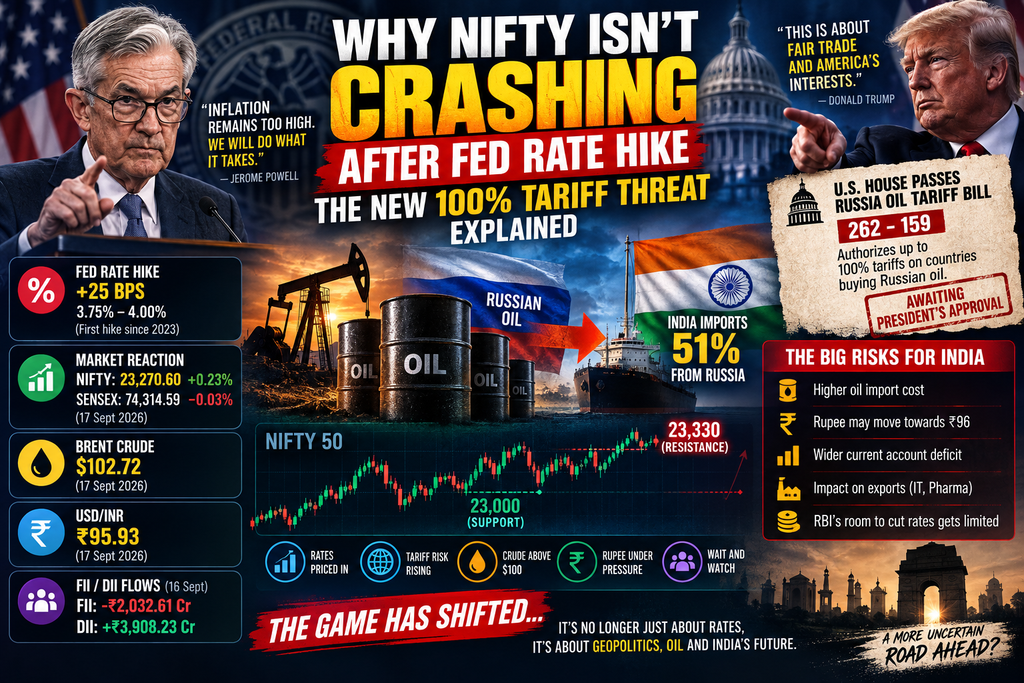
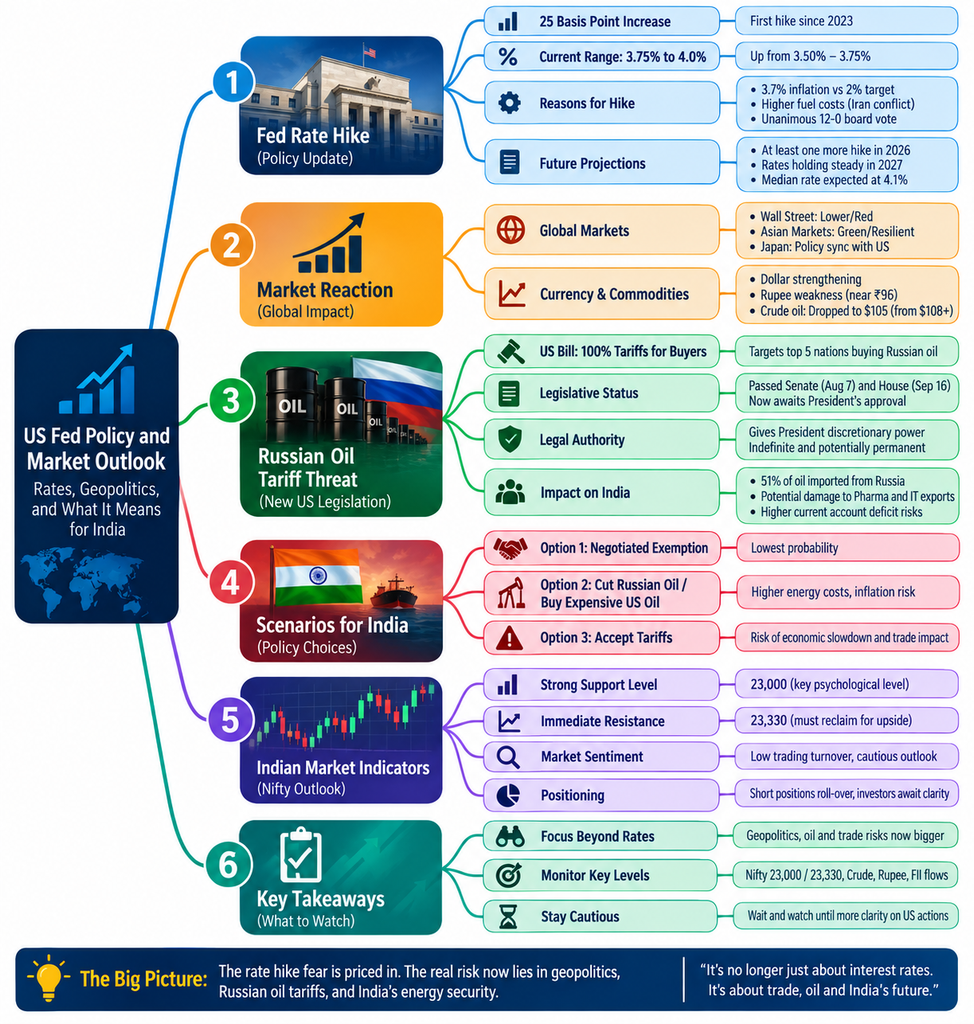
On September 16, 2026, the Fed raised the federal funds target range by 25 basis points to 3.75%-4.00%, the first rate increase since July 2023. The decision was unanimous, with all 12 voting FOMC members supporting the move.
Yet the expected market panic did not materialise.
On September 17, the Nifty 50 gained 0.23% to 23,270.60, while the Sensex slipped just 0.03% to 74,314.59. Indian markets were volatile but relatively resilient despite the Fed’s hawkish message.
So what changed?
The answer is simple:
The Fed hike was largely expected. The bigger uncertainty has now shifted from interest rates to geopolitics, oil and trade policy.
And that brings us to the new U.S. legislation targeting countries that continue to buy Russian energy.
1. The Fed Hiked — But the Market Had Already Prepared
The Fed’s 25-basis-point hike was not a surprise.
Before the meeting, futures markets were pricing a very high probability of a 25-bps move. Reuters reported that Fed funds futures were pricing roughly a 92.5% probability of the hike before the decision.
The Fed then delivered exactly that:
25 bps → 3.75%-4.00%
This illustrates one of the most important rules of financial markets:
Expected news usually creates less volatility than unexpected news.
The market had already spent weeks adjusting to the possibility of higher rates.
Therefore, the headline:
“Fed hikes rates”
was not enough to create a fresh shock.
The more important question became:
“What happens next?”
2. The Dot Plot Was More Important Than the Rate Hike
The September projections changed the conversation.
The Fed’s updated projections indicate that policymakers see the federal funds rate around 4.00%-4.25% at the end of 2026, with the median projection remaining around that level through 2027. Reuters reported that 16 of 18 policymakers see at least one additional hike by the end of 2026.
That means the market cannot simply conclude:
“One hike is finished, so the rate story is over.”
It isn’t.
The Fed is effectively saying:
Inflation remains too high + economy remains resilient = further tightening remains possible.
The Fed’s own projections put median 2026 PCE inflation at 3.7%, falling to 2.3% in 2027 and 2.1% in 2028.
That is important because the Fed’s long-run inflation target is 2%.
3. Why the Market Didn’t Collapse
There are several reasons the Indian market remained relatively stable.
First: The hike was priced in
Investors were already positioned for the 25-bps move.
Second: Nifty recovered from the 23,000 area.
After falling sharply on September 15, Nifty recovered and closed at 23,270.60 on September 17.
Third: Domestic institutions are providing support
FII selling remains significant, but DII buying has been cushioning the market.
On September 16:
FII: -₹2,032.61 crore
DII: +₹3,908.23 crore
And on September 15:
FII: -₹2,977.86 crore
DII: +₹2,686.05 crore
This creates an important tug-of-war:
Foreign selling vs domestic institutional buying.
4. FII Selling Is Still a Major Warning Signal
Although Nifty recovered, foreign investors have not suddenly become bullish.
According to market data, FIIs were net sellers of more than ₹2,000 crore on September 16, taking September’s cumulative cash-market selling to roughly ₹4,431.72 crore by that point. DIIs had invested about ₹31,581 crore during the same period.
This explains why the index can remain stable even when foreign investors are selling:
FII selling
↓
DII buying
↓
Index support
But if domestic institutional buying slows while FII selling remains elevated, the market’s support structure could weaken.
5. The New Threat: America’s Russia-Oil Tariff Bill
This is where the story becomes much bigger than monetary policy.
On September 16, 2026, the U.S. House of Representatives passed the Lindsey O. Graham Sanctioning Russia and Iran Act of 2026 by a 262-159 vote. The legislation now goes to President Donald Trump.
One of its most significant provisions would give the President authority to impose tariffs of up to 100% on countries that continue purchasing Russian oil and gas.
India and China are among the countries that could be affected.
But there is an important distinction:
This is an authorised power, not a 100% tariff already imposed on India.
That distinction is critical for investors.
The legislation still requires the presidential action necessary for such tariffs to actually be imposed. Reuters reported on September 17 that India has already warned that the legislation could strain bilateral relations.
6. Why India Is Particularly Exposed
India’s exposure to Russian crude has increased significantly.
In July 2026, Russian crude accounted for approximately 50.83% of India’s total oil imports, according to Reuters. Russia supplied around 2.47 million barrels per day during the month.
For April-July 2026, Russia’s average share was approximately 43.25%.
That means Russia is not a marginal supplier.
It is a major component of India’s crude-oil supply chain.
And that creates a difficult policy equation.
Russia oil → cheaper/available supply
↓
U.S. tariff threat → potential trade penalty
↓
Alternative crude sourcing → potentially higher cost
↓
Higher energy costs → inflation pressure
↓
Higher import bill → rupee pressure
↓
Corporate margin pressure
This is the real economic risk.
7. India’s 88% Import Dependency Makes Oil Even More Important
India is one of the world’s largest crude-oil importers.
That means the country cannot simply ignore a major change in the global oil market.
If Russian barrels become significantly more expensive to import because of tariffs or sanctions, Indian refiners would have to consider alternative suppliers.
Possible sources include:
- Middle East
- United States
- Latin America
- Africa
But replacing Russian barrels is not simply a matter of changing suppliers.
The final impact depends on:
- crude grade,
- freight cost,
- insurance,
- discounts,
- sanctions compliance,
- refining compatibility,
- and global oil prices.
So the real risk is not simply:
“Russia oil disappears.”
It is:
“The cost of securing replacement barrels rises.”
8. Crude Oil Is Already Above $100
The oil market is making the situation more complicated.
Brent crude had moved above $108 per barrel earlier in the week, but supply concerns eased somewhat on September 17 after Saudi Arabia arranged additional exports through Oman.
Reuters reported Brent falling to around $102.72, while WTI fell to approximately $100.47.
So the market is not currently dealing with a $120 crude price.
But it is still dealing with:
$100+ oil
And that is significant for India.
9. The Rupee Is Already Testing ₹96
The currency market provides another warning.
The rupee briefly weakened beyond ₹96 per dollar on September 17 before recovering.
It eventually closed around ₹95.93, with probable RBI intervention and portfolio inflows helping limit the decline.
This creates a critical macro chain:
Crude ↑
→ import bill ↑
→ dollar demand ↑
→ rupee ↓
→ imported inflation ↑
→ RBI flexibility ↓
This is why oil and currency need to be watched together.
10. The Real “No-Win” Problem for India
India now faces a difficult policy trade-off.
Scenario A: Continue buying Russian crude
Potential advantages:
- maintain access to Russian supply,
- preserve refinery economics,
- reduce immediate energy costs.
Potential risks:
- exposure to U.S. tariff measures,
- pressure on India-U.S. trade relations,
- sanctions-related compliance risk.
Scenario B: Reduce Russian purchases
Potential advantages:
- reduce exposure to U.S. tariff action,
- potentially ease diplomatic pressure.
Potential risks:
- replacement crude could be more expensive,
- freight and insurance costs could increase,
- refining margins could change,
- domestic inflation could rise.
This is therefore not simply a political decision.
It is an energy-security and economic-cost calculation.
11. Is the 100% Tariff Already Imposed?
No.
This is one of the most important corrections for anyone publishing an article about the issue.
The House has passed legislation that authorizes tariffs of up to 100% against countries buying Russian energy.
It does not mean India is currently paying a 100% tariff on Russian oil.
Reuters reported on September 17 that Indian officials are already communicating concerns to Washington, while Indian refiners are seeking possible exemptions or quotas.
Therefore, investors should watch three separate stages:
Bill passed
↓
Presidential approval
↓
Actual implementation/tariff decision
The market may react at each stage differently.
12. Why This Is More Important Than the Fed for Indian Markets
The Fed determines the cost of global money.
The Russia-oil issue potentially affects the cost of India’s energy.
These are two different macro variables.
Fed problem
Higher rates → higher bond yields → tighter liquidity.
Oil problem
Higher crude → higher import bill → inflation → currency pressure.
Now combine them:
Fed tightening
Crude above $100
Rupee near ₹96
FII selling
=
A much tighter financial environment for India.
That is why the market’s focus is rapidly shifting from “Fed hike fear” toward “trade and energy risk.”
13. Nifty 23,000 vs 23,330: The Technical Battlefield
The Nifty has recovered from the recent low.
On September 17:
Nifty = 23,270.60
The index therefore remains below the 23,330 area mentioned in the original thesis.
For traders, the zones can be viewed as:
| Level | Significance |
|---|---|
| 23,000 | Major psychological support |
| 23,100–23,150 | Immediate support zone |
| 23,270 | September 17 close |
| 23,330 | Near-term recovery hurdle |
| 23,500 | Next important resistance |
These are technical reference points, not guaranteed targets.
The key question is whether the index can sustain a move above resistance with stronger participation.
14. What Would Change the Market Narrative?
The current narrative could improve if several things happen simultaneously:
Positive catalysts
- Brent falls below $100
- Rupee stabilises
- FII selling slows
- DII buying continues
- Fed signals no immediate additional tightening
- Russia-oil tariff implementation is delayed, or exemptions emerge
- geopolitical tensions ease
On the other hand, pressure could increase if:
Negative catalysts
- Brent moves sharply higher
- Rupee breaks decisively below ₹96
- U.S. tariff action is implemented
- FII selling accelerates
- Fed signals additional hikes
- global bond yields rise further
15. Japan Adds Another Layer of Risk
There is another central bank that Indian investors cannot ignore:
Bank of Japan.
If the BOJ continues tightening while the Fed remains hawkish, the global interest-rate landscape becomes less supportive of the traditional yen carry trade.
That matters because global funds have historically used low-cost yen financing to invest in higher-yielding assets.
If:
Japan rates ↑
Yen strengthens
US rates ↑
then the global funding environment can become significantly less comfortable.
This is one reason the current market cannot be analysed through the Fed alone.
16. The New Four-Way Macro Equation
Indian investors now have four major variables to monitor:
1. FED
Higher rates → higher global funding cost
2. CRUDE
Higher oil → higher inflation/import bill
3. RUPEE
Weaker rupee → imported inflation
4. RUSSIA TARIFFS
Potential tariff → trade + energy-supply uncertainty
And these four variables interact.
Fed + Oil + Rupee + Tariffs = India’s new macro risk equation.
17. What Investors Should Watch Next
The next few sessions are likely to be driven by headlines rather than a single technical indicator.
Global indicators
- US 10Y Treasury yield
- Dollar Index
- Brent crude
- Fed rate expectations
- BOJ policy expectations
Indian indicators
- USD/INR
- FII/DII flows
- India VIX
- Nifty 23,000
- Nifty 23,330
- Bank Nifty
- sector rotation
Geopolitical indicators
- U.S. tariff implementation
- India-U.S. negotiations
- Russian crude flows
- Strait of Hormuz shipping
- Middle East supply disruptions
18. The Big Question: Is the Fed No Longer the Main Risk?
For the immediate session, the market has demonstrated that a fully expected Fed hike does not necessarily produce a crash.
But that does not mean monetary policy has become irrelevant.
The Fed has signalled that another hike may still be required.
At the same time, the U.S. 10-year Treasury yield has been around the 5% threshold, while oil remains above $100. Reuters reported the 10-year yield around 5% following the Fed decision.
Therefore, the rate story has not disappeared.
It has simply changed from:
“Will the Fed hike?”
to:
“How high will rates stay, and for how long?”
19. The Real Market Test
The Indian market has already shown some resilience.
On September 17:
Nifty: 23,270.60 (+0.23%)
Sensex: 74,314.59 (-0.03%)
At the same time, crude remained above $100, and the rupee hovered near ₹96.
This is an important divergence.
The market is not ignoring the risks.
It is absorbing them while waiting for more clarity.
The next major catalyst may therefore not be another Fed headline.
It could be:
What Washington actually does with the new Russia-oil tariff authority.
Conclusion: From Rate-Hike Fear to Trade-War Risk
The first phase of this market correction was dominated by:
Fed → Rates → Bond yields → Liquidity
The next phase could increasingly be driven by:
Russia oil → Tariffs → Crude → Rupee → Inflation
The Fed has already delivered its 25-basis-point hike, taking the policy range to 3.75%-4.00%. The decision was unanimous, and the latest projections leave the door open to another hike in 2026.
But the Indian market has so far absorbed the decision relatively calmly.
Now investors have another question to answer:
What happens if the U.S. actually uses the newly granted tariff authority against countries buying Russian energy?
For India, that question is particularly important because Russian crude accounted for about 50.83% of oil imports in July 2026.
That makes the issue bigger than a normal tariff dispute.
It is a question of:
Energy security + trade policy + inflation + currency + global capital flows.
And that is why the next major market move may come not from another 25 basis points—but from Washington’s next decision on Russian oil.
📊 Key Market Data — 17 September 2026
| Indicator | Latest |
|---|---|
| Fed policy rate | 3.75%–4.00% |
| September Fed vote | 12–0 |
| Further 2026 hike signal | 16 of 18 officials see ≥1 more hike |
| Nifty 50 | 23,270.60 |
| Sensex | 74,314.59 |
| Brent crude | ~$102–105 |
| USD/INR | ~₹95.93 |
| FII net flow, Sep 16 | -₹2,032.61 Cr |
| DII net flow, Sep 16 | +₹3,908.23 Cr |
| Russian share of India’s oil imports, July | 50.83% |
| Potential U.S. tariff authority | Up to 100% |
| House Russia sanctions bill | Passed 262–159 |
SEO FAQ
Q1. Why did Nifty not crash after the Fed rate hike?
Because the 25-bps hike was largely expected and had already been incorporated into market pricing.
Q2. What is the new 100% Russia oil tariff threat?
U.S. legislation passed by the House on September 16 authorizes the President to impose tariffs of up to 100% on countries purchasing Russian energy. It has not automatically imposed a 100% tariff on India.
Q3. How much Russian oil does India import?
Russian crude represented approximately 50.83% of India’s oil imports in July 2026, according to Reuters.
Q4. Why is ₹96 per dollar important for India?
A weaker rupee can increase the rupee cost of imported commodities such as crude oil, potentially adding to inflation and the import bill.
Q5. What are the key Nifty levels now?
The 23,000 area remains an important psychological support, while 23,330 is a near-term recovery/reference level in the setup discussed above.
Q6. What should investors watch after the Fed hike?
US Treasury yields, Brent crude, USD/INR, FII flows, the BOJ, and developments around the U.S.-Russia oil tariff legislation.
Disclaimer: This article is for educational and informational purposes only and is not investment advice. Market conditions can change rapidly due to monetary policy, geopolitical developments, commodity prices, and government decisions.