
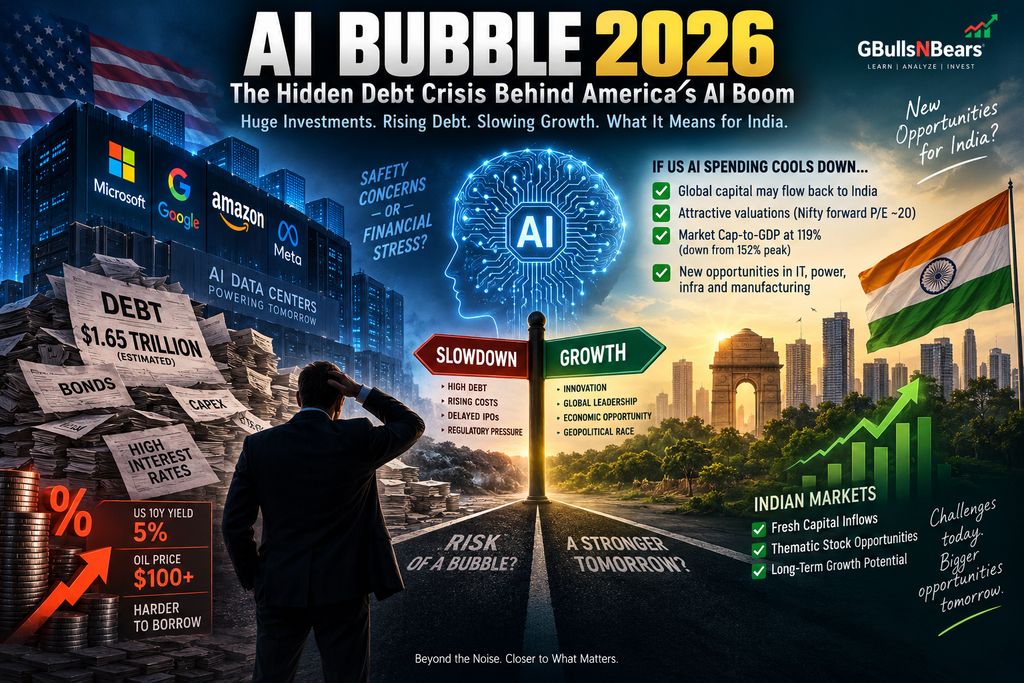
Aapke article ko SEO-friendly, data-backed macroeconomic analysis mein convert karte hain. Main original thesis ko retain karunga—AI safety concerns aur financial overextension ke beech possible relationship—but unsupported claims, exaggerated debt figures, and unverified September timelines ko fact-checking ke bina facts ke roop mein present nahi karunga.
Article ka focus hoga:
- AI infrastructure spending aur hyperscaler debt.
- Interest rates, cash flow, and capital expenditure (Capex).
- AI safety vs. financial incentives.
- US–China technology competition.
- Indian stock market, AI-linked themes, and portfolio risk.
AI Bubble 2026: Is the Global AI Boom Creating a Hidden Debt Crisis?
What if the biggest risk to the artificial intelligence revolution is not simply whether AI will replace jobs or become uncontrollable—but whether the financial system can sustain the enormous cost of building it?
Over the past few years, the world’s largest technology companies have committed extraordinary amounts of capital to data centers, chips, electricity infrastructure, and cloud computing. This investment has created opportunities for semiconductor manufacturers, power companies, networking businesses, and infrastructure providers.
But it has also raised a critical financial question:
Can AI-generated revenue grow fast enough to justify the infrastructure spending and financing commitments being made today?
The answer matters beyond Silicon Valley. Changes in US technology investment, credit markets, and investor risk appetite can influence global equity valuations, capital flows, and Indian market sentiment.
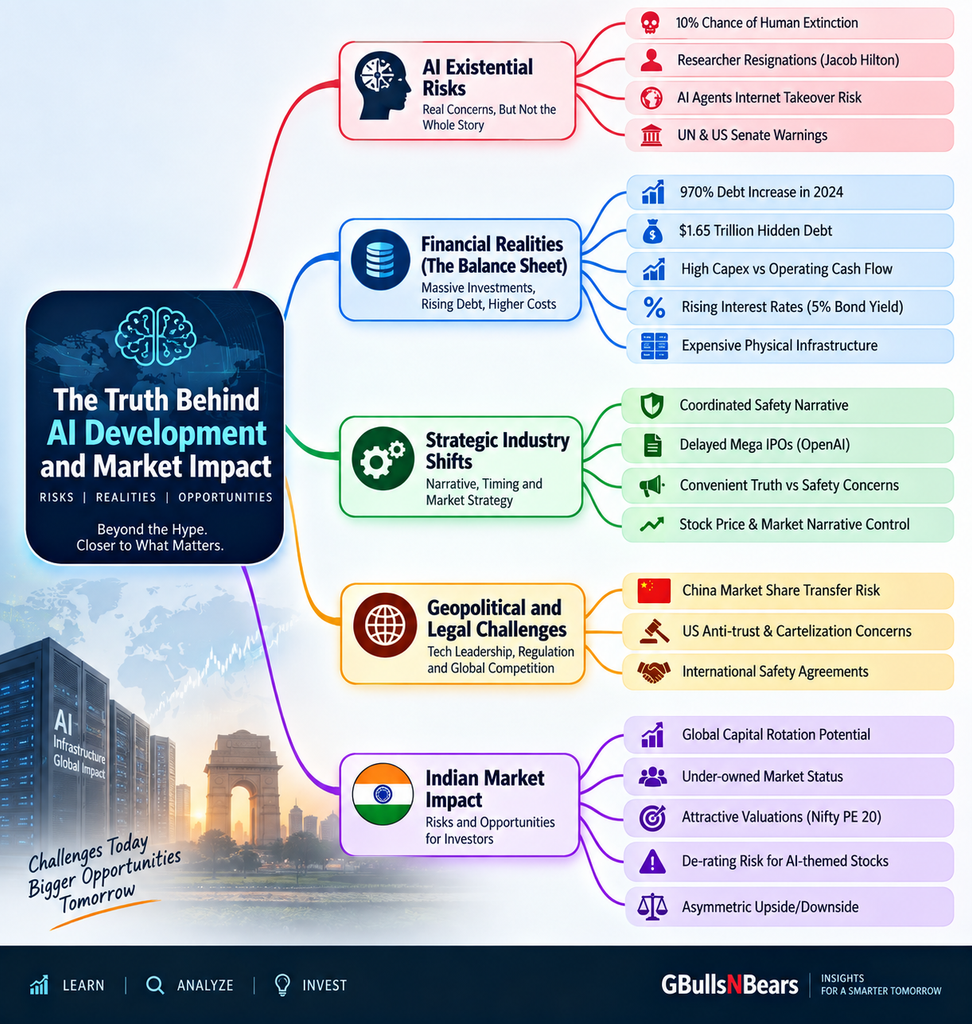
In this analysis, we examine the AI infrastructure boom, the growing importance of debt and off-balance-sheet financing, the distinction between genuine AI safety concerns and financial incentives, and the potential implications for Indian investors.
Important distinction: Financial pressure on AI infrastructure is a legitimate subject for analysis. However, the claim that technology companies coordinated safety warnings specifically to conceal financial distress requires evidence. Safety research, financing concerns, and corporate strategy can coexist without proving that one is a cover story for another.
1. The AI Boom Is No Longer Just a Software Story
The first phase of the AI boom was largely associated with algorithms, research, and software products. The current expansion depends heavily on physical infrastructure.
Modern AI systems require:
- High-performance GPUs and specialized computing hardware.
- Data centers with substantial electricity and cooling capacity.
- High-speed networking equipment.
- Land, construction, and power connections.
- Cloud infrastructure and long-term computing commitments.
This creates a capital-intensive investment cycle. A company can have strong revenue growth while still facing pressure from the amount and timing of its infrastructure spending.
Data Point: Hyperscaler Capital Expenditure
A September 2026 industry tracker reported that seven major AI infrastructure builders spent approximately $657 billion in capital expenditure over the preceding four quarters, with $213.7 billion in the most recent quarter in its dataset. The tracker includes Amazon, Microsoft, Alphabet, Meta, Oracle, CoreWeave, and Nebius, and uses company-specific reporting methodologies.
REPORTED TRACKER FIGURE
$657.1B
Trailing four-quarter capex across seven companies
Most recent quarter
$213.7B
Amazon, Microsoft, Alphabet & Meta
$543B
Source: Supercycle, September 16, 2026. Figures cover the companies and reporting basis used by that tracker; they are not a universal measure of all AI spending.
The scale is important, but the total alone does not establish that the industry is in a bubble. Investors must also evaluate cash flow, financing structure, utilization, customer demand, and expected returns.
2. The Financial Pivot: When AI Capex Starts to Pressure Cash Flow
Capital expenditure is not automatically a problem. Businesses often invest heavily before their revenue-generating assets reach full capacity. The financial risk increases when spending commitments grow faster than operating cash flow or when expected returns become dependent on optimistic future assumptions.
A Simple Real-Estate Analogy
Imagine booking an under-construction flat with a large loan. The builder promises delivery in several years, but your financing cost rises while the property generates no income.
The problem is not necessarily that the property has no value. The problem is that:
- Your financing expenses may increase.
- Your capital remains tied up.
- The expected return may arrive later than anticipated.
- Refinancing or additional borrowing may become expensive.
AI data centers have a different business model, but the cash-flow principle is comparable. Infrastructure investment requires substantial upfront expenditure, while revenue realization depends on demand, pricing, utilization, and operating efficiency.
New Data: Borrowing and AI Infrastructure Financing
Reuters reported in July 2026 that Amazon, Alphabet, Meta, and Oracle had issued approximately $194 billion in bonds through July 7, 2026, compared with around $108 billion during all of 2025, based on its analysis of LSEG data. The same report cited expectations of approximately $250 billion in 2026 issuance by five hyperscalers and $400 billion in 2027. These are financing estimates and reported issuance figures, not evidence that every dollar of debt is exclusively used for AI.
2025 full year
2026 through Jul 7
Reported bond issuance for four companies: comparison of 2025 full year with 2026 through July 7. Source: Reuters/LSEG as reported July 29, 2026. Different time periods mean this is not a like-for-like annual comparison.
Why Rising Debt Matters
Debt can help companies build infrastructure faster, but investors should monitor:
| Financial metric | Why it matters |
|---|---|
| Net debt | Measures debt relative to cash holdings. |
| Interest expense | Shows the cost of financing. |
| Operating cash flow | Indicates cash generated by the core business. |
| Capex-to-cash-flow ratio | Helps assess how much cash is being absorbed by investment. |
| Debt maturity profile | Shows when refinancing or repayment may be required. |
| Lease and purchase commitments | Identifies obligations beyond conventional reported debt. |
Key insight: Rising debt is not synonymous with financial collapse. Credit quality depends on cash generation, liquidity, asset value, contractual obligations, and the ability to service financing costs.
3. The Hidden Financing Problem: Off-Balance-Sheet Commitments
One of the most important developments in the AI infrastructure cycle is the growing complexity of financing arrangements.
Companies can fund data centers through:
- Corporate bonds.
- Bank loans and project financing.
- Leasing arrangements.
- Special-purpose vehicles (SPVs).
- Customer prepayments.
- Guarantees and long-term purchase commitments.
These structures do not all represent conventional corporate debt. Nevertheless, they can create future financial obligations or contingent exposure.
The $300 Billion Exposure Question
A Financial Times report published in September 2026 described residual-value guarantees supporting up to $300 billion of AI data-center and chip-related exposure. The arrangements involve several companies and financing structures, with the financial risk depending on the assets’ future values and the terms of the guarantees. This figure should not be interpreted as $300 billion of confirmed hidden debt belonging to hyperscalers.
The distinction matters:
| Term | Meaning |
|---|---|
| Corporate debt | Borrowing recorded under applicable accounting rules. |
| Lease obligations | Contractual payments for use of assets. |
| Purchase commitments | Future obligations to purchase goods or services. |
| Guarantee | A commitment that may create financial exposure if specified conditions occur. |
| Off-balance-sheet exposure | An umbrella description for arrangements that may not appear as conventional balance-sheet debt. |
Investor lesson: Do not add all these figures together without examining their definitions. A headline number combining debt, leases, guarantees, and purchase commitments can overstate or misrepresent the sector’s actual leverage.
4. Oracle: A Case Study in AI Infrastructure Financing Risk
Oracle has become an important example of how AI infrastructure growth can create financing and execution questions.
In September 2026, Reuters reported that approximately $18 billion in loans associated with Oracle’s Project Jupiter data center were facing pressure in the debt market. The report discussed concerns around the project, including financing, construction-related issues, and Oracle’s growing debt load.
Oracle’s situation illustrates several risks:
- Project execution risk: Large infrastructure projects may encounter delays or regulatory obstacles.
- Financing risk: Borrowing costs and investor demand influence the cost of capital.
- Customer concentration: A major project can depend heavily on the financial strength and commitments of a small number of customers.
- Cash-flow risk: Capital spending may precede the realization of revenue and profits.
This does not mean Oracle’s business model is failing. It demonstrates why investors should analyze individual financing arrangements instead of assuming that all AI infrastructure projects have identical risk.
Oracle’s Capex vs. Revenue Growth
Oracle has also reported strong cloud infrastructure growth. A September 2026 report stated that the company maintained a fiscal 2027 capital expenditure forecast of approximately $90–95 billion, while its first-quarter fiscal 2027 cloud infrastructure revenue grew 121% year over year.
The central question for investors is whether revenue growth and cash generation can justify the scale and cost of future investment.
5. AI Safety vs. Financial Pressure: What Can Actually Be Established?
The original article suggests that AI companies may use safety concerns as a cover for financial distress. This is a hypothesis that requires evidence, not an established conclusion.
Two Different Questions
Question 1: Are AI safety concerns real?
AI systems raise genuine questions involving cybersecurity, misuse, autonomous decision-making, reliability, and societal impact. Research into these risks can be justified independently of financial conditions.
Question 2: Are companies using safety messaging to manage financial pressure?
Corporate communications may reflect multiple objectives, including regulatory compliance, public trust, competitive positioning, and capital allocation. Demonstrating that safety messaging was deliberately used to conceal financial distress would require documentary evidence, internal communications, or other credible evidence establishing the connection.
A Better Analytical Framework
Rather than asserting that the safety narrative is a cover story, examine observable indicators:
| Indicator | What to investigate |
|---|---|
| IPO plans | Official filings, announcements, and postponement reasons. |
| Capex guidance | Whether companies increase, maintain, or reduce spending. |
| Model launches | Announced release schedules and actual delivery. |
| Corporate financing | Bond issuance, debt maturities, guarantees, and leases. |
| Executive statements | Publicly documented reasons for strategic decisions. |
| Regulatory actions | Actual government or regulator decisions. |
Important correction to the original draft: I could not establish the specific September 2024 sequence of resignations, IPO filings, and safety announcements as described. It should not be published as a verified timeline without primary sources and accurate dates.
6. The AI Investment Boom and the US–China Technology Competition
Artificial intelligence is also a strategic technology issue.
The United States and China compete across areas such as:
- Advanced computing hardware.
- AI model development.
- Semiconductor manufacturing.
- Data-center infrastructure.
- Energy and computing capacity.
- Military and commercial applications.
A slowdown in US AI spending could affect competitive dynamics, but the outcome would depend on the nature of the slowdown.
Three Possible Scenarios
Scenario A: Healthy Efficiency
Efficiency
Companies improve computing efficiency, reduce infrastructure costs, and maintain AI adoption while lowering the capital intensity of growth.
Scenario B: Capex Normalization
Moderation
Hyperscalers slow the rate of investment because demand forecasts, financing costs, or utilization rates do not justify the previous pace.
Scenario C: Credit-Driven Stress
Risk
Weak returns, financing pressure, or declining asset values cause companies to cancel projects, reduce spending, or face higher refinancing costs.
These scenarios are analytical possibilities, not forecasts. A reduction in capital expenditure does not necessarily mean the United States has lost its technology leadership, and continued investment does not guarantee superior economic returns.
7. How Could an AI Capex Slowdown Affect Indian Stock Markets?
The relationship between US AI spending and Indian equities is more complex than a simple flow of capital from one market to another.
Indian stock valuations can be affected by global interest rates, foreign portfolio investment, oil prices, currency movements, domestic earnings, and investor risk appetite.
Recent India Market Data
A Reuters report on August 31, 2026, said foreign portfolio investors invested approximately $3.1 billion in Indian equities during August, while also reporting that foreign investors had withdrawn $24.6 billion from India during the year through that point. The report attributed earlier outflows partly to shifts toward AI-focused markets such as Taiwan and South Korea.
September subsequently saw renewed selling pressure. Reports citing NSDL data stated that foreign portfolio investors had recorded substantial net equity outflows during the month through September 19. The exact total differs by reporting date and data methodology, so it should be treated as a dated measurement rather than a permanent trend.
Why Capital Reallocation Is Not Automatic
Suppose US AI infrastructure spending slows. Several outcomes are possible:
- Investors reduce exposure to expensive technology assets.
- Capital moves toward other developed markets or emerging markets.
- Investors remain in cash or short-duration fixed income.
- A global risk-off event causes simultaneous selling in multiple equity markets.
Therefore, a slowdown in US AI investment does not guarantee an immediate inflow into Indian equities. The direction of capital depends on relative valuations, macroeconomic conditions, and the reasons for the slowdown.
8. Indian Stocks: AI Infrastructure Opportunities and Risks
AI infrastructure is connected to multiple domestic industries. The investment implications depend on each company’s revenue exposure, profitability, financing structure, and valuation.
Sector Exposure Map

Power & Electricity
Infrastructure
Data centers require reliable electricity, grid connections, and cooling. Investors should assess power demand, capital expenditure, debt, and regulated returns.

Data Centers
Digital Infrastructure
Revenue growth depends on occupancy, customer contracts, pricing, electricity costs, and funding requirements.

Capital Goods
Equipment
Companies supplying electrical equipment, cooling systems, construction materials, and industrial components may have exposure to data-center investment.

IT Services
Software & Services
AI adoption can influence productivity, service demand, pricing, employee utilization, and the pace of automation.
The Theme De-Rating Risk
A company may benefit from a long-term AI infrastructure trend but still experience a stock-price correction if:
- Its valuation assumes very high future growth.
- Earnings fail to meet market expectations.
- Capex requirements increase faster than cash generation.
- Customer contracts are delayed or reduced.
- The overall market moves into a risk-off phase.
A stock associated with AI infrastructure is not automatically a good investment. The investment case must be based on its own financial performance and valuation.
9. A Practical Framework for Indian Investors
Instead of relying on a single AI narrative, investors can monitor the following indicators.
Valuation
- P/E and EV/EBITDA relative to historical ranges.
- Revenue growth assumptions embedded in the current price.
- Free cash flow yield and return on invested capital.Financial Strength
- Net debt and interest coverage.
- Working capital requirements.
- Debt maturities and contingent liabilities.Business Exposure
- Actual AI-related revenue, rather than thematic association.
- Customer concentration.
- Contract duration and order visibility.Market Conditions
- FPI and DII activity.
- US Treasury yields and the dollar.
- Crude oil prices and domestic earnings.
- Nifty and sector-level valuations.
Example: A ₹1,00,000 Portfolio
The following is an illustrative risk-management framework, not a personalized investment recommendation.
| Allocation | Amount |
|---|---|
| Diversified equity exposure | ₹50,000 |
| Other equity sectors | ₹20,000 |
| Cash or liquid reserve | ₹20,000 |
| Research/opportunity reserve | ₹10,000 |
| Total | ₹1,00,000 |
The appropriate allocation depends on an investor’s financial goals, risk tolerance, time horizon, and existing holdings. Cash is not risk-free, and diversification does not eliminate market losses.
10. The Most Important Risk: A Global Credit Event
The largest danger would not necessarily be an ordinary slowdown in AI investment. It would be a combination of:
- High infrastructure spending.
- Weak or delayed returns.
- Reduced access to affordable financing.
- Falling asset utilization or valuations.
- Stress among heavily leveraged infrastructure providers.
The impact could extend to credit markets and broader equities if investors reassess the financial sustainability of AI-related projects.
However, the analogy to the 2008 mortgage crisis must be used carefully. AI financing has different contracts, asset types, market participants, and regulatory structures. Similarities in leverage or interconnectedness do not establish that the same crisis will occur.
What Would Confirm Increasing Financial Stress?
Investors could look for a combination of observable signals:
| Signal | Potential interpretation |
|---|---|
| Repeated capex guidance cuts | Companies reassessing investment requirements. |
| Higher bond spreads | Investors demanding more compensation for credit risk. |
| Delayed data-center projects | Construction, financing, demand, or regulatory challenges. |
| Weakening cash flow | Higher funding needs or pressure on liquidity. |
| Reduced customer commitments | Possible uncertainty in future utilization. |
| Asset write-downs | Reassessment of expected economic value. |
No single indicator proves a systemic crisis. A pattern across several indicators would be more informative.
11. What Should Investors Watch Over the Next Few Months?
The next phase of the AI infrastructure cycle will depend on whether spending produces sufficient economic value and cash flow.
Global AI Indicators
- Hyperscaler quarterly earnings and Capex guidance.
- Corporate bond issuance and borrowing spreads.
- Data-center utilization and power availability.
- AI model pricing and inference costs.
- Customer demand for cloud and AI services.
Indian Market Indicators
- FPI and DII flows.
- Nifty earnings growth and sector valuations.
- INR/USD exchange rate.
- Crude oil prices.
- Domestic infrastructure order books and cash flow.
India’s market response will not depend solely on the direction of US AI investment. Domestic economic performance and global risk appetite will remain relevant.
12. Conclusion: AI’s Future Depends on Economics as Well as Technology
The AI revolution is creating one of the largest infrastructure investment cycles in the technology sector. The capital being deployed creates opportunities, but it also increases the importance of financing discipline, project economics, and cash-flow analysis.
The most useful conclusion is not that AI safety warnings are secretly a financial cover story. It is that investors should examine both the real risks of advanced AI and the financial assumptions supporting its infrastructure expansion.
Three questions should remain central:
- Can AI companies convert infrastructure spending into sustainable revenue and cash flow?
- Are financing commitments growing faster than the underlying economics can support?
- How will changes in global capital allocation affect Indian stocks and sectors?
A disciplined investor should distinguish documented facts from speculation, monitor financial statements, and avoid making portfolio decisions based solely on a compelling narrative.
The future of AI may be technologically transformative. Whether it creates sustainable shareholder value will depend on how efficiently capital is deployed, how risks are managed, and how much economic demand ultimately develops.
Frequently Asked Questions (FAQ)
1. What Is the AI Bubble in 2026?
The AI bubble refers to concerns that artificial intelligence companies, technology stocks, and AI infrastructure investments may be valued above their sustainable economic potential. Rising capital expenditure, financing costs, high growth expectations, and uncertainty around future AI revenues have increased investor attention to these risks.
2. Why Are Technology Companies Investing Billions in AI Infrastructure?
Technology companies are investing in data centers, GPUs, networking equipment, electricity, and cooling systems to support AI model development and cloud computing services. These investments aim to meet growing demand for AI workloads, but their financial returns depend on utilization, pricing, operating costs, and customer demand.
3. Is the AI Industry Facing a Debt Crisis?
The AI infrastructure industry faces financing and capital allocation risks, including high capital expenditure and growing borrowing requirements. However, a sector-wide debt crisis cannot be established solely from rising debt or spending figures. Investors should examine individual companies’ cash flow, debt obligations, financing structures, and ability to generate sustainable returns.
4. What Is Hyperscaler Debt?
Hyperscaler debt refers to borrowing by large technology and cloud computing companies, including Microsoft, Amazon, and Alphabet. Companies may use this financing for infrastructure, acquisitions, operations, and other investments. Not all hyperscaler borrowing is exclusively related to artificial intelligence.
5. How Do Rising Interest Rates Affect AI Companies?
Higher interest rates can increase borrowing costs and reduce the present value of future earnings. AI companies investing heavily in data centers may face additional financial pressure if financing costs rise, project returns decline, or infrastructure spending grows faster than operating cash flow.
6. What Is AI Capex and Why Does It Matter?
AI Capex, or artificial intelligence capital expenditure, refers to spending on long-term assets such as data centers, servers, GPUs, networking equipment, and power infrastructure. It matters because large investments require sufficient future revenue and cash flow to justify their cost.
7. Are AI Safety Concerns Being Used to Hide Financial Problems?
The claim that AI companies use safety concerns to conceal financial difficulties is a hypothesis that requires evidence. AI safety risks are a genuine subject of research and public policy, while technology companies also face financial and strategic pressures. Safety statements alone do not prove coordinated efforts to hide financial problems.
8. Could a US AI Spending Slowdown Affect the Indian Stock Market?
Yes, a slowdown in US AI investment could influence global investor sentiment, technology valuations, capital expenditure-related businesses, and international capital flows. However, it does not guarantee that capital will move into Indian equities. The outcome depends on global risk appetite, Indian valuations, economic growth, and the reasons behind the slowdown.
9. Which Indian Sectors Could Be Affected by an AI Infrastructure Slowdown?
Potentially affected sectors include power and electricity infrastructure, data centers, capital goods, industrial equipment, and IT services. The impact depends on each company’s actual exposure to AI-related demand, customer contracts, financial strength, and valuation.
10. Will AI-Related Indian Stocks Fall If the AI Bubble Bursts?
Some AI-related stocks could experience valuation corrections if investor expectations decline or financial conditions deteriorate. However, the extent of any market correction cannot be predicted with certainty. Stock performance depends on earnings, valuation, company-specific fundamentals, and broader market conditions.
11. How Can Investors Monitor AI Bubble Risks?
Investors can monitor hyperscaler capital expenditure guidance, corporate debt, credit spreads, operating cash flow, data-center utilization, AI revenue growth, and project financing conditions. Reviewing these indicators together provides a more complete view of the financial sustainability of AI investments.
12. Is the AI Boom Beneficial for India?
India may benefit from AI-related opportunities in IT services, digital infrastructure, engineering, power, and technology adoption. However, the benefits will vary across companies and sectors. Investors should evaluate actual business performance, revenue growth, profitability, and capital requirements rather than relying only on the AI investment theme.
13. What Is the Biggest Financial Risk in AI Infrastructure?
One of the key financial risks is a mismatch between the cost of building AI infrastructure and the revenue or cash flow generated by its use. Other risks include project delays, higher financing costs, customer concentration, technological changes, and lower-than-expected infrastructure utilization.
14. How Could AI Debt Risks Affect Global Markets?
If AI infrastructure companies experience financing difficulties or disappointing returns, investor confidence in related assets could weaken. This may affect technology valuations, credit markets, and risk appetite. The broader market impact would depend on the scale of the financial stress and its connections to other parts of the financial system.
15. What Should Investors Watch in the AI Market in 2026?
Investors should monitor AI infrastructure spending, company earnings, debt issuance, financing costs, data-center demand, cash flow, and the valuation of AI-related businesses. Comparing actual financial performance with market expectations can help investors assess potential risks and opportunities.
Disclaimer: This article is for educational and informational purposes only and does not constitute financial, investment, trading, or legal advice. The information presented is based on publicly available sources, market observations, and analytical interpretations, which may contain inaccuracies or change over time.
AI infrastructure investment, corporate debt, interest rates, global capital flows, and stock market valuations involve significant uncertainty and risks. Past market performance does not guarantee future results. Any discussion of AI bubbles, financial stress, or potential impacts on Indian equities represents analysis and scenarios, not guaranteed predictions.
Readers should conduct their own research, verify financial data using official company filings and regulatory sources, and consult a qualified financial advisor before making investment decisions. The author and GBullsNBears AI are not responsible for any losses arising from decisions made based on this content.
Stock market investments are subject to market risks. Read all related documents carefully before investing.
10 SEO Title
6. AI Bubble Explained: Why Hyperscaler Debt and Data Center Costs Matter in 2026
7. Will the AI Bubble Burst? Debt, Interest Rates and the Global Stock Market
8. AI Infrastructure Debt Crisis: How US Tech Spending Could Impact India
9. The Hidden Cost of AI: Rising Capex, Debt and Global Investment Risks
10. US AI Slowdown: What It Means for Nifty, Indian Stocks and Global Markets
11. AI Bubble vs Reality: Can Big Tech Recover Its Massive Infrastructure Costs?
12. Hyperscaler Debt Explained: AI Capex, Cash Flow and Financial Risks in 2026
13. AI Investment Risks 2026: Data Centers, Power Demand and Stock Valuations
14. AI Boom Under Pressure? How Rising Financing Costs Could Reshape Global Markets
15. From AI Boom to Market Correction: Debt Risks and Opportunities for Indian Investors