

Is Nifty 22,000 Imminent? The Three Red Flags Indian Investors Should Watch
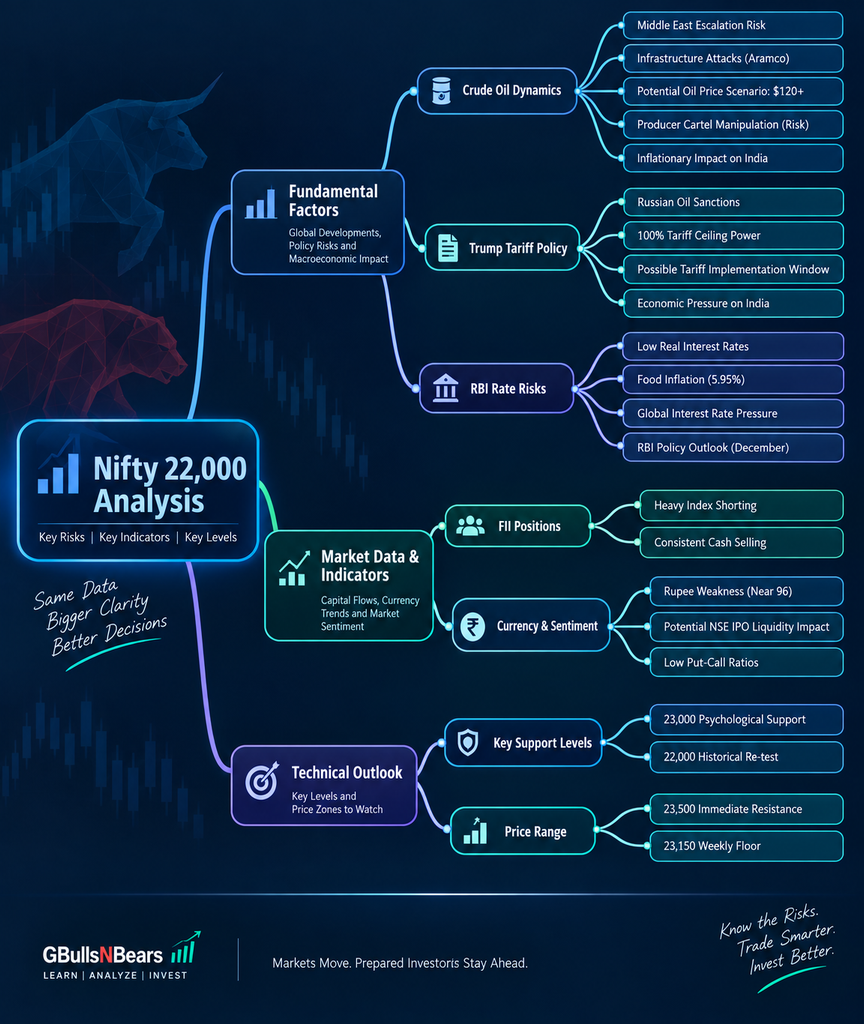
The Indian stock market is facing a combination of geopolitical uncertainty, elevated crude oil prices, foreign institutional selling, and potential trade restrictions. Although the Nifty 50 has remained near the 23,300–23,500 zone, this stability should not automatically be interpreted as a confirmation of a sustained bullish trend.
On September 23, 2026, reports indicated that the Nifty 50 had recovered toward the 23,400–23,450 region, while investors continued to monitor crude oil prices, global bond yields, foreign fund flows and US trade policy. The previous session saw the Nifty close at approximately 23,329, after declining 0.36%.
A fall toward 22,000 is a downside scenario rather than a confirmed prediction. From a Nifty level of 23,446.80, a move to 22,000 would represent a decline of approximately 6.2%. Whether such a move occurs will depend on the interaction between oil prices, global policy decisions, liquidity and corporate earnings.
This article examines three major risks that Indian investors should monitor.
Market Snapshot: Important Data Investors Should Know
| Indicator | Recent information |
|---|---|
| Nifty 50 | Approximately 23,446.80 on September 23, 2026 |
| Previous reported close | Around 23,329 on September 22 |
| RBI repo rate | 5.25% |
| Brent crude | Above $100 per barrel during recent September volatility |
| FII activity | ₹3,809.99 crore net selling reported on September 22 |
| DII activity | ₹4,120.07 crore net buying reported on September 22 |
| Potential Nifty 22,000 decline | Approximately 6.2% from 23,446.80 |
The figures represent reported market observations and can change as updated exchange data becomes available.
Red Flag 1: Crude Oil Above $100 Could Pressure India’s Economy
Why expensive oil matters for Indian investors
India remains highly dependent on imported crude oil. When international oil prices rise sharply, the impact can spread across several parts of the economy:
- Higher import costs
- Pressure on the Indian rupee
- Increased transportation and logistics expenses
- Higher input costs for manufacturing companies
- Inflationary pressure
- Reduced disposable income for consumers
- Potential pressure on the current account deficit
Crude oil is particularly important for India because an increase in energy costs can affect both corporate profitability and household consumption.
Recent oil market developments
Brent crude was reported at approximately $104.82 per barrel on September 17, while WTI was near $101.91. The price movement was linked to concerns over Middle East supply disruptions, damage to energy infrastructure,e and lower shipping activity through important routes.
However, oil prices have also shown volatility. Reports on September 23 indicated that crude had moved below the $100 level during early trading, demonstrating that the market remains sensitive to supply updates and geopolitical developments.
What happens if crude remains above $110–$120?
A sustained crude oil price above $110–$120 could create several challenges for India:
1. Inflationary pressure
Higher energy and transportation costs can increase the cost of goods and services. The actual effect would depend on the duration of the price rise, government measures, currency movement, and the extent to which companies pass higher costs to consumers.
2. Pressure on the rupee
India’s oil import bill could increase if crude prices remain elevated. A weaker rupee can make imports more expensive and may increase pressure on inflation.
3. Corporate margin compression
Industries with high fuel, transportation or raw-material costs may experience margin pressure, especially when they cannot immediately increase selling prices.
4. Consumer spending slowdown
If fuel and essential expenses rise, households may have less money available for discretionary consumption, including travel, retail and other non-essential products.
Important clarification
The claim that major oil-producing countries are secretly coordinating to force crude oil to $120 should be treated as speculation unless supported by verifiable evidence. Oil prices are influenced by several measurable factors, including supply disruptions, OPEC+ policy, geopolitical risk, inventory levels, shipping costs, demand expectations and currency movements.
Stocks and sectors to monitor
Investors should monitor the potential impact on:
- Paint companies
- Tyre manufacturers
- Aviation companies
- Logistics and transportation
- Chemicals
- Consumer discretionary companies
- Oil marketing companies
- Refining and petrochemical businesses
The impact will differ across companies because some businesses have pricing power, hedging arrangements,s or different exposure to crude-related costs.
Red Flag 2: US Tariff Powers Could Increase Pressure on India
New tariff risk related to Russian energy imports
The United States has enacted legislation granting the President authority to impose tariffs of up to 100% on certain countries importing Russian oil and gas or helping Russia evade sanctions. The legislation does not automatically mean that a 100% tariff will be imposed on India; implementation depends on policy decisions, exemptions, and further actions.
India and China have been identified as countries that could potentially face consequences because of their trade relationships with Russian energy. The law gives the US administration substantial discretion, but the actual scope and timing of any measures remain uncertain.
Is October 20 a confirmed tariff deadline?
The proposed October 20 timeline should not be presented as a guaranteed implementation date without an official government notification confirming it.
A 30-day period may be relevant to a legal or administrative process, but it does not necessarily mean that tariffs will automatically begin on that exact date. Investors should distinguish between:
- Legislation being passed
- Presidential authority being granted
- A formal tariff decision
- Country-specific implementation
- Exemptions or negotiated arrangements
- Actual enforcement
Possible effects on Indian markets
If the US imposes significant additional tariffs or trade restrictions on India, the consequences could include:
- Higher export costs
- Pressure on profit margins
- Uncertainty for IT and service companies
- Disruption in selected manufacturing supply chains
- Reduced business confidence
- Pressure on the Indian rupee
- Increased market volatility
However, the actual market impact would depend on the tariff’s size, affected sectors, exemptions, negotiation outcomes and the response of Indian policymakers.
What should investors monitor?
Investors should follow:
- Official White House announcements
- US Treasury and Commerce Department notifications
- Indian Ministry of Commerce statements
- Sector-specific tariff exemptions
- Changes in India–US trade negotiations
- Currency and bond market reactions
A tariff proposal is a risk factor, not proof that a market crash will occur.
Red Flag 3: FII Selling and Liquidity Pressure
Foreign institutional investors remain an important market variable
Foreign Institutional Investors, also called FPIs, can influence Indian equity prices through their allocation to equities, futures, bonds and other financial assets.
According to a September 23 market report, FIIs sold shares worth approximately ₹3,809.99 crore on September 22, while domestic institutional investors purchased approximately ₹4,120.07 crore.
This data highlights an important market dynamic:
Foreign selling can create pressure, but domestic institutional buying may partially absorb that selling.
Therefore, FII selling alone does not guarantee a major market decline. Investors should assess the combined flow of FIIs, DIIs, mutual funds, market breadth, derivatives positioning, and price structure.
Why FII selling matters
Persistent foreign selling can affect the market through several channels:
- Direct selling in large-cap stocks
- Pressure on index heavyweights
- Currency depreciation concerns
- Reduced risk appetite
- Higher volatility in futures and options
- Weakness in sectors with significant foreign ownership
However, the intensity of the impact depends on whether domestic investors, corporations, sovereign funds and other institutions provide sufficient demand.
Key data points to track
| Market indicator | Why it matters |
|---|---|
| FII cash market flows | Measures foreign buying and selling in equities |
| DII flows | Shows domestic institutional participation |
| Index futures positioning | Indicates hedging and directional exposure |
| Put-call ratio | Provides context on derivatives positioning |
| India VIX | Measures expected market volatility |
| Market breadth | Shows whether gains are broad or concentrated |
| Advance-decline ratio | Indicates participation across stocks |
| Rupee movement | Reflects currency and capital-flow pressure |
RBI Rate Risk: Is a December Rate Hike Inevitable?
The Reserve Bank of India kept the policy repo rate at 5.25% during its August 3–5, 2026 monetary policy meeting and retained a neutral policy stance.
The original argument that a rate hike is unavoidable by December is too definitive. Monetary policy decisions depend on a combination of factors, including:
- Consumer inflation
- Food prices
- Core inflation
- Crude oil prices
- Exchange-rate movement
- Economic growth
- Liquidity conditions
- Global interest rates
- Inflation expectations
Understanding the real interest rate
A simple calculation of the repo rate minus current CPI inflation can provide a rough nominal policy-rate spread, but it is not a complete measure of the real policy rate.
A more meaningful real-rate assessment considers:
Real Policy Rate≈Policy Rate−Expected Inflation
Current inflation, expected inflation,n and the policy transmission mechanism can produce different interpretations. Therefore, a low spread between the repo rate and one CPI reading does not automatically make a rate hike mandatory.
Possible RBI scenarios
| Scenario | Possible market effect |
|---|---|
| RBI holds rates | May support rate-sensitive sectors if inflation remains controlled |
| RBI adopts a hawkish stance | Could pressure high-valuation and rate-sensitive stocks |
| RBI hikes rates | May increase borrowing costs and affect liquidity |
| Inflation moderates | Could reduce pressure for immediate tightening |
| Oil prices remain elevated | Could complicate inflation management |
Investors should focus on official RBI communication and inflation data rather than treating a future rate decision as predetermined.
Technical Analysis: Important Nifty Levels
The following levels should be treated as scenario-based reference zones, not guaranteed support or resistance levels.
Key levels to monitor
| Nifty level | Possible interpretation |
|---|---|
| 23,500 | Near-term resistance and recovery zone |
| 23,300 | Immediate price-support area to monitor |
| 23,000 | Important psychological level |
| 22,800 | Possible intermediate downside zone |
| 22,500 | Potential next support area |
| 22,000 | Larger downside scenario and psychological support |
A decisive breakdown below 23,000, especially with rising volumes and weak market breadth, could increase the probability of a deeper correction. However, historical support levels do not guarantee that buyers will defend a particular price.
What could invalidate the bearish scenario?
The downside scenario may weaken if:
- Crude oil prices decline sustainably
- US tariff concerns reduce
- FII selling slows or reverses
- Domestic institutional buying remains strong
- Market breadth improves
- Nifty reclaims resistance with strong participation
- Corporate earnings expectations remain stable
A market can also experience short-term short covering even when the broader trend remains uncertain.
Could Nifty Fall to 22,000?
A move toward Nifty 22,000 is mathematically possible, but it should not be described as imminent without stronger confirmation from price action and macroeconomic data.
From a reference level of 23,446.80:
Downside=23,446.8023,446.80−22,000×100
The decline would be approximately 6.2%.
This magnitude of correction can occur during periods of elevated volatility, but the timing cannot be reliably established using only crude oil prices, FII selling, or a single political deadline.
Three possible market scenarios
Scenario 1: Bullish recovery
This scenario could develop if:
- Crude oil prices decline
- Trade tensions ease
- FII selling moderates
- Domestic liquidity remains supportive
- Nifty sustains above important resistance levels
Potential result: A recovery toward higher resistance zones.
Scenario 2: Range-bound market
This could occur if:
- FIIs continue selling,g but DIIs absorb supply
- Crude remains volatile
- Trade policy remains uncertain
- Earnings remain mixed
Potential result: Nifty trades within a broad range without a decisive breakout or breakdown.
Scenario 3: Bearish breakdown
This risk increases if:
- Crude oil remains elevated for an extended period
- New tariffs are implemented
- The rupee weakens significantly
- FII selling accelerates
- Nifty breaks key support with weak market breadth
- Corporate earnings estimates decline
Potential result: A move toward lower support zones, including the 22,500–22,000 region.
These are conditional scenarios, not forecasts or probabilities.
How Indian Investors Can Prepare
Investors should avoid making portfolio decisions based solely on a single Nifty target. A more practical approach is to assess individual holdings and portfolio-level risks.
1. Review position sizing
Avoid excessive concentration in one stock, sector or market theme. Position sizing should reflect your risk tolerance, investment horizon and liquidity requirements.
2. Monitor valuation
High-valuation stocks may be more sensitive to:
- Rising bond yields
- Higher interest rates
- Earnings downgrades
- Foreign selling
- Risk-off sentiment
A market correction does not affect every company equally.
3. Separate investment from trading
Long-term investors should focus on business quality, cash flow, debt, earnings and valuation. Traders should define entry, stop-loss and position-size rules before taking a position.
4. Track the rupee and crude oil
A combination of a weaker rupee and higher crude oil prices can create additional macroeconomic pressure. Investors should monitor whether the movement is temporary or persistent.
5. Avoid excessive leverage
Leveraged futures and options positions can experience rapid losses during gap openings and volatility spikes. Risk should be calculated using the total position exposure, not only the premium paid.
Conclusion: Prepare for Volatility, Not Panic
The Indian stock market is currently facing three significant risks:
- Elevated crude oil prices and Middle East supply disruptions
- Potential US tariff action linked to Russian energy imports
- Foreign institutional selling and market liquidity pressure
These risks can influence the Nifty 50, the Indian rupee, corporate margins and investor sentiment. However, the evidence does not establish that Nifty 22,000 is certain or imminent.
The more useful question for investors is not simply:
“Will Nifty fall to 22,000?”
Instead, investors should ask:
“What conditions would trigger a sustained correction, and how much risk can my portfolio withstand?”
Monitoring crude oil, FII–DII flows, RBI communication, market breadth, earnings revisions and important technical levels can help investors make more disciplined decisions.
Markets do not always move directly from stability to collapse. They often pass through volatility, range-bound trading, short covering and failed breakdowns before establishing a clear trend.
Frequently Asked Questions
Is Nifty 22,000 guaranteed?
No. Nifty 22,000 is a possible downside scenario, not a confirmed target. Its probability would depend on crude oil, global trade policy, capital flows, earnings, gs and technical breakdowns.
Why is crude oil important for the Indian stock market?
India imports a significant amount of crude oil. Higher oil prices can increase import costs, pressure the rupee, raise transportation expenses,ses and affect inflation and corporate margins.
Will the US impose a 100% tariff on India?
The new US law grants authority to impose tariffs of up to 100% on certain countries linked to Russian energy imports. It does not automatically confirm that India will face a 100% tariff. Implementation, exemptions and further policy decisions remain important.
Is an RBI rate hike in December confirmed?
No. The RBI’s future decision will depend on inflation, growth, oil prices, currency movement and other macroeconomic conditions. The August 2026 repo rate was maintained at 5.25%.
What should investors monitor before buying the dip?
Investors should monitor market breadth, FII and DII flows, crude oil, the rupee, earnings estimates, valuations and the Nifty’s response to major support and resistance zones.
Disclaimer
This article is intended for educational and informational purposes only. It is not financial, investment, trading, legal or tax advice. Market levels, scenarios and macroeconomic interpretations may change rapidly. Investors should independently verify data, evaluate their risk tolerance, and consult a qualified financial professional before making investment decisions. Past market behaviour does not guarantee future results.
Top 10 SEO Titles
- Nifty 22,000 at Risk? Key Market Signals Every Indian Investor Must Watch
- Nifty 22,000 Analysis: Crude Oil, US Tariffs and FII Selling Explained
- Will Nifty Fall to 22,000? Key Support Levels and Market Risks in 2026
- Nifty 50 Outlook 2026: 3 Major Risks That Could Trigger a Market Correction
- Nifty 22,000 Prediction: RBI Rate Risks, FII Positions and Technical Levels
- Indian Stock Market Warning: Could Nifty 50 Retest the 22,000 Level?
- Nifty 50 Bearish Scenario: Crude Oil, Tariffs and FII Selling Impact
- Nifty 22,000 Alert: Fundamental and Technical Risks Investors Should Know
- Indian Stock Market Crash Risk 2026: Nifty Support and Resistance Explained
- Nifty 50 Market Analysis: Can Global Risks Push the Index Toward 22,000?