
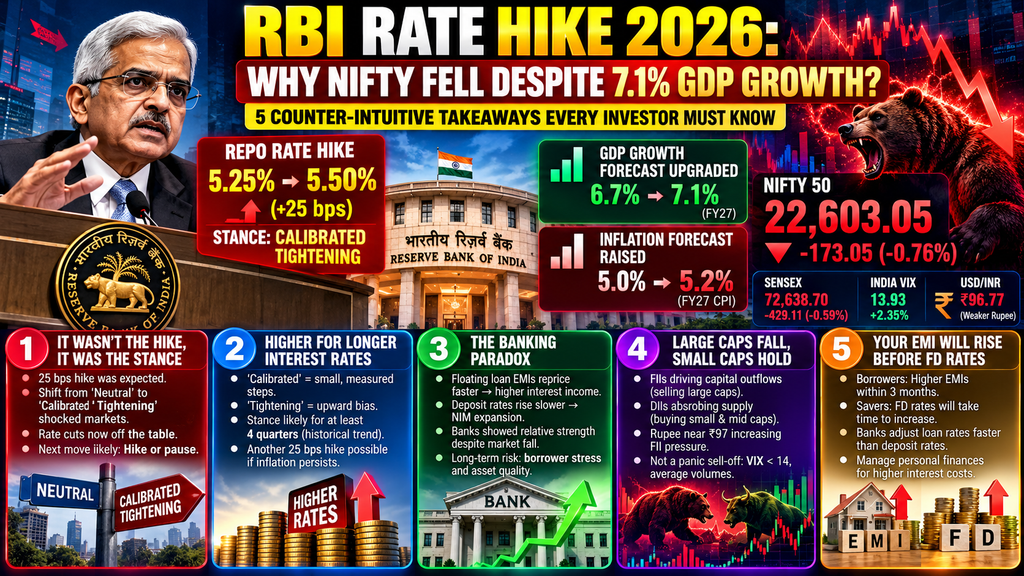
Introduction: Why Did Markets Fall When the RBI Did Exactly What Investors Expected?
Financial markets often behave counter-intuitively.
The Reserve Bank of India delivered a 25-basis-point repo-rate hike, exactly in line with expectations. Yet Indian equities finished lower.
On October 7, 2026:
- Repo rate: 5.25% → 5.50%
- Nifty 50: 22,776.10 → 22,603.05
- Nifty fall: 173.05 points (-0.76%)
- Sensex: -429.11 points (-0.59%)
- India VIX: around 13.93, up 2.35%
- Rupee: around ₹96.77/$
- FY27 GDP forecast: raised from 6.7% to 7.1%
- FY27 CPI inflation forecast: raised to 5.2%
The key surprise was therefore not the 25-bps hike itself.
It was the change in policy stance from “Neutral” to “Calibrated Tightening.”
This tells investors something much more important:
The RBI is no longer preparing the market for rate cuts. The next move is now more likely to be either another hike or a pause.
RBI Governor Sanjay Malhotra also explicitly ruled out near-term rate cuts.
1. Takeaway #1: The Market Wasn’t Really Shocked by the Rate Hike — It Was Shocked by the Stance
The 25-bps increase was largely anticipated.
The bigger message came from the RBI’s decision to move from:
Neutral → Calibrated Tightening
The MPC unanimously approved the rate increase, while the stance change received a 4–2 majority vote.
This distinction matters.
Neutral stance
Under a neutral stance, investors can reasonably expect:
- hike
- pause
- cut
depending on incoming data.
Calibrated tightening
The policy bias becomes much more restrictive.
The RBI has effectively communicated:
Next move = hike or pause
rather than:
Next move = hike, pause or cut.
Governor Malhotra specifically said that near-term rate cuts are not on the table.
That is why equity investors reacted negatively even though the 25-bps hike itself was expected.
2. RBI’s Inflation Problem Is Bigger Than the Rate Hike
The most important number in this policy may not be 5.50%.
It may be 5.2%.
That’s the RBI’s revised FY27 CPI inflation forecast.
The central bank increased its inflation projection from roughly 5.0% to 5.2%, while simultaneously raising its GDP forecast from 6.7% to 7.1%.
This creates an unusual combination:
Growth ↑
6.7% → 7.1%
Inflation ↑
5.0% → 5.2%
Normally, investors love higher growth.
But when higher growth comes alongside higher inflation, the RBI has less room to cut interest rates.
That’s the real market problem.
3. The 7.1% GDP Forecast Is Actually Bullish — So Why Didn’t Stocks Celebrate?
This is one of the biggest paradoxes of the policy.
The RBI upgraded FY27 GDP growth to:
7.1%
from:
6.7%
That is a significant 40-basis-point upgrade.
The RBI is essentially saying:
India’s economy is strong enough to handle tighter monetary policy.
That is fundamentally positive.
But for equity valuations, there is another side.
Higher growth + higher inflation can mean:
Strong economy → higher inflation → tighter RBI → higher bond yields → higher discount rate → pressure on equity valuations
This is especially relevant for expensive growth stocks whose valuations depend heavily on future cash flows.
4. Takeaway #2: “Calibrated Tightening” Does NOT Automatically Mean Four Straight Rate Hikes
Your original draft makes an important point but goes slightly too far here.
A tightening stance does not guarantee that the RBI will hike for four consecutive quarters.
The word “calibrated” is important.
It means the RBI can:
- hike
- pause
- evaluate inflation
- assess crude oil
- monitor currency pressure
- reassess global monetary conditions
before acting again.
For example, ICRA expects another 25-bps hike in December 2026, but it also expects tightening to stop afterward unless inflation produces a major negative surprise.
So investors should not interpret the policy as:
“Four automatic hikes are coming.”
A better interpretation is:
“Rate cuts are no longer the base case, and the RBI has opened the door to additional hikes if inflation remains persistent.”
That’s a much more accurate market interpretation.
5. Why Crude Oil Has Become the RBI’s Biggest Problem
The RBI’s tightening shift cannot be understood without looking at crude oil.
The central bank highlighted the impact of:
- higher energy prices
- food inflation
- geopolitical tensions
- global financial tightening
- a stronger dollar
- higher global bond yields
on India’s inflation outlook.
For India, crude oil is especially important because the country is heavily dependent on imported energy.
Higher crude can create a chain reaction:
Crude ↑
↓
Import bill ↑
↓
Current-account pressure ↑
↓
Rupee weakens
↓
Imported inflation ↑
↓
RBI tightening pressure ↑
↓
Bond yields ↑
↓
Equity valuation pressure ↑
This is why investors should watch Brent crude alongside the RBI rate.
6. Takeaway #3: The Banking Sector Paradox
One of the most interesting parts of a rate-hiking cycle is the effect on banks.
A simplistic view says:
“Higher interest rates are bad for banks.”
That’s not always true.
In the short term, banks can actually benefit from faster repricing of floating-rate assets.
Potential short-term benefit
If loan rates reset faster than deposit costs:
Loan yield ↑ faster than deposit cost
↓
NIM can improve
↓
Bank profitability can receive support
However, this benefit is not guaranteed and varies by bank and loan/deposit mix.
The Long-Term Banking Risk
If rates remain high for an extended period:
- loan demand can slow
- refinancing becomes expensive
- borrower stress can increase
- retail delinquencies can rise
- corporate capex can weaken
- credit costs can eventually increase
So the banking story is:
Short term
🟢 Potential NIM support
Medium/long term
🟠 Potential credit-quality and loan-growth risk
This is why banks with strong deposit franchises and better asset quality can be better positioned than weaker lenders during prolonged tightening.
7. Why NBFCs and Rate-Sensitive Stocks Can Feel More Pressure
The immediate market reaction on October 7 showed weakness across several rate-sensitive sectors.
Nifty Metal was among the major laggards, while IT, Auto, FMCG and Realty also ended lower.
NBFCs and small-finance banks also faced selling pressure after the RBI decision.
Why?
Because their business models are often more sensitive to:
- borrowing costs
- refinancing
- credit demand
- funding spreads
Higher rates can therefore create a double challenge:
Funding cost ↑
while
Loan demand ↓
That can pressure profitability.
8. Takeaway #4: FII Selling Is Making the RBI Reaction Worse
The RBI policy did not occur in isolation.
Foreign investors are already reducing exposure.
On October 6:
- FII selling: ₹2,961.30 crore
- DII buying: ₹5,088.92 crore
And on October 7:
- FII selling: approximately ₹6,121 crore
- DII buying: approximately ₹4,597 crore
That means FIIs accelerated selling after the RBI decision, while domestic institutions continued absorbing part of the supply.
This creates a crucial market equation:
FII selling ↑
Rupee weakness ↑
RBI tightening ↑
=
Large-cap pressure
This is particularly important because foreign investors tend to have large exposure to highly liquid large-cap stocks.
9. The Rupee Is Sending Another Warning
The rupee closed around:
₹96.77 per US dollar
on October 7, weaker than the previous day’s ₹96.42.
The ₹97 level therefore remains psychologically and technically important.
If USD/INR breaks decisively above ₹97, investors may worry about:
- imported inflation
- crude costs
- foreign capital outflows
- external financing conditions
However, exporters such as IT companies can benefit from a weaker rupee.
So the currency impact is not uniformly negative.
10. Takeaway #5: Your EMI Can React Faster Than Your Investment Returns
The RBI rate hike also matters outside the stock market.
For borrowers with floating-rate loans, higher policy rates can eventually translate into:
- higher EMI
- longer loan tenure
- higher total interest cost
The transmission isn’t necessarily instantaneous for every borrower because it depends on the lender, benchmark, and reset mechanism.
But the direction is clear:
Borrowers
Higher rates → higher financing cost
Savers
Higher rates → potentially better deposit yields
The important point is that FD rates don’t necessarily move one-for-one or immediately with every RBI decision.
Therefore, households should not assume:
“Repo rate +25 bps = my FD automatically +25 bps.”
Bank pricing depends on liquidity, competition and deposit demand.
11. Market Reaction: The 373-Point Figure Needs Correction
This is important for your article’s credibility.
Your draft says:
“Nifty index suffered a sharp drop of 373 points.”
That is not the October 7 Nifty move.
Actual October 7, 2026 data:
| Index | Previous Close | Oct 7 Close | Change |
|---|---|---|---|
| Nifty 50 | 22,776.10 | 22,603.05 | -173.05 (-0.76%) |
| Sensex | 73,067.81 | 72,638.70 | -429.11 (-0.59%) |
| Bank Nifty | 55,128.85* | 55,055.55 | -73.30 |
The 373-point gain that appears in recent market reports refers to Bank Nifty’s September 30 rally, not the October 7 Nifty sell-off.
This correction is important if you’re publishing the article.
12. Nifty Technical Structure After the RBI Decision
The October 7 close is technically important.
Nifty finished:
22,603.05
after falling 173 points.
Technical analysts identified:
Support
22,500
Below that:
22,400
and then:
22,200
Resistance
22,800
followed by:
23,000–23,100
Moneycontrol technical commentary also highlighted 22,400 and 22,200 as potential downside supports, while 22,800 and 23,100 remain important upside levels.
Therefore:
Bullish confirmation
Nifty > 22,800 → 23,000 → 23,100
Bearish confirmation
Nifty < 22,500 → 22,400 → 22,200
13. India VIX Is Still Not Signalling Panic
One interesting feature of the current sell-off is that volatility remains relatively contained.
India VIX closed around:
13.93
on October 7, up about 2.35%.
This is important.
A falling market with VIX remaining below 14 is very different from a market falling with VIX exploding above 20–25.
Therefore, the current move looks more like:
Policy repricing + institutional selling
rather than:
Full-scale panic liquidation.
That doesn’t eliminate downside risk, but it changes the character of the decline.
14. Market Breadth Shows Selling Was Broad
Only 9 of the 50 Nifty stocks advanced, while 41 declined on October 7.
The broader market was mixed:
- Nifty Midcap 100: -0.63%
- Nifty Smallcap 100: +0.30%
- Nifty IT: -1.34%
- Nifty Auto: -1.58%
- Nifty Pharma: -0.43%
- Nifty FMCG: -0.89%
- India VIX: +2.35%
This suggests that the RBI decision caused broad repricing rather than simply weakness in one or two heavyweight stocks.
15. The Counter-Intuitive Positive: India’s Growth Story Has Not Broken
Despite the hawkish policy stance, the RBI did not downgrade India’s growth outlook.
It actually upgraded it:
FY27 GDP: 6.7% → 7.1%
That’s a strong signal that the central bank believes economic activity remains resilient enough to withstand tighter financial conditions.
This creates two simultaneous narratives:
Macro narrative
🟢 India’s growth remains strong
Market narrative
🔴 Cost of capital is rising
Both can be true simultaneously.
And that is exactly why stock selection becomes more important.
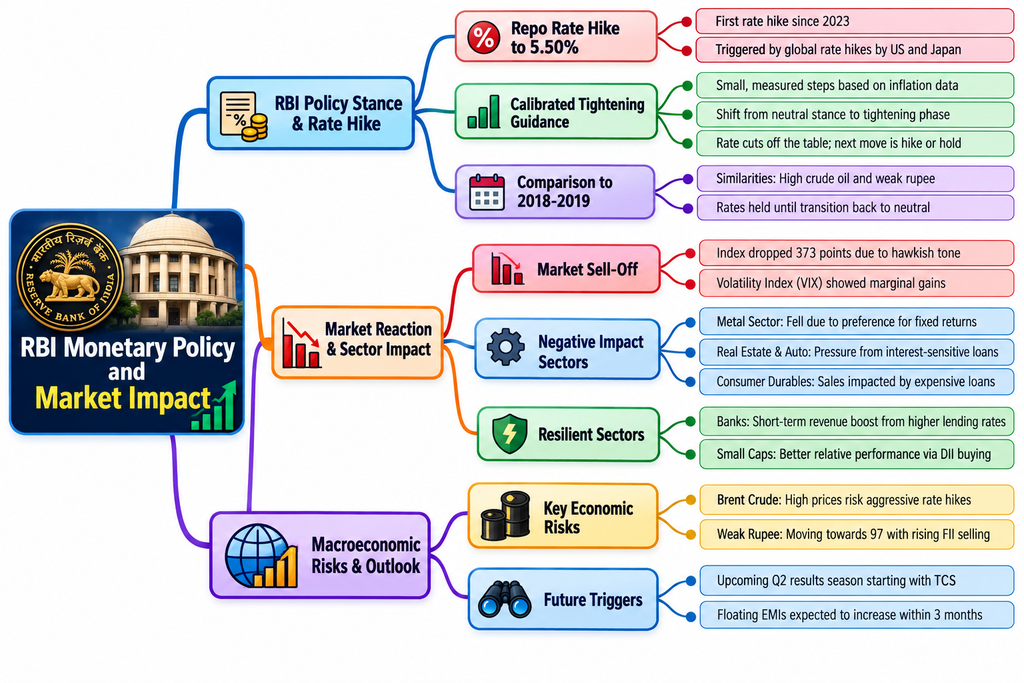
16. Which Companies Could Be More Vulnerable?
A higher-for-longer environment generally creates greater pressure on companies with:
- high debt
- weak free cash flow
- refinancing requirements
- low interest coverage
- speculative valuations
- weak pricing power
- dependence on cheap credit
Investors should therefore examine:
Debt-to-equity
Interest coverage
Free cash flow
EBITDA margins
Working-capital requirements
Debt maturity profile
before buying heavily during a tightening cycle.
17. Which Businesses Could Be More Resilient?
Instead of simply asking:
“Which sector will rise?”
investors should ask:
“Which companies can survive higher financing costs?”
Potentially stronger characteristics include:
🟢 Strong cash generation
🟢 Low net debt
🟢 Pricing power
🟢 Stable demand
🟢 Strong deposit franchise for banks
🟢 High return on capital
🟢 Low refinancing dependence
🟢 Reasonable valuation
This is more useful than blindly rotating into an entire sector.
18. The Bigger Global Problem
The RBI’s decision is also part of a broader global macro story.
The central bank highlighted:
- geopolitical uncertainty
- higher global energy costs
- rising bond yields
- stronger dollar
- global inflation risks
- tighter financial conditions
as significant risks.
This means Indian investors cannot analyse the RBI in isolation.
They also need to watch:
US Treasury yields + Dollar Index + Brent crude + Fed policy + geopolitical risk
because all five can influence Indian capital flows.
19. Three Scenarios for the Indian Market
🟢 Bullish Scenario
Conditions:
- Brent falls below $100
- USD/INR stabilises
- FII selling slows
- DII buying remains strong
- Nifty crosses 22,800
- Earnings remain resilient
Potential outcome:
22,800 → 23,000 → 23,100
🟡 Neutral Scenario
Conditions:
- RBI pauses after one hike
- Crude remains around $95–105
- FII selling continues moderately
- DII buying absorbs supply
Potential outcome:
22,400–23,000 range
This could become a stock-picker’s market.
🔴 Bearish Scenario
Conditions:
- Brent moves sharply higher
- Rupee breaks ₹97
- FII selling accelerates
- RBI signals additional hikes
- Nifty breaks 22,400
Potential outcome:
22,200 becomes the next major technical test.
20. What Investors Should Do Now
This is not the environment for blindly chasing every dip.
For long-term investors
Focus on:
- balance sheet
- cash flow
- valuation
- earnings visibility
- debt
For swing traders
Watch:
22,500 support
and
22,800 resistance.
For aggressive traders
Avoid oversized positions immediately after major RBI events because volatility can remain elevated.
For borrowers
Review floating-rate loans and ensure the household budget can absorb higher interest costs.
For FD investors
Compare actual bank FD rates rather than assuming every RBI hike will immediately produce a matching FD-rate increase.
21. The Five Counter-Intuitive Lessons
Lesson 1
A rate hike can be expected and still hurt stocks if the policy language becomes more hawkish.
Lesson 2
A higher GDP forecast does not automatically mean higher stock prices when inflation and discount rates are rising.
Lesson 3
Higher rates can initially help some banks through asset repricing, but prolonged tightening can eventually create asset-quality risks.
Lesson 4
FII selling does not automatically mean a market crash because DIIs can absorb significant supply.
Lesson 5
The RBI’s “calibrated tightening” stance does not guarantee four consecutive hikes—it means future policy is tilted toward a hike or pause, with cuts currently off the table.
Final Verdict: Is This a Crash or a Policy Repricing?
The October 7 sell-off should not yet be classified as a structural market crash.
Nifty declined 173 points to 22,603, while India VIX remained around 13.93. The market was weak, breadth was poor, and FII selling accelerated, but volatility has not reached panic levels.
The bigger message from the RBI is this:
India’s growth outlook remains strong, but the cost of money is moving higher.
That creates a very different investment environment.
The next few weeks will depend heavily on:
- Brent crude
- USD/INR
- FII flows
- RBI’s next communication
- Q2 corporate earnings
- Nifty 22,500 support
- Nifty 22,800–23,000 breakout
The most important takeaway for investors is therefore not:
“RBI hiked rates, so sell everything.”
Nor is it:
“GDP is 7.1%, so buy everything.”
The better approach is:
Higher growth + higher inflation + tighter policy = greater selectivity.
Companies with strong cash flow, manageable debt, pricing power and reasonable valuations may prove much more resilient than highly leveraged or excessively valued businesses.
📊 RBI Policy & Market Snapshot
| Indicator | Latest |
|---|---|
| RBI Repo Rate | 5.50% |
| Rate Change | +25 bps |
| Previous Rate | 5.25% |
| Policy Stance | Calibrated Tightening |
| FY27 GDP Forecast | 7.1% |
| FY27 CPI Forecast | 5.2% |
| Nifty Close | 22,603.05 |
| Nifty Change | -173.05 (-0.76%) |
| Sensex Close | 72,638.70 |
| Sensex Change | -429.11 (-0.59%) |
| India VIX | 13.93 |
| USD/INR | ~₹96.77 |
| Oct 7 FII Flow | ~₹6,121 Cr selling |
| Oct 7 DII Flow | ~₹4,597 Cr buying |
| Nifty Immediate Support | 22,500 / 22,400 |
| Major Support | 22,200 |
| Immediate Resistance | 22,800 |
| Major Resistance | 23,000–23,100 |
FAQs
Why did Nifty fall after the RBI’s expected 25-bps rate hike?
Because the market focused more on the RBI’s shift from Neutral to Calibrated Tightening and its signal that near-term rate cuts are not on the table.
What is the new RBI repo rate?
The RBI raised the repo rate by 25 bps to 5.50%, the first hike since February 2023.
What is the RBI’s new GDP forecast?
The FY27 GDP growth projection was raised from 6.7% to 7.1%.
What is the RBI’s inflation forecast?
The FY27 CPI inflation projection was raised to 5.2%.
Does calibrated tightening mean RBI will hike every meeting?
No. The stance allows for hikes or pauses depending on incoming data. It does not guarantee consecutive rate increases. ICRA currently expects another 25-bps hike in December but does not expect further tightening unless inflation surprises significantly.
What are the important Nifty levels?
For the near term, 22,500–22,400 is an important support zone, while 22,800–23,000/23,100 is the key resistance area.
⚠️ Disclaimer
This article is for educational and informational purposes only and should not be considered investment, trading, lending, or financial advice. Stock-market investments involve risk and can result in loss of capital. RBI policy, inflation, crude oil, currency movements, and FII flows can change rapidly. Investors should conduct their own research and consult a SEBI-registered investment adviser before making investment decisions.
🔥 Top 10 SEO Titles
- RBI Rate Hike 2026: Why Nifty Fell Despite 7.1% GDP Growth Forecast
- RBI Policy 2026: Calibrated Tightening Sends Nifty Lower — What Investors Should Know
- Nifty Falls After RBI Rate Hike: 5 Counter-Intuitive Lessons for Investors
- RBI Repo Rate 5.50%: Why Indian Stocks Fell Despite Strong GDP Outlook
- RBI Calibrated Tightening Explained: Impact on Nifty, Banks, Rupee and FII Flows
- Nifty 50 Outlook 2026: RBI Rate Hike, FII Selling and Key Support Levels
- RBI Rate Hike Impact on Stocks: Why Banks May Benefit While Realty and Autos Suffer
- Indian Stock Market Outlook: RBI Tightening, Inflation, Crude Oil and FII Selling
- RBI Policy Shock: Nifty Drops as Rate Cuts Move Off the Table
- Higher for Longer Rates? RBI’s 5.50% Repo Rate and What Investors Should Watch