
- Focus Keyword: AI and blockchain infrastructure stocks
- Secondary Keywords: AI infrastructure stocks, copper stocks, semiconductor memory stocks, blockchain tokenization, stock exchange stocks, AI investment opportunities
- URL Slug:
ai-blockchain-infrastructure-stocks - Meta Description: Discover four AI and blockchain infrastructure investment trends, including copper, memory chips, stock exchanges and tokenization, with financial data and key risks.
- Suggested Category: Stock Market Research / Global Investing
1. Introduction: The Gold Rush Dilemma
Every major technological revolution creates a difficult question for investors: Which company will ultimately become the biggest winner?
During the artificial intelligence boom, many investors have focused on high-profile technology companies, GPU manufacturers and AI software developers. Meanwhile, blockchain technology is beginning to influence how financial institutions approach asset ownership, trading and settlement.
However, there is another way to approach these trends: invest in the infrastructure required to make them work.
Consider the California Gold Rush of 1849. Thousands of prospectors searched for gold, but the businesses supplying tools, equipment and essential services also found opportunities in the expanding market.
This is often called the “picks-and-shovels” investment strategy. Instead of predicting which individual company will dominate a new technology, investors examine the businesses supplying essential products and services to the wider ecosystem.
In today’s markets, these businesses may include:
- Semiconductor manufacturers and advanced-memory suppliers.
- Copper producers and electrical infrastructure companies.
- Stock exchanges, securities depositories and financial technology providers.
- Banks and financial institutions building digital-asset infrastructure.
These businesses are not guaranteed winners. Their investment potential depends on valuations, competition, capital expenditure, regulation and their ability to convert demand into profits.
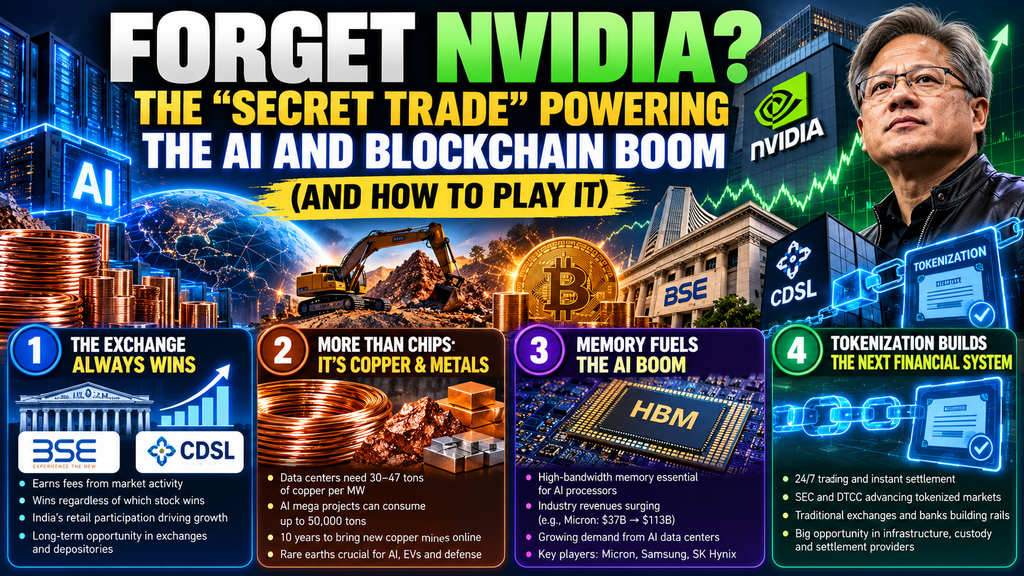
2. Takeaway One: The Infrastructure Behind Stock Market Growth
Why exchanges and depositories matter
Investors often spend considerable time identifying the next multibagger stock. But another important question is: Who provides the infrastructure that allows investors to trade and hold securities?
India offers two useful examples:
Bombay Stock Exchange (BSE): Operates an exchange platform for securities trading.
Central Depository Services (India) Limited (CDSL): Provides securities depository services, helping investors hold and transfer securities electronically.
As participation in India’s capital markets expands, exchanges and depositories can benefit from greater market activity, new account openings and demand for financial infrastructure.
However, their revenues are not identical. Exchange earnings may depend on transaction volumes, listing fees and other services, while depository earnings depend on factors such as transaction activity, account-related services and other business operations.
What investors should monitor
| Metric | Why it matters |
|---|---|
| Revenue growth | Shows whether the business is expanding |
| Operating margins | Measures operating efficiency |
| Active investor accounts | Indicates participation in the market |
| Transaction volumes | Helps assess activity-sensitive revenues |
| Valuation multiples | Indicates how much investors pay for earnings |
| Regulatory changes | May affect pricing, market structure and profitability |
The key lesson: Financial infrastructure can provide exposure to broader market participation, but even an established exchange or depository can be overvalued or face weaker earnings.
3. Takeaway Two: AI Is More Than Nvidia—It Also Needs Memory, Power and Metals
Nvidia remains an important name in AI computing, but AI infrastructure involves much more than GPU design.
Large AI systems require data centres, networking equipment, advanced memory, electricity, cooling systems, power distribution and substantial physical infrastructure.
This creates several potential investment themes.
A. AI capital expenditure is creating a large infrastructure market
The spending commitments of major technology companies demonstrate the scale of the buildout.
| Company or indicator | Reported data | Investment implication |
|---|---|---|
| Microsoft | Projected capital expenditure of more than $175 billion for 2026 | Significant demand for computing and data-centre infrastructure |
| Meta Platforms | 2026 capital expenditure guidance of $130–$145 billion | Continued investment in AI computing capacity |
| Micron Technology | FY2026 revenue of $133.19 billion, versus $37.38 billion in FY2025 | Strong growth in a memory-intensive technology cycle |
Sources: Reuters reporting on Microsoft’s October 2026 AI-chip plans and Meta’s 2026 spending guidance; Micron’s FY2026 results. These figures refer to different companies and reporting periods and should not be added together as a complete industry total.
The Microsoft and Meta figures are spending forecasts, not guaranteed final expenditure. Micron’s reported revenue is a historical financial result, not a prediction of future returns.
B. Semiconductor memory: An essential part of AI computing
AI processors require fast access to large amounts of data. High-bandwidth memory (HBM) is an important component in many advanced AI accelerator systems.
Micron’s reported FY2026 revenue rose to $133.19 billion from $37.38 billion in FY2025, illustrating how dramatically its financial performance changed during the period of strong memory demand.
Nevertheless, semiconductor memory is a cyclical industry. Prices, inventory levels, manufacturing capacity, customer demand and capital spending can change rapidly. Strong historical revenue growth does not guarantee that current valuations are attractive.
C. Copper and electrical infrastructure
AI data centres require power distribution, electrical connections, cooling systems and extensive supporting infrastructure.
Copper is used in many of these applications, including cables, transformers, motors and electrical equipment. As data-centre capacity grows, demand for electrical infrastructure may create opportunities for copper producers and related industrial suppliers.
But copper prices also depend on construction activity, electric vehicles, renewable energy, mine supply, inventories, interest rates and China’s industrial demand.
Potential areas to research:
- Copper miners and diversified mining companies.
- Electrical equipment manufacturers.
- Power transmission and distribution companies.
- Data-centre cooling and energy-management suppliers.
Investors should distinguish between a company benefiting from rising demand and a company whose share price already reflects years of expected growth.
D. Rare earths and strategic materials
Rare earth elements are used in certain permanent magnets and other specialised applications. Selected materials also play important roles in electronics, renewable energy and defence equipment.
However, rare earths are not interchangeable with copper, and not every AI data centre has the same exposure to these materials.
Investors should investigate each company’s actual products, processing capabilities, customer relationships, production costs and supply-chain position rather than buying a stock simply because it is labelled an AI beneficiary.
4. Building an AI Infrastructure Watchlist
Instead of concentrating entirely on one company, investors can examine several parts of the AI supply chain.
| Infrastructure layer | Examples to research | Main risk |
|---|---|---|
| Semiconductor design and manufacturing | Nvidia, Broadcom, TSMC | High expectations, competition and technology shifts |
| Memory and storage | Micron, Samsung Electronics, SK Hynix | Memory-price cycles and supply expansion |
| Copper and mining | Freeport-McMoRan, BHP, Southern Copper | Commodity-price volatility and operating costs |
| Strategic materials | MP Materials, Lynas Rare Earths | Processing capacity, geopolitical risks and pricing |
| Power and electrical infrastructure | Grid equipment and industrial electrical suppliers | Project delays, costs and valuation |
These are research examples, not a ranked list of recommended purchases. Company exposure varies, and some businesses operate across several sectors.
An illustrative thematic allocation
An investor researching the theme could compare the following hypothetical allocation:
| Theme | Illustrative weight |
|---|---|
| Semiconductor core | 30% |
| Memory and storage | 15% |
| Copper and mining | 25% |
| Strategic materials | 15% |
| Power and electrical infrastructure | 15% |
| Total | 100% |
This is an example for studying diversification, not a personalised portfolio recommendation. It does not account for an investor’s existing holdings, time horizon, risk tolerance, taxes or liquidity needs.
A thematic basket can still fall sharply when technology valuations decline or commodity prices weaken.
5. Takeaway Three: Wall Street Is Building Blockchain-Based Financial Infrastructure
Blockchain investing is often associated with cryptocurrencies, speculative tokens and decentralised finance. Yet an important development is taking place within traditional financial markets: the exploration of tokenized securities.
Tokenization means representing an asset or an associated ownership interest digitally on a blockchain or another distributed ledger.
Depending on the legal and technical structure, tokenization may support faster transfers, more efficient collateral management and new settlement processes. But a token representing a stock does not automatically provide the same legal ownership rights as the underlying share.
Important 2026 developments
September 17, 2026 — SEC action
The US Securities and Exchange Commission announced temporary, conditional exemptive relief for certain tokenized securities trading venues. The order allows specified activity under conditions, including requirements relating to investor protection, eligible securities, trading limits and operational transparency.
This is a limited regulatory development, not blanket approval for every tokenized-stock platform.
July 15, 2026 — DTCC production trials
The Depository Trust & Clearing Corporation (DTCC) announced that it had processed real production trades using tokenized assets held at The Depository Trust Company. Its announcement described the milestone as preparation for a planned October 2026 launch of its tokenization service.
The planned launch date should not be confused with proof that every part of the service is fully operational or widely adopted.
International stock-token products
Robinhood reported in its second-quarter 2026 results that stock tokens were available to eligible users in more than 120 countries through Robinhood Wallet. Product availability and eligibility depend on the relevant market and service terms.
Who could benefit from tokenization?
Potential beneficiaries include:
- Stock exchanges: Trading and market-access infrastructure.
- Securities depositories and settlement providers: Asset custody, recordkeeping and post-trade processing.
- Banks: Tokenized deposits, payments and institutional settlement.
- Brokerages and financial technology firms: Investor access and transaction services.
- Asset managers: Potentially more efficient distribution and administration of eligible assets.
These are potential opportunities, not confirmed financial benefits. Adoption depends on regulation, interoperability, investor demand, operating costs and the willingness of institutions to change existing systems.
6. India’s Financial Infrastructure: BSE, CDSL and the Digital Transition
India’s established financial infrastructure offers another way to study the theme.
BSE operates an exchange, while CDSL provides securities depository services. Both are distinct from cryptocurrency platforms, and neither should be assumed to benefit automatically from every blockchain-related development.
The potential long-term opportunity lies in the expansion and modernisation of regulated financial markets.
Investors should examine:
- Growth in demat accounts and securities participation.
- Revenue generated by transaction-related and other services.
- Operating costs and profit margins.
- Regulatory changes affecting market fees or competition.
- Whether new digital infrastructure creates additional revenue or merely requires investment.
The important question is not simply whether blockchain becomes more popular. It is whether a particular listed company can turn that adoption into sustainable earnings and cash flow.
7. Takeaway Four: Avoid the Dot-Com Trap—Buy the Business Case, Not Just the Theme
The dot-com boom demonstrated that a technology can transform the economy while many investors still lose money buying overvalued companies.
The same principle applies to AI and blockchain.
A company may operate in a promising sector but still disappoint because its valuation is excessive, competition intensifies, costs rise or customers fail to adopt its products at the expected pace.
Single-stock investing versus thematic diversification
| Factor | Single-stock approach | Thematic basket approach |
|---|---|---|
| Company-specific risk | Often concentrated | May be distributed across holdings |
| Exposure | Depends heavily on one business | Can cover several parts of a supply chain |
| Research needs | Deep analysis of one company | Analysis of several companies and the overall theme |
| Diversification | Limited unless combined with other holdings | Depends on holdings, weights and overlap |
| Downside risk | Can be severe | Can also be severe during a sector-wide sell-off |
Diversification reduces some company-specific risks, but it cannot eliminate market risk. A basket containing many AI stocks may still be highly concentrated in one economic theme.
Three risks every investor should evaluate
1. Valuation risk
Even a growing business can be a poor investment if the purchase price assumes unrealistically high future earnings.
2. Capital-expenditure risk
Technology companies may spend heavily on data centres before earning an adequate return. Reuters reported in July 2026 that rising AI investment was putting pressure on the free cash flow of major technology companies.
3. Commodity and supply-chain risk
Copper and memory prices can be cyclical. Mining projects may face permitting delays, production problems and rising costs. Semiconductor suppliers can experience abrupt changes in customer orders and inventory.
The best investment case therefore combines a credible long-term demand trend with reasonable valuation, financial strength and evidence of sustainable profitability.
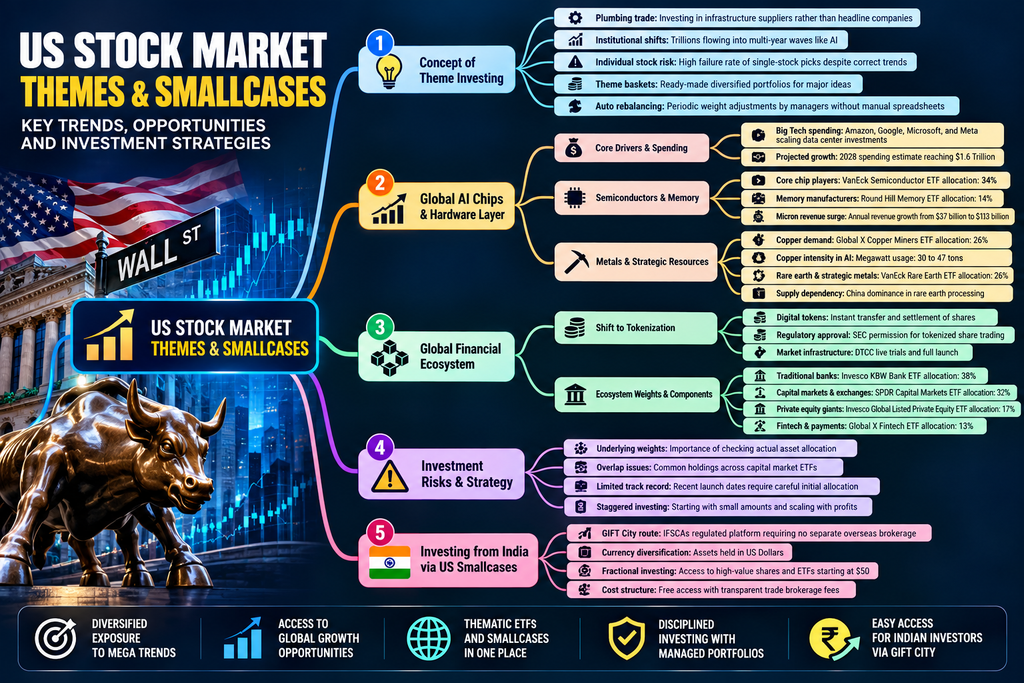
8. How Indian Investors Can Research Global AI and Blockchain Themes
Indian investors interested in international technology trends should first understand which products and investment routes are legally available to them.
Possible approaches include researching eligible international investments, comparing regulated investment products and studying Indian-listed businesses that supply relevant infrastructure.
Before investing through any international platform or the GIFT City ecosystem, verify:
- The exact legal entity and regulatory status of the provider.
- Whether the product is available to Indian residents.
- Minimum investment and brokerage charges.
- Currency conversion and withdrawal costs.
- Tax treatment and reporting obligations.
- Whether the product represents direct ownership, a fund interest or a derivative.
- The custody arrangements and investor protections.
Do not assume that every US-listed ETF, fractional share or thematic basket is available through every route. Minimum investment amounts, product access and fees must be checked against current official terms.
9. Final Verdict: Follow the Infrastructure, but Verify the Valuation
The AI and blockchain transitions may create opportunities beyond the most visible technology companies.
Semiconductor memory, electrical infrastructure, copper supply, regulated exchanges, securities depositories and institutional settlement systems all deserve attention as part of a broader investment-research process.
But no infrastructure company is automatically a winner. Strong demand may already be reflected in its stock price, and some businesses may struggle to earn an adequate return on their investments.
A disciplined investor should focus on three questions:
- Is demand for the company’s products or services growing?
- Can that demand translate into sustainable earnings and free cash flow?
- Is the current valuation reasonable relative to the risks and expected growth?
The goal is not to predict every winning AI application or blockchain project. It is to understand the businesses that may support the wider transformation—and to buy only when the financial evidence justifies the risk.
The picks-and-shovels strategy is a research framework, not a guarantee of superior returns.
Frequently Asked Questions (FAQs)
1. What are AI infrastructure stocks?
AI infrastructure stocks are shares of companies that supply essential components or services for AI systems. Examples include semiconductor designers, memory manufacturers, data-centre equipment suppliers and power infrastructure companies.
2. Is Nvidia the only way to invest in AI?
No. Investors can research other parts of the AI supply chain, including memory, networking, electrical equipment, cooling and power infrastructure. Each category has different risks and valuations.
3. Why are copper stocks linked to AI growth?
AI data centres need electricity distribution and other physical infrastructure. Copper is used in many electrical applications, although copper prices also depend on broader industrial demand and supply conditions.
4. What is blockchain tokenization?
Tokenization represents an asset or an associated ownership interest digitally. Its legal rights, settlement mechanics and investor protections depend on the product’s structure and applicable regulations.
5. Can BSE and CDSL benefit from financial-market growth?
They may benefit from greater market participation and demand for their respective services. However, their revenue drivers differ, and actual performance depends on transaction activity, pricing, costs, competition and regulation.
6. Are thematic ETFs safer than individual stocks?
They can reduce exposure to the failure of one company, but thematic ETFs can remain concentrated in a single sector. They may also carry high fees, overlapping holdings and significant market risk.
7. What should investors check before buying AI infrastructure stocks?
Review revenue growth, margins, cash flow, debt, competitive advantages, capital expenditure, valuation and the company’s sensitivity to commodity or semiconductor cycles.
8. Is blockchain tokenization guaranteed to replace traditional stock-market infrastructure?
No. Tokenization is developing, but its future adoption depends on legal frameworks, operational reliability, investor protections, interoperability and market demand.
Disclaimer
This article is for educational and informational purposes only and does not constitute investment advice, a recommendation to buy or sell any security, or a guarantee of future returns. Financial figures and regulatory developments are subject to change. Company examples and illustrative allocations are provided for research purposes only. Investors should independently verify information, review official disclosures, assess their risk tolerance and consult a qualified financial adviser where appropriate.
GBullsNBears.com is not responsible for investment decisions made solely on the basis of this article.
Top 10 SEO Titles
- Forget Nvidia? 4 Hidden AI Infrastructure Investment Trends
- Beyond Nvidia: 7 AI Infrastructure Stocks to Watch in 2026
- AI and Blockchain Stocks: 4 Hidden Investment Opportunities
- The Hidden AI Trade: Copper, Memory Chips and Infrastructure Stocks
- AI Infrastructure Stocks: How to Invest Beyond Nvidia
- Blockchain Tokenization Stocks: The Future of Financial Markets?
- AI Boom 2026: Semiconductor, Copper and Memory Stocks Explained
- Beyond AI Chips: The Infrastructure Powering the Next Tech Boom
- AI and Blockchain Investment Trends: Stocks, Risks and Opportunities
- The Picks-and-Shovels Strategy: Investing in AI and Blockchain Infrastructure