
1. Introduction: Why India’s Forex Reserves Matter to the Stock Market
Indian equity markets are facing a combination of currency pressure, foreign investor selling and tighter liquidity conditions. While domestic investors may continue buying selected stocks, sustained foreign portfolio outflows can weigh on large-cap shares and benchmark indices.
One of the most important developments is the decline in India’s foreign exchange reserves.
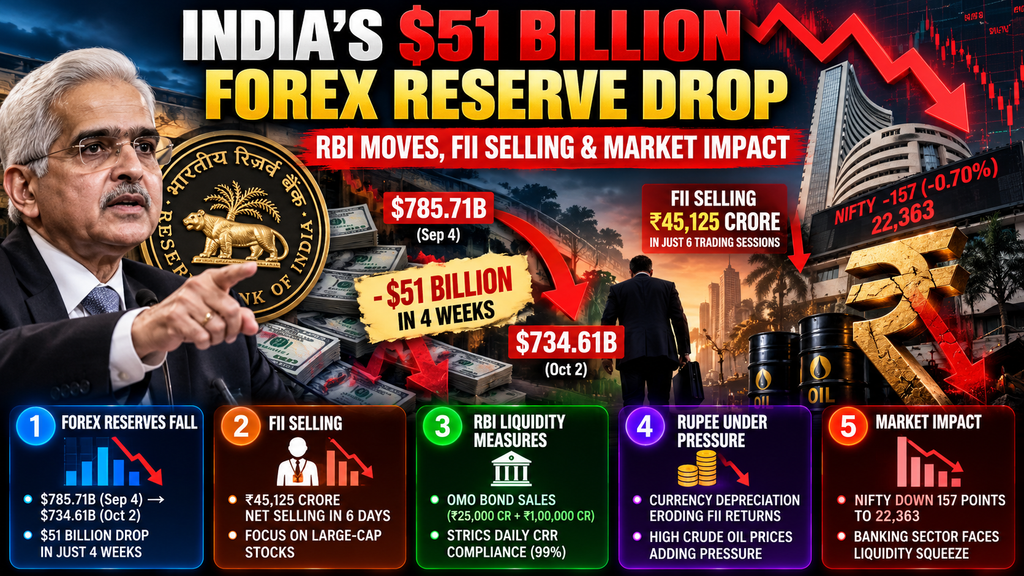
According to reports based on Reserve Bank of India (RBI) data, India’s forex reserves fell from approximately $785.71 billion on 4 September 2026 to $734.61 billion in the week ended 2 October. That represents a decline of approximately $51.1 billion in four weeks. The reduction reflects foreign exchange market intervention and valuation changes, among other factors.
At the same time, foreign institutional investors (FIIs) have been selling Indian equities aggressively. Economic Times reporting put their net selling at approximately ₹45,125 crore over the first six trading sessions of October.
These developments raise several important questions:
- Why are foreign investors selling Indian equities?
- How can RBI currency-defence measures affect banking liquidity?
- Why do rising government bond yields matter for banks?
- Can domestic institutional investors offset foreign selling?
- What should investors watch before making fresh investments?
Understanding these connections is more useful than assuming that a single indicator explains the entire market decline.
2. Takeaway One: The $51 Billion Forex Reserve Decline
What the numbers show
| Indicator | Reported figure |
|---|---|
| Forex reserves on 4 September 2026 | Approximately $785.71 billion |
| Forex reserves for the week ended 2 October | Approximately $734.61 billion |
| Decline from the September peak | Approximately $51.1 billion |
| Foreign currency assets for the week ended 2 October | Approximately $604.75 billion |
| Reduction in reserves during that latest reported week | Approximately $12.95 billion |
Why are forex reserves falling?
When the rupee faces depreciation pressure, the RBI can sell US dollars in the foreign exchange market to moderate the pace of the decline. Such intervention can reduce the dollar assets held in reserves.
However, changes in the headline reserve figure do not represent dollar sales alone. Currency movements affecting non-dollar assets, gold-price changes and other valuation adjustments can also influence the total.
For the week ended 2 October, reporting indicated that the decline included lower foreign currency assets and gold reserves.
Does a $51 billion decline mean India is running out of dollars?
No. A decline of this size deserves attention, but it does not by itself establish that India is approaching an external payments crisis.
India’s reserves remain a substantial financial buffer. A more complete assessment requires looking at import coverage, short-term external debt, the current account, capital flows and the pace of future reserve changes.
For investors, the important issue is whether currency pressure persists and whether the cost of stabilising the rupee begins affecting inflation, financial conditions and corporate earnings.
3. Takeaway Two: FII Selling Is Adding Pressure to Indian Equities
Foreign investors often allocate capital across multiple countries. Their decisions can depend on relative valuations, US interest rates, currency expectations, geopolitical developments and earnings growth.
When the rupee weakens, an unhedged foreign investor’s return in US dollars may be lower than the return measured in rupees.
For example, suppose an Indian investment rises by 5% in rupee terms while the rupee depreciates by 7% against the dollar. The investor’s approximate dollar return would be negative before fees and taxes, illustrating how currency movements can offset equity gains.
This is a hypothetical example, not a calculation of the current Nifty return.
October’s foreign selling
Reports indicate that FIIs sold Indian equities worth approximately ₹45,125 crore during the first six trading sessions of October 2026. The pace of selling was significant compared with the approximately ₹45,536 crore of net selling reported for the whole of September. <Cite refs={[“turn877719news68”]} />
Foreign selling can affect the market through several channels:
- Large-cap pressure: Foreign portfolio allocations often include liquid, widely traded companies.
- Index weakness: Selling in heavyweight shares can pull benchmark indices lower.
- Currency pressure: Equity outflows may add to demand for dollars when funds repatriate money, although actual currency effects depend on hedging and transaction arrangements.
- Valuation adjustments: Investors may demand a lower valuation when currency and global economic risks rise.
Can DIIs offset FII selling?
Domestic institutional investors (DIIs), including mutual funds and insurance companies, can provide an important source of demand.
However, DII purchases do not guarantee that the market will rise. The result depends on the amount of buying, the securities being purchased, overall liquidity and the intensity of foreign selling.
Investors should compare daily and monthly FII/DII cash-market flows rather than relying on one day’s figures.
4. Takeaway Three: RBI Is Tightening Liquidity Alongside Its Currency Measures
The RBI has introduced several measures aimed at managing liquidity and supporting the rupee. These actions have different purposes and should not be treated as one single policy instrument.
A. Open Market Operation bond sales
The RBI announced a ₹25,000 crore open market operation (OMO) sale of government securities for 13 October 2026. Separately, it had announced a ₹1 lakh crore programme of government-security sales in three tranches during September.
In an OMO sale, the central bank sells government securities to market participants and receives payment. This can withdraw liquidity from the banking system.
Potential market effects include:
- Reduced surplus liquidity available to banks.
- Greater sensitivity of short-term money-market rates.
- Changes in demand for government bonds.
- Potential pressure on bond prices if yields rise.
The actual effect depends on demand at the auction, the prevailing liquidity surplus and other RBI operations.
B. Daily Cash Reserve Ratio maintenance rises to 99%
The RBI raised the minimum daily maintenance requirement for the cash reserve ratio (CRR) from 90% to 99% of the prescribed requirement, effective from the fortnight beginning 16 October 2026. The move was reported alongside a 25-basis-point increase in the repo rate to 5.50%.
CRR is the proportion of specified bank liabilities that banks must maintain as cash reserves with the RBI.
The 99% figure refers to the daily maintenance requirement, not the CRR rate itself. The two numbers must not be confused.
The higher daily maintenance requirement reduces the flexibility banks have to manage reserve balances throughout the maintenance period. This can affect treasury operations and short-term liquidity management.
C. Repo rate: 25 basis points, not 5 basis points
A 25-basis-point increase equals 0.25 percentage points. The reported change to a 5.50% repo rate is therefore different from a 5-basis-point increase, which equals just 0.05 percentage points.
Higher policy rates can influence borrowing costs, deposit pricing, bond yields and valuations. The effect on each bank depends on its funding mix, loan repricing, asset-liability duration and credit quality.
5. Takeaway Four: The RBI’s Special Dollar Window for Oil Companies
India imports substantial quantities of crude oil, making oil marketing companies important participants in the foreign exchange market.
When oil prices rise, importers may need more dollars to pay overseas suppliers. If this demand is concentrated in the open spot market, it can add pressure to the rupee.
Recent reporting described a special RBI dollar-supply facility for state-owned oil refiners as part of the central bank’s currency-stabilisation measures.
How the mechanism can work
The simplified sequence is:
- Oil companies obtain dollars through the designated facility.
- Their immediate need to purchase dollars in the open spot market may be reduced.
- This can moderate direct spot-market demand.
- The central bank’s dollar supply and the associated rupee transactions affect its balance sheet and banking-system liquidity.
However, it would be inaccurate to conclude that every dollar supplied to an oil company necessarily creates an equivalent permanent loss of reserves or that every rupee payment produces the same net liquidity outcome. The result depends on the transaction structure and how the RBI manages the resulting balances.
The facility should therefore be assessed as one element of a broader currency-management strategy, not as proof that a crisis is being concealed.
6. Takeaway Five: Tighter Forex Derivative Rules Could Affect Banks and Traders
On 12 October 2026, Reuters reported that the RBI expanded the scope of a cash-deposit requirement for rupee-involved foreign exchange derivatives undertaken by authorised banks. The regulator also tightened the permitted use of certain non-deliverable forward contracts, restricting them to hedging purposes for specified non-resident users.
The broader objective is to reduce excessive speculative pressure and strengthen discipline in the currency market.
Potential consequences for banks
Banks may need to review:
- The cost of maintaining the required reserves.
- The pricing of eligible currency-hedging products.
- The documentation and compliance process.
- The liquidity required for treasury operations.
- The profitability of affected trading and market-making activities.
Reuters reported on 13 October that some banks had halted certain dollar-rupee forward quotations while seeking clarity on the implementation of the new rules. This illustrates how regulatory changes can create short-term operational uncertainty.
However, it would be too strong to say that the RBI has eliminated all speculative forex activity or that banks have lost all derivative-related income. The precise impact depends on the applicable rules, exemptions, customer business and each bank’s exposure.
For listed banks, investors should monitor management commentary, treasury income, compliance costs and the financial impact disclosed in quarterly results.
7. What Rising Bond Yields Could Mean for PSU Bank Stocks
Government bond yields and bond prices generally move in opposite directions. When market yields rise, the market value of existing fixed-rate bonds generally falls.
Banks hold government securities for liquidity management, regulatory requirements and investment purposes. Consequently, changes in yields can affect their treasury performance.
The possible transmission mechanism
| Development | Potential consequence |
|---|---|
| Tighter banking liquidity | Banks may face greater pressure to manage short-term funding |
| Rising government bond yields | Existing fixed-rate bond prices may decline |
| Bond holdings subject to market valuation | Possible mark-to-market impact, depending on classification and accounting treatment |
| Higher deposit competition | Potential pressure on funding costs |
| Loan repricing | Can support or reduce margins depending on asset-liability structure |
A rise in yields does not automatically translate into an equal loss for every bank. The impact depends on portfolio duration, accounting classification, hedging, deposit costs and the timing of asset and liability repricing.
What investors should check in PSU banks
Before making an investment decision, review:
- Net interest margin (NIM).
- Deposit growth and the credit-deposit ratio.
- Gross and net non-performing assets.
- Capital adequacy.
- Treasury income and disclosed valuation impacts.
- Loan growth and credit costs.
- Valuation relative to sustainable earnings.
A bank with a strong capital position and stable deposits may respond differently from a bank with expensive funding or a large sensitivity to market yields.

8. Nifty 50: How to Interpret the Market’s Technical Picture
The uploaded draft refers to a Nifty closing level of 22,363 and support near 22,300. These figures should be checked against the relevant exchange closing data before publication; they are not independently established here as the confirmed close for 13 October 2026.
Rather than relying on an unverified level, investors can use a structured technical framework.
Three scenarios to monitor
Scenario 1: Currency and liquidity stabilise
If the rupee becomes more stable, oil prices ease and foreign selling slows, equity-market sentiment may improve. A recovery would still need confirmation from price action, breadth and trading volumes.
Scenario 2: The market remains volatile
If the rupee stabilises temporarily but foreign selling continues, indices may trade unevenly. Large caps, banks and rate-sensitive sectors may respond differently from small- and mid-cap stocks.
Scenario 3: External pressure intensifies
If crude oil rises sharply, the rupee comes under renewed pressure and global bond yields increase, investors may demand a larger risk premium for Indian equities. In that situation, support levels may fail, and volatility may rise.
These are conditional scenarios, not price predictions or guaranteed trading signals.
Market indicators worth tracking
- Nifty 50 and Bank Nifty closing levels.
- India VIX and changes in implied volatility.
- Daily FII and DII cash-market flows.
- USD/INR spot and forward rates.
- Brent crude prices.
- Government bond yields.
- RBI liquidity announcements.
- Corporate earnings and management guidance.
Combining these indicators provides a more complete picture than interpreting any single market statistic in isolation.
9. The Two Major Variables to Watch Next
Variable 1: Crude oil prices
Higher crude prices can increase India’s import bill and put pressure on the current account and inflation outlook. The ultimate impact depends on global supply, domestic fuel pricing, currency movements and government policy.
Variable 2: Rupee stability and capital flows
A stabilising rupee may help reduce currency-related uncertainty for foreign investors. But a durable recovery in equity inflows also depends on earnings growth, valuations, global risk appetite and relative investment opportunities.
Investors should also monitor the RBI’s liquidity operations and the implementation of new foreign-exchange rules, as these can affect financial conditions even if the rupee temporarily strengthens.
10. Final Verdict: Is India’s Market Facing a Liquidity Shock?
India’s recent market environment reflects several interacting pressures: falling forex reserves from a recent peak, substantial foreign equity selling, elevated oil-related risks and tighter RBI liquidity management.
These developments can create challenges for banks, bond investors and equity-market participants. Nevertheless, a fall in reserves does not automatically imply a currency crisis, and foreign selling does not guarantee that stock prices will continue to decline.
The most useful approach is to monitor the data, understand the mechanisms behind RBI policy and evaluate companies on their own financial strength.
For long-term investors, volatility can create opportunities—but only where business fundamentals, balance sheets and valuations justify the risk. For short-term traders, strict risk management is essential when currency markets, bond yields and equity prices are moving rapidly.
The key question is not simply whether the RBI can support the rupee. It is whether currency stability, banking liquidity and corporate earnings can improve together over time.
Frequently Asked Questions (FAQs)
1. Why did India’s forex reserves fall by around $51 billion?
Reported reserves declined from approximately $785.71 billion on 4 September to $734.61 billion in the week ended 2 October 2026. RBI foreign-exchange intervention and valuation changes contributed to the reduction.
2. Does falling forex reserves mean India is heading toward a financial crisis?
Not necessarily. Reserve levels must be assessed alongside import coverage, external debt, current-account conditions, capital flows and the pace of change.
3. Why are FIIs selling Indian stocks?
Possible drivers include global interest rates, currency depreciation, oil prices, valuations and relative investment opportunities. The exact motivation varies by investor and cannot be attributed to a single factor without evidence.
4. What does a 99% daily CRR maintenance requirement mean?
It means banks must maintain 99% of their prescribed CRR requirement on a daily basis during the applicable maintenance period. It does not mean that the CRR rate itself is 99%.
5. How can OMO bond sales affect stock markets?
OMO sales can withdraw liquidity from the banking system. Depending on market conditions, this may influence short-term rates, government bond yields and the cost of funding.
6. Can higher bond yields hurt PSU banks?
They can affect the market value of some bond holdings and may increase funding costs. The impact varies with portfolio structure, accounting treatment, deposit pricing and loan repricing.
7. Should investors buy the dip during FII selling?
Not automatically. Investors should check valuations, earnings quality, debt, cash flows and risk tolerance. A decline in share price alone does not establish that a stock is undervalued.
8. Which indicators should traders watch during rupee volatility?
Track USD/INR, Brent crude, Nifty and Bank Nifty, India VIX, FII/DII flows, bond yields and official RBI announcements. Use confirmed exchange data for technical levels.
Disclaimer
This article is for educational and informational purposes only. It is not investment advice or a recommendation to buy or sell any security, currency or derivative. Macroeconomic data, market prices and regulatory measures can change. Readers should verify official RBI and exchange disclosures before making financial decisions. Trading in equities, futures, options and currencies involves significant risk, including the possible loss of capital.
GBullsNBears.com does not guarantee the accuracy of future market outcomes or investment returns.
Top 10 SEO titles
- India’s $51 Billion Forex Reserve Drop: RBI Moves, FII Selling & Market Impact
- Why Are India’s Forex Reserves Falling? RBI Actions and Stock Market Risks
- India Forex Reserves Fall by $51 Billion: What Investors Need to Know
- Rupee Under Pressure: How RBI Measures Could Impact the Indian Stock Market
- FII Selling in India: Forex Reserves, Rupee Weakness and Nifty 50 Outlook
- RBI’s Latest Moves Explained: Forex Reserves, CRR Rules and Bond Sales
- India’s Forex Reserves Decline: Is the Rupee Facing More Pressure?
- RBI Tightens Banking Liquidity: What It Means for Banks, Bonds and Stocks
- Forex Reserves vs FII Outflows: What’s Driving India’s Market Volatility?
- Indian Stock Market Outlook: Forex Reserves, RBI Policy and Rupee Risks