

Introduction: Why Is the Nifty Rallying Despite Global Uncertainty?
The Indian stock market is approaching a crucial moment as investors prepare for the scheduled listing of Jio Platforms on October 28, 2026. Elevated crude oil prices, geopolitical tensions in the Middle East, persistent foreign investor outflows, and uncertainty surrounding global monetary policy have created a challenging environment for equities.
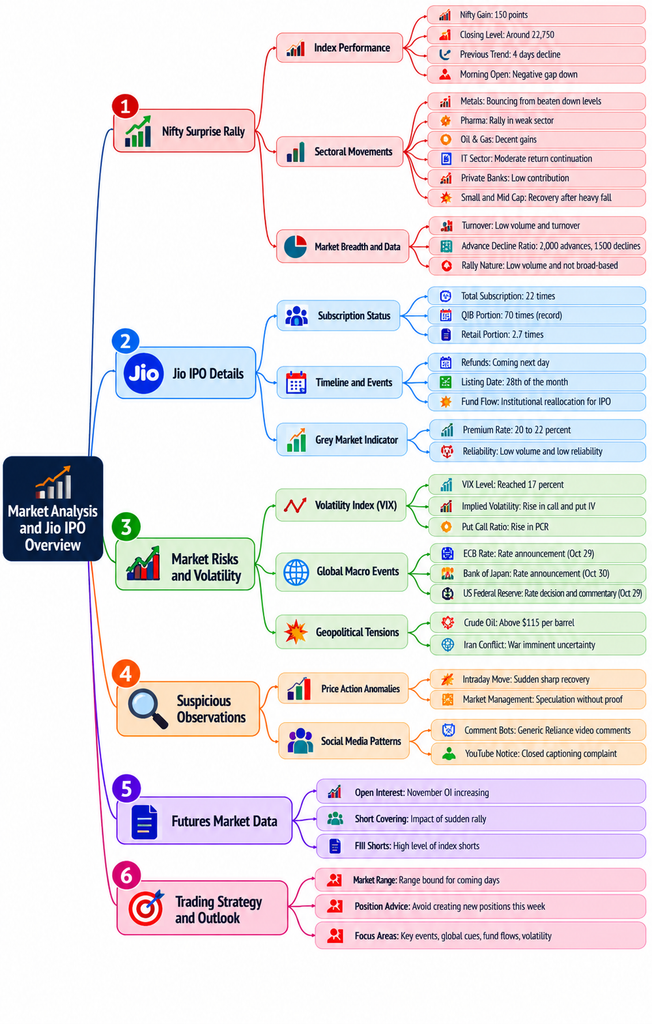
Against this backdrop, the Nifty 50 staged a notable recovery during the previous trading session, rising approximately 0.68% on October 26 to close at 22,753.20. However, the index finished October 27 at 22,749.75, down 0.02%, following another volatile session. The latest closing data therefore suggest that the earlier recovery has not yet developed into a sustained upward breakout.
At the same time, Brent crude remained near $115–$116 per barrel, close to a six-month high, while investors awaited the US Federal Reserve’s policy decision. Expensive oil is particularly important for India because it can increase import costs, place pressure on inflation and complicate the outlook for corporate earnings.
The result is a market presenting two competing signals: a short-term recovery in selected equities and a broader environment of elevated uncertainty.
This raises several important questions:
- Is the Nifty recovery supported by genuine buying demand?
- Could IPO-related cash allocation affect liquidity in other market segments?
- Does elevated volatility increase the risk of a bull trap?
- Can the Jio Platforms listing improve market sentiment, or could disappointment create additional pressure?
- What should traders monitor before taking fresh positions?
To answer these questions, investors need to distinguish confirmed market data from assumptions about institutional intentions.
1. The Nifty Rally Paradox: Recovery or Short-Covering?
A rising index does not always indicate that the entire market is becoming stronger.
The Nifty can advance because of fresh buying, short-covering, gains in a few heavyweight stocks, or a combination of these factors. Understanding the source of a rally is therefore just as important as observing the number of points gained.
What Happened on October 26 and October 27?
The Nifty closed at 22,753.20 on October 26 after gaining approximately 0.68%. On October 27, however, it finished at 22,749.75, indicating that the index had largely consolidated rather than extended its previous advance.
This distinction matters. A sharp intraday recovery can attract momentum traders, but a sustainable reversal generally requires follow-through buying, improving market breadth and a convincing break above resistance.
Four Indicators Every Trader Should Examine
1. Trading volume
A rally accompanied by expanding turnover may indicate stronger participation. A rally without meaningful volume expansion can be less convincing, although low volume alone does not prove that a move is artificial.
2. Market breadth
If the index rises while most constituent stocks decline, the recovery may be concentrated in a limited number of companies.
On October 27, however, broader-market indices also advanced: the small-cap index gained approximately 2.59%, while the mid-cap index rose nearly 1%. This suggests that the latest session was not simply a case of the benchmark rising while all smaller stocks weakened.
3. Banking-sector participation
Banks and financial companies have significant influence on the Nifty. If banking stocks fail to participate in an upward move, traders should examine whether strength in other sectors is sufficient to sustain the index.
On October 27, banking and IT shares faced pressure, even as selected sectors advanced. This mixed performance points to rotation between sectors rather than an entirely uniform market recovery.
4. Derivatives positioning
Short-covering can accelerate an upward move when traders holding bearish positions buy back their positions. However, open interest alone cannot establish whether traders are opening shorts, closing shorts or building other types of positions.
Investors should examine price movement, changes in open interest, futures positioning and options data together.
What Does This Mean for Investors?
The recent recovery deserves attention, but it should not automatically be treated as the beginning of a new bull market.
A stronger bullish signal would include a sustained move above resistance, improving participation across sectors and continued buying in subsequent sessions.
Conversely, a failure to hold support after a temporary rally could indicate that the market remains vulnerable to another decline.
Key takeaway: A green candle is a price observation, not proof of a trend reversal.
2. The Jio IPO Liquidity Effect: Could Mid-Caps and Small-Caps Be Affected?
One of the major events influencing investor attention is the Jio Platforms IPO.
The issue opened on October 21 and closed on October 23, 2026. The reported issue size was approximately ₹30,213 crore, with a price band of ₹1,065–₹1,119 per share. The scheduled listing date is October 28.
An IPO of this size can influence how some investors allocate their available capital. However, it is important to distinguish the potential liquidity effect from the claim that the IPO directly caused the broader market correction.
Jio Platforms IPO: Key Numbers
| Parameter | Reported Details |
|---|---|
| IPO issue size | Approximately ₹30,213 crore |
| Price band | ₹1,065–₹1,119 |
| Issue opening date | October 21, 2026 |
| Issue closing date | October 23, 2026 |
| Total subscription | 22.19 times |
| QIB subscription, excluding anchors | 70.55 times |
| Non-institutional investor subscription | 14 times |
| Retail investor subscription | 2.72 times |
| Allotment date | October 26, 2026 |
| Scheduled listing date | October 28, 2026 |
Source: IPO subscription and timeline information reported by The Economic Times and Moneycontrol.
The subscription figures reveal substantial demand from qualified institutional buyers, alongside participation from retail and non-institutional investors.
However, subscription levels should not be confused with guaranteed listing gains. They measure demand for shares during the bidding period, not the price at which the shares will trade after listing.
How Can a Large IPO Influence Market Liquidity?
IPO applications can temporarily block funds under the applicable application process. Investors who do not receive allotment may subsequently have those funds released.
Large institutional investors may also adjust portfolios to accommodate a major primary-market investment. Such adjustments can affect the timing of purchases and sales elsewhere.
Several mechanisms are possible:
- Capital allocation: Some investors may direct cash towards the IPO rather than additional secondary-market purchases.
- Portfolio rebalancing: Funds may sell existing holdings to manage exposure or finance new investments.
- Temporary liquidity changes: Funds blocked during the application process may become available after allotment.
- Post-allotment reallocation: Investors may decide to reinvest released capital in equities, bonds or other assets.
Nevertheless, there is insufficient evidence to conclude that the Jio IPO alone caused declines in mid-cap or small-cap shares. Market movements can also reflect earnings expectations, valuations, foreign flows, interest rates and geopolitical developments.
What Should Investors Watch After the IPO?
The important question is whether the market attracts sustained buying after the allotment process.
If mid-cap and small-cap stocks continue to advance alongside stronger volumes, that would be consistent with improving demand.
If the benchmark remains stable but broader-market participation deteriorates, investors should investigate whether the strength is concentrated in selected stocks.
Neither outcome can be predicted solely from the IPO subscription figures.
Key takeaway: IPO-related liquidity is a plausible factor to monitor, not a proven explanation for every market decline.
3. Is the Market Being Managed Before the Jio Listing?
The timing of a major IPO can generate speculation about unusual movements in the benchmark index. Sudden recoveries, positive social-media commentary and changes in derivatives positioning may appear suspicious when they occur together.
However, suspicion is not proof of market manipulation.
The original observations about abrupt intraday recoveries, standardized social-media comments and reporting-related difficulties are claims that require independent verification. They should not be presented as established evidence of coordinated activity by a company, institution or market participant.
Clue 1: Abrupt Intraday Reversals
A sharp reversal after a weak opening can result from several mechanisms:
- Short-covering by bearish traders.
- Buying in oversold stocks.
- Changes in global market sentiment.
- Institutional portfolio rebalancing.
- Reactions to company-specific earnings or announcements.
To determine which explanation is most plausible, analysts would need intraday price and volume data, constituent-level contributions,s and relevant derivatives information.
A price chart alone cannot identify the participants responsible for a move.
Clue 2: Social-Media Sentiment
An unusual increase in positive comments under IPO-related posts may justify closer examination of the accounts and their activity.
However, repeated wording or unexpectedly high engagement does not automatically establish a coordinated campaign. Genuine users, promotional activity, automated accounts and unrelated engagement patterns can produce superficially similar results.
A credible investigation would require evidence such as account histories, timestamps, coordination patterns and links to identifiable activity.
Clue 3: Problems Affecting Financial Content
Creators may encounter moderation decisions, captioning complaints or administrative restrictions for different reasons.
Without independent documentation connecting those events to a deliberate attempt to influence market sentiment, it would be inappropriate to describe them as proven suppression of market analysis.
Investors should rely on exchange disclosures, regulatory filings, audited financial information and transparent market data rather than unverified social-media claims.
Could Authorities Investigate Suspicious Activity?
Indian securities-market rules prohibit specified forms of market manipulation and fraudulent trading. If credible evidence of misconduct emerges, it may warrant reporting to the appropriate exchange or regulator.
But the existence of unusual price movements is not, by itself, sufficient to establish a violation.
Key takeaway: Investigate evidence, question unsupported narratives and avoid making definitive accusations without verification.
4. India VIX, Crude Oil and Global Risks: Why the Recovery Could Remain Fragile
Even when the Nifty is relatively stable, investors may continue to price in substantial uncertainty.
Two important factors are crude oil and volatility.
Crude Oil Near $115–$116
Brent crude remained around $115–$116 per barrel on October 27, close to a six-month high amid Middle East tensions.
For India, higher oil prices can create several challenges:
- Inflationary pressure: Higher energy and transportation costs can feed into prices across the economy.
- Corporate margins: Companies that cannot fully pass on higher input costs may experience margin pressure.
- Currency sensitivity: A larger import bill can place pressure on external balances and the rupee.
- Interest-rate expectations: Persistent inflation risks can complicate monetary-policy decisions.
- Sector divergence: Oil producers, refiners, airlines, logistics companies and energy-intensive manufacturers may react differently to changes in crude prices.
The relationship is not uniform. The impact depends on company-specific exposure, government policies, currency movements and the speed at which prices change.
Why India VIX Matters
India VIX measures the market’s expectation of near-term volatility implied by Nifty options.
A rising VIX generally indicates that options markets are pricing in greater uncertainty. It does not, however, predict whether the next major move will be upward or downward.
For traders, elevated volatility has practical consequences:
- Option premiums may become more expensive.
- Stop-loss orders may be triggered by larger intraday swings.
- Breakouts can fail more frequently during unstable conditions.
- Overnight positions may face larger-than-expected gaps.
- Position sizing becomes increasingly important.
A trader buying options should remember that being correct about direction does not guarantee a profit if the move is too small or too slow relative to the premium paid and the change in implied volatility.
Likewise, option sellers face the risk of sharp adverse moves and potentially substantial losses.
Global Monetary Policy
The Federal Reserve’s October 27–28 meeting is another important event for investors. Markets are evaluating the potential implications of the Fed’s decision and its guidance for interest rates and financial conditions.
Changes in US interest-rate expectations can influence the dollar, bond yields, emerging-market capital flows and equity valuations.
For Indian stocks, the combination of elevated oil prices and uncertainty around US monetary policy may make the market more sensitive to foreign investor flows and earnings expectations.
Key takeaway: A stable index does not necessarily mean that uncertainty has disappeared. Volatility, oil prices and global policy decisions must be considered alongside price action.
5. Nifty 50 Technical Analysis: Support, Resistance and Possible Scenarios
As of the October 27 close, the Nifty 50 stood at 22,749.75. The following levels provide a framework for scenario analysis rather than a guarantee of future price movements.
A market commentary published on October 27 identified nearby support levels at approximately 22,509 and 22,265, with resistance around 22,875 and 22,997. These should be treated as reference levels, not permanent technical boundaries.
Important Nifty Levels
| Technical Reference | Nifty Level | Possible Interpretation |
|---|---|---|
| Immediate resistance | 22,875 | A sustained move above this level could strengthen the short-term recovery |
| Higher resistance | 22,997 | A potential test of the 23,000 zone |
| Current closing level | 22,749.75 | Benchmark for evaluating the next session |
| First support | 22,509 | A break below may weaken the immediate technical picture |
| Lower support | 22,265 | A further downside reference if selling pressure increases |
These are indicative technical reference levels based on published market commentary. Recalculate them using current charts before making a trade.
Scenario A: Bullish Recovery
A bullish scenario would become more credible if the Nifty moves above 22,875 and sustains the advance, followed by a convincing test of the 22,997–23,000 area.
Additional confirmation could include:
- Improving market breadth.
- Rising cash-market turnover.
- Participation from banking and other heavyweight stocks.
- Stable or declining volatility.
- Supportive global cues.
A brief move above resistance without follow-through would be weaker evidence.
Scenario B: Range-Bound Consolidation
The market could remain between nearby support and resistance if buyers and sellers continue to offset each other.
During consolidation, traders may encounter false breakouts and repeated reversals. A clear trading plan and predefined risk limits are therefore important.
Scenario C: Bearish Breakdown
A sustained move below 22,509 could weaken the short-term structure and expose the next reference level around 22,265.
A downside break accompanied by expanding volume, deteriorating breadth and weakness in heavyweight stocks would provide stronger confirmation than an isolated intraday dip.
These levels should be updated as new price data becomes available.
Should Traders Open Fresh Positions Before the Jio Listing?
The answer depends on the trading strategy, risk tolerance, and available confirmation.
Aggressive directional trades based solely on expectations about the listing can be dangerous. A listing may produce a positive surprise, disappointing performance,ce or a reaction that is already reflected in market prices.
Traders should avoid assuming that the Nifty must rise to support the IPO or fall because the market is supposedly being manipulated.
A disciplined approach is to wait for price confirmation, calculate the maximum acceptable loss,oss and avoid taking a position simply because a major event is approaching.
6. Jio Platforms IPO: What Investors Should Know Before Listing Day
The Jio Platforms IPO is a major primary-market event, but its listing performance will depend on more than subscription demand.
The company filed its Red Herring Prospectus, and the reported issue terms included a price band of ₹1,065–₹1,119 per share. The issue attracted approximately 22.19 times overall subscription, including 70.55 times subscription in the QIB category, excluding anchor investors.
Why a Highly Subscribed IPO Can Still Disappoint
Subscription figures reflect applications relative to shares available in each investor category. They do not guarantee that every applicant will purchase shares in the secondary market after listing.
Several factors can influence the listing price:
- The issue price relative to expected future earnings.
- Investor assessments of business growth.
- Market conditions on listing day.
- Institutional demand and available liquidity.
- Broader sentiment towards large-cap equities.
- Expectations already incorporated into the issue price.
A company may have strong long-term prospects while its shares experience weak short-term performance if expectations are excessively optimistic.
Conversely, volatile market conditions do not necessarily prevent a company with strong investor demand from listing well.
How to Evaluate the Listing
Investors should monitor the actual opening price, trading volume, price stability and subsequent buying or selling activity.
For investors who receive allotment, the decision to hold or sell should reflect their financial objectives, risk tolerance, valuation assessment and investment horizon.
For those who did not receive allotment, buying immediately after listing solely out of fear of missing out can expose them to excessive risk.
Grey market premiums are unofficial and may be based on limited trading activity. They should not be treated as reliable forecasts of the listing price.
Important: The IPO’s scheduled listing date is October 28, 2026. Any assessment of actual listing performance must wait for verified exchange trading data.
7. Three Market Signals to Monitor After the Jio IPO
The next few sessions could provide useful information about the market’s underlying strength. Rather than predicting the outcome in advance, investors can monitor three developments.
Signal 1: Broader-Market Participation
Observe whether small-cap and mid-cap indices continue to participate in any recovery.
If gains spread across multiple sectors and a wider range of stocks, the advance would show broader participation. If strength becomes increasingly concentrated, the market may remain vulnerable to sector-specific reversals.
Signal 2: Foreign and Domestic Institutional Flows
On October 26, foreign institutional investors were reported as net sellers of approximately ₹1,462.49 crore in the cash market, while domestic institutional investors were net buyers of approximately ₹2,609.57 crore.
These figures illustrate the differing activity of foreign and domestic institutions during that session.
However, a single day’s flows do not establish a lasting trend. Investors should examine several sessions of data and distinguish cash-market activity from derivatives positioning.
Signal 3: Volatility and Price Confirmation
A recovery accompanied by improving breadth, stable volatility, and sustained price gains would be more convincing than a brief rise followed by a rapid reversal.
If volatility remains elevated, traders should consider reducing position sizes and avoiding excessive leverage.
No single indicator can provide certainty. The strongest conclusions come from combining price action, breadth, volume, institutional flows and the prevailing macroeconomic environment.
8. Practical Risk-Management Checklist for Retail Investors
The combination of a major IPO, elevated oil prices and global monetary-policy uncertainty creates an environment in which disciplined risk management is particularly important.
Before entering a trade, consider the following checklist:
- Define the trade: Identify whether the position is based on a breakout, a pullback, a reversal, or a longer-term investment thesis.
- Wait for confirmation: Avoid entering solely because the Nifty has moved sharply in one direction.
- Calculate position size: Decide how much capital can be lost if the trade fails.
- Use a logical stop-loss: Base the stop on the trading setup and volatility, rather than choosing an arbitrary number of points.
- Avoid excessive leverage: Large positions can magnify losses during unexpected price gaps.
- Review event risk: Consider the Jio listing and major central-bank announcements before holding overnight positions.
- Check market breadth: Compare the benchmark’s performance with that of the wider market.
- Do not rely on rumours: Verify market claims through official disclosures and credible reporting.
- Record the trade rationale: Document the entry conditions, exit plan and maximum acceptable loss.
- Review the outcome objectively: Distinguish a well-executed trade that loses money from a poorly planned trade that happens to make a profit.
These principles apply to cash equities, futures and options, although derivatives require additional attention to expiry, implied volatility, liquidity and leverage.
Conclusion: Is the Nifty Rally Genuine or a Bull Trap?
The recent Nifty recovery presents a market puzzle, but the available evidence does not establish that the index is being artificially supported ahead of the Jio Platforms IPO.
The Nifty rose approximately 0.68% on October 26 before closing nearly unchanged on October 27. Broader-market indices advanced on October 27, while selected heavyweight sectors remained under pressure. At the same time, crude oil prices stayed elevated,d and investors prepared for the Federal Reserve’s policy decision.
These developments support a cautious interpretation: the market is experiencing competing forces, and the durability of the recovery remains uncertain.
The Jio IPO could influence investor attention and the allocation of some capital. However, it would be premature to attribute the broader market’s weakness to the IPO alone or to conclude that unusual intraday price movements prove manipulation.
For investors, the most useful approach is to monitor observable evidence:
- Whether the Nifty sustains a move above its nearby resistance levels.
- Whether market breadth and trading activity confirm the recovery.
- Whether institutional flows show a persistent change.
- Whether crude oil and global monetary-policy developments alter market sentiment.
- Whether volatility remains elevated around the listing and other major events.
The central lesson is simple: do not confuse a temporary index recovery with a confirmed market reversal. Investors who rely on verified data, predefined risk limits and disciplined execution are better prepared for both bullish and bearish outcomes.
The Jio listing may become an important market event, but its significance will be determined by actual trading behaviour and subsequent evidence—not speculation about what the market is supposedly trying to achieve.
Frequently Asked Questions (FAQs)
1. Why did the Nifty recover before the Jio IPO listing?
The Nifty gained approximately 0.68% on October 26, 2026, before closing nearly unchanged on October 27. Possible contributors to a recovery include buying in selected stocks, short-covering, ng and changes in investor positioning. The precise contribution of each factor requires detailed market data.
2. Is the Jio IPO responsible for the Indian stock market correction?
There is insufficient evidence to attribute the broader market correction solely to the Jio IPO. IPO-related cash allocation may influence some investment decisions, but crude oil prices, foreign flows, earnings expectations and global uncertainty can also affect equities.
3. What was the Jio Platforms IPO subscription status?
The IPO received approximately 22.19 times overall subscription. The QIB category, excluding anchor investors, was subscribed approximately 70.55 times, while the retail category was subscribed 2.72 times.
4. Does a rising India VIX mean the market will fall?
No. India VIX reflects expected near-term volatility implied by Nifty options. It does not determine the direction of the next market move.
5. What are the important Nifty support and resistance levels?
Published market commentary on October 27 identified support near 22,509 and 22,265, with resistance near 22,875 and 22,997. These levels can change as market conditions evolve and should be checked against current charts.
6. Should investors buy Jio shares immediately after listing?
Not automatically. Investors should evaluate the actual listing price, valuation, trading liquidity, business outlook and personal risk tolerance before deciding whether to buy, hold or sell.
7. Can unusual price movements prove stock-market manipulation?
No. Unusual price movements may justify further investigation, but proving manipulation requires credible evidence and appropriate regulatory assessment. Investors should avoid treating speculation as a fact.
Disclaimer
This article is for educational and informational purposes only. It does not constitute investment advice, a recommendation to buy or sell securities, or a prediction of guaranteed market performance.
Stock prices, IPO listings, and derivatives can involve substantial risk. Market levels and institutional-flow figures may change as new data becomes available. Investors should verify current information through official exchange disclosures and relevant regulatory filings before making financial decisions.
GBullsNBears.com does not guarantee the accuracy of unofficial grey market premiums, market rumours,s or speculative interpretations of institutional activity. Consult a SEBI-registered investment adviser for advice tailored to your circumstances.
Top 10 SEO Titles
- Nifty 150-Point Rally Before Jio IPO: Recovery or Bull Trap?
- Nifty 50 Prediction: Is the Jio IPO Hiding a Bigger Market Risk?
- Nifty Rally Before Jio IPO: 5 Warning Signals Every Investor Must Know
- Jio IPO 2026: Why the Nifty Rally Has Investors Watching Closely
- Indian Stock Market Outlook: Nifty Rally, Crude Oil and India VIX Explained
- Nifty 50 Analysis: Can the Market Recover Before the Jio IPO Listing?
- Jio IPO vs Market Crash: Is India’s Stock Market Facing a Bull Trap?
- India VIX Near 17: What It Means for Nifty 50 and Jio IPO Investors
- Nifty 50 Today: FII Selling, Rising Crude Oil and Jio IPO Risks
- Nifty Market Analysis 2026: Key Support, Resistance and Jio IPO Impact