

1. Introduction: The Ghost of 2008 Returns to Dalal Street
Financial markets have a habit of repeating familiar patterns—but rarely under the same circumstances.
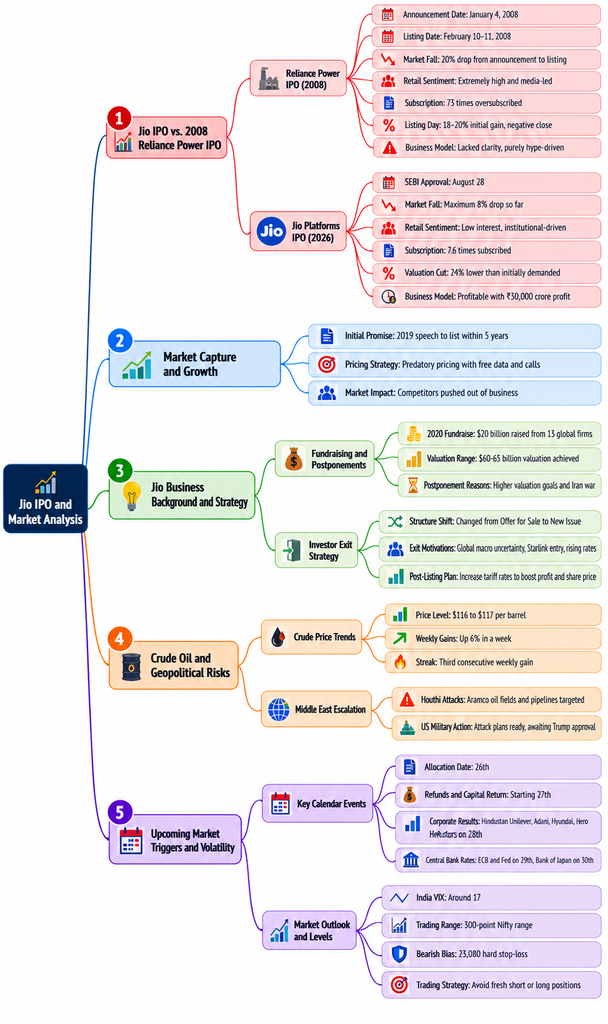
In January 2008, the Reliance Power IPO attracted extraordinary investor demand. The issue was subscribed more than 73 times, reflecting intense enthusiasm among retail investors and institutions. However, the stock’s listing on 11 February 2008 proved disappointing. After opening above its issue price, Reliance Power reversed sharply and closed its first trading day below the IPO price.
The broader market was also under severe pressure. The Sensex suffered a decline of approximately 834 points on the listing day, while global financial-market concerns and foreign investor selling were weighing on Indian equities.
Fast-forward to October 2026, and another major corporate event has captured investor attention: the proposed stock-market listing of Jio Platforms, Reliance Industries’ telecom and digital-services business.
The Jio Platforms IPO has attracted substantial demand. Yet Indian equities are simultaneously dealing with elevated crude oil prices, currency pressure, foreign institutional selling and uncertainty about global monetary policy.
This raises an important question:
Is the Jio Platforms IPO a warning sign of another 2008-style market crash, or are investors confusing two fundamentally different situations?
The answer requires more than comparing IPO subscription numbers or headline index movements. Investors must examine valuations, business fundamentals, institutional positioning, liquidity and the wider economic environment.
Here are five important lessons from the comparison.
2. Lesson One: IPO Euphoria Can Be Dangerous—but Jio’s Subscription Data Tells a Different Story
What happened during the Reliance Power IPO in 2008?
Reliance Power’s IPO opened on 15 January 2008 and closed on 18 January. The issue raised approximately ₹11,700 crore at an issue price of ₹450 per share.
Demand was extraordinary. The IPO received subscriptions exceeding 73 times the shares available, with substantial participation from institutional and non-institutional investors.
However, the enthusiasm surrounding the offering did not translate into a successful first trading day.
On 11 February 2008, Reliance Power initially listed at a premium on the exchanges. Selling pressure subsequently intensified, and the stock closed at approximately ₹372.50—around 17.2% below its ₹450 issue price.
The episode demonstrated that even an exceptionally popular IPO can disappoint investors when its valuation, market conditions or investor expectations prove unsustainable.
How does Jio Platforms compare?
Jio Platforms’ IPO has a different demand profile.
The offering closed on 23 October 2026 with total subscription of approximately 22.2 times. Its final issue price was ₹1,119 per share, and its market debut is scheduled for 28 October 2026.
The subscription figures reveal a particularly strong institutional response.
| IPO indicator | Reliance Power, 2008 | Jio Platforms, 2026 |
|---|---|---|
| IPO issue size | Approximately ₹11,700 crore | Approximately ₹30,188 crore |
| Subscription | More than 73 times | Approximately 22.2 times |
| Retail subscription | More than 14 times | 2.72 times |
| QIB subscription | More than 82 times | 70.55 times |
| Listing date | 11 February 2008 | Scheduled for 28 October 2026 |
| Business profile | Power projects, largely under development | Established telecom and digital-services business |
Historical Reliance Power figures are based on contemporaneous reporting and IPO records. Jio figures reflect the reported final issue price and subscription data available before its scheduled listing.
What do these numbers actually tell us?
The first observation is that the two IPOs attracted different levels and patterns of demand.
Reliance Power experienced exceptional subscription enthusiasm across investor categories. Jio Platforms also received strong demand, particularly from qualified institutional buyers.
Jio’s retail subscription of 2.72 times was meaningful, even though it was far below the extreme enthusiasm associated with Reliance Power.
The second observation is that IPO subscription does not guarantee listing gains.
An IPO can be heavily oversubscribed because investors expect strong returns. If the final valuation leaves insufficient room for additional upside, the stock can still decline after listing.
Similarly, a lower subscription multiple does not automatically mean an IPO is unattractive.
The key lesson
Investors should separate three different questions:
- Is the business fundamentally strong?
- Is the IPO valuation reasonable?
- Is the broader market environment supportive?
A positive answer to the first question does not guarantee positive answers to the other two.
Investor takeaway: Never treat IPO oversubscription or grey-market premiums as guarantees of listing gains. Evaluate the company’s financial performance, valuation, competitive position and risks before making an investment decision.
3. Lesson Two: Jio’s Business Profile Is Different from Reliance Power’s 2008 Profile
One of the biggest mistakes investors can make is assuming that two large IPOs from the same corporate group must behave similarly.
The name of a promoter or corporate group does not determine whether a particular stock is fairly valued.
What matters is the underlying business.
Reliance Power in 2008: Growth expectations and execution risk
At the time of its IPO, Reliance Power was raising capital to support the development of power projects.
Its investment case depended heavily on future capacity expansion, project execution, financing and the ability to translate development plans into operating assets and earnings.
These factors introduced substantial uncertainty.
Large infrastructure projects can face delays related to land acquisition, fuel availability, regulatory approvals, financing and construction costs.
Investors purchasing shares at an aggressive valuation therefore faced risks that were not fully captured by the company’s growth narrative.
Jio Platforms in 2026: An established operating business
Jio Platforms has a different business profile.
Its operations span telecommunications and digital services, supported by an established customer base and a large network infrastructure.
According to Reuters’ October 2026 reporting, its telecom business had approximately 524.4 million customers as of March 2026. Annual revenue increased 14.6% to approximately ₹1.47 lakh crore, while profit rose 15.1% to around ₹30,050 crore.
These figures indicate that Jio has a substantial operating business rather than relying solely on future project development.
However, established operations do not eliminate investment risk.
Telecom businesses require substantial capital expenditure, network investment and ongoing technology upgrades. Competition, pricing decisions, spectrum costs and regulatory developments can also influence profitability.
What about Jio’s valuation?
Jio Platforms’ IPO was priced at ₹1,119 per share, implying a valuation of approximately ₹10.3 lakh crore.
Reuters reported that this valuation was below the approximately ₹13 lakh crore valuation discussed earlier in the IPO preparation process.
That represents a reduction of roughly 21% from the earlier reference valuation—not an established 24% cut.
The distinction matters because investors should compare the final issue price with the company’s financial performance and valuation multiples rather than relying on dramatic headlines.
A lower valuation than originally targeted can improve the investment case, but it does not automatically make a stock cheap.
The relevant questions are:
- What is the company’s price-to-earnings ratio at the IPO valuation?
- How quickly are revenue and earnings growing?
- How much capital expenditure will be required?
- What is the company’s debt position?
- How sustainable are its operating margins?
- How much future growth is already reflected in the issue price?
The key lesson
A profitable, established company can still deliver disappointing investment returns if investors pay too much for its shares.
Conversely, a company with significant execution risks may offer an attractive investment opportunity if its valuation adequately compensates investors for those risks.
Investor takeaway: Compare Jio with businesses that have similar operations, earnings profiles and capital requirements. Do not assume that a large brand or strong customer base automatically justifies any valuation.
4. Lesson Three: The Real Risk May Be Institutional Positioning, Not the IPO Itself
A large IPO can influence financial markets because investors must allocate capital between new offerings and existing stocks.
However, the relationship is more complicated than simply saying that money invested in an IPO disappears from the stock market.
How an IPO can influence secondary-market liquidity
Consider a hypothetical situation in which investors have ₹10,000 crore available for equity investments.
A major IPO attracts ₹3,000 crore from investors who might otherwise have purchased existing listed shares.
If other conditions remain unchanged, demand for some secondary-market stocks could weaken temporarily.
However, the actual effect depends on where the IPO money comes from, how investors fund their applications, the level of institutional demand and the behaviour of other market participants.
IPO applications using the ASBA mechanism generally block funds in investors’ bank accounts rather than immediately transferring the full amount to the issuer. Funds associated with unsuccessful applications are subsequently released according to the applicable process.
Consequently, IPO-related liquidity effects are not always equivalent to a permanent withdrawal of capital from equities.
What do foreign institutional flows tell us?
Foreign institutional investors can exert significant influence on Indian share prices because they often trade large positions in liquid companies.
When overseas investors reduce exposure, large-cap stocks—particularly heavily traded banking, financial-services and information-technology companies—can experience selling pressure.
But foreign selling is not always a forecast of an impending crash.
Investors may reduce exposure because of currency movements, global interest rates, portfolio rebalancing, relative valuations or changing economic expectations.
Domestic institutional investors can offset some of that selling, although their buying does not guarantee that prices will remain stable.
The current market backdrop
Indian markets ended 27 October 2026 nearly flat.
- Nifty 50: 22,749.75, down approximately 0.02%.
- Sensex: 73,598.67, down approximately 0.01%.
- Brent crude: Around $116 per barrel during the session.
- FII activity: Foreign investors had sold approximately ₹1,462.49 crore of Indian equities in the latest reported session for 26 October.
- DII activity: Domestic institutions had purchased approximately ₹2,609.57 crore over the same session.
These figures illustrate the contrast between foreign selling and domestic institutional buying. They do not establish that the Jio IPO caused the market’s movements.
The key lesson
Investors should monitor institutional flows, but they should not interpret one day’s data as a definitive signal.
A more useful approach is to examine:
- Whether FII selling persists over several weeks.
- Whether domestic institutions continue absorbing available supply.
- Whether market breadth improves or deteriorates.
- Whether large-cap and small-cap stocks move in the same direction.
- Whether earnings growth supports prevailing valuations.
Investor takeaway: A major IPO may influence short-term liquidity, but a broader market correction usually requires a wider explanation involving valuations, earnings, liquidity, economic conditions or investor risk appetite.
5. Lesson Four: Crude Oil at $116 and Global Interest Rates Could Matter More Than IPO Headlines
The Jio listing is an important corporate event, but investors should not ignore the global environment in which it is taking place.
One of India’s biggest macroeconomic vulnerabilities is its dependence on imported crude oil.
When oil prices rise sharply, the consequences can spread through inflation, the current account, corporate margins and currency markets.
Why rising crude oil prices matter to India
Higher crude prices can affect the Indian economy through several channels.
1. Inflation pressure
Higher energy costs can increase transportation, logistics and production expenses. Depending on how these costs are passed through, consumer prices may also rise.
2. Corporate profitability
Industries with substantial energy or transportation expenses may experience margin pressure if they cannot pass higher costs on to customers.
3. Currency pressure
A larger oil import bill can increase demand for foreign currency. Other factors also influence exchange rates, but expensive crude can add pressure to the rupee.
4. Interest-rate expectations
If energy prices contribute to persistent inflation, central banks may have less flexibility to reduce interest rates.
5. Investor sentiment
Higher inflation, currency uncertainty and rising financing costs can reduce investors’ willingness to pay elevated valuation multiples.
What is happening in the oil market?
On 27 October 2026, Reuters reported Brent crude trading near $116.26 per barrel amid renewed security concerns following reported Houthi attacks on Saudi Arabia and continued risks to energy shipments.
Diplomatic efforts were also under way, creating uncertainty about whether supply risks would intensify or ease.
The situation illustrates how geopolitical events can influence oil prices independently of individual corporate announcements.
The Federal Reserve decision
The US Federal Reserve’s two-day policy meeting is scheduled for 27–28 October 2026.
Investors are watching the decision because US interest-rate expectations influence global borrowing costs, bond yields, currency movements and capital allocation.
A more hawkish-than-expected policy outlook could put pressure on emerging-market assets. A more accommodative outlook could improve risk appetite, although the reaction would also depend on the Fed’s assessment of inflation and economic growth.
The market response cannot be predicted reliably in advance.
The Jio IPO versus macroeconomic risk
A successful Jio listing could improve sentiment around the company and attract attention to India’s capital markets.
However, it would not eliminate the effects of expensive oil, currency depreciation or tighter global financial conditions.
Equally, a disappointing listing would not automatically mean the Indian stock market must crash.
Investor takeaway: Watch crude oil, the rupee, global bond yields and central-bank communication alongside IPO developments. These factors may have a broader influence on the market than the performance of a single stock on listing day.
6. Lesson Five: Derivatives Can Amplify Volatility, but Large Positions Do Not Predict a Crash
The original market narrative refers to derivative positions worth approximately ₹5,200 crore in Reliance Industries.
Without a verifiable exchange disclosure or reliable data identifying the exact instruments, expiry, direction, and transaction structure, that figure should not be treated as proof that an institution is preparing for a crash.
Large derivative positions can represent several different strategies, including:
- Directional bullish positions.
- Directional bearish positions.
- Hedging against existing cash-market holdings.
- Arbitrage between cash and derivatives.
- Spread strategies involving multiple expiries or strike prices.
- Market-making and risk-management activity.
The gross notional value of a position does not necessarily equal the amount of capital at risk.
For example, an options strategy with a large notional exposure may have a much smaller maximum loss than an unhedged futures position. The actual risk depends on the instruments, premiums, hedge structure, volatility,y and position sizing.
What should traders monitor?
Instead of interpreting a single large position as a guaranteed market signal, traders should examine several indicators together.
| Indicator | What it can reveal | Important limitation |
|---|---|---|
| Price and volume | Strength of buying or selling activity | High volume alone does not establish direction |
| Open interest | Changes in outstanding derivatives contracts | Rising open interest does not independently identify bullish or bearish intent |
| Put-call data | Positioning across options contracts | Put-call ratios can be distorted by hedging and expiry effects |
| Implied volatility | Market pricing of expected future movement | It does not predict the direction of the next move |
| Futures basis | Difference between futures and spot prices | Can reflect financing, dividends and other factors |
| India VIX | Market-implied volatility based on Nifty options | It is not a direct probability of a crash |
| Market breadth | Participation across listed stocks | A strong index can still conceal weakness in individual sectors |
Why traders should avoid false precision
The original draft suggests a hard stop-loss at 23,080 for Nifty short positions.
That level cannot be treated as a current, universally valid stop-loss without specifying the trade date, entry price, timeframe, strategy and risk tolerance. Nifty closed at 22,749.75 on 27 October 2026, so a trading plan should be built around verified current prices rather than carried forward from an earlier market setup.
For a short-term trade, a disciplined framework should identify:
- The entry trigger.
- The level that invalidates the bearish or bullish thesis.
- The stop-loss and position size.
- The maximum acceptable loss.
- The target and expected risk-reward ratio.
- Whether an overnight position is justified before major economic announcements.
Investor takeaway: Derivatives data is useful for understanding positioning and potential volatility, but it cannot reliably establish that a market crash is imminent. Combine it with price action, liquidity, macroeconomic conditions,s and disciplined risk management.
7. Jio’s Listing: Five Scenarios Investors Should Prepare For
Jio Platforms is scheduled to list on 28 October 2026. The actual market response will depend on the final price discovery, investor demand, nd and the broader market environment.
The following scenarios are analytical possibilities, not predictions.
Scenario 1: Strong listing and positive market sentiment
If the stock attracts buying interest after listing, investor confidence in large Indian offerings may improve.
However, gains in one newly listed company do not guarantee a broad market rally.
Scenario 2: Listing gains followed by profit-booking
Investors who receive IPO allotments may choose to sell after a strong opening.
If selling supply exceeds fresh demand, the share price could retreat even after a positive debut.
Scenario 3: A flat or weak listing
If the market considers the issue price demanding, or if global conditions deteriorate, the stock could deliver limited gains or decline.
This would not automatically establish that the company’s long-term business outlook has deteriorated.
Scenario 4: A strong Jio debut but a weak broader market
Jio may outperform while the broader market remains under pressure from crude oil, currency weakness or global risk aversion.
This would demonstrate why stock-specific performance and overall market direction must be assessed separately.
Scenario 5: A disappointing listing combined with a macroeconomic shock
A weak listing occurring alongside a negative global policy surprise or a sharp increase in geopolitical risk could intensify short-term volatility.
Even then, investors would need additional evidence before concluding that a 2008-style systemic crash was underway.
A practical checklist for 28 October
Before making a trading or investment decision, investors should review:
- The official listing price and opening-market activity.
- Trading volume and price behaviour after the initial volatility.
- Broader Nifty 50 and Sensex direction.
- Crude oil and the rupee.
- Global market reaction to the Federal Reserve decision.
- The behaviour of banking, IT and other heavyweight sectors.
- The company’s valuation relative to its financial performance.
Avoid basing an investment decision entirely on the first few minutes of trading.
8. Conclusion: History Does Not Repeat Exactly, but Investor Mistakes Often Do
The Reliance Power IPO of 2008 and the Jio Platforms IPO of 2026 offer a useful comparison, but they are not identical events.
Reliance Power entered the market with substantial growth expectations and project-execution risks. Its highly anticipated listing coincided with severe selling pressure in the broader market.
Jio Platforms, by contrast, is an established telecom and digital-services business with a substantial customer base and operating earnings. Its IPO has attracted strong demand, especially from institutional investors.
Nevertheless, its valuation, listing performance and future returns remain subject to market risk.
The more important lesson is that neither IPO enthusiasm nor a famous corporate name can replace careful valuation analysis.
Investors should distinguish between temporary liquidity effects and structural market weakness. They should also recognise that crude oil, global interest rates, currency movements and institutional positioning can influence the wider market independently of an individual listing.
For long-term investors, the priority should be business quality, reasonable valuations and diversification.
For traders, the priority should be a clearly defined setup, appropriate position sizing and disciplined stop-loss management.
The most useful question is not whether history is repeating itself. It is whether today’s market conditions justify the risks investors are taking.
Frequently Asked Questions
1. Is the Jio Platforms IPO similar to the Reliance Power IPO of 2008?
Both attracted considerable investor attention, but their business profiles differ substantially. Reliance Power’s investment case depended heavily on future power-project execution, whereas Jio Platforms operates an established telecom and digital-services business. Similarities in market sentiment do not guarantee similar outcomes.
2. When is Jio Platforms expected to list?
Jio Platforms is scheduled to list on the BSE and NSE on 28 October 2026. Investors should verify the latest exchange announcements for any changes.
3. How much was the Jio Platforms IPO subscribed?
The IPO was subscribed approximately 22.2 times overall. The retail category was subscribed 2.72 times, while the qualified institutional buyer category was subscribed 70.55 times.
4. Can a large IPO cause a stock market crash?
An IPO can temporarily affect liquidity and investor allocations, but it does not automatically cause a market crash. Broader declines can involve global financial conditions, valuations, earnings expectations, foreign investment flows and economic shocks.
5. Why are crude oil prices important for Indian stocks?
India’s reliance on imported oil means higher crude prices can increase inflationary pressure, raise import costs, affect the rupee and squeeze corporate margins.
6. Does a large derivatives position mean the market will fall?
No. Large positions may reflect bullish trades, bearish trades, hedging or arbitrage. Their meaning depends on the instruments, direction, expiry and broader market context.
7. Should investors buy Jio Platforms on listing day?
That depends on the investor’s objectives, valuation assessment, risk tolerance and investment horizon. IPO allotment, subscription levels and grey-market premiums do not guarantee future returns.
Disclaimer
This article is for educational and informational purposes only. It does not constitute investment advice or a recommendation to buy or sell any security. Stock-market investments involve risk, including the possibility of losing capital. Investors should review official offer documents, exchange disclosures, and company financial statements before making investment decisions.
Top 10 SEO Titles
- Jio IPO vs 2008 Market Crash: 5 Lessons Every Investor Must Know
- Is History Repeating Itself? Jio IPO vs Reliance Power IPO 2008
- Jio IPO 2026: 5 Warning Signals Investors Should Not Ignore
- Jio IPO Listing 2026 vs 2008 Crash: What Investors Need to Know
- Jio IPO Valuation: Are We Seeing Another Reliance Power Moment?
- Jio IPO vs Reliance Power IPO: Similarities, Risks and Key Differences
- Indian Stock Market Crash Warning? 5 Lessons from Jio IPO and 2008
- Jio Platforms IPO 2026: Valuation Risks and Listing-Day Scenarios
- Reliance Power IPO 2008 vs Jio IPO 2026: Could History Repeat Itself?
- Jio IPO Analysis 2026: Market Risks, Valuation and Listing Outlook