

Introduction: When Record Revenue Cannot Protect a Market Giant
Nvidia has become one of the most important companies in the global artificial intelligence revolution. Its GPUs power AI models, hyperscale data centres, enterprise computing and advanced technology infrastructure.
However, November 2026 has presented the company with an extraordinary challenge.
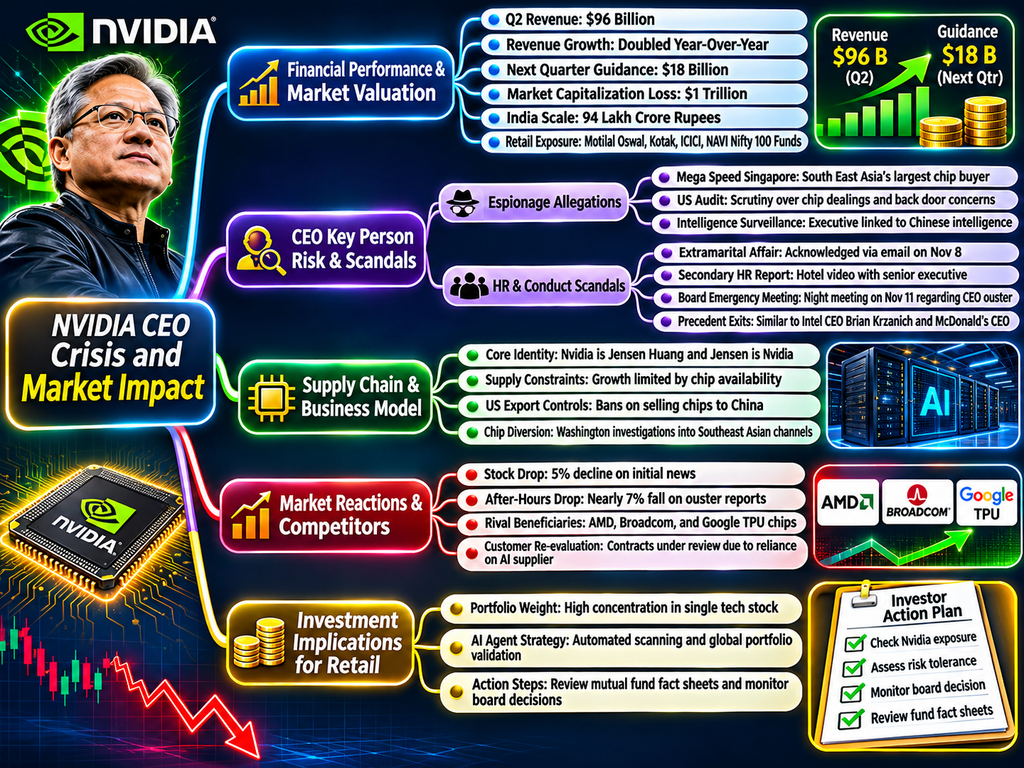
On November 12, Nvidia announced that co-founder and CEO Jensen Huang had resigned with immediate effect. The company’s board appointed CFO Colette Kress as interim CEO while beginning a search for a permanent successor.
The leadership transition followed media reports about Huang’s personal relationships and questions surrounding a Singapore-based businesswoman connected to an investigation involving possible Chinese intelligence links.
The controversy created significant uncertainty for investors.
Yet Nvidia’s financial performance tells a very different story. On November 17, the company announced quarterly revenue of $115.8 billion, representing 103% year-over-year growth.
This creates an unusual investment situation:
- The company is generating record revenue.
- Its AI infrastructure business continues expanding.
- Its founder and long-time CEO has departed.
- Regulatory and geopolitical scrutiny is increasing.
- Investors are questioning whether Nvidia can maintain its dominance without Huang.
The central question is no longer whether Nvidia can generate revenue. It is whether the company can preserve its competitive advantage during a major leadership transition.
1. The Jensen Huang Leadership Crisis: What Actually Happened?
Jensen Huang co-founded Nvidia in 1993 alongside Chris Malachowsky and Curtis Priem. Over more than three decades, he became closely associated with the company’s technology strategy, product roadmap, and relationships with major AI customers.
The November controversy developed rapidly.
Timeline of major developments
| Date | Development |
|---|---|
| November 9, 2026 | Reports emerged about a board investigation involving Huang and questions concerning foreign intelligence risks |
| November 11, 2026 | Reports of additional personal-conduct allegations increased pressure on the company.ny |
| November 12, 2026 | Nvidia announced Huang’s immediate resignation |
| November 12, 2026 | CFO Colette Kress was appointed interim CEO |
| November 17, 2026 | Nvidia announced Q3 FY2027 financial results |
| November 19, 2026 | Reuters reported potential legal exposure, regulatory investigations and proposed investor litigation |
| November 20, 2026 | Nvidia fell behind Alphabet in US market-capitalisation rankings |
Importantly, allegations and investigations should not be confused with proven wrongdoing. The relationship involving Alice Huang, a former executive of Singapore-based Megaspeed, has attracted national-security scrutiny. The investigation remains a developing matter.
Nvidia’s official announcement confirmed Huang’s departure and Colette Kress’s interim appointment.
Who is Colette Kress?
Colette Kress joined Nvidia in September 2013 and served as its Executive Vice President and Chief Financial Officer.
Her responsibilities have included financial planning, capital allocation, investor relations and corporate financial management.
Her appointment provides continuity in the finance organisation, but the permanent CEO search remains important.
Investors will want to understand whether the next CEO can maintain Nvidia’s existing strategy and relationships with major customers, suppliers and technology partners.
2. Nvidia’s Financial Performance: Record Revenue Despite the Leadership Crisis
One of the most surprising elements of the Nvidia story is the strength of its latest financial results.
The company reported Q3 FY2027 revenue of $115.8 billion for the quarter ended October 25, 2026.
Nvidia Q3 FY2027 financial results
| Financial Metric | Q3 FY2027 | Year-over-Year Change |
|---|---|---|
| Revenue | $115.8 billion | +103% |
| Data Centre Revenue | $107.6 billion | +110% |
| GAAP Gross Margin | 74.8% | +1.4 percentage points |
| GAAP Operating Income | $77.5 billion | +115% |
| GAAP Net Income | $65.3 billion | +105% |
| GAAP Diluted EPS | $2.70 | +108% |
These figures demonstrate that Nvidia’s operating business remains exceptionally strong despite the leadership transition.
The importance of Data Centre revenue
Data Centre revenue reached $107.6 billion, representing approximately 93% of total quarterly revenue.
This is important because Nvidia’s future is increasingly connected to demand for AI computing infrastructure.
Major customers are investing in:
- AI training infrastructure.
- AI inference systems.
- Hyperscale data centres.
- Enterprise AI platforms.
- High-performance networking.
- Advanced GPU computing systems.
The business is no longer dependent only on traditional gaming graphics cards. AI infrastructure has become its primary revenue engine.
Revenue growth over recent quarters
| Quarter | Revenue |
|---|---|
| Q3 FY2026 | $57.0 billion |
| Q4 FY2026 | $68.1 billion |
| Q1 FY2027 | $81.6 billion |
| Q2 FY2027 | $96.2 billion |
| Q3 FY2027 | $115.8 billion |
Figures are in US dollars. Q4 FY2026 is included as the reported comparative quarter in the company’s financial history.
The progression demonstrates the extraordinary scale of Nvidia’s AI infrastructure business.
3. The $800 Billion Market-Value Shock: Why Investors Became Nervous
The market reaction has been severe.
Reuters reported that Nvidia’s market capitalisation had fallen by approximately $800 billion since the leadership controversy became public.
A separate broader comparison showed that Nvidia’s market value had fallen from approximately $5.8 trillion in early October to around $3.9 trillion in mid-November.
By November 20, Nvidia was valued at approximately $3.4 trillion and had fallen behind Alphabet in the US market-capitalisation rankings.
These are different measurement periods. The broader decline cannot be attributed entirely to the leadership controversy.
Why the market is concerned
There are five major reasons.
1. Founder dependency
Huang was not simply a corporate spokesperson. His leadership influenced Nvidia’s product direction, customer relationships and long-term AI strategy.
2. Succession uncertainty
Investors need confidence that a permanent CEO can maintain the company’s execution speed.
3. Regulatory uncertainty
Questions surrounding AI-chip exports and Singapore-based customer relationships could create additional scrutiny.
4. AI valuation concerns
Nvidia’s valuation also depends on expectations that AI infrastructure spending will remain strong.
5. Institutional risk management
Large investors may reduce exposure when governance, regulatory and valuation risks increase simultaneously.
A falling market capitalisation does not automatically mean that the company’s underlying business has deteriorated by the same amount.
4. The China Connection: Why Megaspeed Matters
Nvidia’s China-related business has been a sensitive issue for US policymakers.
Advanced AI chips have become strategically important because they can support large-scale artificial intelligence development and high-performance computing.
US export restrictions are designed to limit access to certain advanced technologies.
The controversy involving Alice Huang and Singapore-based Megaspeed has therefore attracted attention beyond ordinary corporate governance.
Three important questions investors should monitor
| Issue | Why It Matters |
|---|---|
| Export compliance | Whether Nvidia’s chip distribution follows applicable US restrictions |
| Customer verification | Whether intermediaries and cloud customers can be properly monitored |
| Government investigations | Whether additional regulatory or legal action could follow |
Singapore’s government has also discussed its investigation and the limited assistance received from US authorities.
However, investors should avoid assuming that every allegation has been established as fact.
The wider issue is that Nvidia operates in a strategically sensitive industry where commercial relationships can have geopolitical consequences.
5. Nvidia’s AI Ecosystem: Why Its Competitive Advantage Still Matters
Nvidia’s business is much larger than the sale of individual GPUs.
Its competitive position is supported by an interconnected technology ecosystem.
Nvidia’s AI infrastructure business model
| Layer | Business Activity | Strategic Importance |
|---|---|---|
| Hardware | GPUs and AI accelerators | Core computing performance |
| Networking | High-speed interconnect technology | Connects large AI systems |
| Software | CUDA and AI development tools | Developer ecosystem |
| Systems | Integrated AI computing platforms | Complete infrastructure solutions |
| Enterprise | AI platforms and accelerated computing | Commercial adoption |
This integrated ecosystem creates switching costs for customers.
Companies that have built their AI infrastructure around Nvidia’s technology may face significant engineering and operational challenges when switching to competing platforms.
Who are Nvidia’s major competitors?
| Company | Competitive Area |
|---|---|
| AMD | AI accelerators and GPUs |
| Broadcom | Custom AI chips and networking |
| Tensor Processing Units (TPUs) | |
| Amazon | Trainium and Inferentia |
| Intel | Data-centre processors and accelerators |
Nvidia’s competitors are investing heavily, but replacing its complete ecosystem is more difficult than simply developing an alternative chip.
The leadership crisis creates an opportunity for competitors to attract customers, particularly if Nvidia experiences prolonged uncertainty.
6. Nvidia’s Q4 FY2027 Guidance: What Comes Next?
Nvidia’s November 17 financial announcement provided an important signal about future demand.
Q4 FY2027 company guidance
| Metric | Management Guidance |
|---|---|
| Expected Revenue | $130 billion |
| Revenue Guidance Range | ±3% |
| Expected GAAP Gross Margin | 71%–72% |
| Expected Non-GAAP Gross Margin | 71%–72% |
| Expected GAAP Operating Expenses | Approximately $11 billion |
One particularly important detail is that Nvidia’s guidance does not assume Data Centre compute revenue from China.
This means investors can evaluate the company’s near-term outlook without assuming a recovery in that market.
What the guidance indicates
If Nvidia achieves the midpoint of its guidance, it would generate another substantial quarterly revenue increase.
However, investors must monitor whether growth can continue without sacrificing margins.
A company can grow revenue rapidly while experiencing valuation pressure if the market believes its future growth expectations are too optimistic.
7. Three Possible Scenarios for Nvidia Investors
Rather than predicting a single outcome, investors can evaluate three scenarios.
| Scenario | Possible Development | Investor Interpretation |
|---|---|---|
| Bull Case | Permanent CEO appointment, strong AI demand and regulatory clarity | Confidence could gradually recover |
| Base Case | Business growth continues but leadership and legal uncertainty remain | Volatility and valuation adjustment may continue |
| Bear Case | Extended governance problems, stricter export restrictions and weaker AI spending | Further valuation compression becomes possible |
These are analytical scenarios, not price targets or predictions.
Key indicators to monitor
- Appointment of a permanent CEO.
- Progress of investigations and regulatory reviews.
- Data Centre revenue growth.
- Gross-margin performance.
- AI infrastructure spending by hyperscalers.
- Competitive developments from AMD, Broadcom and custom-chip providers.
- Nvidia’s stock valuation relative to expected earnings growth.
8. What Should Indian Investors Do?
Indian investors may have exposure to Nvidia through international funds, Nasdaq 100 funds, technology funds and overseas investment portfolios.
However, exposure differs between funds and changes with portfolio rebalancing.
Example: How Nvidia exposure affects an SIP
Suppose an investor invests ₹10,000 every month in an international fund.
If Nvidia represents 8% of that fund’s portfolio:
| Particular | Amount |
|---|---|
| Monthly SIP | ₹10,000 |
| Assumed Nvidia Weight | 8% |
| Indirect Nvidia Exposure | ₹800 |
| Other Investments | ₹9,200 |
This is an illustrative calculation, not the actual allocation of any particular Indian mutual fund.
Investors should check the latest portfolio factsheet before making decisions.
Five practical investment rules
- Avoid investing only because Nvidia’s share price has corrected.
- Check the fund’s actual Nvidia exposure.
- Review currency risk when investing in US equities.
- Avoid excessive concentration in a single AI company.
- Prefer staggered allocation rather than deploying all capital at once.
Indian investors should also remember that international investment returns are affected by USD-INR movements, fund expenses,s and taxation.
9. The Biggest Lesson: A Strong Business Still Needs Strong Governance
Nvidia’s situation demonstrates an important distinction between corporate performance and corporate governance.
A company can report record revenue, strong margins and rapidly growing demand while simultaneously facing serious leadership problems.
The most important lesson is that investors should evaluate more than financial statements.
A comprehensive investment analysis should include:
- Financial performance.
- Management quality.
- Corporate governance.
- Regulatory exposure.
- Competitive advantage.
- Capital allocation.
- Valuation and risk.
No single CEO should become the only pillar supporting an investment thesis.
Conclusion: Can Nvidia Remain an AI Giant Without Jensen Huang?
Nvidia’s November 2026 crisis is one of the most significant leadership transitions in the technology industry.
The departure of Jensen Huang has created uncertainty, but the company’s financial performance remains impressive.
Revenue reached $115.8 billion in Q3 FY2027, Data Centre revenue exceeded $107 billion, and management guided for another $130 billion quarter.
The challenge is to maintain that momentum while resolving leadership, regulatory,ry and governance concerns.
For long-term investors, Nvidia remains an important company to study, but extraordinary business growth does not automatically make a stock attractive at every valuation.
The real test is whether Nvidia can transform its founder-led success into a durable institution that continues to perform under new leadership.
Frequently Asked Questions (FAQs)
1. Why did Jensen Huang resign from Nvidia?
Nvidia announced his resignation on November 12, 2026, following reports concerning personal relationships and questions involving national-security scrutiny. The company has not publicly established every allegation as fact.
2. Who is the interim CEO of Nvidia?
Colette Kress, Nvidia’s former CFO and Executive Vice President, was appointed interim CEO while the board searches for a permanent successor.
3. What was Nvidia’s Q3 FY2027 revenue?
Nvidia reported revenue of $115.8 billion, up 103% year over year.
4. How much revenue did Nvidia’s Data Centre business generate?
Data Centre revenue reached $107.6 billion in Q3 FY2027.
5. Did Nvidia lose $1 trillion in market value?
The exact figure depends on the measurement period. Reuters reported approximately $800 billion in market-value losses since the controversy became public. A broader decline from early October was considerably larger but also included wider market and valuation pressures.
6. Is Nvidia still a leader in AI chips?
Nvidia remains a leading supplier of AI computing infrastructure, supported by its GPU, networking, software and systems ecosystem.
7. Should Indian investors buy Nvidia after the correction?
Investors should evaluate valuation, earnings growth, regulatory risk, currency exposure and portfolio concentration before investing. A falling share price alone is not a buy signal.
Disclaimer: This article is for educational and informational purposes only. It is not investment advice or a recommendation to buy or sell Nvidia shares or any mutual fund. Allegations and ongoing investigations are described as reported developments, not proven findings. Financial figures are based on company announcements and cited reporting available as of November 21, 2026. Investors should independently verify information before making financial decisions.
Top 10 SEO Titles
- Nvidia Crisis 2026: Jensen Huang Resigns as Record Revenue Shakes Wall Street
- Jensen Huang Resignation: Can Nvidia Survive Without Its Legendary CEO?
- Nvidia Stock Analysis 2026: Record $115.8 Billion Revenue Amid Leadership Crisis
- Nvidia CEO Crisis: 5 Major Risks Every AI Investor Should Understand
- Nvidia Stock Market Crash: Leadership Controversy, AI Growth and Investor Concerns
- Nvidia Q3 FY2027 Results: $115.8 Billion Revenue and $130 Billion Outlook
- Nvidia vs AMD 2026: Can Competitors Benefit from Jensen Huang’s Exit?
- Nvidia Leadership Change: Colette Kress Takes Charge as Interim CEO
- AI Stocks Under Pressure: How Nvidia’s Leadership Crisis Could Impact Global Markets
- Nvidia Future Outlook 2026: AI Dominance, China Risks and Corporate Governance