

Introduction: When Global Markets Fell, India Suddenly Became Attractive
November 2026 delivered one of the most interesting market reversals of the year.
While global technology and semiconductor stocks faced selling pressure, Indian equities experienced a powerful recovery. Foreign Institutional Investors (FIIs), who had previously reduced their exposure to Indian equities, returned aggressively to the cash market.
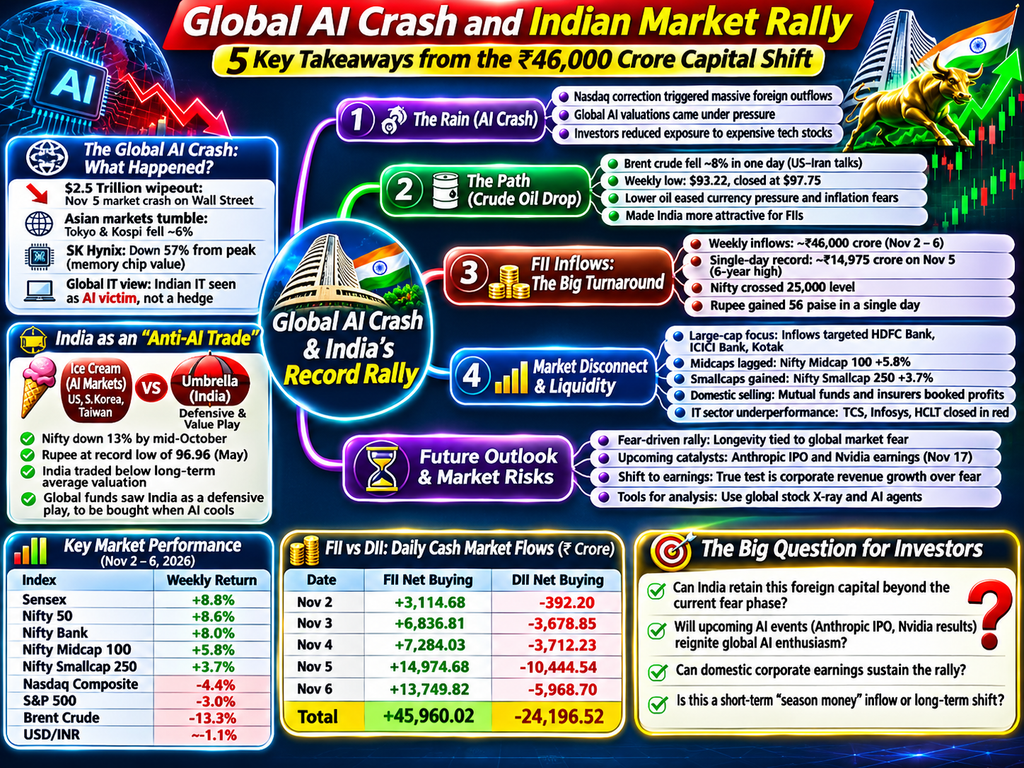
Between November 2 and November 6, 2026, FIIs recorded approximately ₹45,960 crore in net cash-market buying. During the same week, the Nifty 50 advanced 8.6%, recovering the psychologically important 25,000 level.
This created an unusual situation: global investors were reassessing expensive AI-related investments while Indian large-cap equities attracted substantial foreign capital.
However, the rally was not driven by AI selling alone.
Falling crude oil prices, improving currency sentiment, changing institutional positioning and valuation differences all contributed to India’s recovery.
The important question is whether this represents a permanent shift in global investment preferences or simply a temporary tactical opportunity.
Here are five important lessons behind the market rotation.
1. The Anti-AI Trade: Why India Became an Alternative to Expensive Technology Markets
Imagine two businesses operating on the same street.
One is an ice cream shop, and the other sells umbrellas.
During a heatwave, customers line up outside the ice cream shop while the umbrella shop struggles to attract buyers.
When heavy rain arrives, the situation reverses.
The businesses have not fundamentally changed. The weather has changed.
This analogy explains an important aspect of global capital rotation.
For much of 2026, international investors were attracted to AI-related opportunities in semiconductor-heavy markets such as South Korea, Taiwan and the United States.
India, meanwhile, faced relatively weaker market performance and concerns about valuations, earnings growth and foreign capital outflows.
When global investors began reducing exposure to expensive technology-related positions, Indian equities became an alternative destination.
Global market performance: November 2–6, 2026
| Market / Asset | Weekly performance |
|---|---|
| Sensex | +8.8% |
| Nifty 50 | +8.6% |
| Nifty Bank | +8.0% |
| Nifty Midcap 100 | +5.8% |
| Nifty Smallcap 250 | +3.7% |
| Nasdaq Composite | -4.4% |
| S&P 500 | -3.0% |
| Brent crude | -13.3% |
| USD/INR | Approximately -1.1% |
Weekly comparisons use the market-watch report for the period ending November 6. Currency and US market comparisons reflect the report’s specified measurement window.
The divergence was significant.
Indian equities gained strongly while US technology-heavy indices experienced a difficult week.
However, this does not establish that every dollar leaving AI stocks entered Indian equities.
Global investors allocate money across multiple markets, asset classes and investment strategies.
Key takeaway: India can benefit when investors seek alternative opportunities, but a temporary capital rotation does not automatically establish a permanent investment trend.
2. Falling Crude Oil Was the Missing Piece Behind India’s Rally
The global AI sell-off attracted attention, but crude oil was arguably one of the most important catalysts for India’s recovery.
India imports a substantial portion of its crude oil requirements. Therefore, international oil prices influence the country’s import bill, inflation expectations, currency stability and corporate profitability.
When crude prices remain elevated, foreign investors become more cautious about Indian equities.
Higher oil prices can create several problems:
- Higher import costs.
- Greater pressure on the Indian rupee.
- Increased transportation and manufacturing expenses.
- Potential inflationary pressure.
- Pressure on corporate profit margins.
This makes crude oil particularly important for foreign investors evaluating emerging markets.
What happened to crude oil in November?
On November 2, Brent crude fell approximately 7.6% to around $104.77 per barrel as expectations of diplomatic engagement between the United States and Iran improved.
During the November 2–6 trading week, Brent touched approximately $93.22 before closing at $97.75 on Friday.
| Crude oil indicator | Price |
|---|---|
| Brent on November 2 | Approximately $104.77 |
| Weekly low | Approximately $93.22 |
| November 6 closing price | Approximately $97.75 |
| Weekly decline | Approximately 13.3% |
The decline helped improve sentiment towards oil-importing economies.
Why falling oil prices matter for India
| Economic factor | Impact of lower crude oil |
|---|---|
| Current account | Can reduce the import bill |
| Indian rupee | May reduce external currency pressure |
| Inflation | Can ease energy-related inflation |
| Aviation | Can reduce fuel-cost pressure |
| Paint and chemicals | May improve input-cost conditions |
| Transportation | Can reduce operating expenses |
These benefits are not automatic. The actual impact depends on exchange rates, domestic fuel pricing, taxation and the duration of the crude-price decline.
The important connection
The AI sell-off created a potential reason for investors to reconsider their allocations.
Falling crude oil made India relatively more attractive by reducing one of its major macroeconomic vulnerabilities.
The AI correction provided the investment opportunity, but falling crude oil improved the macroeconomic conditions needed to support the Indian rally.
3. The ₹46,000 Crore FII Buying Wave: What the Actual Numbers Reveal
The most important evidence behind India’s November recovery is the institutional cash-market data.
FIIs returned aggressively to Indian equities during the November 2–6 period.
FII and DII cash-market activity
| Date | FII net buying/selling | DII net buying/selling |
|---|---|---|
| November 2 | +₹3,114.68 crore | -₹392.20 crore |
| November 3 | +₹6,836.81 crore | -₹3,678.85 crore |
| November 4 | +₹7,284.03 crore | -₹3,712.23 crore |
| November 5 | +₹14,974.68 crore | -₹10,444.54 crore |
| November 6 | +₹13,749.82 crore | -₹5,968.70 crore |
| Weekly total | +₹45,960.02 crore | -₹24,196.52 crore |
Figures represent provisional cash-market net activity in ₹ crore.
The numbers reveal three important developments.
A. FII buying accelerated
Foreign investors were net buyers throughout the five-session period.
The largest daily buying occurred on November 5, when net purchases reached approximately ₹14,975 crore.
This was followed by another substantial buying session on November 6.
B. Domestic institutions booked profits
DIIs were net sellers during all five sessions in this dataset.
This suggests that domestic institutions used the strong recovery to reduce some positions or rebalance their portfolios.
C. Foreign buying exceeded domestic selling
Total FII net buying was approximately ₹45,960 crore, compared with DII net selling of approximately ₹24,197 crore.
This created a strong positive institutional flow imbalance.
Why were FIIs buying?
Potential explanations include:
- Improving global risk appetite towards selected emerging markets.
- Lower crude oil prices.
- Attractive relative valuations in Indian large-cap stocks.
- Short covering and changes in derivatives positioning.
- Portfolio rebalancing after previous underperformance.
It is important to distinguish actual cash-market buying from the interpretation of why investors purchased those shares.
Exchange flow data does not reveal the precise investment motive behind each transaction.
Key takeaway: The November rally had measurable institutional support, but investors should look for sustained buying rather than extrapolating one exceptional week into a permanent trend.
4. Why Retail Investors May Not Have Experienced the Same Rally
One of the most interesting features of the November recovery was the difference between large-cap performance and broader market participation.
The Nifty 50 gained 8.6% during the week.
However, this did not mean that every stock in the market gained 8.6%.
Large institutional investors typically prefer highly liquid companies because they can deploy substantial capital without causing excessive price movements.
This is why banking majors and other index-heavyweight companies frequently attract foreign portfolio flows.
Large-cap versus broader-market performance
| Index | Weekly return |
|---|---|
| Nifty 50 | +8.6% |
| Nifty Bank | +8.0% |
| Nifty Midcap 100 | +5.8% |
| Nifty Smallcap 250 | +3.7% |
The data shows that mid-caps and small-caps also gained during the week, but their returns were lower than those of the major large-cap indices.
This distinction is important.
The rally was not restricted exclusively to large-cap stocks, but the strongest performance came from the larger indices.
Why FIIs prefer large-cap stocks
| Factor | Large-cap stocks | Small-cap stocks |
|---|---|---|
| Liquidity | Generally higher | Often lower |
| Institutional capacity | Easier to deploy large capital | Greater price impact |
| Market impact | More index influence | Less index influence |
| Research coverage | Generally extensive | Often more limited |
| Volatility | Usually relatively lower | Often higher |
What retail investors should understand
A strong Nifty rally does not guarantee that every individual portfolio will recover at the same speed.
Investors holding highly speculative micro-cap companies may experience a very different performance pattern from investors holding large private-sector banks or index constituents.
Portfolio returns depend on stock selection, entry prices, sector allocation and position sizing.
Key takeaway: Do not evaluate your portfolio only by comparing it with the Nifty. Compare it with the appropriate benchmark for your investment style and holdings.
5. The AI Sell-Off Does Not Automatically Mean Indian IT Will Benefit
A common assumption is that whenever global technology stocks decline, Indian IT services companies should attract defensive investment flows.
However, traditional IT services and AI infrastructure companies are not identical businesses.
Nvidia, AMD and semiconductor companies supply computing hardware and infrastructure.
Indian IT services companies primarily generate revenue from consulting, software implementation, outsourcing, cloud migration and technology services.
Generative AI creates opportunities for these companies, but it can also disrupt traditional outsourcing and software-development business models.
Why Indian IT may face a different challenge
| Development | Potential impact on Indian IT |
|---|---|
| AI-driven automation | Could reduce traditional billable work |
| Enterprise AI adoption | Creates new consulting opportunities |
| Lower software-development costs | Could change service pricing |
| Cloud transformation | Creates implementation demand |
| Global technology spending slowdown | May delay client projects |
Is Indian IT a hedge against the AI sell-off?
Not necessarily.
Investors need to evaluate each company’s ability to monetise AI rather than assuming that all technology companies will benefit equally.
Important companies to monitor include:
- TCS.
- Infosys.
- HCLTech.
- Wipro.
- Tech Mahindra.
The most important questions are whether these companies can increase AI-related revenue, maintain margins and protect client relationships.
Nvidia’s November results add another dimension.
Nvidia announced Q3 FY2027 revenue of $115.8 billion on November 17, up 103% year over year.
Its Data Centre revenue reached $107.6 billion, up 110%.
This is important because it shows that the global AI infrastructure business continued to expand despite the preceding market volatility.
Therefore, the market correction should not automatically be interpreted as the collapse of AI demand.
Key takeaway: A correction in AI valuations and a deterioration in AI business fundamentals are two different things.
6. The Global Capital Rotation: What the South Korean Market Tells Us
South Korea provides an important example of how rapidly capital can move away from an expensive or crowded market.
The country is particularly important to the AI investment cycle because Samsung Electronics and SK Hynix are major suppliers of memory chips used in advanced computing infrastructure.
On November 19, Reuters reported that South Korea’s KOSPI had fallen approximately 44% from its June peak, erasing around 3.3 quadrillion won, equivalent to roughly $2.4 trillion, in market value.
Foreign investors were on track for a seventh consecutive month of net selling.
This was a major development, but the loss represented a decline measured from the June peak, not a single-day November 5 event.
Why South Korea matters to the AI trade
| Factor | Market importance |
|---|---|
| Samsung Electronics | Memory and semiconductor exposure |
| SK Hynix | Advanced memory and AI-related demand |
| Global data centres | Major source of semiconductor demand |
| Foreign portfolio flows | Important driver of market liquidity |
| AI infrastructure investment | Influences earnings expectations |
Does money leaving South Korea automatically enter India?
No.
Foreign investors may allocate money to:
- US Treasury securities.
- Cash and money-market instruments.
- European equities.
- Japanese equities.
- Emerging-market funds.
- Gold and other commodities.
- Indian large-cap equities.
There is no public account-level evidence establishing that every dollar leaving South Korea or Taiwan was transferred into Indian equities.
The simultaneous movement of capital across markets is evidence of changing investor preferences, not proof of direct fund-to-fund transfers.
Key takeaway: India may benefit from global portfolio diversification, but it should not depend entirely on capital leaving other countries.
7. The Next Big Test: Can India Retain Foreign Capital?
The November rally created a powerful improvement in market sentiment.
However, the durability of foreign investment depends on India’s own economic performance.
Investors will be watching several important developments.
Upcoming market indicators
| Indicator | Why it matters |
|---|---|
| FII cash-market flows | Shows foreign institutional participation |
| DII activity | Indicates domestic institutional support |
| Brent crude | Influences India’s import bill |
| USD/INR | Reflects currency-market conditions |
| Corporate earnings | Determines underlying market growth |
| US technology earnings | Influences global AI investment sentiment |
| India VIX | Indicates expected market volatility |
Nvidia’s results: A test of global AI demand
Nvidia’s November 17 results reported:
- Revenue of $115.8 billion.
- Data Centre revenue of $107.6 billion.
- Year-over-year revenue growth of 103%.
- Q4 FY2027 revenue guidance of $130 billion, plus or minus 3%.
These results provide evidence that AI infrastructure demand remained strong.
However, strong AI earnings do not automatically guarantee that global semiconductor stocks will rise.
Stock prices also depend on valuation, future expectations, interest rates and investor positioning.
The Anthropic IPO question
Large AI-company listings can attract significant investor attention and influence capital allocation across the technology sector.
However, the draft’s claim that Anthropic was preparing to raise $100 billion should not be presented as a confirmed IPO fundraising figure without an official filing or company announcement.
For investors, the more useful indicators are actual listing disclosures, valuation, fundraising size, and the market’s ability to absorb new equity issuance.
8. Three Scenarios for India’s Market After the FII Rally
Investors should prepare for multiple outcomes rather than assuming that the November rally will continue uninterrupted.
| Scenario | Conditions | Potential market impact |
|---|---|---|
| Bullish | Sustained FII buying, stable crude oil and strong earnings | Continued large-cap strength |
| Neutral | FII buying slows, crude stabilises and earnings remain mixed | Consolidation and sector rotation |
| Bearish | Oil rises, global risk appetite deteriorates,s and FIIs return to selling | Renewed correction and volatility |
These are analytical scenarios, not market forecasts.
What would make the rally sustainable?
India needs more than foreign portfolio inflows.
Long-term market performance will depend on:
- Corporate earnings growth.
- Stable inflation.
- Reasonable valuations.
- Strong domestic consumption.
- Infrastructure and capital expenditure.
- Consistent foreign investment.
- Stable currency and external balances.
If these conditions improve, India can become a more durable destination for global capital.
Conclusion: From Anti-AI Trade to a Potential Long-Term Opportunity
November 2026 demonstrated how quickly global investment preferences can change.
A combination of AI-related market volatility, falling crude oil prices and aggressive FII buying helped Indian equities deliver one of their strongest weekly performances of the year.
FIIs invested approximately ₹45,960 crore in the Indian cash market between November 2 and November 6.
The Nifty 50 gained 8.6%, while the Sensex advanced 8.8%.
However, the most important lesson is not that AI is finished or that India has permanently replaced South Korea and Taiwan in global portfolios.
It is that international capital continuously searches for attractive risk-adjusted opportunities.
India benefited when global investors reconsidered their exposure to expensive technology markets and when lower oil prices improved its macroeconomic outlook.
But maintaining that investment requires consistent earnings growth, competitive businesses and disciplined valuations.
The real test is whether India can transform temporary foreign capital inflows into long-term investment confidence.
The umbrella shop may be enjoying a busy season, but lasting success will depend on the strength of the business even after the weather changes.
Frequently Asked Questions (FAQs)
1. Why did the Indian stock market rally in November 2026?
The rally was supported by strong FII buying, a sharp decline in crude oil prices, improved currency sentiment,nt and changing global portfolio allocations.
2. How much did FIIs invest in Indian equities between November 2 and November 6?
FIIs recorded approximately ₹45,960 crore in net cash-market buying during the five trading sessions.
3. What was the Nifty 50’s return during the first week of November 2026?
The Nifty 50 gained approximately 8.6% between October 30 and November 6, closing at 25,030.35.
4. Why did crude oil prices fall in November 2026?
Improved expectations of diplomatic engagement between the United States and Iran contributed to lower geopolitical risk premiums in oil prices.
5. Why are FIIs interested in Indian large-cap stocks?
Large-cap companies generally offer greater liquidity, making it easier for institutional investors to deploy substantial amounts of capital.
6. Does an AI stock market correction benefit India?
It can create opportunities for global portfolio diversification, but the benefit depends on India’s valuations, earnings outlook, currency stability and broader economic conditions.
7. Will Indian IT companies benefit from an AI sell-off?
Not automatically. AI creates opportunities for Indian IT companies, but it can also disrupt traditional outsourcing and software-development services.
8. Is the November FII buying wave sustainable?
Its sustainability depends on continued foreign participation, corporate earnings, crude oil prices, currency stability and global investor sentiment.
Disclaimer
This article is for educational and informational purposes only. It does not constitute investment advice or a recommendation to buy or sell any stock, index, ETF, mutual fund or commodity. FII and DII data are provisional cash-market figures. Market performance and commodity prices are historical references for the stated period. Global capital movements do not establish direct transfers between individual markets. Investors should conduct independent research and consult a qualified financial adviser before making investment decisions.
Top 10 SEO Titles
- Global AI Sell-Off 2026: How ₹46,000 Crore FII Buying Triggered India’s Market Rally
- Why FIIs Invested ₹46,000 Crore in Indian Stocks: 5 Big Reasons Behind the Nifty Rally
- AI Stock Market Crash 2026: Why Global Investors Are Turning Towards India
- Nifty Rally 2026 Explained: FII Buying, Crude Oil Crash and Global Market Rotation
- From AI Crash to Indian Stock Market Rally: Where Is Global Money Moving?
- FII vs DII November 2026: Understanding India’s Biggest Institutional Buying Wave
- Why Falling Crude Oil Prices Triggered a Rally in Indian Stock Markets
- South Korea vs India Stock Market 2026: Understanding the Global Capital Shift
- Is India’s Stock Market Becoming the New Global Investment Destination?
- Global Market Rotation 2026: 5 Investment Lessons from the AI Sell-Off