
Introduction: Is the Stock Market Rally Hiding a Bigger Problem?
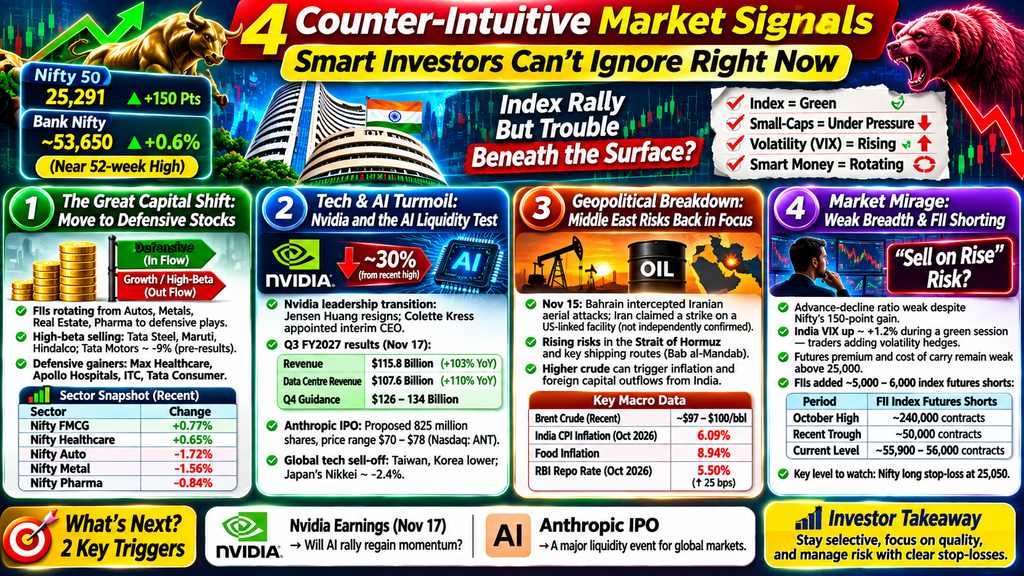
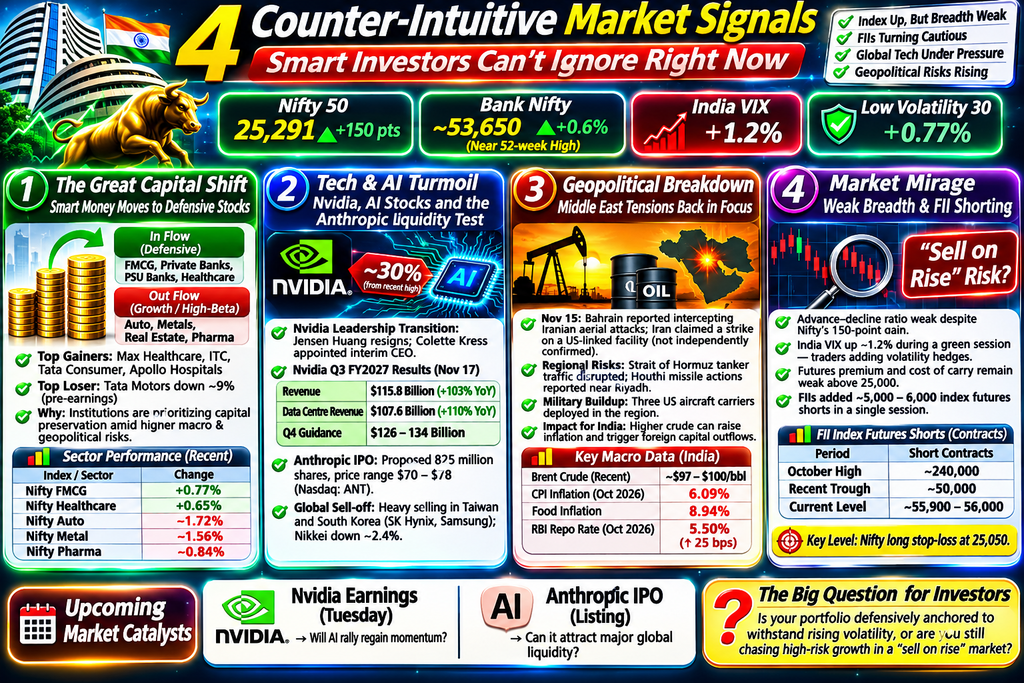
At first glance, India’s equity market appears resilient. The Nifty 50 recently advanced approximately 150 points to close near 25,291, while Bank Nifty gained around 0.6% and approached its 52-week high.
However, headline index performance does not always represent the condition of the entire stock market.
A rally led by a limited number of heavyweight companies can create the impression of broad market strength, even when smaller stocks are under pressure, defensive sectors are outperforming, and volatility is increasing.
This divergence deserves attention.
Institutional investors do not necessarily abandon equities when uncertainty increases. Instead, they can change their sector allocations, reduce exposure to expensive growth companies and increase investments in businesses with more predictable cash flows.
At the same time, global developments involving artificial intelligence, semiconductor companies, central-bank policies and geopolitical tensions can influence foreign investment flows into India.
In this analysis, we examine four counterintuitive market signals that investors should monitor before making their next investment decision.
1. The Great Capital Rotation: Why Defensive Stocks Are Attracting Attention
One of the most important signals in the current market environment is the difference between growth-oriented and defensive sectors.
High-beta stocks can deliver substantial returns during strong bull markets. However, these companies may also experience larger corrections when economic uncertainty, higher interest rates, or geopolitical risks increase.
Investors may consequently shift towards businesses supported by relatively stable domestic demand.
Growth sectors versus defensive sectors
| Growth-oriented sectors | Defensive sectors |
|---|---|
| Automobiles | FMCG |
| Metals | Healthcare |
| Real Estate | Pharmaceuticals |
| High-beta industrials | Select banking stocks |
| Cyclical consumer businesses | Consumer staples |
The original market snapshot highlighted weakness in Tata Steel, Maruti Suzuki, Hindalco and Tata Motors, while Max Healthcare, Apollo Hospitals, ITC and Tata Consumer Products were among the defensive names attracting attention.
Tata Motors’ reported approximately 9% decline ahead of its earnings announcement is a useful example of how company-specific uncertainty can amplify broader sector weakness.
However, one session of price movement cannot independently establish institutional accumulation or distribution. Investors should compare sector performance across several sessions and examine actual FII and DII cash-market data.
Why defensive sectors can outperform
Three factors can support defensive stocks during uncertain market conditions:
- Predictable demand: Essential products and healthcare services may experience less demand volatility than discretionary purchases.
- Cash-flow visibility: Established companies with consistent operating cash flows can become attractive when investors reduce risk.
- Lower earnings sensitivity: Some defensive businesses may be less sensitive to economic slowdowns and borrowing costs.
What investors should monitor
- Relative performance of Nifty FMCG, Nifty Healthcare and Nifty Auto.
- Earnings upgrades and downgrades across sectors.
- Institutional cash-market buying and selling.
- Whether defensive stocks outperform for several consecutive weeks.
Important lesson: Defensive-sector outperformance is not automatically a bullish signal. It can reflect capital preservation rather than expectations of strong economic growth.
2. Nvidia’s Leadership Crisis and the AI Liquidity Question
The second major signal comes from the global artificial intelligence industry.
Nvidia has been one of the most important companies in the AI investment cycle. Its GPUs, networking products and data-centre platforms are essential components of modern AI infrastructure.
However, November 2026 brought an unusual combination of leadership uncertainty and strong operating performance.
Nvidia’s leadership transition
On November 12, Nvidia announced that Jensen Huang had resigned as President, CEO, and a member of the board, effective immediately.
CFO Colette Kress was appointed interim CEO, while Harvey C. Jones became the company’s first-ever board chair.
This development created a significant key-person risk discussion because investors had closely associated Nvidia’s strategic direction with Huang’s leadership.
Nvidia Q3 FY2027: Financial performance
Despite the leadership transition, Nvidia’s November 17 earnings announcement showed substantial revenue growth.
| Financial metric | Q3 FY2027 |
|---|---|
| Total revenue | $115.8 billion |
| Year-on-year revenue growth | 103% |
| Data Centre revenue | $107.6 billion |
| Data Centre revenue growth | 110% |
| Q4 revenue guidance | $126–134 billion |
The most important figure is Data Centre revenue.
At approximately $107.6 billion, it represented the overwhelming majority of Nvidia’s quarterly revenue, demonstrating the continued importance of AI infrastructure demand.
Nvidia also indicated that it expected fiscal 2028 revenue growth of approximately 75%, according to its post-results commentary.
The company said it did not include data-centre chip sales to China in its Q4 outlook.
Why this matters for global investors
The Nvidia situation creates two separate investment questions:
- Can the company maintain its financial performance despite a major leadership transition?
- Can global AI infrastructure spending justify the high valuations assigned to semiconductor and technology companies?
A company can report excellent earnings and still experience share-price volatility if investors believe its valuation already reflects exceptionally strong future growth.
The Anthropic IPO and global liquidity
Anthropic’s proposed public offering is another important development.
Its November 2026 registration documents proposed an offering of 825 million Class A shares under the Nasdaq ticker symbol ANT, with an indicated initial price range of $70–$78 per share.
A major IPO can attract substantial investor attention and potentially influence portfolio allocations.
However, there is an important distinction: the existence of a large IPO does not prove that institutional investors are selling Nvidia or other AI stocks specifically to finance Anthropic shares.
That relationship must be demonstrated through actual fund-flow evidence.
What should investors watch?
| Indicator | Why it matters |
|---|---|
| Nvidia revenue growth | Measures AI infrastructure demand |
| Data Centre revenue | Shows the strength of AI-related business |
| Gross margins | Indicates pricing power and operating economics |
| Capital expenditure | Reveals infrastructure investment commitments |
| AI company valuations | Helps identify excessive market expectations |
| IPO subscription and pricing | Measures investor appetite for new listings |
Investor takeaway: AI remains a major long-term technology opportunity, but investors should distinguish genuine earnings growth from valuation-driven market enthusiasm.
3. Middle East Geopolitical Risk: Why Crude Oil Remains India’s Critical Variable
The third signal is geopolitical uncertainty.
For India, crude oil is particularly important because the country depends heavily on imported energy.
A sustained increase in international oil prices can affect:
- The import bill.
- The Indian rupee.
- Domestic inflation.
- Transportation and manufacturing costs.
- Corporate profit margins.
- Foreign institutional investment sentiment.
November 15: Developments in Bahrain
On November 15, Bahrain reported that its air-defence systems had intercepted several Iranian aerial attacks.
Iran’s Revolutionary Guard claimed that it had launched drones targeting a US-linked facility. However, the specific claimed strike was not immediately confirmed by US or Bahraini authorities.
The incident followed another reported drone-related episode two days earlier.
These developments demonstrate that geopolitical risks remain relevant to global energy markets.
However, investors should distinguish confirmed government statements from military claims that have not been independently verified.
Why the Strait of Hormuz matters
<escape>The Strait of Hormuz</escape> is one of the world’s most important energy transportation routes.
<escape><</escape>Any prolonged disruption to shipping through this corridor could increase transportation costs, insurance premiums and international crude oil prices.
For India, the potential consequences include:
- Higher crude oil import costs.
- Additional pressure on the rupee.
- Increased inflationary expectations.
- Lower profit margins for oil-consuming companies.
- Potential pressure on foreign investment flows.
India’s inflation situation is already serious
According to the Government of India’s October 2026 CPI release:
| Inflation indicator | October 2026 |
|---|---|
| Headline CPI inflation | 6.09% |
| Rural CPI inflation | 6.63% |
| Urban CPI inflation | 5.41% |
| Food inflation | 8.94% |
Headline inflation moved above the RBI’s 6% upper tolerance level, while food inflation remained particularly elevated.
This makes energy-price movements an important variable for investors to monitor.
RBI policy: Another rate hike?
The RBI had already increased the repo rate by 25 basis points to 5.50% during its October 5–7, 2026 monetary policy meeting.
The central bank also shifted its policy stance to calibrated tightening.
A further rate increase may become a possibility if inflationary pressures persist, but investors should not treat another hike as a confirmed decision.
How different sectors may react to higher crude prices
| Sector | Potential impact of higher crude |
|---|---|
| Aviation | Higher aviation fuel costs |
| Paints | Higher input costs |
| Tyres | Pressure from petroleum-based raw materials |
| Logistics | Higher transportation expenses |
| Oil marketing companies | Potential marketing-margin pressure |
| Upstream oil companies | Potential benefit from higher realised prices |
| Renewable energy | Potential improvement in relative attractiveness |
Investor takeaway: For the Indian stock market, crude oil is not simply a commodity price. It is an important indicator of inflation, currency risk and corporate profitability.
4. Market Mirage: Weak Breadth, Rising Volatility and FII Positioning
The fourth signal is the gap between index performance and the broader market.
The Nifty can rise even when a large number of individual stocks decline.
This happens because index performance is influenced by the weights of its constituent companies. A handful of large companies can significantly influence the benchmark.
Understanding the market breadth problem
Suppose the Nifty rises 150 points while:
- A majority of Nifty 500 stocks decline.
- Mid-cap and small-cap stocks underperform.
- India VIX increases.
- Futures premiums remain weak.
This combination would indicate that the rally lacks broad participation.
It would not automatically prove that the market is about to crash, but it would justify a more cautious approach.
Five indicators investors should track
| Indicator | Positive market signal | Warning signal |
|---|---|---|
| Advance-decline ratio | More advancing stocks | More declining stocks |
| India VIX | Stable or declining volatility | Rising volatility during a rally |
| Futures premium | Healthy positive premium | Weak or declining premium |
| FII cash activity | Sustained net buying | Persistent net selling |
| Market breadth | Mid-caps and small-caps participate | Rally concentrated in a few large-caps |
Understanding FII index futures positioning
The original market snapshot mentioned FII index futures short positions of approximately 55,900–56,000 contracts, compared with an earlier level of around 50,000 contracts.
It also compared this with an October peak of approximately 240,000 contracts.
These figures should be checked against the relevant NSE participant-wise open-interest data for the exact trading date before publication.
More importantly, an increase in short positions does not automatically mean that FIIs are bearish.
Institutional investors may use index futures to hedge long cash-market portfolios.
For meaningful interpretation, compare:
- Index futures long positions.
- Index futures short positions.
- Net futures exposure.
- FII cash-market activity.
- Changes in open interest.
- Price movement and futures basis.
Nifty technical levels: A disciplined approach
The original analysis identified 25,050 as an important long-position risk level.
That level should be treated as a reference from the specific market snapshot, not as a current live support level.
A more reliable trading framework is:
| Market condition | Possible approach |
|---|---|
| Nifty holds above important support | Monitor for bullish continuation |
| Nifty moves sideways with weak breadth | Reduce aggressive position sizing |
| Nifty breaks support with rising volume | Reassess long positions |
| Nifty recovers with broader participation | Look for stronger confirmation |
| India VIX rises sharply | Reduce leverage and reassess stop-losses |
For swing traders, the objective should be to identify confirmation rather than predict every short-term market movement.
The Bigger Picture: Four Signals, One Investment Strategy
The four signals point towards an important conclusion: investors should not rely on headline index movements alone.
| Market signal | What it tells investors | What to monitor |
|---|---|---|
| Defensive-sector rotation | Institutional risk appetite may be changing | Sector relative strength |
| Nvidia leadership and AI uncertainty | AI valuations and earnings expectations remain important | Revenue, margins and guidance |
| Middle East geopolitical risk | Energy costs can influence Indian inflation | Brent crude and shipping conditions |
| Weak market breadth and FII positioning | Index strength may not represent the entire market | Advance-decline data and FII activity |
Conclusion: Smart Investors Follow Evidence, Not Just the Index
The Indian stock market is being influenced by several forces at the same time.
Defensive-sector rotation, global AI developments, geopolitical tensions and derivatives positioning are creating a complicated investment environment.
The most important lesson is that a rising Nifty does not necessarily mean every stock is becoming stronger.
Investors should concentrate on business quality, earnings growth, balance-sheet strength and reasonable valuations rather than chasing stocks simply because the benchmark is rising.
For long-term investors, corrections can create opportunities in fundamentally strong companies. For traders, market breadth, volatility and institutional positioning can help improve risk management.
The next phase of the market will depend on how corporate earnings, global technology investment, crude oil prices and inflation evolve.
The question investors should ask is not simply whether the Nifty will rise tomorrow. It is whether the companies in their portfolios can continue generating sustainable earnings through the next market cycle.
Frequently Asked Questions (FAQs)
1. Why can the Nifty rise when most stocks are falling?
The Nifty is a free-float market-cap-weighted index. Large companies have greater influence on its movement, so a small number of heavyweight stocks can lift the index even when broader market breadth is weak.
2. Why are defensive stocks attractive during market uncertainty?
Defensive companies often have relatively stable demand, established brands and more predictable cash flows. These characteristics can make them attractive when investors reduce exposure to cyclical businesses.
3. How does Nvidia affect the Indian stock market?
Nvidia influences global sentiment towards AI, semiconductors and technology investment. Its earnings and guidance can affect global risk appetite and international portfolio allocations, although the impact on Indian equities is not always direct.
4. Why is crude oil important for Indian investors?
India imports substantial quantities of crude oil. Higher prices can increase import costs, put pressure on the rupee and raise operating expenses for several industries.
5. Does an increase in FII short positions mean the market will fall?
No. FIIs can use futures shorts to hedge their cash-market holdings. Investors should examine total long and short positions, net exposure, cash-market flows and price behaviour together.
6. What should investors monitor before buying stocks?
Investors should examine earnings growth, debt levels, ROCE, cash flow, valuation, sector performance and market volatility before making investment decisions.
Disclaimer
This article is for educational and informational purposes only. It is not investment advice or a recommendation to buy or sell any security.
Market prices, derivatives positioning and technical levels can change rapidly. Verify all exchange data, company disclosures, and regulatory announcements before making investment decisions.
Top 10 SEO Titles
- Stock Market 2026: 4 Hidden Signals Smart Investors Must Watch
- Nifty 50 Analysis: FII Rotation, Nvidia Crisis and Market Volatility
- Indian Stock Market Outlook 2026: 4 Warning Signs Investors Can’t Ignore
- FII Investment Strategy: Why Smart Money Is Shifting to Defensive Stocks
- Nvidia Crisis 2026: How AI Market Volatility Could Impact Indian Stocks
- Nifty 50 Rally vs Market Reality: Is a Bigger Correction Coming?
- FII vs DII Activity: What Institutional Investors Are Signalling in 2026
- Crude Oil, Inflation and RBI Policy: 3 Risks Facing Indian Stock Markets
- AI Stocks Crash and Global Market Rotation: What Indian Investors Should Know
- India Stock Market Forecast 2026: Market Breadth, FII Flows and Key Risks