
Introduction: The Dangerous Illusion of Limited Risk
Options buying is frequently marketed as one of the safest ways to participate in the stock market because the maximum loss is limited to the premium paid.
Technically, this is true.
But there is a massive difference between limited risk and controlled risk.
Thousands of retail traders enter India’s Futures and Options (F&O) market every day, attracted by screenshots of overnight profits, social media trading calls, and the possibility of turning a small investment into a substantial amount of money.
Consider Rahul, a hypothetical retail trader with ₹5,00,000 in savings.
After seeing a friend make ₹20,000 in a single trading session, Rahul decides to start trading NIFTY options. Initially, he invests ₹10,000. After a few profitable trades, his confidence increases. Soon, he starts deploying ₹50,000 or more into individual positions.
Eventually, a few consecutive losses destroy months of savings.
What went wrong?
Was the market manipulated? Was the option premium too expensive? Was the direction incorrect?
Sometimes, the actual problem is much simpler: poor capital allocation, inappropriate strike selection, time decay, transaction costs, and emotional decision-making.
What Does SEBI’s Latest FY26 Data Reveal?
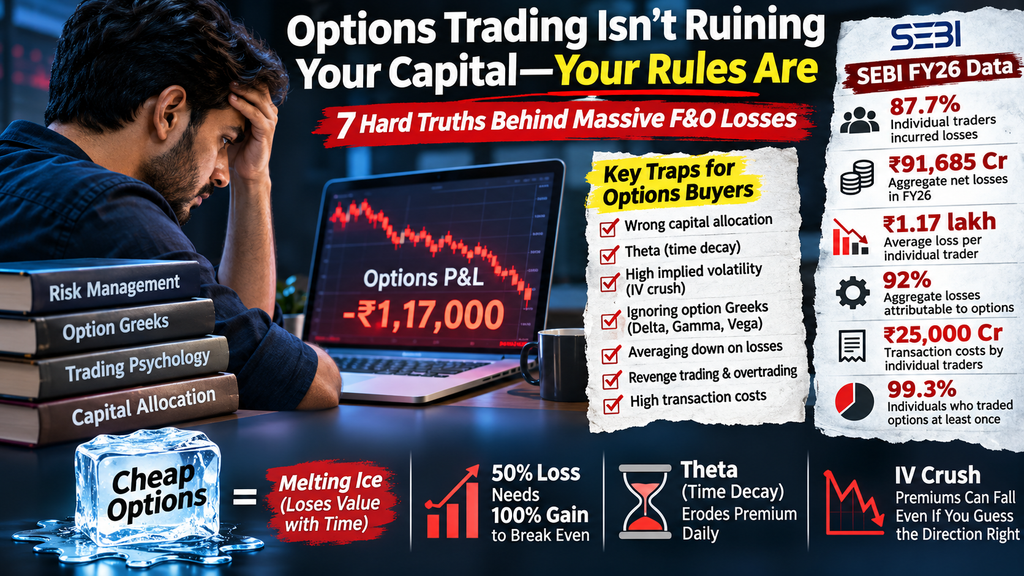
According to the Securities and Exchange Board of India (SEBI), its FY25–FY26 study revealed:
- 87.7% of individual F&O traders incurred losses during FY26.
- Aggregate net losses reached ₹91,685 crore.
- Average loss per individual trader was approximately ₹1.17 lakh.
- Options accounted for approximately 92% of aggregate individual losses.
- Individual traders incurred approximately ₹25,000 crore in transaction costs.
These numbers reveal an important reality: participating in the derivatives market is easy, but generating sustainable profits is extremely difficult.
The problem isn’t simply predicting whether NIFTY will move up or down. It is understanding how much capital to risk, what premium to pay, how much time remains until expiry,y and when to exit.
Here are seven important truths every options trader should understand.
1. The Drawdown Trap: A 50% Loss Requires a 100% Gain
One of the biggest mistakes beginners make is risking too much money on a single trade.
Most traders calculate how much they can potentially earn but rarely calculate how difficult it will be to recover after a substantial loss.
Consider this example:
| Initial Capital | Loss | Remaining Capital | Recovery Required |
|---|---|---|---|
| ₹1,00,000 | 10% | ₹90,000 | 11.11% |
| ₹1,00,000 | 20% | ₹80,000 | 25% |
| ₹1,00,000 | 30% | ₹70,000 | 42.86% |
| ₹1,00,000 | 40% | ₹60,000 | 66.67% |
| ₹1,00,000 | 50% | ₹50,000 | 100% |
| ₹1,00,000 | 70% | ₹30,000 | 233.33% |
This is the mathematics of capital destruction.
The 1%–2% Risk Management Rule
A disciplined trader should establish a maximum acceptable loss before entering a trade.
For example, with ₹1,00,000 in dedicated trading capital:
- 1% risk = ₹1,000.
- 2% risk = ₹2,000.
- Maximum planned loss per trade = ₹2,000.
If the trader experiences ten consecutive losses, risking a fixed ₹2,000 each time, the remaining capital will be ₹80,000.
If risk is instead recalculated as 2% of the remaining balance, approximately ₹81,707 remains.
This is why position sizing matters more than chasing large targets.
Three Separate Money Buckets
Never combine all your financial resources into one trading account.
- Essential money: Household expenses, rent, EMIs and emergency savings.
- Investment money: Long-term equity investments, mutual funds and retirement savings.
- Trading money: Only money you can afford to lose without affecting your lifestyle.
Borrowed money and emergency savings should never be used for speculative options buying.
Premium Deployed vs Actual Planned Risk
Suppose you purchase options worth ₹10,000.
- Entry premium value: ₹10,000.
- Planned exit value: ₹8,000.
- Planned loss: ₹2,000.
Your intended risk is ₹2,000, not ₹10,000.
However, this is only a planned risk. Slippage, illiquidity, ty and sudden market gaps can cause the actual loss to exceed the planned amount. For a long option, the maximum contractual loss is the premium paid plus applicable charges.
2. Cheap Options Are Melting Ice: The Delta and Theta Trap
A ₹20 or ₹40 option may look affordable, but a low premium does not automatically mean an attractive trading opportunity.
Consider a hypothetical NIFTY option buyer who purchases an Out-of-the-Money (OTM) call option for ₹40.
The market moves sideways for several hours.
Despite no major directional decline, the option premium falls from ₹40 to ₹15.
The trader loses 62.5% of the premium.
Why?
Because options are wasting assets. Their time value generally declines as expiry approaches, all else being equal.
Understanding the Three Important Strike Categories
| Option Type | Characteristics |
|---|---|
| ITM | Contains intrinsic value and generally costs more |
| ATM | Near the current underlying price |
| OTM | Has no intrinsic value and consists entirely of time value |
Far OTM options are attractive to beginners because they require less premium. However, they also require a sufficiently large and timely underlying price movement to become profitable.
Understanding Option Greeks
Four Greeks are especially important for options buyers.
Delta (Δ): Directional sensitivity
Delta estimates how much an option premium changes for a one-point movement in the underlying asset, assuming other factors remain constant.
Example:
- ATM option Delta = 0.50.
- NIFTY moves 100 points upward.
- Approximate premium movement = ₹50 per unit.
This is an approximation. Actual movement can differ because of Gamma, Theta, and changes in implied volatility.
Theta (Θ): Time decay
Theta estimates the daily loss in option value attributable to the passage of time, all else being equal.
For option buyers, Theta is generally negative.
Gamma (Γ): Delta acceleration
Gamma measures how quickly Delta changes when the underlying asset moves.
Near expiry, Gamma can become particularly important for ATM options, making their price sensitivity change rapidly.
Vega (V): Volatility sensitivity
Vega measures how much an option premium changes when implied volatility changes by one percentage point, all else being equal.
A buyer must understand all four factors instead of looking only at the premium.
The ATM Straddle and Expected Move
Suppose:
- ATM Call premium = ₹150.
- ATM Put premium = ₹150.
- Combined premium = ₹300.
The ₹300 ATM straddle premium provides a rough market-implied estimate of the expected absolute movement around expiry, subject to pricing assumptions.
It is not a guaranteed prediction of where the index will move.
Buying an OTM option 500 points away simply because it costs ₹20 ignores the probability of reaching that strike and the time available.
Practical lesson: Never select an option based on low premium alone. Evaluate Delta, Theta, implied volatility, liquidity, bid-ask spread, and remaining time to expiry.
3. IV Crush: Why Correct Directional Predictions Can Still Lose Money
Imagine that NIFTY is trading near an important resistance level.
A major economic announcement is approaching.
Market participants expect substantial volatility, and implied volatility increases.
An option buyer purchases a call option expecting a bullish breakout.
The announcement comes out. NIFTY moves upward, but the option premium declines.
How is this possible?
The answer is Implied Volatility Crush.
What Is Implied Volatility?
Implied Volatility (IV) represents the volatility level implied by the market price of an option.
It is not a direct forecast of market direction.
Before major events, uncertainty can increase demand for options, pushing premiums higher.
After the event, uncertainty may decline rapidly. Consequently, IV can fall and reduce option premiums.
A Hypothetical IV Crush Example
| Parameter | Before Event | After Event |
|---|---|---|
| Option premium | ₹200 | ₹160 |
| Implied volatility | 30% | 20% |
| Underlying movement | — | +50 points |
| Trader’s result | Entry | Loss of ₹40 per unit |
This is an illustrative example, not a live option valuation.
The actual result depends on Delta, Gamma, Theta, Vega, and the size of the underlying movement.
How Traders Can Manage IV Risk
Before purchasing an option:
- Check current IV.
- Compare IV with its historical range.
- Examine India VIX for broader market volatility conditions.
- Check upcoming earnings, RBI policy announcements, Union Budget, and major economic events.
- Avoid paying unusually high premiums without a clear volatility-based thesis.
High IV does not automatically mean that options should be sold. Option selling has its own substantial risks, including theoretically unlimited losses for certain unhedged positions.
4. The Transaction Cost Drain: Profitable Trades Can Produce Negative Returns
Many retail traders calculate their trading performance using only gross profit and loss.
This is incomplete.
Every trade can involve several costs:
- Brokerage.
- Securities Transaction Tax (STT).
- Exchange transaction charges.
- SEBI turnover fees.
- GST on applicable services and charges.
- Stamp duty.
- Bid-ask spread and slippage.
Why Transaction Costs Matter
According to SEBI’s FY26 study, individual traders paid approximately ₹25,000 crore in transaction costs.
That is a substantial amount of money leaving retail trading accounts through trading-related expenses.
Consider a hypothetical monthly trading statement:
| Particulars | Amount |
|---|---|
| Gross trading profit | ₹10,000 |
| Brokerage and statutory charges | -₹2,000 |
| Slippage and execution costs | -₹1,000 |
| Net trading profit | ₹7,000 |
The trader generated ₹10,000 in gross profit but retained only ₹7,000.
Actual charges depend on the broker, exchange, contract, and applicable tax rates.
Calculate Net Profit, Not Chart Profit
A trading strategy should be evaluated after:
- Brokerage and statutory charges.
- Bid-ask spread.
- Slippage.
- Failed and partial executions.
- All applicable taxes.
Overtrading can destroy an otherwise profitable trading strategy.
A trader who executes 30 unnecessary trades every day may be paying substantial costs without generating a corresponding performance improvement.
5. Averaging Down on Losing Options Is Not Always a Recovery Strategy
One of the most dangerous habits in options buying is averaging down.
Suppose a trader purchases 100 units at ₹100.
Initial investment = ₹10,000.
The premium declines to ₹50.
Instead of accepting the loss, the trader purchases another 100 units at ₹50.
| Particulars | Amount |
|---|---|
| First purchase | ₹10,000 |
| Second purchase | ₹5,000 |
| Total investment | ₹15,000 |
| Total quantity | 200 |
| New average premium | ₹75 |
The trader has reduced the average purchase price from ₹100 to ₹75.
But the total capital exposed has increased from ₹10,000 to ₹15,000.
If the option premium continues declining, the loss increases.
Why Averaging Down Can Become Dangerous
Options have expiry dates.
Unlike a fundamentally strong business that may recover over several years, an option contract has a limited lifespan.
Time decay, volatility contraction and an unfavourable underlying movement can all reduce its value.
Averaging down without a predefined strategy can transform a manageable loss into a much larger one.
Rule: Never increase exposure simply because an existing position is losing money.
Any additional position should have its own independent trading thesis, risk calculation, and position-size approval.
6. Revenge Trading and Overtrading: The Psychological Capital Killer
A trader loses ₹2,000 in the morning.
Instead of stopping, the trader attempts to recover the loss immediately.
The next trade loses another ₹3,000.
Now frustration increases.
The trader doubles the position size and starts taking random trades.
This is revenge trading.
Five Stages of Revenge Trading
- Initial trade produces a loss.
- Trader refuses to accept the loss.
- Emotional decision-making replaces the original strategy.
- Position size increases.
- Trading discipline breaks down.
This behaviour is particularly dangerous in short-expiry options because premiums can change rapidly.
Introduce Automated Trading Controls
A disciplined trading system should include predefined alerts.
| Risk Control | Suggested Trigger |
|---|---|
| Loss alert | Position loss exceeds 20% |
| Averaging alert | Additional purchase in an existing losing position |
| Daily loss alert | Daily loss reaches predefined limit |
| Trade frequency alert | Number of orders exceeds personal limit |
| Overnight risk alert | Unhedged positions remain near market close |
These are suggested personal risk controls, not official SEBI requirements.
Establish Daily and Monthly Loss Limits
For example, a trader with ₹50,000 in dedicated trading capital could establish:
- Maximum planned risk per trade: ₹500–₹1,000.
- Daily loss limit: ₹2,000.
- Monthly loss limit: ₹5,000.
These are illustrative limits. Actual limits should reflect the trader’s financial circumstances and strategy.
Once the daily or monthly limit is reached, stop trading.
The purpose is not to eliminate every loss. It is to prevent one bad session from damaging the entire account.
7. The Expiry Trap: Why Short-Dated Options Demand Greater Discipline
Short-expiry options attract retail traders because of their potential for rapid premium movements.
However, they also introduce considerable risk.
As expiry approaches:
- Time value declines faster, particularly for ATM options.
- Gamma can become more sensitive.
- Small underlying movements can produce large percentage changes in option premiums.
- Liquidity and bid-ask spreads can become important.
- A position can lose most or all of its premium.
SEBI’s FY26 research also highlights the concentration of trading activity in contracts close to expiry.
A trader should not confuse rapid price movement with a high-probability trading opportunity.
A Better Approach to Expiry Trading
Before entering an expiry-day trade, evaluate:
- Underlying trend.
- Support and resistance.
- Volume and liquidity.
- Option-chain Open Interest.
- Bid-ask spread.
- Delta and Gamma.
- Remaining time to expiry.
- Maximum acceptable loss.
Avoid entering trades simply because premiums appear cheap.
Sometimes, the best trading decision is not to trade.
A Practical Options Risk Management Framework
Here is a simple framework that traders can use before every trade.
| Trading Capital | 1% Risk | 2% Risk |
|---|---|---|
| ₹10,000 | ₹100 | ₹200 |
| ₹25,000 | ₹250 | ₹500 |
| ₹50,000 | ₹500 | ₹1,000 |
| ₹1,00,000 | ₹1,000 | ₹2,000 |
| ₹2,00,000 | ₹2,000 | ₹4,000 |
Position Sizing Formula
Quantity = Maximum Acceptable Risk ÷ Expected Loss Per Unit
For example:
- Trading capital = ₹50,000.
- Risk per trade = 1%.
- Maximum acceptable risk = ₹500.
- Entry premium = ₹100.
- Planned stop-loss premium = ₹90.
- Expected loss per unit = ₹10.
Position quantity = ₹500 ÷ ₹10 = 50 units.
The actual number of contracts must be adjusted to the applicable lot size. If the required lot size exceeds the risk budget, skip the trade rather than increasing risk.
Stop-loss execution is not guaranteed at the specified price during fast markets.
The Professional Trader’s Pre-Trade Checklist
Before entering an options position, answer these questions:
- Is the underlying trend clear?
- Is the selected strike liquid?
- Have I checked Delta, Theta, Gamma and Vega?
- Is implied volatility reasonable?
- Have I calculated the complete transaction costs?
- Is the stop-loss defined?
- Is the maximum loss within my risk limit?
- Am I trading according to a tested strategy?
- Am I avoiding emotional decisions?
- Can I afford to lose the entire premium?
If you cannot answer these questions, reconsider the trade.
Conclusion: The Real Secret to Long-Term Survival in Options Trading
Options trading is not simply a game of predicting whether the market will rise or fall.
It is a complex activity involving probability, volatility, time decay, capital allocation, execution costs,s and psychological discipline.
SEBI’s FY26 data demonstrates that the majority of individual F&O traders continue to lose money.
The important lesson is not that every trader should immediately stop trading options.
It is that traders must understand the risks before committing capital.
Remember these seven principles:
- Protect trading capital before chasing profits.
- Limit planned risk per trade.
- Never purchase an option simply because its premium is cheap.
- Understand all four major option Greeks.
- Include transaction costs in every performance calculation.
- Avoid emotional averaging and revenge trading.
- Establish daily and monthly loss limits.
A successful trader does not need to win every trade.
A successful trader needs a system that allows them to survive losing trades without destroying their capital.
And sometimes, the most profitable decision in the market is choosing not to enter a trade.
The market does not reward the trader who takes the most trades. It rewards the trader who manages risk intelligently and consistently.
Frequently Asked Questions (FAQs)
1. Why do most options traders lose money in India?
According to SEBI’s FY26 study, 87.7% of individual F&O traders incurred losses. Common contributing factors include poor capital allocation, time decay, expensive premiums, transaction costs, excessive trading, ng and emotional decisions.
2. Is options buying safer than options selling?
Options buying has a defined maximum contractual loss equal to the premium paid. Unhedged options selling can expose traders to substantially larger losses. However, defined risk does not mean options buying is automatically profitable or suitable for everyone.
3. What is the 2% rule in options trading?
The 2% rule means limiting the planned loss on a trade to approximately 2% of dedicated trading capital. It is a risk-management guideline, not a guarantee against larger execution losses.
4. What is Theta decay in options?
Theta measures the estimated decline in an option’s premium due to the passage of time, assuming other variables remain unchanged. Time decay generally accelerates as expiry approaches, especially for ATM options.
5. What is IV Crush?
IV Crush occurs when implied volatility falls sharply, reducing option premiums. It commonly happens after major events when uncertainty declines.
6. Can an option buyer lose money even when the market moves in the predicted direction?
Yes. An unfavourable combination of time decay, falling implied volatility and insufficient underlying movement can reduce an option’s premium despite a correct directional prediction.
7. How much capital should a beginner use for options trading?
There is no universally appropriate amount. Beginners should first understand derivatives, practise with simulated trades, and use only money they can afford to lose. Essential savings and borrowed money should never be used.
8. Is averaging down in options a good strategy?
Not automatically. Options have limited expiry periods and can lose value through time decay. Adding to a losing position without a separate risk calculation can increase total exposure significantly.
Risk Disclaimer: Options and futures trading involve substantial financial risk and may not be suitable for all investors. This article is for educational purposes only and does not constitute investment advice or a recommendation to buy or sell any security or derivative.