
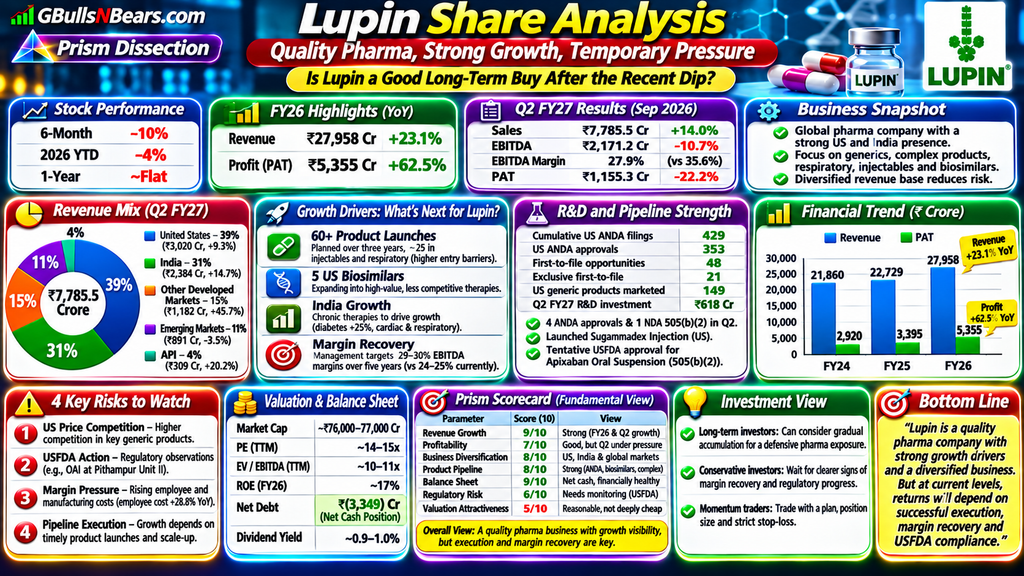
Introduction: Why Lupin Deserves a Place on the Investor Watchlist
In a market where investors frequently chase high-growth and high-momentum stocks, pharmaceutical companies can offer a different investment opportunity: businesses supported by recurring healthcare demand, established brands, research capabilities and international distribution networks.
Lupin Limited is one such pharmaceutical company worth studying.
The company delivered strong financial growth in FY2026, with revenue from operations increasing 23.1% year-on-year to ₹27,958 crore and profit after tax rising 62.5% to approximately ₹5,333 crore.
However, the investment story is not completely straightforward. Lupin’s latest Q2 FY2027 results show that revenue continues to grow, but profitability has come under pressure.
This creates an important question for investors:
Is Lupin experiencing a temporary earnings slowdown, or does its current performance indicate that the next phase of growth will be more difficult?
Let’s examine the company’s financial performance, business model, international exposure, growth opportunities, valuation considerations, and major risks.
1. FY2026 Financial Performance: Strong Revenue and Profit Growth
Lupin delivered a strong financial performance during FY2026.
Its revenue growth was supported by the US business, Indian formulations, emerging markets,s and improved product mix.
FY2026 financial snapshot
| Financial metric | FY2026 | Year-on-year growth |
|---|---|---|
| Revenue from operations | ₹27,958 crore | +23.1% |
| EBITDA | ₹9,241 crore | +68.6% |
| Profit before tax | ₹6,873 crore | +71.2% |
| Profit after tax | ₹5,355 crore | +62.5% |
| EBITDA margin | 33.6% | Improved |
| Gross profit | ₹20,161 crore | +31.3% |
Source: Lupin’s FY2026 audited financial results.
The most important observation is that EBITDA and net profit grew faster than revenue. This indicates a significant improvement in operating profitability during FY2026.
However, investors should not automatically assume that these margins will continue expanding at the same pace. Pharmaceutical earnings can be affected by product launches, generic pricing, foreign exchange, regulatory expenses, and changes in product mix.
2. Q2 FY2027 Results: Revenue Is Growing, but Margins Need Attention
The latest quarterly results provide a more balanced picture.
For the quarter ended September 30, 2026, Lupin reported product sales of ₹7,785.5 crore, representing 14% year-on-year growth.
But EBITDA and net profit declined compared with the corresponding quarter last year.
Q2 FY2027 financial performance
| Metric | Q2 FY27 | Q2 FY26 | YoY change |
|---|---|---|---|
| Product sales | ₹7,785.5 Cr | ₹6,831.4 Cr | +14.0% |
| EBITDA | ₹2,171.2 Cr | ₹2,431.3 Cr | -10.7% |
| EBITDA margin | 27.9% | 35.6% | -770 bps |
| Profit before tax | ₹1,579.6 Cr | ₹2,007 Cr | -21.3% |
| Profit after tax | ₹1,155.3 Cr | ₹1,484.8 Cr | -22.2% |
Note: The reported EBITDA figures include forex and other income.
The company’s investor presentation also reports an adjusted EBITDA margin of 25.1% for Q2 FY27, excluding forex and other income, compared with 31.3% in Q2 FY26.
This distinction matters because investors should compare operating profitability consistently.
What caused the pressure?
Three figures deserve attention:
- Employee costs increased 28.8% year-on-year.
- Manufacturing and other expenses increased 23.2%.
- Depreciation and amortisation increased 53.4%.
These expenses grew faster than product sales, putting pressure on operating margins.
Our interpretation: Lupin’s revenue growth remains encouraging, but the next earnings improvement will depend on controlling costs and converting new product launches into sustainable profitability.
3. Geographic Diversification: How Lupin Makes Money
One of Lupin’s important strengths is its presence across multiple pharmaceutical markets.
In Q2 FY27, its product sales were distributed across the following regions:
| Geography / Segment | Revenue | Share of sales | YoY growth |
|---|---|---|---|
| United States | ₹3,020 Cr | 39% | +9.3% |
| India | ₹2,384 Cr | 31% | +14.7% |
| Other developed markets | ₹1,182 Cr | 15% | +45.7% |
| Emerging markets | ₹891 Cr | 11% | -3.5% |
| API | ₹309 Cr | 4% | +20.2% |
Figures rounded from Lupin’s Q2 FY27 investor disclosures.
Why this diversification matters
United States: 39% of sales
The US remains Lupin’s largest market. The company had 149 generic products in the US market and ranked among the leading pharmaceutical players by prescriptions.
It received four ANDA approvals and one NDA 505(b)(2) approval during Q2 FY27.
The opportunity is significant, but US generic drug pricing pressure and regulatory compliance remain important risks.
India: 31% of sales
India is another major growth engine.
Domestic sales increased 14.7% year-on-year during Q2 FY27. The company continues to focus on chronic therapies, including cardiovascular, respiratory and diabetes treatments.
Chronic therapies can support recurring demand, although competition and pricing regulations must be monitored.
Other developed markets: 15% of sales
This segment grew 45.7% year-on-year in Q2 FY27, making it one of the strongest contributors to quarterly growth.
Emerging markets: 11% of sales
Emerging market sales declined 3.5% during the quarter. This is an area where investors should monitor whether growth returns in subsequent quarters.
The key advantage is that Lupin is not dependent on a single country. However, its 39% US exposure means international pricing and regulatory developments can still materially affect earnings.
4. Product Pipeline: Where Could the Next Growth Phase Come From?
In pharmaceuticals, today’s revenue is important, but tomorrow’s product pipeline can determine long-term competitiveness.
Lupin continues investing in research and development, complex generics, specialty products, and biosimilars.
Important pipeline indicators
| Pipeline metric | Latest disclosed position |
|---|---|
| Cumulative US ANDA filings | 429 |
| US ANDA approvals received | 353 |
| First-to-file opportunities | 48 |
| Exclusive first-to-file opportunities | 21 |
| US generic products marketed | 149 |
| Q2 FY27 R&D investment | ₹618 crore |
The company also received approval for four ANDAs and one NDA 505(b)(2) during Q2 FY27.
Two developments worth watching include:
- Sugammadex Injection was launched in the US.
- Apixaban Oral Suspension 505(b)(2) received tentative US FDA approval.
In India, Lupin launched Formoflo-G MDI, a triple-combination inhaler for COPD management.
These developments demonstrate why complex products and differentiated formulations are important. They can create opportunities beyond conventional, highly competitive generic medicines.
However, regulatory approval does not guarantee commercial success. Launch timing, manufacturing capacity, market adoption, and competition will determine the actual financial contribution.
5. The Margin Recovery Opportunity: Can Lupin Reach 29–30%?
Margin improvement is one of the most important factors in the long-term Lupin investment thesis.
The company reported strong profitability in FY2026, but Q2 FY27 showed a significant decline in margins.
Investors should therefore monitor the following indicators:
- Employee costs as a percentage of revenue.
- Manufacturing and other expenses.
- US generic pricing and product mix.
- Contribution from complex generics and specialty products.
- Revenue growth in India and developed markets.
- Operating cash flow and working-capital efficiency.
Management’s long-term margin ambitions should be treated as targets rather than guaranteed outcomes.
A sustained return towards higher margins could support earnings growth. On the other hand, continued cost inflation or pricing pressure could delay the recovery.
6. Four Major Risks Every Lupin Investor Must Understand
A quality pharmaceutical business is not automatically a risk-free investment.
Risk 1: US generic pricing pressure
The United States accounts for approximately 39% of Q2 FY27 sales.
Generic drug competition can lead to price erosion, especially when multiple manufacturers enter the same product category.
Risk 2: USFDA compliance
Pharmaceutical companies must maintain strict manufacturing and quality standards.
Lupin’s Q2 FY27 presentation disclosed that its Pithampur Unit II remained under an Official Action Indicated (OAI) classification, with remediation in progress and a response submitted.
The company also disclosed an Establishment Inspection Report with Voluntary Action Indicated status for Ankleshwar and Somerset.
Regulatory developments should be monitored because manufacturing restrictions can affect product approvals, launches and revenue.
Risk 3: Margin pressure
Employee expenses and manufacturing costs increased faster than sales in Q2 FY27.
If this trend continues, revenue growth may not translate into equivalent earnings growth.
Risk 4: Product pipeline execution
Research investment and regulatory approvals are only the beginning.
A successful launch requires manufacturing readiness, commercial distribution, competitive pricing and sustained demand.
Investors should distinguish between products in development, products approved for launch and products already generating revenue.
7. Lupin Valuation: Is the Stock Attractive After Its Recent Performance?
Valuation is where an otherwise strong business can become an unattractive investment.
A company can deliver excellent revenue growth and still generate disappointing shareholder returns if investors pay too much for its future earnings.
Before investing, examine:
- Price-to-earnings ratio compared with historical averages.
- Price-to-sales ratio compared with pharmaceutical peers.
- Enterprise value to EBITDA.
- Free cash flow yield.
- Return on capital employed.
- Expected earnings growth over the next three to five years.
The valuation should also account for the latest margin decline.
Rather than assuming FY2026 profitability will continue unchanged, investors should test at least three scenarios:
| Scenario | Operating assumptions | Investment implication |
|---|---|---|
| Bull case | Margin recovery, successful launches and sustained US growth | Earnings growth could accelerate |
| Base case | Moderate revenue growth and gradual margin improvement | Returns depend heavily on entry valuation |
| Bear case | US price erosion, regulatory setbacks and lower margins | Earnings downgrades and valuation compression are possible |
A precise fair value requires a current market price, share count,t and forward earnings assumptions. Without those inputs, assigning a fixed target price would create false precision.
8. Our Prism Dissection: Lupin Fundamental Scorecard
| Parameter | Score out of 10 | Assessment |
|---|---|---|
| Revenue growth | 9 | Strong FY26 and Q2 FY27 growth |
| Business diversification | 8 | Meaningful presence across markets |
| Product pipeline | 8 | Significant approvals and filings |
| Profitability | 7 | Strong FY26, weaker Q2 FY27 |
| Balance sheet | 9 | Net cash position in Q2 FY27 |
| Regulatory risk | 6 | Compliance issues require monitoring |
| Competitive position | 8 | Established presence in major markets |
| Valuation attractiveness | 5 | Depends on current market price |
This is an illustrative research scorecard, not a formal investment rating or a price target.
9. Investment Strategy: How Should Long-Term Investors Approach Lupin?
Our view is that Lupin deserves a place on a long-term pharma watchlist, but investors should not confuse defensive business characteristics with guaranteed capital protection.
A pharmaceutical company can experience significant stock-price corrections due to regulatory developments, pricing pressure, earnings disappointments, ts or broad market weakness.
A disciplined accumulation approach
Step 1: Avoid investing the entire amount at once.
Consider dividing planned investment capital into multiple tranches rather than attempting to predict the exact bottom.
Step 2: Track quarterly margins.
Look for improvement in adjusted EBITDA margins and operating profitability.
Step 3: Monitor USFDA developments.
Watch for updates on remediation, inspections and manufacturing-site compliance.
Step 4: Review valuation before every additional purchase.
A falling share price does not automatically make a stock undervalued.
Step 5: Keep portfolio allocation reasonable.
Lupin should be one component of a diversified portfolio, not a substitute for an emergency fund or fixed deposit.
Our final view
- Long-term investors: Keep Lupin on the watchlist and consider gradual accumulation only when valuation and earnings trends support the decision.
- Conservative investors: Wait for more evidence of sustained margin recovery and regulatory progress.
- Momentum traders: Use a separate technical trading plan, position sizing, and predefined stop-loss rules.
The most important confirmation will be whether Lupin can maintain revenue growth while restoring operating margins.
Conclusion: A Quality Pharma Business, but Execution Will Decide the Returns
Lupin’s FY2026 results demonstrated strong revenue and profit growth. Its Q2 FY2027 performance, however, showed that the path ahead may not be linear.
The company’s diversified revenue base, established US presence, Indian chronic-therapy portfolio and complex generic pipeline provide a meaningful foundation for future growth.
But investors must pay attention to three variables:
- Sustainable margin recovery.
- Successful execution of the product pipeline.
- USFDA compliance and US generic pricing.
Our conclusion: Lupin is a business worth researching for a long-term pharmaceutical portfolio, but it should not be treated like an FD or a guaranteed defensive investment. The right entry valuation and sustained earnings performance will matter more than the company’s reputation alone.
The best investment is not always the company with the strongest historical growth. It is the company whose future growth is available at a sensible price.
Frequently Asked Questions
1. Is Lupin a good stock for long-term investment?
Lupin has an established pharmaceutical business, diversified markets and a sizeable product pipeline. However, investors should assess valuation, profitability, regulatory compliance and future earnings before investing.
2. What was Lupin’s FY2026 revenue?
Lupin reported revenue from operations of approximately ₹27,958 crore in FY2026, representing 23.1% year-on-year growth.
3. What happened in Lupin Q2 FY2027 results?
Product sales increased 14% year-on-year, but reported EBITDA declined 10.7% and profit after tax declined 22.2%.
4. How much of Lupin’s revenue comes from the US?
Approximately 39% of its Q2 FY27 product sales came from the United States.
5. What are the biggest risks for Lupin?
US generic pricing pressure, USFDA compliance, rising operating expenses,s and delays in product launches are key risks.
6. Should investors buy Lupin after a price correction?
A price correction alone does not establish undervaluation. Investors should compare the current valuation with normalized earnings, expected growth and regulatory risks.
Disclaimer: This article is for educational and informational purposes only. It is not investment advice or a recommendation to buy, sell, or hold Lupin shares. Equity investments involve market risk, including possible loss of capital. Conduct independent research or consult a SEBI-registered investment adviser before making investment decisions.