
Is India’s Economic Boom Hiding a Bigger Risk?
India is currently being celebrated as the world’s fastest-growing major economy. The Nifty 50 continues to attract investor attention, GST collections remain robust, and policymakers project confidence in long-term growth.
But beneath the surface, several warning signs are emerging.
Recent market volatility, concerns over banking transparency, rising global bond yields, currency pressures, and growing questions about GDP calculations have sparked a serious debate among economists and investors.
Could India’s economic strength be overstated?
Or is this simply another temporary correction in a long-term growth story?
Let’s examine the seven biggest risks that investors should not ignore.
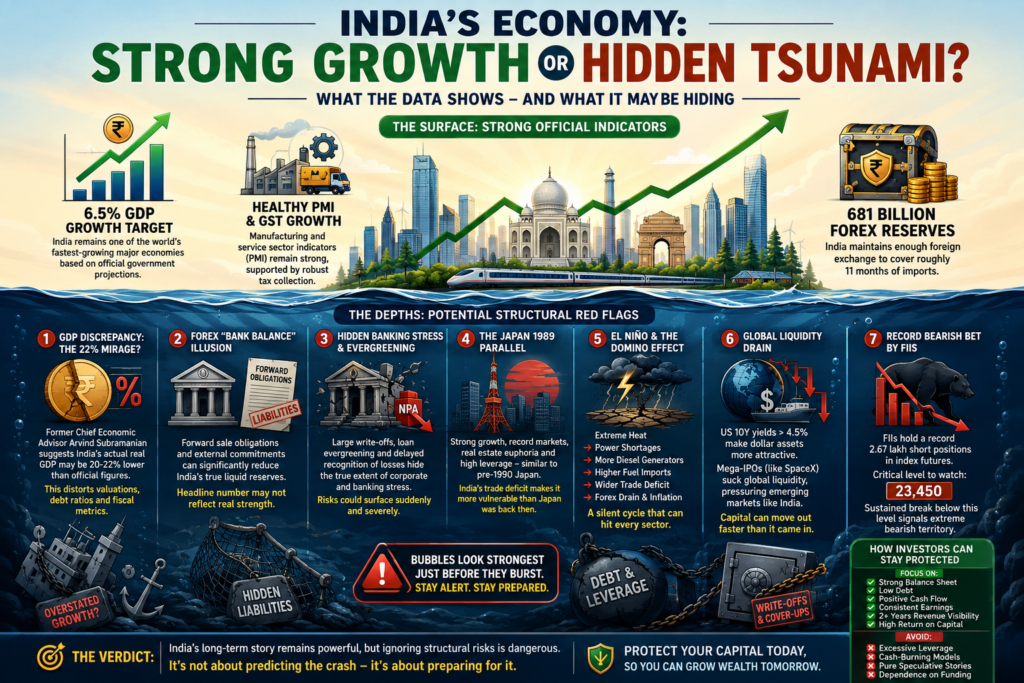
1. The GDP Growth Debate: Is India’s Economy Smaller Than Reported?
One of the most controversial questions in Indian economics today revolves around GDP measurement.
Former Chief Economic Adviser Arvind Subramanian has previously argued that India’s actual economic size may be significantly lower than official estimates suggest.
If economic output is overstated, it affects almost every major financial metric:
- Debt-to-GDP ratio
- Fiscal deficit calculations
- Corporate valuation models
- Long-term growth projections
For investors, this isn’t just an academic discussion.
A miscalculated GDP base can lead to unrealistic expectations and inflated market valuations.
Why It Matters
Markets are often priced on future growth assumptions.
If those assumptions are too optimistic, corrections can become painful.
2. India’s $681 Billion Forex Reserves: Fortress or Illusion?
India’s foreign exchange reserves are frequently presented as a major strength.
At over $681 billion, they appear sufficient to cover many months of imports.
However, headline numbers rarely tell the full story.
A portion of reserves may be tied to forward obligations, currency management operations, and external commitments.
The Bank Balance Example
Imagine someone claims to have ₹10 lakh in the bank.
But they also owe ₹9 lakh that must be paid within a year.
Technically they have ₹10 lakh.
Practically they have only ₹1 lakh available.
This is why professional investors focus on net liquidity rather than headline reserve figures.
3. Hidden Banking Stress: Are NPAs Really Under Control?
Indian banks have reported significant improvements in asset quality.
Official NPA ratios are near multi-year lows.
However, several analysts continue to question whether the banking sector’s health is as strong as reported.
Major concerns include:
- Large write-offs
- Loan restructuring
- Evergreening practices
- Delayed recognition of losses
Recent controversies involving accounting irregularities at certain companies and financial institutions have renewed concerns about transparency.
Investor Risk
Banking crises rarely appear suddenly.
They typically build quietly for years before becoming visible.
4. The Japan 1989 Comparison: A Bubble Warning?
Many market veterans have begun comparing India’s current environment with Japan’s asset bubble before its collapse in 1989.
The similarities include:
- Strong economic growth
- Record stock market levels
- Rising real estate prices
- Increasing leverage
Luxury real estate prices in premium Indian cities have surged dramatically.
Some investors argue this reflects genuine wealth creation.
Others fear it could indicate excessive speculation.
Key Difference
Japan entered its crisis with a trade surplus.
India operates with a persistent trade deficit.
This makes India more dependent on foreign capital flows and external stability.
5. Climate Risks and the El Niño Threat
Climate events are increasingly becoming economic events.
A severe El Niño cycle can affect:
- Agricultural production
- Food inflation
- Electricity demand
- Water availability
Higher food prices reduce disposable income and weaken consumer spending.
At the same time, increased energy demand can worsen fuel imports and pressure the rupee.
The Economic Domino Effect
Extreme Heat → Higher Power Demand → Increased Fuel Imports → Wider Trade Deficit → Currency Pressure → Inflation
This chain reaction can affect every sector of the economy.
6. Global Liquidity Is Tightening
For years, emerging markets benefited from abundant global liquidity.
That environment is changing.
The U.S. Federal Reserve’s higher interest-rate policy has pushed Treasury yields above levels that many global investors find attractive.
When investors can earn strong returns from relatively safe U.S. assets, riskier emerging-market investments often become less attractive.
Why This Matters for India
Foreign Institutional Investors (FIIs) can rapidly move capital across markets.
Even small shifts in global risk appetite can create significant volatility in Indian equities.
7. FIIs Are Positioning Defensively
Institutional positioning often provides clues about market sentiment.
When foreign investors build large hedges or short positions, it suggests increased caution regarding future market direction.
While short positions alone do not guarantee a crash, they indicate that sophisticated investors are preparing for higher volatility.
Market Reality
Bull markets rarely end because everyone is pessimistic.
They often end when optimism becomes excessive.
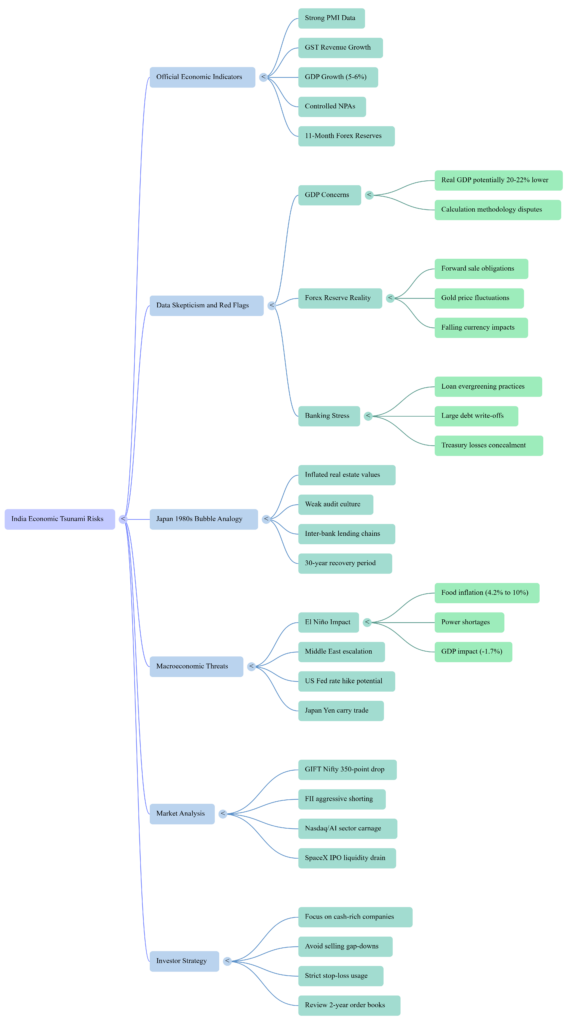
How Investors Can Protect Their Wealth
Whether these risks lead to a correction or not, investors should focus on quality.
Look For:
✅ Strong cash flows
✅ Low debt
✅ Consistent earnings growth
✅ High return on capital
✅ Healthy balance sheets
✅ Businesses with long-term order visibility
Avoid:
❌ Excessive leverage
❌ Cash-burning business models
❌ Pure speculative narratives
❌ Companies dependent on continuous fundraising
Final Verdict: Economic Tsunami or Temporary Turbulence?
India remains one of the most attractive long-term growth stories in the world.
However, every great growth story contains risks that investors must understand.
The biggest danger is not a market crash.
The biggest danger is believing that risks no longer exist.
History shows that bubbles often appear strongest just before they crack.
Whether today’s warning signs prove meaningful or not, disciplined investors should focus on risk management, capital preservation, and high-quality businesses rather than chasing hype.
The question isn’t whether volatility is coming.
The question is whether your portfolio is prepared when it arrives.
The 22% Mirage: Is India’s Economic Growth Story Hiding a Massive Risk?
India’s $681 Billion Forex Fortress: Strength or Dangerous Illusion?
7 Warning Signs Investors Must Watch Before India’s Next Market Shock
Economic Tsunami Ahead? The Hidden Risks Behind India’s Growth Story
Why Smart Investors Are Questioning India’s Economic Numbers in 2026