
When a Fortune 500 Tag Becomes a Trap
Most investors believe that a Fortune 500 company is automatically trustworthy. A large market capitalization, global presence, and institutional investors often create a sense of security. However, the allegations surrounding Rajesh Exports have challenged that belief and raised serious concerns about transparency in India’s financial markets.
What looked like one of India’s most successful export companies is now under regulatory scrutiny for alleged financial irregularities that could impact millions of investors.
The Mystery Behind the Revenue
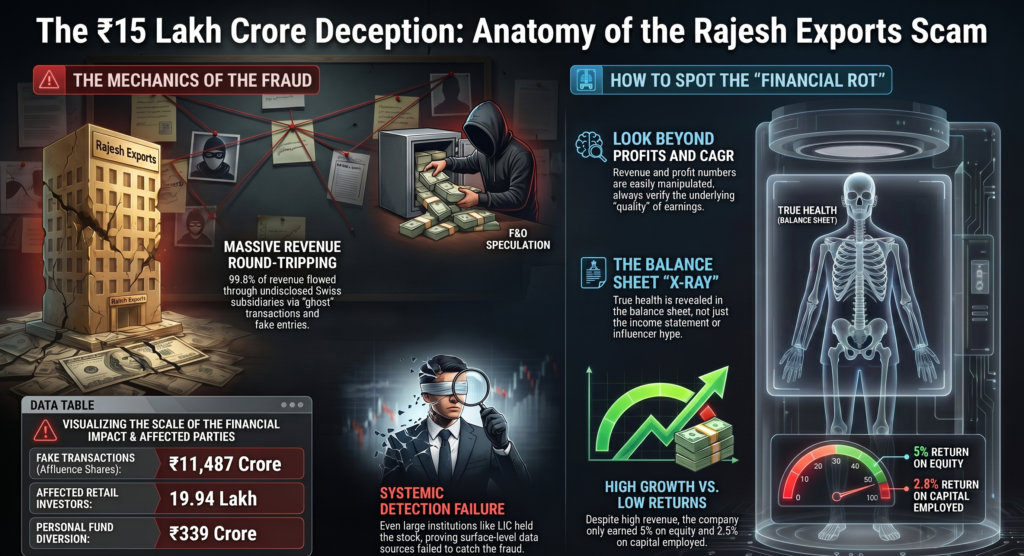
The biggest question revolves around the company’s reported revenue. Investigations suggest that a significant portion of Rajesh Exports’ business was linked to overseas subsidiaries, particularly entities based in Switzerland, whose financial details were not publicly available.
This created a situation where investors could see impressive revenue numbers but had very little visibility into how those numbers were actually generated. Such a lack of transparency makes independent verification extremely difficult and increases the risk of financial manipulation.
Adding to the concerns were reported transactions involving an entity named “Affluence.” Regulatory findings indicated discrepancies between the transactions reported by Rajesh Exports and the records available from the counterparty, raising questions about the authenticity of these dealings.
The Power of Perception
For years, Rajesh Exports was projected as one of India’s largest exporters. Strong revenue growth, attractive valuation metrics, and widespread coverage across financial platforms helped create an image of a thriving business.
Many investors relied on publicly available financial data, stock screeners, and valuation models to assess the company. However, if the underlying data itself is inaccurate, every analysis built on that information becomes unreliable.
The case serves as a reminder that even the most popular stocks can sometimes hide significant risks beneath impressive numbers.
Why LIC’s Presence Increased Investor Confidence
One reason many retail investors felt comfortable investing in the company was the presence of LIC, one of India’s largest institutional investors.
Retail investors often assume that if a major institution has invested after conducting detailed research, the company must be fundamentally strong. This perception can create a powerful “trust effect.”
As concerns around Rajesh Exports emerged, many investors began questioning whether institutional due diligence alone is sufficient protection against complex corporate irregularities.
Allegations of Fund Diversion
Regulatory investigations have also highlighted allegations that company funds may have been diverted for purposes unrelated to normal business operations.
If these allegations are ultimately proven, they would represent a serious breach of shareholder trust. Investors provide capital with the expectation that management will use it to grow the business—not for speculative activities or personal interests.
The Financial Red Flags That Were Visible
Interestingly, some warning signs were already present in the company’s financial performance.
Despite reporting enormous revenue figures, key profitability and efficiency metrics remained weak:
• Return on Equity (ROE): Approximately 5%
• Return on Capital Employed (ROCE): Approximately 2.8%
For a company claiming large-scale growth and industry leadership, such low returns raised important questions about the quality of earnings and overall capital efficiency.
In investing, strong businesses usually generate strong returns on capital. When growth stories and financial efficiency fail to match, investors should investigate further.
Lessons Every Investor Should Learn
The Rajesh Exports episode offers valuable lessons for investors:
✅ Revenue growth alone does not guarantee a healthy business.
✅ Always study ROE, ROCE, and cash flow statements.
✅ Institutional ownership should not replace personal research.
✅ Transparency is often more important than reported profits.
✅ Diversification remains one of the strongest protections against unexpected corporate risks.
Conclusion
The Rajesh Exports controversy is not just about one company. It highlights the importance of questioning assumptions, verifying financial information, and looking beyond headline numbers.
Successful investing is not about finding the most popular stock. It is about understanding the quality of the business behind the stock.
For investors, the biggest takeaway is simple: never confuse reputation with reliability. In the stock market, trust should always be supported by evidence.