
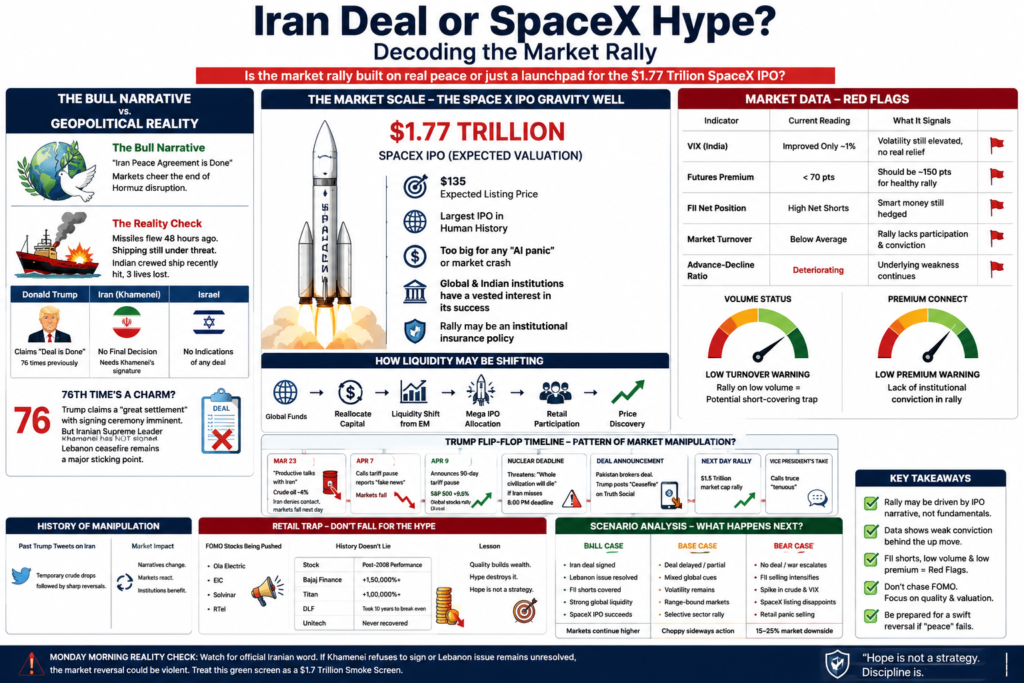
The $1.7 Trillion Smoke Screen
Executive Summary
Global equity markets have suddenly shifted from fear to optimism. The Sensex rallied over 1,700 points, the Nifty gained more than 450 points, and investors rushed back into risk assets after reports of easing geopolitical tensions.
But beneath this optimism lies an important question:
Is this rally driven by improving fundamentals, or is it simply a liquidity-driven narrative supporting one of the largest IPO events in history?
If global institutions are positioning themselves for a mega listing, such as a potential SpaceX IPO, liquidity movements across markets could temporarily distort valuations and investor sentiment.
Global Market Snapshot
| Indicator | Current Situation | Possible Interpretation |
|---|---|---|
| Global Equities | Strong Rally | Risk-On Sentiment |
| Oil Prices | Volatile | Geopolitical Uncertainty |
| India VIX | Elevated | Market Still Nervous |
| FII Positioning | Cautious | Institutional Hedging |
| Retail Sentiment | Extremely Bullish | FOMO Risk |
Why Did Markets Rally So Quickly?
Several factors contributed to optimism:
- Expectations of geopolitical de-escalation
- Short covering by traders
- Positive global headlines
- Institutional repositioning
- Liquidity-driven buying
However, sustainable bull markets generally require:
✅ Strong earnings
✅ Economic growth
✅ Institutional conviction
✅ High participation
rather than headlines alone.
The SpaceX IPO Hypothesis
Some market observers believe that an exceptionally large IPO could attract significant global capital.
Hypothetical Capital Flow
Global Funds
↓
Portfolio Rebalancing
↓
Liquidity Shift
↓
Emerging Market Selling
↓
Mega IPO Allocation
↓
Retail Participation
↓
Price Discovery
This remains a theoretical market scenario rather than an established fact.
Mega IPO Comparison
| Company | Approx. IPO Scale |
|---|---|
| Alibaba | Very Large |
| Saudi Aramco | Historic |
| SoftBank Listings | Major |
| Hypothetical SpaceX Listing | Potentially Record Breaking |
Large IPOs often require institutional capital reallocation.
Market Narrative vs Reality
| Bullish Narrative | Risk Perspective |
|---|---|
| Peace Expectations | Situation may remain fluid |
| Strong Rally | Could include short covering |
| Retail Optimism | May create FOMO |
| Momentum | Needs earnings support |
| Headlines | Fundamentals remain important |
Institutional Positioning Checklist
Professional investors typically monitor:
| Indicator | Why It Matters |
|---|---|
| FII Flows | Foreign confidence |
| DII Flows | Domestic support |
| India VIX | Risk perception |
| Futures Premium | Institutional conviction |
| Market Breadth | Strength of rally |
| Trading Volume | Quality of move |
A rally supported by broad participation is generally stronger than one driven by limited sectors.
Technical Signals to Watch
Positive Signals
- Higher highs
- Strong market breadth
- Rising volumes
- Declining volatility
Warning Signals
- Weak participation
- Low turnover
- Rising volatility
- Heavy institutional hedging
Scenario Analysis
Scenario 1: Bull Case
- Geopolitical stability
- Strong earnings
- Stable global liquidity
- Continued institutional buying
Potential Result:
Steady market expansion.
Scenario 2: Neutral Case
- Mixed news flow
- Moderate earnings
- Sideways movement
- Selective sector leadership
Potential Result:
Range-bound markets.
Scenario 3: Bear Case
- Geopolitical escalation
- Liquidity tightening
- FII selling
- Weak earnings
Potential Result:
Higher volatility and broader correction.
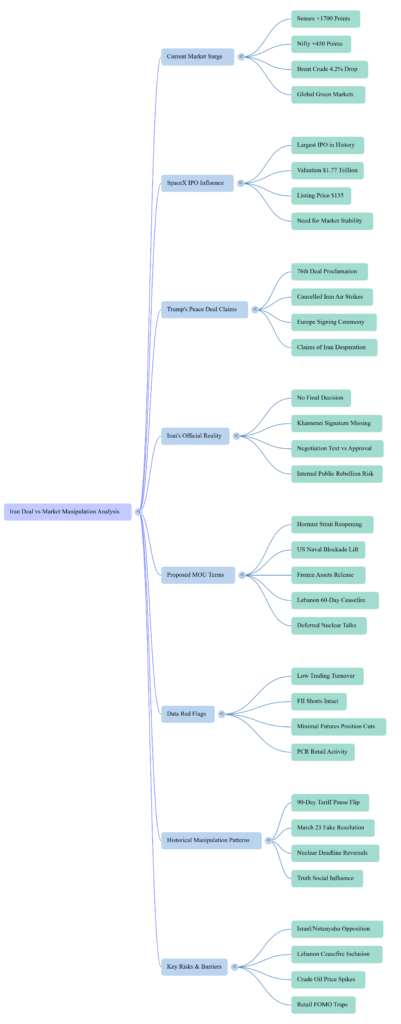
Liquidity Risk Matrix
| Risk Factor | Impact |
|---|---|
| Global IPO Capital Demand | Medium |
| FII Selling | High |
| Geopolitical Conflict | High |
| Retail FOMO | Medium |
| Valuation Compression | High |
| Global Recession Risk | Medium |
Lessons from Market History
History repeatedly shows that:
- Narratives change quickly.
- Liquidity cycles are temporary.
- Valuation eventually matters.
- Quality businesses recover faster than speculative companies.
Historical Observation
| Investment Type | Long-Term Outcome |
|---|---|
| Quality Companies | Often recover and compound |
| Highly Leveraged Firms | Higher risk |
| Speculative Momentum Stocks | Greater volatility |
| Diversified Portfolios | Better resilience |
Investor Checklist
Before investing, ask:
✅ Is the valuation reasonable?
✅ Is the company profitable or on a credible path to profitability?
✅ Am I investing because of research or excitement?
✅ Can I hold this investment through a prolonged downturn?
✅ Would I still buy if there were no media hype?
Key Risks to Monitor
| Indicator | Watch Level |
|---|---|
| India VIX | Rising volatility |
| FII Net Flows | Sustained selling |
| Oil Prices | Inflation pressure |
| Market Breadth | Narrow leadership |
| Corporate Earnings | Below expectations |
| Global Liquidity | Tightening conditions |
Final Thoughts
Financial markets often move ahead of economic reality, driven by expectations, narratives, and liquidity. Large IPOs and geopolitical developments can influence sentiment, but long-term investment success depends on fundamentals rather than headlines.
The Most Important Question
Are you investing based on business quality, valuation, and cash flows—or simply because everyone else appears optimistic?
In investing, hope is not a strategy. Discipline, diversification, and independent analysis remain the strongest defenses against market euphoria and uncertainty.