
The $700 Billion AI Bet
Executive Summary
Artificial Intelligence has become the largest capital investment theme of the decade.
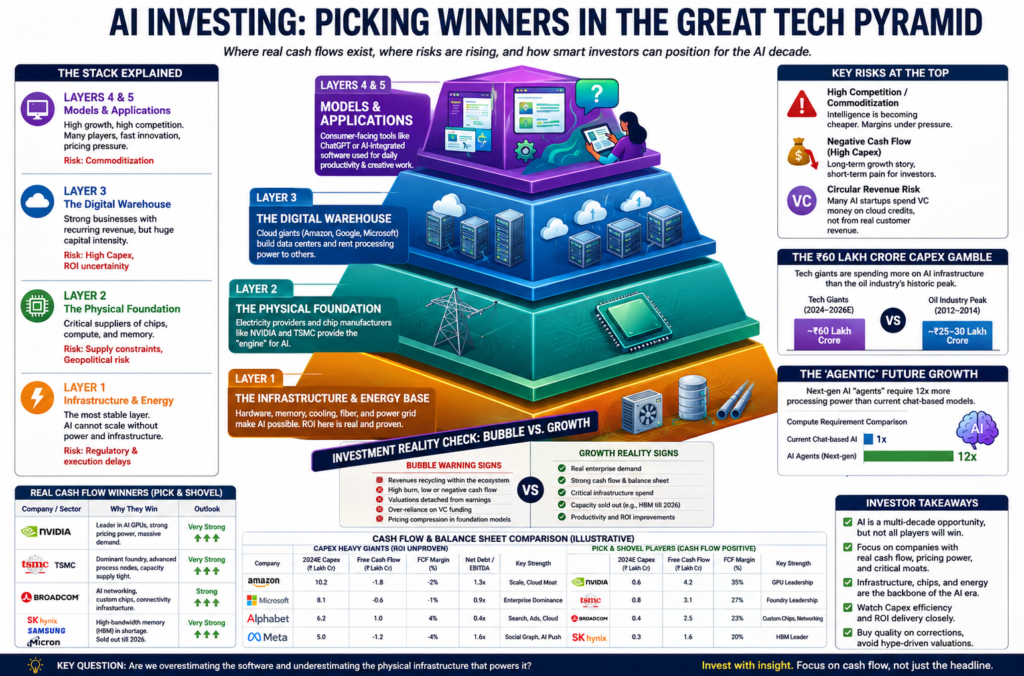
Technology giants, including Amazon, Microsoft, Alphabet, and Meta, are expected to invest nearly $700 billion (≈₹60 lakh crore) into AI infrastructure over the coming years, making it one of the biggest technology spending cycles in history.
Yet investors face a fundamental question:
Are we witnessing the birth of the next Industrial Revolution, or are we simply financing the world’s largest technology bubble?
The answer may lie in understanding where real cash flows exist—and where expectations are running ahead of economic reality.
Global AI Investment Snapshot
| Category | Estimated Scale |
|---|---|
| AI Infrastructure Spending | ~$700 Billion |
| Approx. Indian Equivalent | ~₹60 Lakh Crore |
| Major Investors | Amazon, Microsoft, Alphabet, Meta |
| Primary Focus | Data Centers, GPUs, Cloud, AI Models |
This investment cycle rivals or exceeds previous technology infrastructure booms.
The AI Value Chain
Five Layers of the AI Economy
Electricity & Grid
↓
Data Centers
↓
Semiconductors
↓
Foundation Models
↓
Applications & End Users
Key Insight
Companies supplying the lower layers often earn revenue regardless of which AI application ultimately succeeds.
Layer 1: AI is Also an Energy Story
Every AI query requires:
- Electricity
- Cooling
- Networking
- Storage
- Compute
Infrastructure Requirements
| Resource | Importance |
|---|---|
| Power Grid | Critical |
| Data Centers | Critical |
| Cooling Systems | High |
| Fiber Networks | High |
| Water Supply | Increasingly Important |
Without sufficient infrastructure, AI expansion faces physical constraints.
The Data Center Bottleneck
Challenges
| Issue | Impact |
|---|---|
| Grid Capacity | Delays |
| Regulatory Approval | Slower Expansion |
| Land Availability | Cost Increase |
| Energy Costs | Margin Pressure |
| Construction Delays | Capital Lock-up |
AI growth depends not only on software innovation but also on infrastructure readiness.
The Circular Revenue Question
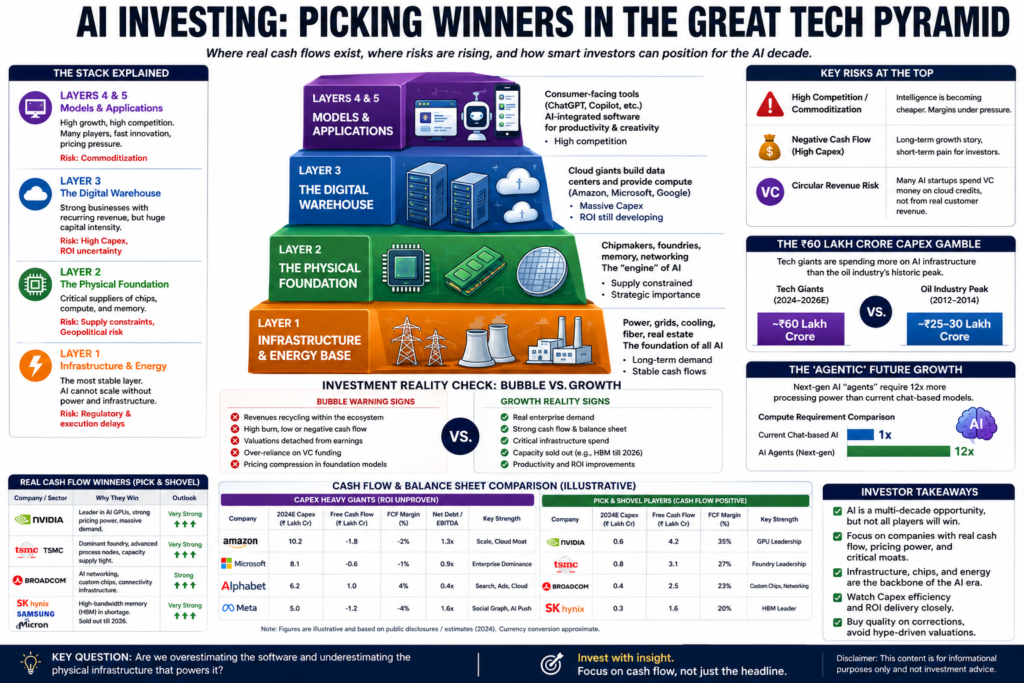
One concern raised by analysts is whether parts of the AI ecosystem are generating sustainable external demand or largely recycling investment capital.
Simplified Illustration
Cloud Provider
↓
AI Startup
↓
VC Funding
↓
GPU Purchase
↓
Cloud Revenue
↓
More Investment
If long-term enterprise adoption accelerates, this cycle becomes self-sustaining. If not, growth expectations may need to be revised.
AI Economics
| Revenue Source | Sustainability |
|---|---|
| Enterprise Software | High |
| Consumer Subscription | Medium |
| Venture Capital Funding | Temporary |
| Government Contracts | Medium |
| Advertising Integration | High |
Long-term success depends on recurring customer revenue rather than continuous capital injections.
Competition and Commoditization
As more capable AI models enter the market, pricing pressure may increase.
Competitive Landscape
| Factor | Effect |
|---|---|
| Open-Source Models | Lower Entry Barrier |
| Low-Cost AI Models | Margin Compression |
| Faster Innovation | Short Product Cycles |
| Global Competition | Higher Efficiency |
Competitive markets often reduce pricing power over time.
Why Hardware May Benefit
Software platforms compete aggressively, but hardware suppliers often benefit regardless of which model becomes dominant.
“Pick-and-Shovel” Businesses
| Segment | Example |
|---|---|
| GPUs | NVIDIA |
| Chip Manufacturing | TSMC |
| Networking | Broadcom |
| Memory | SK Hynix, Samsung, Micron |
| Data Center Equipment | Infrastructure Providers |
Historically, infrastructure suppliers can benefit from multiple technology cycles.
AI Compute Explosion
Traditional Search
↓
Chatbot
↓
AI Assistant
↓
AI Agent
↓
Autonomous Workflow
↓
Much Higher Compute Demand
As AI systems perform more complex tasks, computing requirements increase substantially.
Investment Risk Matrix
| Risk | Severity |
|---|---|
| Valuation Risk | High |
| Execution Risk | High |
| Regulatory Risk | Medium |
| Energy Constraints | Medium |
| Competition | High |
| Margin Compression | High |
Winners vs Risks
| Potential Winners | Key Challenges |
|---|---|
| Semiconductor Companies | Valuation Premium |
| Data Center Providers | Capital Intensity |
| Power Infrastructure | Regulation |
| Cloud Platforms | ROI Uncertainty |
| AI Software Startups | Fierce Competition |
Scenario Analysis
Bull Case
- Enterprise AI adoption accelerates
- Productivity improves
- Corporate earnings rise
- Infrastructure expands
Result:
Long-term technology supercycle.
Base Case
- Moderate adoption
- Gradual monetization
- Selective winners
- Valuation normalization
Result:
Healthy but uneven growth.
Bear Case
- Spending exceeds returns
- Margins compress
- Capital markets tighten
- AI demand grows more slowly than expected
Result:
Correction in overvalued segments while stronger businesses remain resilient.
Historical Comparison
| Technology Era | Outcome |
|---|---|
| Railways | Long-term transformation |
| Electricity | Industrial Revolution |
| Internet | Massive impact after a bubble |
| Smartphones | Multi-decade growth |
| Artificial Intelligence | Still evolving |
History suggests that transformational technologies can coexist with periods of excessive speculation.
Investor Checklist
Before investing in AI-related companies, ask:
✅ Does the company generate positive free cash flow?
✅ Is valuation supported by earnings?
✅ Does it have a competitive advantage?
✅ Can it maintain pricing power?
✅ Is demand coming from real customers rather than temporary funding cycles?
Key Takeaways
- AI is likely to reshape multiple industries over the coming decades.
- However, not every AI company will become a long-term winner.
- Infrastructure providers, semiconductor firms, and essential technology suppliers may benefit regardless of which software platform dominates.
- Investors should distinguish between technological potential and investment valuation.
- Successful investing requires balancing optimism about innovation with disciplined analysis of cash flows, profitability, and competitive positioning.
Final Thought
Every great technological revolution creates extraordinary opportunities—but history also shows that periods of rapid innovation often include episodes of overvaluation and speculation. The most durable investments are usually the companies that convert innovation into sustainable cash flows, not merely compelling narratives.