
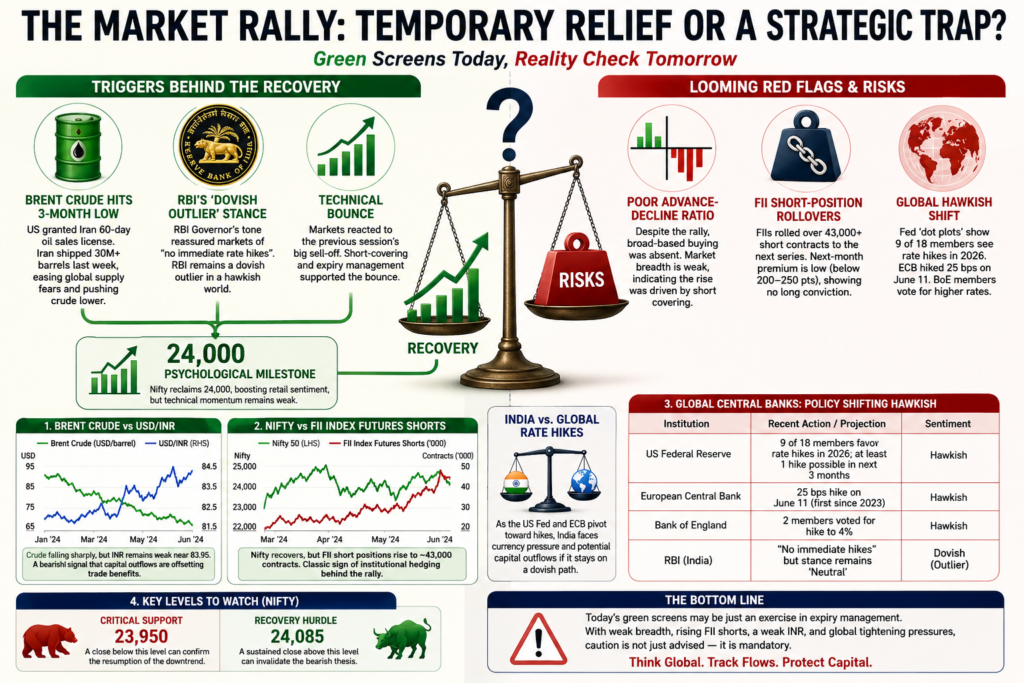
Indian stock markets have staged a remarkable comeback. After global uncertainty, geopolitical tensions, and volatility in crude oil prices, the Nifty has once again reclaimed the crucial 24,000 level. For many retail investors, the green screens suggest that the worst is over and a new bull market has begun.
But is the rally really as strong as it looks?
A deeper analysis of FII positioning, crude oil trends, RBI policy signals, currency movements, and market breadth reveals a very different story. While prices are moving higher, several hidden warning signs suggest that this rally could be a classic bear trap rather than the start of a sustainable uptrend.
Let’s examine the data.
Why Falling Crude Oil Prices Are Not Entirely Bullish
One of the biggest reasons behind the recent rally is the sharp decline in Brent crude oil prices.
India imports nearly 85% of its oil requirements. Therefore, lower crude prices typically reduce inflation, improve corporate margins, and strengthen the Indian Rupee.
Recent developments involving Iran have increased global oil supply. Reports indicate that Iranian exports surged significantly after diplomatic progress in nuclear negotiations, pushing oil prices to multi-month lows.
At first glance, this appears highly positive for India.
However, the market is overlooking an important contradiction.
The Rupee Isn’t Responding
Historically, lower oil prices have supported the Indian Rupee. Yet despite the fall in crude, USD/INR remains near 83.95.
This divergence raises several concerns:
- Foreign capital may be leaving Indian markets.
- Global investors remain cautious despite positive oil trends.
- Currency markets are signaling weakness beneath the surface.
When positive news fails to strengthen the currency, investors should pay attention.
RBI’s Dovish Tone May Be Creating a False Sense of Comfort
The market received another boost after reassuring comments from the RBI Governor.
Investors interpreted the message as a signal that interest rates are unlikely to rise immediately.
However, the RBI faces a difficult challenge.
| Indicator | Latest Outlook |
|---|---|
| GDP Growth Forecast | Reduced |
| Inflation Outlook | Still Elevated |
| Policy Stance | Neutral |
This combination creates a policy dilemma.
Economic growth is slowing while inflation remains stubbornly high.
Although markets celebrated the Governor’s comments, the RBI has not committed to a long-term easing cycle. Any global inflation shock or currency weakness could force policymakers to change direction quickly.
The current optimism may therefore be based more on expectations than reality.
Global Central Banks Are Turning Hawkish Again
While India attempts to maintain stability, major global central banks are becoming increasingly cautious about inflation.
Key Global Developments
- US Federal Reserve officials continue to signal concerns over inflation.
- European policymakers remain cautious despite slower growth.
- Global bond yields are showing signs of upward pressure.
For India, this creates a serious risk.
If global interest rates rise while India remains accommodative, foreign investors may shift capital toward safer and higher-yielding markets.
That could increase pressure on:
- Indian bonds
- The Rupee
- Equity markets
The result may be higher volatility during the coming months.
FII Activity Suggests Institutions Remain Defensive
Perhaps the most important warning sign comes from derivative data.
While the market rallied sharply, foreign investors have reportedly rolled over nearly 43,000 short contracts into the next expiry series.
This is significant because institutional investors typically use derivatives to express their strongest market views.
What the Data Suggests
- Cash market buying remains limited.
- Derivative positioning remains cautious.
- Long-term bullish conviction appears weak.
In simple terms, institutions may be using the rally to adjust positions rather than aggressively accumulate stocks.
This behavior is often observed during short-covering rallies.
Market Breadth Is Sending a Warning Signal
A healthy bull market requires participation from a broad range of stocks.
Unfortunately, market breadth remains weak.
Current Concerns
- Advance-Decline ratio remains unimpressive.
- Gains are concentrated in a handful of heavyweight stocks.
- Many midcap and smallcap stocks continue to underperform.
- Momentum indicators are losing strength.
When only a few stocks drive an index higher, the rally becomes increasingly vulnerable.
Strong bull markets expand participation.
Weak rallies narrow participation.
Current conditions resemble the second scenario.
Important Nifty Levels Investors Must Watch
Technical analysis also highlights key levels that could determine the market’s next major move.
Major Support Zone
23,950
A decisive breakdown below this level could signal renewed selling pressure.
Key Resistance Zone
24,085
A sustained close above this level would improve bullish sentiment and potentially invalidate the bear trap scenario.
Until one of these levels breaks decisively, traders should remain cautious.
Why This Rally Could Be a Bear Trap
Several warning signals are appearing simultaneously:
✔ Weak Rupee despite falling crude oil
✔ Slowing growth outlook
✔ Persistent inflation concerns
✔ Hawkish global central banks
✔ Large FII short positions
✔ Weak market breadth
✔ Technical loss of momentum
Individually, these indicators may not matter.
Collectively, they deserve attention.
Final Verdict: Rally or Trap?
The recovery above 24,000 has certainly improved market sentiment.
However, sentiment alone cannot sustain a bull market.
The combination of cautious institutional positioning, weak currency behavior, global monetary tightening, and poor market breadth suggests that investors should avoid becoming overly optimistic.
The current rally may prove to be genuine.
But it could also be the final phase of a short-covering move before larger global risks re-emerge.
Smart investors should focus on data, not emotions.
Key Takeaway
When prices rise but institutional conviction remains weak, caution becomes more important than excitement. The next major move in Indian markets may be determined not by local headlines, but by global money flows, interest rates, and FII positioning