
Executive Summary
The artificial intelligence revolution has entered a new phase.
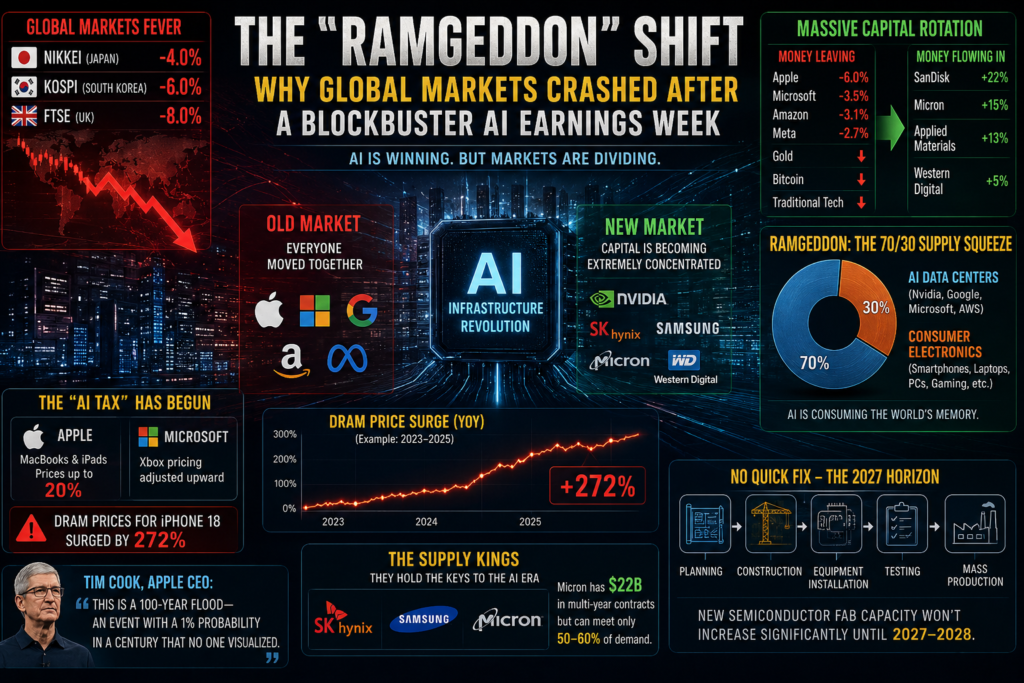
The market is no longer rewarding every AI company equally. Instead, global capital is flowing toward a tiny group of semiconductor and AI infrastructure companies while leaving the rest of the market behind.
This phenomenon—nicknamed “Ramgeddon”—could become one of the defining investment themes of 2026–2028.
AI Capital Flow
2023
│
├── Everyone bought AI
│
2024
│
├── Software AI
├── Cloud AI
├── Hardware AI
│
2025
│
└── Premium AI Infrastructure
     │
     ├── HBM Memory
     ├── GPUs
     ├── AI Networking
     ├── Chip Equipment
     └── Data Centers
Today, money isn’t simply moving into AI.
It is moving inside AI.
Global Capital Rotation
Money Leaving

Apple
Microsoft
Amazon
Google
Consumer Electronics
Gold
Bitcoin
Emerging Markets

           ↓↓↓↓↓↓↓↓

Money Entering

HBM Memory
DRAM
AI Servers
GPU Makers
Semiconductor Equipment
AI Infrastructure
This is why broad indices can fall even while AI-related companies rally.
Why Did Markets Crash After Strong AI Earnings?
The answer is simple:
Markets care more about where money goes than whether earnings are good.
Imagine global investment capital as one giant swimming pool.
When investors suddenly decide that AI infrastructure will produce the highest returns over the next five years, they sell almost everything else to fund those purchases.
Result:
- Stock indices fall
- Gold weakens
- Bitcoin loses momentum
- Consumer technology stocks decline
- AI hardware stocks surge
The Great AI Polarization
Old Market
Technology
├── Apple
├── Microsoft
├── Google
├── Amazon
└── Nvidia
Everyone moved together.
New Market
Premium AI

██████████████████

Normal AI

██████

Traditional Tech

███

Consumer Electronics

██
Capital is becoming extremely concentrated.
What Is “Ramgeddon”?
AI data centers require enormous amounts of:
- High Bandwidth Memory (HBM)
- DRAM
- NAND Flash
- AI GPUs
If AI companies consume most global production, less remains for:
- Smartphones
- Laptops
- Tablets
- Gaming consoles
- PCs
Simple illustration:
Global Memory Production

AI Data Centers

██████████████████████████ 70%

Consumer Electronics

██████████ 30%
Even if the exact percentage varies over time, the direction is clear: AI infrastructure is absorbing a rapidly growing share of advanced memory production.
Why Memory Is the New Oil
Every AI GPU needs memory.
AI GPU

↓

HBM Memory

↓

DRAM

↓

Semiconductor Equipment

↓

Silicon Wafer

↓

Electricity

↓

Data Center
Without memory,
there is no AI.
Supply Chain
Micron

↓

HBM

↓

Nvidia

↓

AI Server

↓

Microsoft Azure

↓

OpenAI

↓

ChatGPT
Every step depends on the previous one.
The AI Tax
Consumer electronics may become more expensive because manufacturers compete with AI companies for limited high-performance components.
Laptop

₹100

↓

Memory Cost Rises

↓

Laptop

₹115–₹120
Higher component costs can eventually translate into higher retail prices, although the exact impact varies by product and manufacturer.
Winners
| Sector | Outlook |
|---|---|
| AI Memory | ⭐⭐⭐⭐⭐ |
| GPU | ⭐⭐⭐⭐⭐ |
| Semiconductor Equipment | ⭐⭐⭐⭐⭐ |
| AI Networking | ⭐⭐⭐⭐ |
| Cloud Infrastructure | ⭐⭐⭐⭐ |
Under Pressure
| Sector | Risk |
|---|---|
| Smartphones | High |
| PCs | High |
| Consumer Electronics | High |
| Traditional IT | Medium |
| Low-Growth Tech | High |
Capital Rotation Diagram
Gold
       ↘

Bitcoin
        ↘

Consumer Tech
          ↘

Traditional Software
             ↘

          AI Infrastructure
Investment Pyramid
           AI Infrastructure
        (Highest Growth)

     Semiconductor Equipment

      AI Networking

       Cloud Providers

 Consumer Electronics

     Traditional Tech
The higher the company sits in the AI supply chain, the greater its potential exposure to AI-driven demand—but also the greater the valuation risk.
Why New Factories Won’t Solve It Overnight
Building an advanced semiconductor fabrication plant typically requires:
- Massive capital investment
- Specialized equipment
- Skilled engineers
- Long construction timelines
- Qualification and yield testing
Planning

↓

Construction

↓

Equipment Installation

↓

Testing

↓

Mass Production
This process often takes several years, which is why supply cannot expand instantly.
Investment Lessons
✔ Follow capital flows, not headlines.
✔ Identify bottlenecks rather than end products.
✔ Hardware scarcity can be more profitable than software abundance.
✔ AI infrastructure has become the backbone of the new technology cycle.
✔ Diversification remains important because high-growth AI hardware companies can also experience significant volatility.
Risks Investors Should Watch
| Risk | Impact |
|---|---|
| Overcapacity after 2027–2028 | High |
| Falling AI spending | High |
| Geopolitical tensions | High |
| Export restrictions | Medium |
| Rising interest rates | Medium |
Final Thought
The AI revolution is no longer just about smarter software—it is increasingly about the physical infrastructure that powers it. Memory chips, advanced semiconductors, networking equipment, and data centers have become the critical bottlenecks of the digital economy.
Whether “Ramgeddon” proves to be a lasting structural shift or a temporary phase will depend on how quickly supply catches up with demand, how sustainable AI investment remains, and whether today’s premium valuations can be justified by future earnings.
For investors, the key question is no longer “Who builds the best AI?” but “Who supplies the essential hardware that every AI system depends on?