

The Sleeping Samurai Wakes Up
For nearly 80 years, Japan stood apart from the world’s military powers.
After World War II, Article 9 of Japan’s Constitution transformed the nation into one of the world’s most pacifist countries. Military expansion became politically sensitive, defense budgets remained restrained, and Japanese companies focused on automobiles, electronics, robotics, and heavy industry instead of weapons exports.
That era is ending.
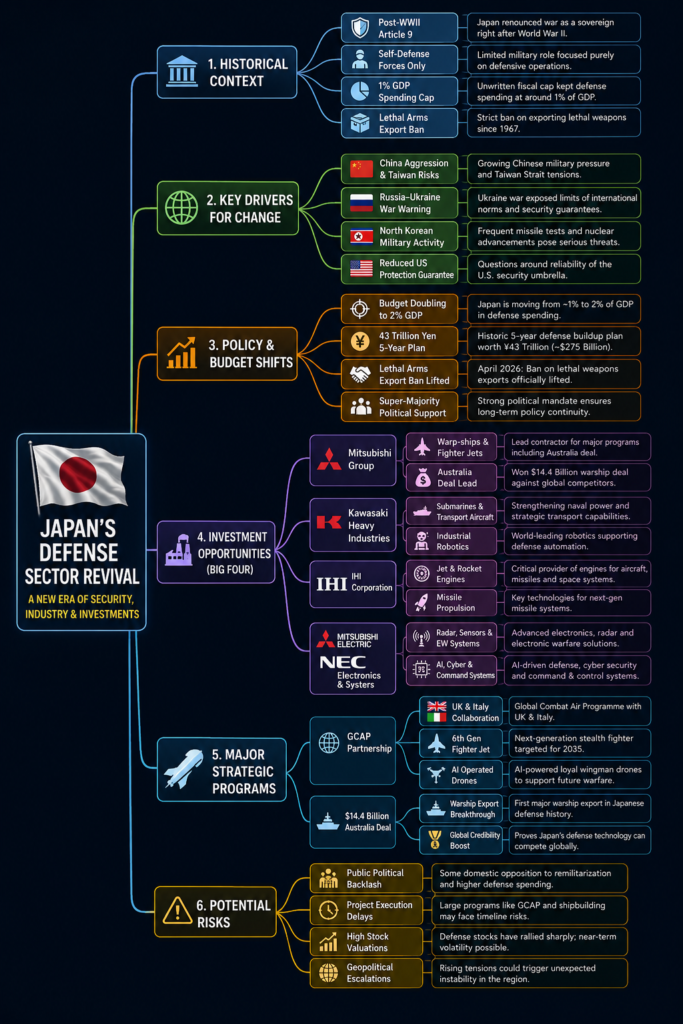
Japan is now implementing one of the biggest defense transformations in modern history—investing 43 trillion yen (around US$275 billion) over five years to modernize its military, strengthen regional deterrence, and expand its defense-industrial base.
This is more than a military story.
It is a geopolitical, industrial, and investment story that could reshape Asia for decades.
Japan’s Defense Revolution at a Glance
| Indicator | Previous | Current Plan |
|---|---|---|
| Five-Year Defense Program | ~27 Trillion Yen | 43 Trillion Yen |
| GDP Allocation | ~1% | Target: 2% of GDP |
| Military Ranking (Budget) | Top 10 | Toward Top 3–5 |
| Export Policy | Highly Restricted | Significantly Relaxed |
| Primary Focus | Homeland Defense | Regional Deterrence |
Why Is Japan Rearming?
Several strategic developments have changed Tokyo’s security calculations.
1. China’s Military Expansion
China has rapidly expanded:
- Aircraft carriers
- Hypersonic missiles
- Naval fleet
- Taiwan’s military pressure
2. North Korea
North Korea continues testing:
- Ballistic missiles
- Nuclear capabilities
- Long-range weapons
3. Russia
Russia’s invasion of Ukraine demonstrated that geopolitical stability cannot be taken for granted.
Many Japanese policymakers concluded that economic interdependence alone does not guarantee peace.
Indo-Pacific Security Map
               Russia
                  ▲

China ◄──────── Japan ───────► Pacific

        Taiwan (110 km)

                  ▼

           North Korea
Japan now finds itself surrounded by multiple strategic flashpoints.
Defense Spending Comparison
| Country | Defense Spending (% GDP Approx.) |
|---|---|
| USA | 3.3–3.5% |
| India | 2.3–2.5% |
| Japan | Moving toward 2% |
| Germany | Around 2% |
| South Korea | ~2.5% |
Japan’s shift to around 2% represents one of the largest structural increases among developed economies.
Timeline of Japan’s Military Transformation
1947
Article 9 Constitution

↓

1976
Unofficial 1% GDP Defense Cap

↓

2022
Major Defense Strategy Announced

↓

2024–2026
Budget Expansion
Industrial Modernization

↓

2027
Target of 2% GDP

↓

2035
GCAP Sixth-Generation Fighter

↓

2050+
Long-Term Defense Manufacturing Cycle
The Weapons Export Revolution
For decades, Japanese defense manufacturers were effectively limited to the domestic market.
Today, policy reforms are opening new export opportunities.
Potential export sectors include:
- Naval Ships
- Radar Systems
- Missile Defense
- Fighter Components
- Aerospace
- AI Defense Systems
- Electronic Warfare
This could significantly expand revenue opportunities for Japan’s defense industry, subject to future government approvals and international demand.
The GCAP Fighter Program
One of Japan’s most ambitious projects is the Global Combat Air Programme (GCAP).
Partner Countries
🇯🇵 Japan
🇬🇧 United Kingdom
🇮🇹 Italy
Expected Features
✔ AI-assisted combat
✔ Drone teaming
✔ Advanced stealth
✔ Long-range strike capability
✔ Next-generation sensors
✔ Network-centric warfare
Expected operational timeline:
Around 2035
Japan’s Defense Industry Leaders
Mitsubishi Heavy Industries
Business Areas:
- Fighter Aircraft
- Naval Ships
- Missiles
- Aerospace
Often viewed as Japan’s flagship defense manufacturer.
Kawasaki Heavy Industries
Specialization:
- Submarines
- Helicopters
- Heavy Transport
- Naval Systems
IHI Corporation
Key Products:
- Jet Engines
- Rocket Engines
- Aerospace Propulsion
Mitsubishi Electric
Focus:
- Radar
- Missile Guidance
- Electronic Warfare
- Defense Electronics
NEC Corporation
Expertise:
- Cybersecurity
- AI Systems
- Military Communications
- Digital Command Networks
Estimated Allocation of the 43 Trillion Yen Program
Missiles & Strike Capability        ████████████

Air Defense                          ████████

Naval Modernization                  █████████

Cyber & Space                        ██████

Logistics                            █████

R&D                                  ███████

AI & Next-Generation Systems         ████████
Economic Impact
Beneficiaries
✔ Defense Manufacturers
✔ Aerospace Companies
✔ Semiconductor Suppliers
✔ Cybersecurity Firms
✔ AI Companies
✔ Robotics Industry
✔ Shipbuilding
✔ Advanced Materials
Risks Investors Should Consider
Every structural theme carries uncertainty.
Key Risks
- Government policy changes
- Budget constraints
- Export licensing
- Regional geopolitical escalation
- Global economic slowdown
- Program execution delays
Japan’s Competitive Advantages
| Strength | Why It Matters |
|---|---|
| Advanced Manufacturing | High-quality production |
| Robotics | Military automation |
| Electronics | Radar & Sensors |
| Shipbuilding | Naval exports |
| Precision Engineering | Defense systems |
| AI Research | Future battlefield technologies |
Why Investors Are Watching Japan
Defense companies often benefit from:
- Multi-year government contracts
- Long product lifecycles
- High barriers to entry
- Recurring maintenance revenue
- Stable cash flows
Japan’s modernization program could create sustained demand across aerospace, electronics, shipbuilding, and advanced manufacturing.
Frequently Asked Questions
Why is Japan increasing defense spending?
Growing regional security challenges, technological modernization, and changing geopolitical conditions have prompted a reassessment of defense priorities.
Is Japan changing its Constitution?
Article 9 remains in place, though defense policies and interpretations have evolved. Constitutional changes would require a separate legal and political process.
What is GCAP?
The Global Combat Air Programme is a joint sixth-generation fighter aircraft project involving Japan, the UK, and Italy.
Which sectors may benefit?
- Aerospace
- Defense Manufacturing
- AI
- Cybersecurity
- Electronics
- Shipbuilding
- Advanced Materials
Key Takeaways
✅ Japan is undertaking one of its largest post-war defense modernization programs.
✅ Defense spending is moving toward 2% of GDP.
✅ Export policy reforms may expand opportunities for Japanese defense companies.
✅ Programs such as GCAP highlight long-term investment in advanced aerospace technology.
✅ The broader impact extends beyond defense, influencing manufacturing, AI, semiconductors, and regional security.
Final Thoughts
Japan’s defense transformation reflects a significant strategic shift shaped by changing regional dynamics and long-term industrial planning.
Whether viewed through the lens of geopolitics or investment, this evolution underscores Japan’s growing role in the Indo-Pacific security architecture.
For investors, analysts, and policymakers alike, the key question is no longer whether Japan’s defense sector is changing, but how rapidly those changes will reshape industries and markets over the coming decades.
Top 10 Best Titles
- The Sleeping Samurai Awakens: Japan’s $275 Billion Defense Revolution Explained
- Japan’s $275 Billion Military Revolution: Why the World Is Paying Attention
- The Sleeping Samurai Wakes Up: How Japan Is Becoming Asia’s New Military Power
- Japan’s Historic Defense Shift: The $275 Billion Bet Reshaping the Indo-Pacific
- The End of Japan’s Pacifist Era: Inside the $275 Billion Defense Transformation
- From Peace to Power: Japan’s Biggest Military Build-Up Since World War II
- The $275 Billion Samurai Strategy: Why Japan Is Rearming for the Future
- Japan’s Defense Boom: The Next 20-Year Investment Opportunity?
- How Japan’s Military Revival Could Change Global Markets Forever
- The Sleeping Giant of Asia: Japan’s $275 Billion Defense Revolution