
India’s Gold Monetization Scheme 2.0: Is Your Gold Really Safe? A Financial Analyst’s Deep Research
Introduction
For decades, Indian families have viewed gold as more than an investment. It represents financial security, cultural heritage, and protection during uncertain times. Whether it is inflation, banking crises, or market crashes, physical gold has remained one of the few assets outside the financial system.
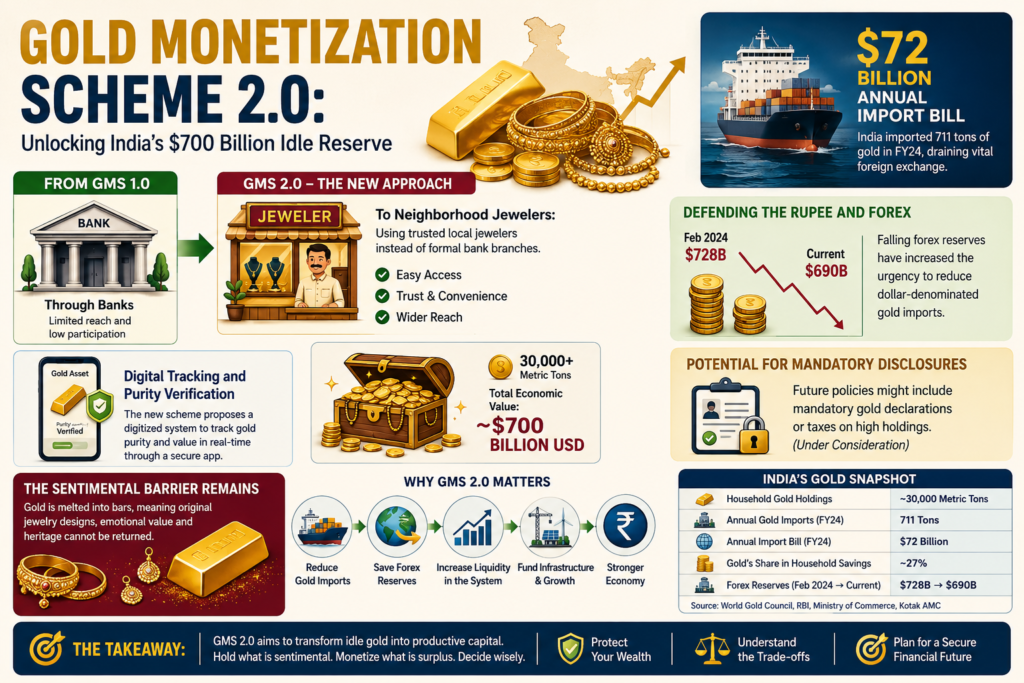
Today, India is preparing a redesigned Gold Monetization Scheme (GMS 2.0) aimed at bringing a significant portion of household gold into the formal economy. Estimates suggest Indian households collectively own nearly 30,000 tonnes of gold, making India one of the world’s largest private holders of the precious metal.
This raises an important question:
Is Gold Monetization Scheme 2.0 an economic necessity for India, or does it fundamentally change how Indians own and preserve wealth?
As a financial analyst, this article examines the facts, the macroeconomic drivers, the opportunities, the risks, and what long-term investors should consider.
India’s Household Gold: A Massive Untapped Asset
According to estimates from the World Gold Council and industry studies:
- Household Gold Holdings: ~30,000 tonnes
- Estimated Market Value: US$2.5–3 trillion (depending on gold prices)
- Annual Gold Imports: 700–900 tonnes
- Annual Import Bill: Often US$50–70+ billion, depending on international prices and import volumes.
Unlike financial assets, most of this gold remains inside homes and lockers and generates no regular income.
From the government’s perspective, this is dormant capital.
From the family’s perspective, it is insurance.
Both viewpoints are valid.
Why is India Interested in Gold Monetization?
Several macroeconomic factors explain the renewed focus.
1. Reducing Gold Imports
India imports most of its gold.
Higher imports mean:
- Higher demand for US Dollars
- Pressure on Foreign Exchange Reserves
- Wider Current Account Deficit (CAD)
If domestic idle gold can be recycled, fresh imports may decline.
2. Financing Economic Growth
Indian households traditionally save through:
- Gold
- Real Estate
- Fixed Deposits
The government wants more household savings to enter productive sectors, such as:
- Infrastructure
- Manufacturing
- MSMEs
- Banking liquidity
This supports long-term GDP growth.
3. Financial Formalization
India has steadily expanded the formal financial ecosystem through:
- Digital Payments
- GST
- Jan Dhan Accounts
- UPI
- Direct Benefit Transfers
Gold monetization aligns with this broader trend by integrating physical wealth into the formal financial system.
Why GMS 1.0 Didn’t Succeed
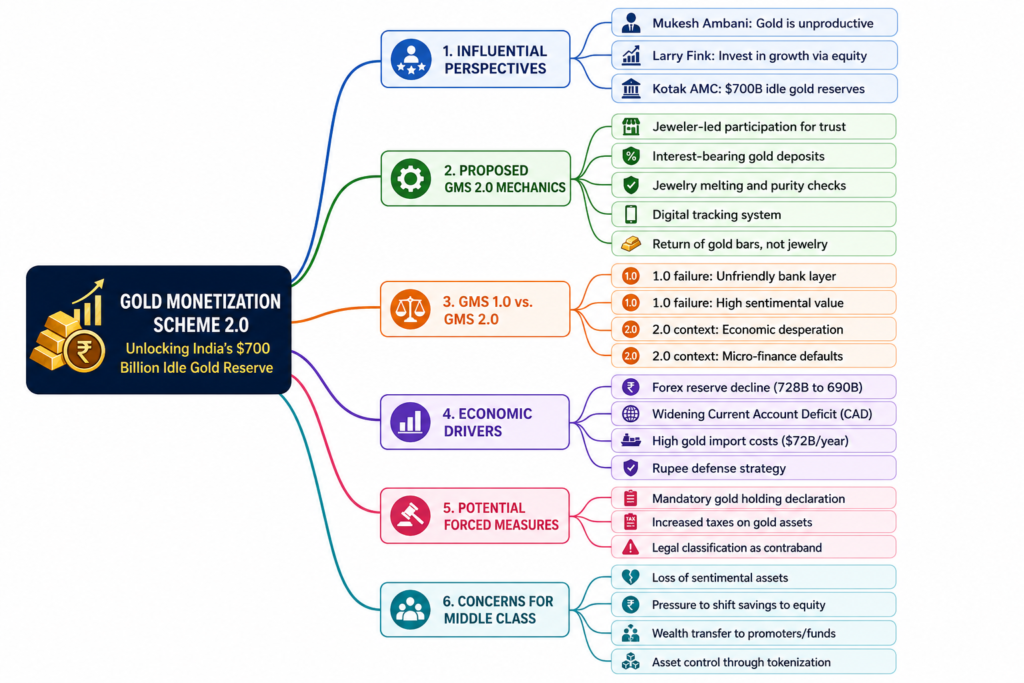
The original Gold Monetization Scheme, launched in 201,5 received limited participation.
Key reasons included:
- Emotional attachment to jewellery
- Fear of melting family ornaments
- Low interest rates
- Complicated banking procedures
- Trust deficit
- Limited awareness
Many households preferred keeping gold at home instead.
What Could Change in GMS 2.0?
Reports suggest policymakers are considering a more user-friendly structure.
Possible improvements include:
- Better collection infrastructure
- Easier participation through jewellers
- Faster processing
- Digital tracking of deposits
- Simplified documentation
If implemented effectively, participation could improve significantly.
Physical Gold vs Monetized Gold
Physical gold provides several unique advantages:
- Complete ownership
- Immediate liquidity
- Crisis protection
- No counterparty dependence
- Cultural and emotional value
Monetized gold may provide:
- Interest income
- Professional storage
- Digital convenience
- Better utilization of idle assets
However, jewellery deposited under monetization is typically melted after purity verification, meaning sentimental and artistic value cannot be recovered.
The Bigger Economic Picture
India’s economy is growing rapidly, requiring enormous capital.
Major investment needs include:
- Roads
- Railways
- Renewable Energy
- Defence
- Manufacturing
- Semiconductor Projects
- AI Infrastructure
Mobilizing domestic savings reduces dependence on foreign borrowing.
From a macroeconomic perspective, this is economically logical.
Risks Investors Should Understand
Investors should also recognize potential concerns.
Liquidity Risk
Access to deposited gold depends on the scheme rules.
Emotional Loss
Family jewellery often carries sentimental value beyond its metal content.
Policy Risk
Future taxation or regulatory changes may affect returns.
Opportunity Cost
If gold prices rise sharply, investors should compare potential appreciation with the benefits offered by monetization.
Is Gold Demonetization Possible?
There is no official announcement indicating any plan to demonetize gold or require blanket declarations above fixed ownership limits.
While discussions and speculation occasionally appear in public commentary, investors should distinguish between:
- Official government policy
- Market rumours
- Independent analyst opinions
Investment decisions should rely on verified information rather than speculation.
Should Investors Participate?
The answer depends on the purpose of the gold.
Consider Monetization If:
- Gold is lying idle.
- Jewellery has no emotional value.
- You seek modest returns on otherwise unused assets.
Consider Holding Physical Gold If:
- It is family heirloom jewellery.
- You value emergency liquidity.
- You want direct ownership outside the financial system.
A balanced approach—keeping essential family gold while evaluating monetization for surplus holdings—may suit many households.
Financial Analyst’s View
India’s household gold represents one of the world’s largest private stores of wealth.
From the government’s perspective, mobilizing part of this asset can strengthen the economy, reduce import dependence, and improve capital formation.
From the investor’s perspective, physical gold remains an important hedge against inflation, currency depreciation, and financial uncertainty.
The objective should not be choosing one over the other but understanding the role each plays within a diversified portfolio.
Smart investors avoid emotional decisions and policy speculation. They evaluate risk, liquidity, taxation, opportunity cost, and long-term financial goals before making any move.
Key Takeaways
- India owns one of the world’s largest household gold reserves.
- Gold imports significantly impact the Current Account Deficit.
- Gold Monetization aims to convert idle assets into productive capital.
- Physical gold and monetized gold serve different purposes.
- Emotional value cannot be replaced once jewellery is melted.
- There is currently no official policy supporting claims of “gold demonetization.”
- Diversification remains the most effective long-term investment strategy.
Final Thought
Gold has protected Indian families for centuries. The challenge today is balancing traditional wealth preservation with modern financial opportunities. Whether one chooses to hold physical gold or participate in monetization, the decision should be based on facts, not fear, and on long-term financial planning rather than short-term narratives.
High CTR Titles
- Is Your Gold Safe? The Truth Behind India’s Gold Monetization Scheme 2.0
- India’s Gold Monetization Scheme 2.0: What Every Gold Owner Must Know
- Why India Wants Your Gold: Complete Analysis of Gold Monetization Scheme 2.0
- Gold Monetization Scheme 2.0 Explained: Risks, Benefits & Investment Strategy
- India’s $3 Trillion Gold Opportunity: Should You Monetize Your Gold?
- Physical Gold vs Gold Monetization Scheme: Which Is Better for Investors?
- Will India’s Gold Monetization Scheme Change Gold Ownership Forever?
- The Future of Gold in India: Gold Monetization Scheme 2.0 Deep Analysis
- Should You Deposit Your Gold? Complete Guide to India’s Gold Monetization Scheme
- Gold Monetization Scheme 2.0: Everything Investors Need to Know in 2026