
Indian IT Sector Crash 2026: Is This the Biggest Value Trap in Indian Stock Market History?
For nearly two decades, Indian IT companies were considered the safest long-term investment.
Whenever markets corrected, investors bought more IT stocks.
Whenever global uncertainty increased, IT companies became the defensive sector.
That formula worked for almost twenty years.
But today…
The market is asking a completely different question.
Has Indian IT entered a temporary slowdown—or is its business model permanently changing because of Artificial Intelligence?
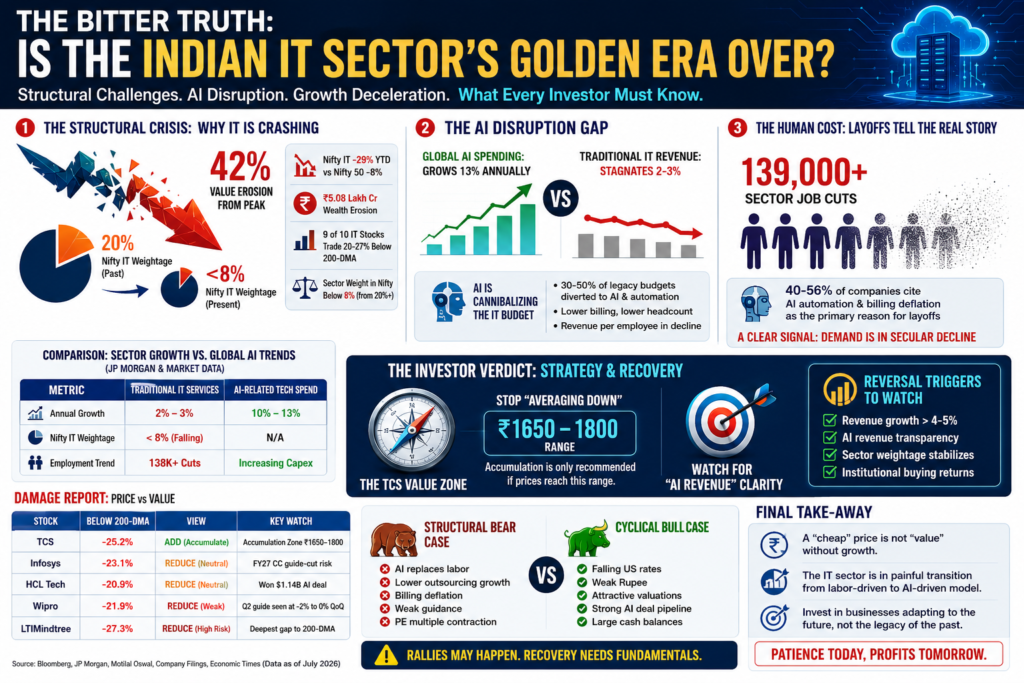
This question matters because more than ₹5 lakh crore of investor wealth has already been wiped out as the sector continues its sharp decline.
Many retail investors continue averaging down in stocks like:
- TCS
- Infosys
- HCL Technologies
- Wipro
- LTIMindtree
But averaging works only when earnings eventually recover.
If earnings remain weak for years, averaging becomes a dangerous trap.
Indian IT Sector Performance: The Worst-Performing Sector of 2026
Key Statistics
| Metric | Value |
|---|---|
| Nifty IT Return | -29% YTD |
| Nifty 50 Return | -8% |
| Wealth Destroyed | ₹5.08 Lakh Crore |
| Peak Correction | -42% |
| Below 200 DMA | 9 of 10 stocks |
| Sector Weight in Nifty | Below 8% |
The sector has dramatically underperformed the broader market.
Instead of acting as a defensive investment, IT has become one of the largest wealth destroyers of the year.
1. The Golden Age of Indian IT Is Officially Over
For twenty years, Indian IT enjoyed four structural advantages:
✔ Cheap engineering talent
✔ Dollar revenue
✔ Outsourcing boom
✔ Digital transformation
These drivers created enormous shareholder wealth.
However, those tailwinds are fading.
Today,
Global enterprises are no longer increasing outsourcing budgets at the same pace.
Instead…
They’re allocating capital toward
- AI Infrastructure
- GPUs
- Cloud Computing
- AI Models
- Automation Platforms
This represents a structural shift—not a temporary slowdown.
2. AI Is Cannibalizing Traditional IT Services
Perhaps the biggest misconception among investors is believing AI will automatically increase IT company revenues.
Reality is much more complicated.
Traditional IT services depended upon:
- Large engineering teams
- Billable hours
- Long implementation projects
Generative AI changes this completely.
Tasks that were once required:
- 20 engineers
- 6 months
- Millions of dollars
can increasingly be completed using AI-assisted development with far fewer people and significantly less time.
This directly impacts:
- Revenue per employee
- Billing rates
- Hiring
- Utilization
The traditional labor-arbitrage model faces its biggest disruption in decades.
Global Tech Spending Is Changing
While AI spending continues growing at 10–13% annually, Indian IT companies are reporting only 2–4% revenue growth.
That gap is widening.
Instead of increasing IT budgets…
Clients are reallocating budgets toward AI investments.
3. AI Is Creating a Growth Gap
Investment banks now expect Indian IT companies to deliver only modest growth.
Several brokerages have reduced FY27 expectations.
Major concerns include:
- Lower discretionary spending
- Weak consulting demand
- AI-driven pricing pressure
- Reduced hiring
- Billing deflation
The market is therefore no longer paying premium valuations for slow-growing businesses.
4. The Great PE De-rating Has Started
One of the biggest mistakes investors make is assuming:
“Stock price has fallen, therefore it is cheap.”
Price alone doesn’t determine value.
Growth does.
Historically,
Large-cap Indian IT companies traded at premium valuations because investors expected:
- double-digit revenue growth
- expanding margins
- strong cash generation
Today,
Those assumptions are changing.
As earnings growth slows,
PE multiples naturally compress.
This phenomenon is known as multiple contraction.
Why This Matters
Suppose earnings remain flat.
If the PE falls from:
30x
to
18x
The stock can decline sharply even without earnings collapsing.
That is exactly what markets are pricing today.
5. Layoffs Are Sending a Clear Message
One of the strongest leading indicators is hiring.
Unfortunately,
Technology companies worldwide have announced large-scale workforce reductions.
Key reasons include:
- AI automation
- Cost optimization
- Reduced client spending
- Shift toward AI infrastructure
Companies are investing heavily in GPUs and AI data centers while simultaneously reducing traditional software roles.
This confirms that the technology industry is undergoing a structural transformation.
Damage Report: Which IT Stocks Look Strongest?
| Company | Below 200 DMA | View |
|---|---|---|
| TCS | -25% | Accumulate on major corrections |
| Infosys | -23% | Neutral |
| HCL Tech | -21% | Neutral |
| Wipro | -22% | Weak |
| LTIMindtree | -27% | Highest Risk |
TCS continues to appear relatively stronger because of:
- Balance sheet
- Client relationships
- AI investments
- Workforce reskilling
- Large deal wins
However,
valuation discipline remains critical.
Structural Bear vs Cyclical Bull
Many investors confuse every rally with the start of a new bull market.
There are actually two competing narratives.
Structural Bear Case
- AI reducing manpower
- Lower outsourcing growth
- Billing deflation
- Weak guidance
- PE contraction
These factors may persist for years.
Cyclical Bull Case
At the same time,
Positive triggers include:
- Falling US interest rates
- Weak Rupee
- Attractive valuations versus history
- Strong AI deal pipeline
- Large cash balances
These factors can produce powerful short-term rallies.
But they do not necessarily reverse the structural slowdown.
Is TCS Still the Best IT Stock?
Among large-cap IT companies,
TCS remains one of the strongest businesses.
Reasons include:
✔ Largest client base
✔ Strong balance sheet
✔ AI training for over 500,000 employees
✔ Massive AI deal pipeline
✔ Industry-leading execution
However,
A quality business does not always mean an attractive investment.
The entry price matters.
Long-term investors should monitor:
- Revenue acceleration
- AI revenue contribution
- Margin stability
- Large deal conversion
Technical Levels Investors Should Watch
Bullish Confirmation
A sustained recovery requires:
- Revenue growth above 5%
- Improving guidance
- Higher institutional buying
- Strong quarterly deal wins
Bearish Signals
Warning signs include:
- Further guidance cuts
- Weak US demand
- Falling margins
- Lower utilization
- Continued PE compression
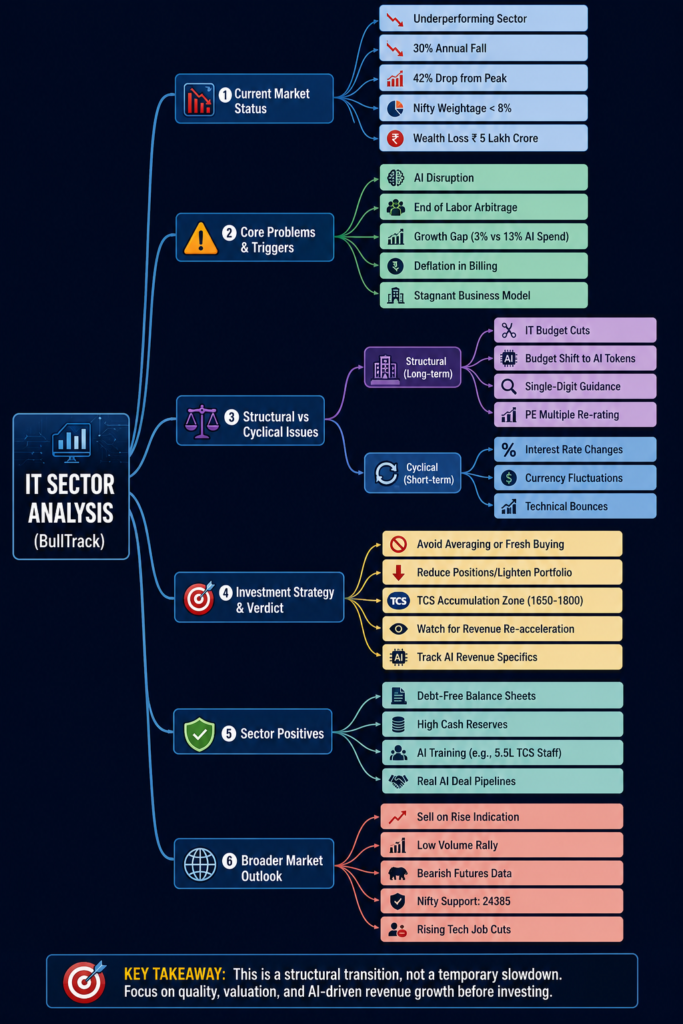
Investment Strategy
Instead of blindly averaging down,
Consider a disciplined framework.
Buy Only When
✔ Revenue growth improves
✔ AI revenues become meaningful
✔ Institutional investors return
✔ Management guidance strengthens
Avoid Buying If
❌ Revenue remains below 4%
❌ Earnings estimates keep falling
❌ PE remains expensive relative to growth
❌ Guidance continues deteriorating
Final Verdict
Indian IT is no longer the “buy every dip” sector it once was.
The industry is transitioning from a labor-driven outsourcing model to an AI-first services ecosystem.
That transition creates uncertainty.
Some companies will successfully reinvent themselves.
Others may struggle for years.
For investors,
The biggest lesson is simple:
Cheap stocks do not automatically become good investments. Growth—not valuation alone—ultimately determines long-term returns.
Until earnings, guidance, and AI monetization show sustained improvement, patience may prove to be the most valuable investment strategy.
Frequently Asked Questions (FAQs)
Is the Indian IT sector a good investment in 2026?
The sector offers selective opportunities, but investors should focus on companies demonstrating strong AI execution, healthy deal pipelines, and improving revenue growth rather than buying solely because valuations have declined.
Why are Indian IT stocks falling?
Key reasons include slower global technology spending, AI-driven automation, weak discretionary demand, lower revenue guidance, and valuation compression after years of premium pricing.
Which IT company looks strongest?
Among the large-cap names, TCS is generally viewed as relatively stronger because of its balance sheet, diversified client base, large AI investments, and execution track record. Even so, valuation and growth trends remain important.
Can AI replace Indian IT companies?
AI is unlikely to eliminate established IT companies, but it is changing how services are delivered. Companies that successfully shift to AI-enabled services may continue to grow, while those relying heavily on traditional labor-arbitrage models could face long-term challenges.
Should investors average down in IT stocks?
Averaging down only makes sense if business fundamentals improve. If revenue growth, guidance, and AI monetization continue to weaken, buying additional shares simply because prices have fallen can increase portfolio risk.
🔥 Top 10 SEO Titles
- The IT Sector’s Golden Era Is Over: 5 Hard Truths Every Investor Must Know
- Indian IT Stocks Crash: Is This a Once-in-a-Decade Buying Opportunity or a Value Trap?
- Why TCS, Infosys & HCL Tech Are Falling: The Real Truth Behind India’s IT Crash
- Indian IT Sector Crash 2026: AI, Layoffs & the End of the Outsourcing Boom
- The ₹5 Lakh Crore IT Crash: Why Smart Investors Are Rethinking TCS & Infosys
- AI Is Killing the Old IT Business Model: What Every Investor Must Know
- Indian IT Sector Analysis 2026: 5 Reasons the Worst May Not Be Over Yet
- TCS, Infosys, HCL Tech: Should You Buy the Dip or Stay Away?
- The Great Indian IT Sell-Off: Opportunity or Permanent Decline?
- Indian IT Stocks Are Cheap—but Are They Really Worth Buying?